Whenever I lead river clean-up drives with local community volunteers or speak with high school students about urban ecology, water always feels personal. Standing at the water’s edge, watching urban runoff mix into public waterways, it is easy to focus only on visible trash—the floating bottles, plastics, and debris. Yet, during my graduate work in environmental management at the University of Toronto, what troubled me most was the toxic load you cannot see.
Heavy metals like lead, cadmium, and arsenic do not announce their presence with a foul odor or murky color; they silently accumulate in soils, riverbeds, and urban aquatic ecosystems. In my consulting work, I frequently encounter municipal systems strained by aging gray infrastructure that was simply never engineered to isolate these persistent ionic pollutants. Traditional chemical precipitation and basic settling ponds served us in the last century, but they often leave behind concentrated hazardous residues while failing to protect delicate downstream ecosystems.
If we want cities that genuinely sustain living systems—from urban bird populations nesting in wetlands to children drinking from school water fountains—we have to rethink our baseline treatment standards. True water resilience requires looking beyond basic compliance and embracing innovative, circular technologies that systematically neutralize these invisible contaminants at the source.
Advanced techniques for removing heavy metals in water treatment systems include innovative biological methods like phytoremediation and biosorption, which utilize plants and microbial biomass for efficient metal uptake. Membrane technologies, such as nanofiltration and reverse osmosis, enhance removal efficiencies and reduce waste. Electrochemical methods apply electric currents for precise metal separation. These approaches address the limitations of traditional methods, ensuring compliance with regulatory standards and improving water quality. Explore further to discover additional revolutionary strategies.
KEY TAKEAWAYS
- Electrochemical techniques utilize electric currents to selectively target and remove heavy metals through reduction and oxidation reactions.
- Nanotechnology improves heavy metal removal efficiency by employing tailored nanoparticles for enhanced adsorption and filtration.
- Advanced membrane filtration, such as nanofiltration and reverse osmosis, achieves high removal rates for heavy metals exceeding 95%.
- Electrocoagulation effectively reduces sludge production while facilitating the removal of heavy metal contaminants from water.
- Integration of biosorption with microbial biomass and agricultural by-products offers a cost-effective and sustainable approach for heavy metal removal.
INTRODUCTION TO HEAVY METAL CONTAMINATION: CAUSES AND EFFECTS
Heavy metal contamination in water sources poses significant health risks, primarily stemming from industrial discharge, agricultural runoff, and mining activities.
These sources of contamination introduce elements like lead, arsenic, and mercury into aquatic environments, leading to dire consequences for human health and ecosystems. You mightn’t realize that heavy metals can bioaccumulate in the food chain, affecting not only the water supply but also terrestrial and aquatic life.
Chronic exposure can result in neurological disorders, developmental issues, and even carcinogenic effects. The implications extend beyond individual health; communities relying on contaminated water face economic burdens and reduced quality of life.
Understanding these health impacts is vital for innovating effective water treatment solutions. As you explore advanced techniques for heavy metal removal, consider how addressing these sources of contamination can safeguard public health and enhance environmental sustainability.
Prioritizing innovation in treatment methods will be essential for mitigating these pervasive threats and strengthening collaboration with environmental advocacy groups to promote sustainable water management.
Traditional Methods of Heavy Metal Removal: Limitations and Challenges
The presence of heavy metals in wastewater has been increasing with the growth of industry and human activities, e.g., plating and electroplating industry, batteries, pesticides, mining industry, rayon industry, metal rinse processes, tanning industry, fluidized bed bioreactors, textile industry, metal smelting, petrochemicals, paper manufacturing, and electrolysis applications. The heavy metal contaminated wastewater finds its way into the environment, threatening human health and the ecosystem. The heavy metals are non-biodegradable and could be carcinogenic; thus, the presence of these metals in water by improper amounts could result in critical health issues to living organisms.
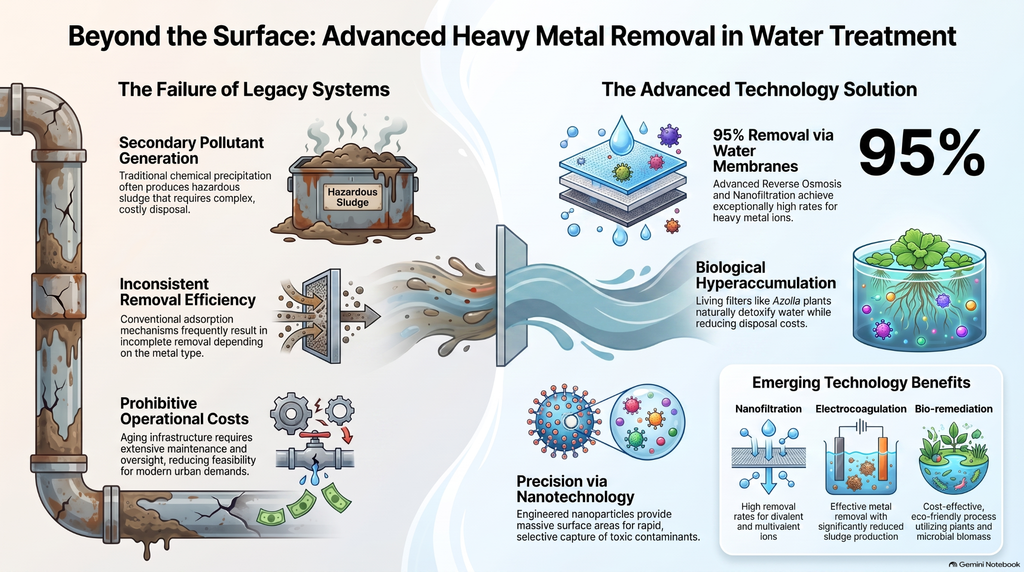
While various traditional methods exist for removing heavy metals from water, they often come with significant limitations and challenges. You might find that the effectiveness of these methods can be inconsistent, leading to inadequate treatment outcomes.
Here are three primary concerns:
- Limited Efficiency: Adsorption mechanisms can vary widely based on the specific metal and the adsorbent used, often resulting in incomplete removal.
- Chemical Precipitation Issues: This method can produce secondary pollutants, making the treatment process more complex and potentially hazardous.
- Operational Costs: Many traditional techniques require extensive maintenance and operational oversight, increasing overall treatment costs and reducing feasibility for widespread application.
These limitations highlight the need for innovative approaches in heavy metal removal, as traditional methods may not meet the growing demands for effective and sustainable water treatment solutions.
Innovative Biological Approaches for Heavy Metal Removal: Phytoremediation and Biosorption
As the demand for sustainable water treatment solutions increases, innovative biological approaches like phytoremediation and biosorption are gaining traction for their effectiveness in heavy metal removal.
Phytoremediation techniques utilize plants to absorb, accumulate, and detoxify heavy metals from contaminated water. This method not only enhances the ecological balance but also reduces disposal costs associated with conventional treatments.
On the other hand, biosorption materials, such as microbial biomass and agricultural by-products, offer a cost-effective alternative by binding heavy metals through passive adsorption processes. These biosorbents can be tailored to target specific contaminants, enhancing their efficiency.
Both techniques show promise in addressing water quality issues while minimizing environmental impact.
As research progresses, integrating these biological approaches into existing water treatment frameworks could revolutionize the industry, providing scalable and eco-friendly solutions to heavy metal pollution.
Exploring Membrane Technologies for Removing Heavy Metals
Wastewater pollution with heavy metals presents serious problems with not only environmental integrity but also human health safety. This review is a complete review that includes different removal methods and technologies for heavy metals from wastewater and proceeds to include the traditional techniques as well as the advanced ones. The traditional techniques such as chemical precipitation, ion exchange, adsorption, membrane filtration, coagulation, and flocculation along with their effectiveness and some of the pitfalls are provided in this discussion. Moreover, the developments of the past years such as nanotechnology, electrochemical methods, hybrid systems, and biological treatments are further outlined as ways to improve treatment outcomes and lower the environmental impact. Efficiency of treatments factors including the pH, temperature, metal concentration, the reactor design, operation parameters, and costs considerations are critically examined to provide ideas into how to improve the performance of the treatments. By means of the combination of state-of-the-art technologies and treated-liquid effectiveness components, this review seeks to supply information for the betterment of heavy metals removal in wastewater treatment, and as such give a cleaner and healthier surrounding to the future generations.
When considering membrane technologies for heavy metal removal, you’ll encounter various filtration methods that enhance water quality.
Nanofiltration offers specific advantages, such as selective permeability that efficiently targets divalent and multivalent ions.
Additionally, reverse osmosis stands out for its high efficiency in removing a broad range of contaminants, making it a critical component in advanced water treatment systems.
Membrane Filtration Methods
Membrane filtration methods offer an effective approach for removing heavy metals from water, greatly enhancing water quality.
By employing various membrane types, you can achieve high filtration efficiency and optimize your water treatment processes.
Consider the following membrane technologies:
- Microfiltration: This method removes larger particles, including some bacteria, while allowing smaller heavy metal ions to pass, making it a preliminary step.
- Ultrafiltration: More advanced, ultrafiltration can separate colloids and smaller heavy metals, increasing removal efficiency considerably.
- Nanofiltration: This technology targets divalent ions and specific heavy metals, providing an excellent balance between selectivity and permeate flux.
Advantages Of Nanofiltration
Nanofiltration presents significant advantages in the removal of heavy metals from water, particularly due to its ability to selectively target specific ions while maintaining a high permeate flux.
This technology operates between microfiltration and reverse osmosis, allowing for the rejection of divalent and multivalent ions, which are often the most hazardous metals. Its cost efficiency stems from lower energy requirements compared to reverse osmosis, enabling sustainable operations.
Moreover, operational simplicity is another hallmark of nanofiltration systems, as they typically require less frequent maintenance and simpler configurations.
Reverse Osmosis Efficiency
Reverse osmosis (RO) stands out as one of the most effective methods for heavy metal removal in water treatment, boasting removal efficiencies often exceeding 95%.
To maximize this efficiency, consider the following strategies for reverse osmosis optimization:
- Pre-treatment: Implement effective pre-treatment processes to minimize membrane fouling, enhancing overall performance.
- Membrane Selection: Choose high-quality membranes tailored for specific heavy metals, ensuring higher rejection rates and longevity.
- Operating Conditions: Optimize pressure and flow rates to balance energy consumption with removal efficiency, reducing wear on membranes.
HOW ELECTROCHEMICAL TECHNIQUES REMOVE HEAVY METALS EFFECTIVELY
In urban sustainability consulting, the biggest hurdle to adopting cutting-edge water treatment is the balance between energy demand and ecological return. Too often, engineering solutions operate in isolated silos: we pump immense energy into mechanical separation like high-pressure reverse osmosis, or we rely on massive chemical dosing that yields hazardous sludge. But nature-based solutions and low-impact technologies show us that water remediation can work harmoniously with ecological systems.
During field studies, I have watched floating biological treatment systems, such as Azolla setups, simultaneously capture dissolved metals and stabilize organic loads without intensive chemical interventions. These living filters prove that green infrastructure does not just belong on rooftops or bioswales—it has a legitimate place within engineered water treatment trains. At the same time, when higher-density separation is non-negotiable for industrial discharge, pairing biological pre-treatment with selective nanofiltration or circular adsorbents from local residuals cuts down energy waste dramatically.
In my own home, I spend hours tinkering with low-waste, DIY closed-loop setups; seeing that same circular philosophy scaled up to municipal and industrial facilities is genuinely inspiring. We cannot afford single-purpose solutions anymore; our treatment trains must be regenerative, energy-conscious, and safe for surrounding ecologies.
While traditional methods for heavy metal removal often struggle with efficiency and cost, electrochemical techniques have emerged as a powerful alternative. These methods harness the principles of electrochemistry to selectively target and remove heavy metals from water, utilizing heavy metal electrodes to facilitate the process.
When you apply an electric current, ions in the solution migrate toward the electrodes, where they undergo reduction or oxidation reactions, effectively precipitating heavy metals out of the water.
This approach not only enhances removal efficiency but also minimizes chemical consumption and waste generation. You’ll find that electrochemical methods can be tailored for specific contaminants, making them versatile for various applications.
The Role of Nanotechnology in Advanced Water Treatment
Recent advancements in electrochemical techniques highlight the growing importance of integrating nanotechnology into water treatment processes.
By harnessing the unique properties of nanomaterials, you can greatly enhance the removal of heavy metals.
Here are three key contributions of nanotechnology:
- Nanoparticle Synthesis: Tailored nanoparticles can be engineered for specific interactions with heavy metals, improving adsorption efficiency and selectivity.
- Quantum Dots: These semiconductor nanoparticles enable efficient detection and monitoring of heavy metal contaminants in real-time, allowing for more responsive treatment strategies.
- Enhanced Reactivity: Nanomaterials exhibit increased surface area and reactivity, which accelerates chemical reactions, leading to quicker and more effective removal of pollutants.
Why New Techniques Are Essential for Effective Heavy Metal Removal?
In the rapid global industrialization, there is a constant effort to improve the use-reuse cycle of water and to protect water resources through legislation, which is the driving force for research and innovation. In addition to numbers and statistics, there is the health factor that cannot be quantified when it comes to people. Water pollution with heavy metals is one of the most harmful pollution throughout the globe due to their non-degradable properties. Despite the national and international standards stipulated by the World Health Organization (WHO) and the United States Environmental Protection Agency (USEPA) that the drinking water should not exceed a maximum concentration of a few to a few tens of µg/L, heavy metals can accumulate in the ecosystem and enter the human body through food.
With rising environmental concerns about water quality, you need effective techniques for heavy metal removal.
Technological advancements provide innovative solutions that enhance efficiency and efficacy.
Additionally, regulatory compliance necessitates adopting these new methods to meet stringent safety standards.
Rising Environmental Concerns
As environmental concerns escalate, the necessity for innovative techniques in heavy metal removal from water has become increasingly urgent.
With rising public awareness and stringent environmental policy, the demand for effective solutions is paramount.
Here are three critical reasons why new techniques are essential:
- Toxicity Mitigation: Heavy metals pose severe health risks; innovative methods can more effectively neutralize these contaminants.
- Regulatory Compliance: Stricter regulations require advanced technologies to meet safety standards and avoid penalties.
- Sustainability Goals: There’s a growing emphasis on eco-friendly practices; new techniques can enhance sustainability in water treatment and encourage the use of eco friendly products.
Technological Advancements Availability
While conventional methods for heavy metal removal have served their purpose, the advent of advanced technologies is transforming the landscape of water treatment. Emerging technologies and treatment innovations are essential for enhancing efficiency and reducing costs. These advancements enable you to tackle complex contaminant profiles that traditional methods struggle with.
| Emerging Technologies | Benefits |
| Nanofiltration | High removal rates |
| Electrocoagulation | Reduced sludge production |
| Bio-remediation | Environmentally friendly process |
Leveraging these innovations allows for more precise removal of heavy metals, ensuring compliance with increasingly stringent regulations while supporting environmental advocacy and mitigating environmental impacts effectively.
Regulatory Compliance Necessities
Regulatory compliance necessitates that water treatment facilities adopt new techniques for effective heavy metal removal, especially as governments impose stricter limits on contaminants.
Adhering to evolving regulatory frameworks and compliance standards is vital for mitigating public health risks. Here are three essential considerations:
- Enhanced Treatment Methods**: Innovative technologies such as advanced filtration and adsorption techniques can considerably reduce heavy metal concentrations.
- Real-time Monitoring: Implementing automated systems guarantees continuous compliance with regulatory benchmarks, allowing for immediate adjustments as needed.
- Sustainability Practices: Eco-friendly solutions not only meet regulatory demands but also promote environmental responsibility, aligning with global sustainability goals.
RELATED STUDIES ABOUT REMOVAL OF HEAVY METALS IN WATER TREATMENT
In tackling heavy metal contamination, you’ll find that traditional methods often fall short. However, embracing innovative approaches like phytoremediation, membrane technologies, and nanotechnology can greatly enhance water treatment efficacy. Just as you’d choose the right tool for a specific task, selecting the most suitable technique can mean the difference between clean water and persistent pollution. It’s essential to stay ahead of the curve, ensuring our water systems are safe and sustainable for future generations.
Emerging nanotechnology approaches for sustainable water treatment and heavy metals removal: a comprehensive review
This review examines the role of engineered nanoadsorbents as high-efficiency, sustainable alternatives to conventional water treatment methods for heavy metal remediation. Conventional techniques such as chemical precipitation, coagulation, and standard filtration often suffer from high chemical costs, toxic sludge generation, secondary pollution, and poor selectivity at low contaminant concentrations. Nanomaterials overcome these barriers via large surface-area-to-volume ratios, tunable surface chemistries, rapid adsorption kinetics, and strong binding affinity.
Key Nanoadsorbent Classes & Performance
- Carbon-Based Nanomaterials: Graphene oxide and functionalized multi-walled carbon nanotubes (MWCNTs) demonstrate high capacities (e.g., dendrimer-modified CNTs achieving 4870 mg/g for Pb2+ and 3333 mg/g for Cu2+) via electrostatic attraction, pi-pi interactions, and metal-ligand complexation.
- Metal & Metal Oxide Nanoparticles: Nanoscale zero-valent iron (nZVI) and iron oxides (Fe3O4, gamma-Fe2O3) excel by coupling adsorption with redox transformation (such as reducing toxic Cr6+ to less hazardous Cr3+) while enabling external magnetic separation. Silver nanoparticles (Ag NPs) provide simultaneous heavy metal capture and antimicrobial disinfection.
- Metal-Organic Frameworks (MOFs): Provide massive specific surface areas (1000 to 10000 m2/g) and custom coordination nodes, achieving high removals such as 1041.9 mg/g for Pb2+ in carbonate-based magnetic MOFs.
- Zeolites & Layered Double Hydroxides (LDHs): Structured aluminosilicates and 2D anionic clays capture divalent and trivalent cations through high cation exchange capacity (CEC), interlayer intercalation, and surface complexation.
- Silica & Polymer Nanocomposites: Mesoporous silica (SiO2) and biopolymer supports (chitosan, alginate, cellulose) provide stable mechanical backbones that disperse active nanoparticles and prevent agglomeration.
Adsorption Mechanisms & Influencing Factors
Uptake occurs predominantly via physisorption (van der Waals, hydrogen bonding) and chemisorption (inner-sphere coordinate bonding with -COOH, -NH2, -OH, and -SH groups, electron sharing, or ion exchange). Performance depends heavily on operating conditions, particularly solution pH (which controls surface charge via the point of zero charge and metal speciation), adsorbent dosage, contact time, and competing background ions.
Critical Challenges & Commercial Bottlenecks
- Particle Recovery & Leaching: Recovering free, suspended nanoparticles from treated effluent is difficult; incomplete recovery risks ecotoxicological bioaccumulation and cell membrane penetration. Magnetic composites offer the most viable route for efficient post-treatment separation.
- Regeneration & Capacity Loss: Successive chemical regeneration using acids, bases, or chelating agents like EDTA causes progressive capacity decline due to active site loss, pore blocking, dealumination in zeolites, or framework collapse in MOFs.
- Cost & Scalability: High production costs for pristine nanostructures, multi-step synthesis routes, pressure drops in continuous-flow packed beds, and a lack of standardized environmental regulations restrict widespread transition from laboratory scale to industrial water treatment infrastructure.
| REFERENCE: Erfan Burhan Hussein, Farouk Abdullah Rasheed, Ahmed Salih Mohammed, Kawan F. Kayani, Emerging nanotechnology approaches for sustainable water treatment and heavy metals removal: a comprehensive review, RSC Advances, Volume 15, Issue 48, 2025, Pages 41061-41107, ISSN 2046-2069, https://doi.org/10.1039/d5ra06914a. (https://www.sciencedirect.com/science/article/pii/S2046206925030888) |
Influence of adsorbent composition and solution pH on heavy metal removal from aqueous solution using water treatment residuals from a groundwater treatment plant
Water treatment residuals (WTR) from groundwater aeration and filtration offer a viable, low-cost circular alternative to commercial adsorbents for heavy metal remediation. This study systematically evaluates iron-rich (Fe-WTR) and manganese-rich (Mn-WTR) backwash residuals collected from a two-stage, flocculant-free groundwater pilot plant to remove As(III), Cd(II), Cu(II), Ni(II), and Pb(II) across multiple pH levels and water matrices.
Adsorbent Properties & Surface Chemistry
- Elemental Composition: Fe-WTR consists almost entirely of oxidized iron (96.41 mg/g Fe, 1.85 mg/g Mn; Fe:Mn ratio roughly 50:1). Mn-WTR contains significant manganese from the secondary filtration stage (105.96 mg/g Fe, 70.07 mg/g Mn; Fe:Mn ratio roughly 1.5:1).
- Surface Morphology & Charge: Fe-WTR displays larger, more crystalline particles, whereas Mn-WTR is less crystalline. Freshly suspended Fe-WTR exhibits a point of zero charge (pHpzc) of 7.1, transitioning to a net negative surface above neutral pH. Fresh Mn-WTR maintains a higher pHpzc of 8.4, remaining net positively charged across typical drinking water operating ranges (pH 6.0 to 8.0).
Adsorption Kinetics & Modeling
- Uptake Rates vs. Total Capacity: Batch kinetic tests at pH 7.0 demonstrate that initial uptake is substantially faster on Fe-WTR. However, equilibrium adsorption capacities (qe) are higher on Mn-WTR for all target cations.
- Selective Saturation: Fe-WTR rapidly exhausts its capacity for Cd(II) and Ni(II) within 30 seconds due to competitive displacement, whereas Mn-WTR sustains continuous sorption.
- Dominant Mechanism: The Elovich kinetic model provided the best fit for most target systems, indicating that chemisorption is the rate-limiting mechanism governing uptake.
Operational Drivers & Multi-Solute Competition
- pH Effects: Removal behavior diverges significantly by metal species. Cationic Cd(II) and Ni(II) removal increases with rising pH (peaking at 86 mg/g and 58 mg/g at pH 8.0) as negative surface charge density develops. Conversely, As(III) and Pb(II) removals are highest under acidic conditions (maximum loadings of 62 mg/g and 269 mg/g at pH 6.0). Cu(II) uptake peaks at pH 7.0 (158 mg/g).
- Colloidal Precipitation Artifacts: The sharp drop in Pb(II) and Cu(II) calculated loadings at pH 8.0 indicates the formation of sub-micron precipitates (<0.45 um) that pass membrane filters during sampling and re-dissolve during post-acidification.
- Water Matrix Effects: Target metal capacities are consistently lower in drinking water than in ultrapure water, driven by competition from background ions (Ca2+, Mg2+, SO4 2-, NO3-) and electric double-layer suppression.
- Isotherm Modeling: Equilibrium data aligned better with the Langmuir model than the Freundlich model, confirming monolayer adsorption. However, single-solute models fail to represent the competitive displacement occurring at elevated initial concentrations.
Engineering Implications
Fe-WTR delivers superior overall performance for As(III), Pb(II), and Cu(II), whereas Mn-WTR is essential for capturing Cd(II) and Ni(II). Leveraging these backwash solids directly provides in-situ multi-metal polishing without requiring chemical flocculants or dedicated downstream adsorption infrastructure. Future technical development requires evaluating residual quality consistency, material leachability, and disposal safety under dynamic municipal operations.
| REFERENCE: Andrea Steuer, Katharina Sperling, Daniel Mahringer, Aki S. Ruhl, Influence of adsorbent composition and solution pH on heavy metal removal from aqueous solution using water treatment residuals from a groundwater treatment plant, Journal of Environmental Chemical Engineering, Volume 14, Issue 2, 2026, 121630, ISSN 2213-3437, https://doi.org/10.1016/j.jece.2026.121630. (https://www.sciencedirect.com/science/article/pii/S2213343726006044) |
Eco-phytoremediation using Azolla microphylla enhances heavy metal removal, water quality, and biomass valorization in semi-arid wastewater treatment
This study investigates the phytoremediation performance of the floating aquatic fern Azolla microphylla for treating raw domestic wastewater from the Salamandre treatment plant in Mostaganem, Algeria, over a 35-day retention period in outdoor pilot ponds. The research evaluates organic load reduction, heavy metal bioaccumulation, and plant physiological stress to establish the feasibility of nature-based wastewater treatment in semi-arid environments.
Key Water Quality Improvements
- Organic Load and Solids Reduction: The system achieved a 94.9% decline in Chemical Oxygen Demand (COD) (dropping from 376-392 mg/L to a minimum of 20 mg/L at Day 28) and an 89% reduction in 5-day Biochemical Oxygen Demand (BOD5) (falling from 480-507 mg/L to 53 mg/L). Total suspended solids (TSS) decreased by over 93% (from 220-280 mg/L to 14.16-15.02 mg/L) via root trapping and bio-sedimentation.
- System Stabilization: Initial slightly acidic wastewater (pH 6.85-6.99) shifted toward neutral (pH 7.09 by Day 35), aiding metal precipitation. Electrical conductivity stabilized at 1.765 mS/cm after a transient spike, confirming minimal long-term mineral leaching or secondary salinization.
- Biomass Senescence Warning: Slight rebounds in COD (44.3 mg/L) and BOD5 (76 mg/L) observed at Day 35 showed that unharvested plant decay releases organic matter back into the water, establishing optimal retention and harvesting cycles between 20 and 28 days.
Heavy Metal Removal and Partitioning Dynamics
- Aqueous Phase Abatement: Final aqueous metal reductions reached 85% for Mn, 84% for Zn, 83% for Fe, 80% for Pb, 80% for Cd, and 76% for Cu.
- Hyperaccumulation Efficiency: Bioconcentration Factors (BCF) ranged from 32.5 (Cd) to 82.1 (Pb), far exceeding the threshold of 1 for hyperaccumulation. Plant tissue accumulation reached 430 mg/kg dry weight (DW) for Fe, 115 mg/kg DW for Zn, 78 mg/kg DW for Pb, 76 mg/kg DW for Mn, 31 mg/kg DW for Cu, and 2.4 mg/kg DW for Cd.
- Compartmentalization Pathways: Translocation factors (TF) exceeded 1 for Zn, Cu, and Mn, indicating active root-to-frond translocation ideal for phytoextraction. Conversely, TF remained below 1 for Fe and Pb, reflecting apoplastic retention in root tissues suitable for rhizofiltration.
Biomass Growth and Physiological Resilience
- Yield Dynamics: Starting from an initial inoculum of 1000 g/m2, fresh biomass expanded following a logistic curve to 1460 g/m2 (160 g DW/m2), yielding an active growth rate of 4-5 g DW/m2/day before leveling off due to canopy density and nutrient depletion.
- Photosynthetic Stimulation: Total chlorophyll content increased by 20.8% (from 1.68 to 2.03 mg/g fresh weight), stimulated by wastewater nitrogen and phosphorus uptake supported by symbiotic Anabaena azollae cyanobacteria.
- Stress Adaptation: Heavy metal exposure triggered defense adaptations, evidenced by increases in malondialdehyde (1.42 mg eq/g fresh weight) and proline accumulation (2.05 umol/g fresh weight) to counteract reactive oxygen species and preserve cell membrane stability.
Azolla microphylla provides an energy-efficient, scalable nature-based treatment stage that purifies municipal wastewater for safe agricultural reuse while yielding secondary biomass for potential biofertilizer or animal feed valorization.
| REFERENCE: Noureddine Benguennouna, Djilali Benabdelmoumene, Said Dahmouni, Zineb Bengharbi, Wasim S.M. Qadi, Hamizah Shahirah Hamezah, Ahmed Mediani, Eco-phytoremediation using Azolla microphylla enhances heavy metal removal, water quality, and biomass valorization in semi-arid wastewater treatment, Desalination and Water Treatment, Volume 324, 2025, 101437, ISSN 1944-3986, https://doi.org/10.1016/j.dwt.2025.101437. (https://www.sciencedirect.com/science/article/pii/S1944398625004539) |
CONCLUSION
Advancing heavy metal removal is not simply a technical exercise for plant engineers and regulatory inspectors; it is an environmental justice imperative. As cities grow denser and industrial pressures climb, our aquatic ecosystems bear the brunt of delayed innovation. In environmental consulting, I constantly remind stakeholders that clean water is the cornerstone of every sustainable community.
If our water treatment facilities only generate secondary toxic waste or bypass sub-micron heavy metals due to outdated infrastructure, we are merely kicking ecological degradation down the line to future generations. By investing in advanced biosorption, tailored nanomaterials, and responsive filtration, we protect more than drinking water reservoirs—we restore urban biodiversity, protect wetland birds foraging along riverbanks, and build a safe foundation for climate-resilient cities.
True progress requires bridging the gap between high-level laboratory research, active environmental advocacy, and classroom education. When we take wastewater seriously as a reclaimable resource rather than an industrial hazard, we reshape our urban footprint to live in balance with the natural water cycle. Modernizing these treatment frameworks is an urgent responsibility we share toward our living planet.