From an engineering perspective, we often evaluate infrastructure through the lens of durability and material strength, which is precisely why lead became such a staple in municipal piping networks decades ago. As a licensed PE working on water conveyance and drainage, I see the physical legacy of past design choices every single day. Generations ago, lead was celebrated because it was malleable, resisted leaks, and lasted for decades in underground environments.
What engineers didn’t fully account for back then was the subtle, corrosive chemistry that occurs when treated water sits stagnant inside those lines. Today, even as municipalities work tirelessly to replace aging distribution networks, the final barrier often rests directly on our own property lines. You cannot manage what you do not measure, which is why treating tap safety as an active household system rather than a passive utility is so vital.
Whenever I inspect older residential service connections, I remind homeowners that high-tech treatment plants can produce pristine effluent, but that effort is completely undermined if the water travels through corroding private lead lines, brass fittings, or old lead-soldered copper joints. Protecting your family starts with understanding where your municipal utility’s responsibility ends and where your home’s physical plumbing begins.
To prevent lead exposure from tap water, first, test your water for lead contamination using certified kits; focus on older homes. Identify lead in plumbing, including pipes and fixtures. Install NSF-certified filters designed for lead reduction, like activated carbon or reverse osmosis systems. Make it a habit to use cold water for cooking and flush taps before use. Regularly check local health resources for lead safety programs. There’s more you can do to guarantee a lead-free home environment.
KEY TAKEAWAYS
- Test your tap water regularly for lead using certified kits or laboratories to identify contamination levels.
- Replace lead pipes and plumbing fixtures to eliminate potential sources of lead in your drinking water.
- Use NSF-certified water filters specifically designed for lead reduction, or consider reverse osmosis systems for effective purification.
- Flush your taps for at least 30 seconds before use to reduce lead exposure from stagnant water.
- Stay informed about local water quality reports and participate in community lead safety programs for ongoing support and education.
UNDERSTANDING THE RISKS OF LEAD EXPOSURE IN TAP WATER
While you might trust that your tap water is safe, understanding the risks of lead exposure is vital for your health and well-being. Lead can leach into your drinking water from old pipes and plumbing fixtures, posing considerable health effects, particularly for children and pregnant women.
Exposure to lead can lead to developmental delays, cognitive impairments, and various physical health issues. The severity of these effects underscores the importance of proactive prevention strategies.
To safeguard yourself and your family, consider using certified water filters that effectively remove lead. Regularly flushing your taps before use can also minimize lead concentration.
Additionally, staying informed about your local water quality reports can empower you to take necessary precautions. Monitoring for other contaminants, such as forever chemicals in groundwater, can also help households better understand potential risks to their overall water quality.
Prioritizing awareness and action is essential in maintaining safe drinking water.
How to Test Your Tap Water for Lead Contamination
To guarantee your tap water is free from lead contamination, it’s essential to conduct a thorough testing process. You can take proactive measures by using water testing kits or seeking assistance from lead testing laboratories. Here’s how:
- Choose a Testing Method: Decide between a DIY water testing kit, which provides immediate results, or sending samples to a certified lead testing laboratory for detailed analysis.
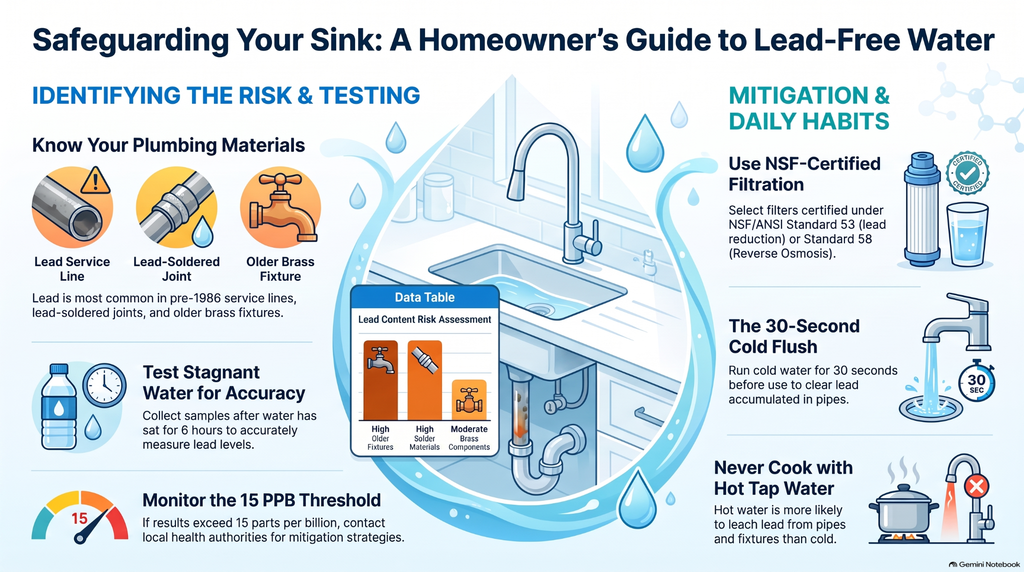
- Collect Samples: Follow the instructions carefully. For accurate results, sample water after it’s been stagnant for at least six hours, usually from the tap you use most frequently.
- Interpret Results: If your results indicate lead levels above 15 parts per billion, consult local health authorities for guidance on mitigation strategies.
Where to Find Lead in Your Plumbing
Lead can enter drinking water when plumbing materials that contain lead corrode, especially where the water has high acidity or low mineral content that corrodes pipes and fixtures. The most common sources of lead in drinking water are lead pipes, faucets, and fixtures. In homes with lead pipes that connect the home to the water main, also known as lead services lines, these pipes are typically the most significant source of lead in the water. Lead pipes are more likely to be found in older cities and homes built before 1986. Among homes without lead service lines, the most common problem is with brass or chrome-plated brass faucets and plumbing with lead solder.
To effectively prevent lead exposure, you need to identify potential sources in your plumbing system.
Lead pipes, fittings, and even plumbing fixtures or solder used in joints can all contribute to lead contamination.
Understanding where these materials are located in your home is essential for safeguarding your water supply.
Lead Pipes and Fittings
Lead is a naturally occurring toxic metal found in the Earth’s crust. Its widespread use has caused extensive environmental contamination, human exposure and significant public health problems globally.
Lead pipes and fittings can lurk in various parts of your plumbing system, posing a significant health risk.
To identify potential lead sources, consider the following:
- Service Lines: Check the pipe connecting your home to the water main; older homes often have lead service lines.
- Interior Plumbing: Inspect pipes within your home, particularly those in pre-1986 constructions, which may still use lead materials.
- Fittings and Connectors: Examine any fittings or connectors that mightn’t have been replaced during renovations.
A thorough plumbing inspection can help you identify these hazards.
If you find lead pipes, prioritize lead pipe replacement to safeguard your health and guarantee your water remains safe for consumption.
Plumbing Fixtures and Solder
After evaluating your plumbing system for lead pipes and fittings, it’s important to contemplate other potential sources of lead contamination. Plumbing fixtures and solder materials can also harbor lead, posing risks to your health.
| Source | Lead Content |
| Older Fixtures | May contain lead alloy |
| Solder Materials | Often contains lead |
| Brass Components | Can have lead up to 8% |
| Lead Free Fixtures | Recommended for safety |
To guarantee your home’s water remains safe, consider replacing older fixtures with lead free options and check solder materials used in your plumbing. Investing in innovative plumbing solutions can protect you and your family from potential lead exposure.

WHAT TYPES OF WATER FILTERS REDUCE LEAD?
Whenever someone asks me how to tackle heavy metal contamination, my engineering instinct is always to advocate for source replacement first. If you have pre-1986 lead service lines or outdated brass valves in your home, removing that physical pipe is the only permanent, fail-safe fix. However, as a realist who balances project budgets and understands capital replacement costs, I know full repiping isn’t an overnight option for every family. That is where secondary point-of-use engineering controls come in.
Personally, I am a strong proponent of under-sink reverse osmosis (RO) systems paired with dedicated lead-certified filtration stages. Unlike standard gravity pitchers that rely on minimal media contact time, a multi-stage RO system uses physical membrane separation capable of rejecting dissolved contaminants at the ionic scale. Just make sure you verify the unit carries third-party certifications, such as NSF/ANSI Standard 53 for lead reduction or Standard 58 for reverse osmosis.
It is equally crucial to remember that filtration hardware requires proper maintenance. A neglected, saturated cartridge can actually become a secondary source of water quality failure. Combine verified filtration with simple hydraulic habits—like running the tap cold after long periods of stagnation—and you add critical layers of defense right at the kitchen sink.
No safe blood level has been identified for young children. All sources of lead exposure for children should be controlled. Lead can be harmful to human health even at low exposure levels. The EPA has set the maximum contaminant level goal for lead in drinking water at zero. Lead is a toxic metal that is persistent in the environment and can accumulate in the body over time.
To effectively reduce lead in your tap water, consider using activated carbon filters or reverse osmosis systems.
Activated carbon filters can absorb lead particles, while reverse osmosis systems greatly reduce lead content by pushing water through a semipermeable membrane.
Understanding the strengths of each type can help you make an informed choice for your home’s water safety.
Activated Carbon Filters
While many water filtration systems claim to reduce contaminants, not all are effective against lead.
Activated carbon filters can be a viable option, but their filter effectiveness varies. To guarantee you choose a reliable system, consider these key factors:
- Certification: Look for filters certified by the National Sanitation Foundation (NSF) specifically for lead reduction.
- Contact Time: The longer water stays in contact with the activated carbon, the more lead it can potentially remove. Check the flow rate specifications.
- Replacement Schedule: Regularly replacing the filter is essential. Follow the manufacturer’s guidelines to maintain peak performance.
Reverse Osmosis Systems
If you’re serious about reducing lead in your tap water, reverse osmosis (RO) systems offer a highly effective solution.
These innovative systems utilize a semi-permeable membrane that effectively removes up to 99% of lead, along with other contaminants.
One of the key reverse osmosis benefits is the significant improvement in water quality, ensuring that you and your family consume safe drinking water.
The reverse osmosis installation process is straightforward, often requiring minimal plumbing adjustments.
Many systems are designed for under-sink installation, making them convenient for everyday use.
By investing in an RO system, you’re not just filtering water—you’re enhancing your overall health and safety.
Prioritizing this technology can lead to long-term benefits for your household.
Daily Habits to Limit Lead Exposure
Since lead can leach into tap water from old pipes and plumbing fixtures, adopting daily habits to minimize your exposure is essential. Being aware of other water-quality concerns, such as nitrate pollution in groundwater, can also encourage households to take a more comprehensive approach to protecting their drinking water.
Implementing healthy habits in your kitchen practices can greatly reduce the risk of lead consumption. Here are three effective strategies:
- Flush Your Tap: Run cold water for at least 30 seconds before using it for cooking or drinking. This helps clear out any lead that may have accumulated overnight.
- Use Cold Water: Always use cold water for cooking and drinking. Hot water is more likely to leach lead from pipes.
- Regularly Clean Faucet Aerators: Remove and clean aerators to eliminate sediment and potential lead particles that could contaminate your water.
Tips for Maintaining a Lead-Free Home Environment
To create a lead-free home environment, it’s essential to assess and address potential sources of lead contamination beyond just tap water. Consider implementing lead safe renovations, especially if you live in an older home. Opt for eco-friendly materials that reduce the risk of lead exposure while contributing to a healthier environment. Choosing eco friendly products for home improvements can further support safer living spaces and reduce reliance on potentially hazardous materials.
| Source of Lead | Solution |
| Old paint | Use lead-safe removal techniques |
| Plumbing fixtures | Replace with certified lead-free options |
| Soil contamination | Use raised garden beds with clean soil |
Regularly inspect your home for peeling paint and replace any fixtures that may contain lead. Additionally, educate yourself on the materials used in your home improvements. By making informed choices, you can considerably decrease potential lead hazards and enhance your living space.
Resources for Further Information on Lead Safety
Understanding lead safety requires access to reliable information and resources. To enhance your knowledge and guarantee your home’s safety, consider exploring these key lead safety resources:
- Centers for Disease Control and Prevention (CDC): Their website offers extensive information on lead exposure, health impacts, and prevention strategies.
- Environmental Protection Agency (EPA): The EPA provides guidelines on testing for lead in water and effective remediation methods to minimize risks.
- Local Health Departments: Your local health organizations often have tailored resources and programs to address lead safety specific to your community.

RELATED STUDIES ABOUT LEAD COMPOUNDS IN TAP WATER
In the quest for a safe haven, think of your home as a fortress. By understanding and addressing the hidden dangers of lead in your tap water, you’re not just protecting yourself; you’re fortifying your castle against unseen invaders. Implementing effective testing, using the right filters, and adopting daily habits can transform your environment into a sanctuary. Remember, vigilance and knowledge are your strongest allies in this ongoing battle for health and safety. Stay alert, and guard your fortress well.
Electrochemical per- and polyfluoroalkyl substances (PFAS) removal from tap water: Proof-of-concept and laboratory scale pilot
This study demonstrates the electrochemical removal of fluorinated organic compounds (FOCs) and per- and polyfluoroalkyl substances (PFAS) from water, elucidating degradation versus separation mechanisms and validating performance across both batch and continuous treatment systems.
Study Overview & Methodology:
- Mechanistic Proof-of-Concept: Evaluated the degradation pathways of high-concentration (~40 to 100 mg/L) model FOCs—including 5-fluorouracil (5FU), enrofloxacin, and fluometuron—as well as legacy PFAS (PFOA, PFOS) in double-deionized water under applied voltage (20 V, 0.1 A current). Defluorination was verified by measuring liberated fluoride ions via ion chromatography, while reaction intermediates were profiled using UPLC-MS.
- Electrode & Electrolyte Optimization: Investigated catalytic coatings (palladium-coated stainless steel vs. bare stainless steel, copper, and Pd-coated copper) and electrolyte salts (iron(III) chloride [FeCl3], iron(III) nitrate, nickel chloride, manganese chloride, and copper chloride).
- Batch Tap Water Remediation: Evaluated the removal of a realistic multi-component PFAS mixture (PFOA, PFOS, PFNA, PFDA, PFBA at ~4.6 to 10.5 µg/L each; total ~38.5 µg/L) in tap water using multi-layer stainless steel electrodes and FeCl3 (1.85 mM) at low operational voltages (~2 V, 0.1 to 3 A).
- Continuous Pilot Reactor: Developed a continuous stirred-tank reactor (CSTR) system comprising a primary electrochemical reactor (150 mL volume, residence time 9 min) followed by an inline granular calcium carbonate (CaCO3) precipitation vessel designed to capture residual iron species to meet drinking water standards.
Key Findings:
- Divergent Removal Mechanisms (Chemical Cleavage vs. Electrocoagulation):
- Degradable FOCs: Non-PFAS compounds (such as 5FU) underwent true electrochemical defluorination (up to 100% fluoride release), driven by a synergistic radical pathway: anodic oxidation of chloride produces reactive chlorine species (RCS, e.g., OCl-) that chemically activate the organic backbone, followed by cathodic C–F bond cleavage via reactive reduced iron species (Fe2+ and Fe0).
- PFAS Compounds: In contrast, PFOA and PFOS exhibited high removal (>95%) without any measurable fluoride release. Because the fully fluorinated aliphatic chain lacks oxidizable sites for RCS activation, PFAS are separated via physical electrocoagulation/electro-flocculation driven by solution polarization and surface-active foam accumulation.
- Rapid Batch Removal of Long-Chain PFAS: In batch tap water treatment, long-chain variants (PFOA, PFOS, PFNA, PFDA) were eliminated rapidly (half-lives t1/2 < 15 min), dropping from ~5–10 µg/L down to below 0.06 µg/L (99.3% to 99.9% removal). This brings residual concentrations below European regulatory thresholds (0.1 µg/L).
- Recalcitrance of Short-Chain PFAS: Short-chain PFBA exhibited poor removal efficiency (~20%, declining from 9.29 to ~7.3 µg/L; keff ~ 0.016 min-1). The authors attribute this to PFBA’s shorter perfluoroalkyl tail, which generates weaker hydrophobic and van der Waals interactions, reducing aggregation and physical entrapment during electrocoagulation.
- Continuous System Performance & Operational Challenges: The continuous CSTR pilot operated effectively across extended runtimes (30 to 80 min, processing up to 1.33 L), but steady-state removal was lower than batch mode. Long-chain PFAS settled at ~0.1 to 0.8 µg/L (with PFBA remaining mostly untreated at ~13 µg/L), caused by hydraulic residence time distributions and internal dead volume within the electrode-dense tank. The post-treatment CaCO3 stage successfully precipitated iron residues into an easily handled solid waste stream.
Engineering & Practical Implications:
- Low-Cost, Scalable Electrodes: Highly effective removal was achieved using low-cost stainless steel electrodes and iron coagulants, eliminating the requirement for expensive boron-doped diamond (BDD) anodes or noble metals.
- Management of Concentrated PFAS Waste: Because PFAS removal operates via phase separation rather than destructive mineralization, the resulting iron-floc and CaCO3 precipitates contain concentrated, intact PFAS, requiring proper hazardous solid waste disposal or secondary thermal/destructive treatment.
- Hybrid Treatment Needed for Short Chains: To meet stringent drinking water regulations across the full PFAS spectrum, electrochemical coagulation should be integrated with targeted pre-treatment (e.g., evaporation) or complementary polishing steps (e.g., specialized resins or reverse osmosis) capable of capturing recalcitrant short-chain carboxylates.
| REFERENCE: Phillip Vershinin, Omri Seemann, Ishai Dror, Brian Berkowitz, Electrochemical per- and polyfluoroalkyl substances (PFAS) removal from tap water: Proof-of-concept and laboratory scale pilot, Environmental Technology & Innovation, Volume 42, 2026, 104897, ISSN 2352-1864, https://doi.org/10.1016/j.eti.2026.104897. (https://www.sciencedirect.com/science/article/pii/S2352186426001549) |
Monthly monitoring of neonicotinoid concentrations in tap water in Japan
This study presents a nationwide, year-long monitoring campaign assessing neonicotinoid insecticide contamination in Japanese drinking tap water across diverse source-water regimes, watershed land-use patterns, and municipal treatment processes.
Study Design & Methodology:
- Spatiotemporal Sampling: Collected monthly tap water samples across 12 municipalities in Japan from May 2022 to April 2023 (n = 144), complemented by paired environmental source-water testing (river water, lake water, and bank-filtered water).
- Site Diversity: Monitored locations spanning major rice-producing areas (Niigata, Akita, Ogata), tea cultivation regions (Hamamatsu), urban metropolises (Nagoya, Kawasaki), southwestern agricultural hubs (Fukuoka, Saga, Takamatsu, Tokushima), and groundwater-reliant cities (Izumo, Tottori).
- Chemical Analysis: Quantified seven target neonicotinoids—acetamiprid, clothianidin, dinotefuran, imidacloprid, nitenpyram, thiacloprid, and thiamethoxam—using solid-phase extraction (SPE) coupled with liquid chromatography-tandem mass spectrometry (LC-MS/MS).
- Geospatial Correlation: Delineated catchment boundaries in ArcGIS Pro to correlate maximum pesticide concentrations with watershed rice-paddy area ratios.
Key Findings:
- Ubiquitous Occurrence of Dinotefuran: Dinotefuran was detected in 100% of samples year-round across all 12 locations, with concentrations spanning 0.37 to 868 ng/L (mean: 27.3 ng/L). Clothianidin (65% detection frequency, up to 24.3 ng/L) and thiamethoxam (63%, up to 15.5 ng/L) were the second and third most prevalent compounds, while nitenpyram was undetected.
- Seasonal Surges Tied to Rice Agriculture: Dinotefuran concentrations peaked sharply between August and September, directly coinciding with mid-summer aerial spraying to suppress stink bugs in rice paddies. The highest individual concentration occurred in August in Akita City tap water (868 ng/L), followed by Takamatsu City (426 ng/L).
- Watershed Rice-Paddy Ratio as a Primary Driver: In municipal systems sourcing river water without activated carbon, maximum tap water dinotefuran levels exhibited a strong exponential correlation (R2 = 0.947, p = 0.00532) with the percentage of rice paddies in the catchment.
- Effectiveness of Activated Carbon: Conventional rapid sand filtration and chlorination failed to remove neonicotinoids, yielding tap water concentrations nearly identical to raw river sources. In contrast, plants employing powdered activated carbon (PAC) maintained dinotefuran levels consistently below 7 ng/L. However, partial replacement of spent carbon in Saga City caused concentrations to spike to 17.4 ng/L, highlighting vulnerability to operational cutbacks.
- Attenuation Through Deep Soil & Bank Filtration: Shallow subterranean infiltration (3 m depth in Tottori) showed negligible pesticide reduction. Conversely, extensive bank filtration across a 200 m embankment in Ogata Village attenuated raw lake water containing ~1,919–2,000 ng/L of dinotefuran down to 1.4–3.85 ng/L in finished tap water, achieving near-complete removal without added consumable treatment costs.
Policy & Public Health Implications:
- Regulatory Exceedances: While all samples satisfied domestic Japanese drinking water standards, tap water derived from surface waters without activated carbon treatment repeatedly exceeded the European Union benchmark of 100 ng/L during peak summer months.
- Economic Disparities in Rural Infrastructure: Rural municipalities with extensive rice coverage face the greatest source-water pesticide loads but often lack the municipal tax base to finance and maintain continuous activated carbon infrastructure.
- Adoption of Natural Bank Filtration: Converting direct river intakes to riverbank or lake-embankment filtration presents a sustainable, low-cost engineering alternative to protect drinking water systems from seasonal agrochemical runoff.
| REFERENCE: Wenkun Luo, Zanne Sandriati Putri, Toshiko Sato, Masumi Yamamuro, Monthly monitoring of neonicotinoid concentrations in tap water in Japan, Science of The Total Environment, Volume 1013, 2026, 181250, ISSN 0048-9697, https://doi.org/10.1016/j.scitotenv.2025.181250. (https://www.sciencedirect.com/science/article/pii/S004896972502892X) |
Rare earth element abundances and gadolinium contamination in tap water worldwide
This study introduces a method to estimate macrocyclic gadolinium-based contrast agents (GBCAs) in water and provides an updated global survey of anthropogenic gadolinium (Gd) contamination across 73 municipal tap water supplies in 60 major cities and megacities.
Methodological Innovation:
- Iron-Hydroxide Coprecipitation Partitioning: The protocol leverages a difference in chemical behavior during ferric iron hydroxide (Fe(OH)3) coprecipitation. Linear GBCAs and free or inorganic Gd3+ are almost completely coprecipitated (>95%), whereas highly stable macrocyclic GBCAs remain in solution (<5% coprecipitated).
- Two-Aliquot ICP-MS Protocol: By analyzing a nitric acid-digested aliquot (aliquot A, total Gd) alongside an untreated coprecipitated aliquot (aliquot B, non-macrocyclic Gd), laboratories can quantify total anthropogenic Gd (Gdanthr), macrocyclic GBCAs (Gdm-GBCA), and dechelated or linear fractions without dedicated chromatographic speciation equipment.
- Global Sampling Scope: Tap water was sampled from mid-May to September 2025 across Europe (n = 32), Asia (n = 12), North America (n = 7), Oceania (n = 4), South America (n = 2), Africa (n = 2), and the Caribbean (n = 1).
Key Findings:
- Widespread Tap Water Contamination: Positive Gd anomalies (Gd/Gd* from 0.6 to 125) were identified in the vast majority of municipal distribution networks, confirming that GBCAs from magnetic resonance imaging (MRI) pass through wastewater and drinking water treatment plants. Pristine or near-zero contamination (Gd/Gd* < 1.2) was limited to systems drawing from protected mountain or deep groundwater reserves (e.g., Stanford from Yosemite, Kiel, Beijing, New York City).
- Marked Geographic Disparity (Europe vs. Global Megacities): Anthropogenic Gd contamination is substantially higher in European cities than in the rest of the world. More than half of European tap water samples exceeded 4 ng/kg (peaking in Berlin and Amsterdam at >60 ng/kg), whereas only three samples outside Europe exceeded 4 ng/kg (Tunis, Rio de Janeiro, and Washington, D.C.). Major global megacities (Tokyo, Seoul, Shanghai, Guangzhou, Los Angeles) showed low Gd concentrations.
- Source Water Controls: Contamination is not directly correlated with city population or number of MRI scanners, but depends heavily on source water vulnerability—particularly rivers heavily loaded with upstream treated sewage effluents (e.g., the Rhine, Seine, and Thames) versus protected catchment systems.
- Partial Degradation During Potabilization: Macrocyclic GBCAs accounted for only 11% to 95% of anthropogenic Gd in European tap waters, and were absent in several cities displaying clear positive Gd anomalies (e.g., Toulouse, Brussels, Guangzhou, Wuhan, Los Angeles). Because linear GBCAs have been largely banned in Europe since 2017, the non-macrocyclic anthropogenic fraction demonstrates that drinking water treatment processes (such as ozonation, chlorination, and UV disinfection) partially dechelate stable GBCAs, releasing potentially more bioavailable and toxic free Gd3+ ions into tap water.
- Treatment Impacts on General REEs: Comparing finished tap water to raw river inputs (e.g., in Amsterdam, Nantes, Budapest, Seoul) showed that conventional water treatment preferentially scavenges light rare earth elements over heavy rare earths (via iron flocculation) and enhances negative Cerium (Ce) anomalies through oxidation of Ce3+ to insoluble Ce4+.
Policy & Public Health Implications:
- Water Treatment Verification: Municipalities and water utilities using river water downstream of urban centers must evaluate their oxidation and disinfection steps, as chemical processes designed to remove pathogens inadvertently break down stable GBCAs into free metal species.
- Hospital Effluent Management: Because standard municipal wastewater and drinking water treatment fail to eliminate intact GBCAs, targeted point-source capture or pre-treatment of MRI hospital effluents before entering public sewer networks remains the most effective intervention.
| REFERENCE: Jean-Alix Barrat, Germain Bayon, Raphaël Tripier, Marie-Laure Rouget, Yoan Germain, Douraied Ben Salem, Rare earth element abundances and gadolinium contamination in tap water worldwide, Chemosphere, Volume 394, 2026, 144812, ISSN 0045-6535, https://doi.org/10.1016/j.chemosphere.2025.144812. (https://www.sciencedirect.com/science/article/pii/S004565352500760X) |
CONCLUSION
When you zoom out from individual kitchen sinks to broader urban water cycles, the challenge of safe drinking water becomes a shared technical reality. True water resilience isn’t just about large-scale municipal drainage, catchment protection, or wastewater modernization; it requires thoughtful engineering at the household level, too. Recent research across environmental engineering continuously reminds us that water distribution networks are dynamic chemical environments.
Whether our systems are navigating dissolved heavy metals, seasonal agrochemical surges, or persistent synthetic compounds, water quality demands continuous vigilance rather than complacency. In my own home, I take an active role in water management, from building small rainwater collection systems in the backyard to regularly inspecting intake valves and filter housings. Good civil design works quietly in the background to safeguard communities, but individual homeowners shouldn’t hesitate to take control of their own tap safety.
Testing your lines, upgrading legacy fixtures, and maintaining certified filtration aren’t just defensive health moves—they are smart, long-term investments in your home’s infrastructure. By treating our domestic plumbing with the same rigor we apply to municipal systems, we can make certain the water flowing through our taps is safe, clean, and reliable for generations to come.