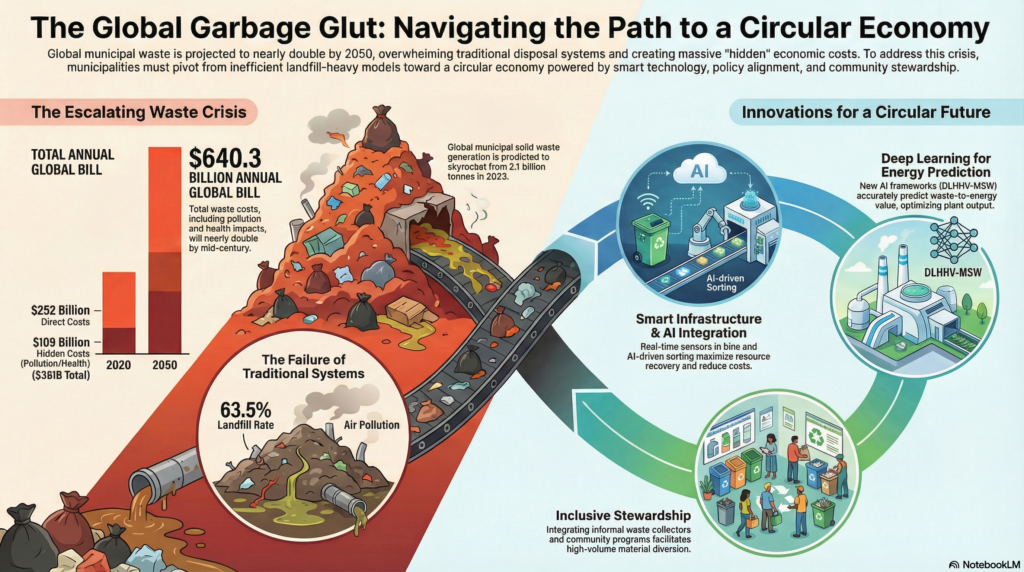
When I first started in industrial compliance, I spent my days staring at spreadsheets of hazardous waste manifests and auditing factory floors to see where we could shave off a few kilograms of scrap metal. It taught me a fundamental truth: you can’t manage what you don’t measure. Today, as we look at the state of municipal waste, that lesson is more urgent than ever. We are currently facing a global surge, with municipal solid waste generation predicted to skyrocket from 2.1 billion tonnes in 2023 to 3.8 billion tonnes by 2050.
The scale of this “garbage glut” is staggering, and the costs are even heavier than they look on a city budget. While the direct costs hit about USD 252 billion in 2020, the “hidden” costs of pollution, public health crises, and climate change push that number to USD 361 billion. If we don’t pivot toward sustainable waste management now, we’re looking at an annual global bill of USD 640.3 billion by mid-century.
To go green isn’t just a lifestyle choice anymore; it’s a fiscal and environmental necessity. In this article, we’ll dive into why our traditional systems are stumbling and how a mix of high-tech innovation and old-school community stewardship can help us build a circular framework that actually works.
Municipal waste management encounters multifaceted challenges, such as escalating waste generation, operational inefficiencies, and significant environmental impacts. Urbanization and population growth exacerbate waste issues, while outdated systems struggle with transparency and effectiveness. However, innovations such as smart bins, data analytics, and community engagement initiatives are transforming waste management practices. Emphasizing a circular economy, strategies like composting and upcycling contribute to sustainability. Additionally, policy alignment and public awareness campaigns can foster greater accountability and participation. The path forward includes leveraging these innovations to not only address existing barriers but also create a more sustainable waste management framework. Those interested can explore further insights on these transformative variations.
KEY TAKEAWAYS
- Urbanization leads to increased waste generation, necessitating sustainable practices like reduction, reuse, and recycling to minimize landfill dependency.
- Traditional waste management systems face inefficiencies, prompting investments in infrastructure and data analytics for optimized operations.
- Improper waste disposal causes pollution, making effective waste management essential for climate change adaptation and ecosystem protection.
- Circular economy principles promote resource recovery, with initiatives like composting and waste-to-energy conversions enhancing sustainability.
- Technological innovations, such as smart bins and AI integration, improve waste collection efficiency and recycling rates.
GROWING WASTE GENERATION
Municipal solid waste generation is predicted to grow from 2.1 billion tonnes in 2023 to 3.8 billion tonnes by 2050. In 2020, the global direct cost of waste management was an estimated USD 252 billion. When factoring in the hidden costs of pollution, poor health and climate change from poor waste disposal practices, the cost rises to USD 361 billion. Without urgent action on waste management, by 2050 this global annual cost could almost double to a staggering USD 640.3 billion. Amidst the rapid urbanization and population growth observed globally, the phenomenon of growing waste generation has emerged as a critical challenge for municipalities. This escalating issue demands immediate attention, as the volume and complexity of waste produced can overwhelm existing management systems and threaten environmental sustainability. A thorough waste composition analysis is essential for understanding the types and sources of waste generated. By identifying key components—such as organic materials, plastics, and hazardous substances—municipalities can tailor waste management strategies to address specific challenges effectively.
Sustainable practices in waste management are paramount in mitigating the adverse effects of increasing waste generation. Emphasizing reduction, reuse, and recycling, municipalities can foster an ecosystem that prioritizes resource conservation and minimizes landfill dependency. Implementing innovative waste segregation systems at the source, for example, allows for more efficient recycling processes and reduces the overall waste footprint. Additionally, public awareness campaigns can empower citizens to go green by adopting responsible consumption habits and participating actively in waste reduction and recycling initiatives within their communities.
The integration of technology into waste management systems also presents promising opportunities. Smart waste bins, data analytics, and tracking systems can optimize collection schedules and enhance operational efficiency. As the global population continues to grow, municipalities must proactively adopt sustainable practices informed by rigorous waste composition analysis. This will not only alleviate the burden of waste generation but also promote a healthier environment, fostering a community committed to sustainable living and the freedom to thrive within a clean, well-managed urban landscape.
Inefficiencies in Traditional Systems
The increasing complexity and volume of waste generated by urban populations highlight considerable inefficiencies in traditional waste management systems. These systems often falter under outdated collection logistics, resulting in missed pickups and excessive operational costs. A lack of operational transparency further complicates the identification of inefficiencies, leading to a disconnect between waste generation and management efforts.
To address these challenges, it is essential to invest in infrastructure that supports innovative solutions. For instance, the integration of data analytics can enhance service optimization by providing real-time insights into waste generation patterns and collection routes. This allows municipalities to allocate resources more effectively, ultimately improving service delivery. Additionally, public awareness campaigns are crucial to educate citizens on recycling initiatives and responsible waste disposal, fostering community engagement in waste reduction efforts.
Workforce training is another critical component in transforming traditional systems. Equipping personnel with the skills necessary to adapt to new technologies and processes can greatly enhance operational efficiency. Furthermore, stakeholder collaboration among government agencies, private companies, and community organizations can drive thorough waste management strategies that are both cost-effective and sustainable.
Environmental Impact Concerns
The environmental impact of municipal waste management is profound, as improper disposal methods can lead to significant pollution and ecosystem damage. Effective resource recovery strategies are essential to mitigate these adverse effects, allowing communities to reclaim valuable materials while reducing landfill reliance. Addressing these concerns not only promotes sustainability but also enhances public health and environmental integrity. Municipal Solid Waste (MSW)—more commonly known as trash or garbage—consists of everyday items we use and then throw away, such as product packaging, grass clippings, furniture, clothing, bottles, food scraps, newspapers, appliances, paint, and batteries. This comes from our homes, schools, hospitals, and businesses.
Pollution and Ecosystem Damage
Effective municipal waste management is essential for mitigating pollution and minimizing ecosystem damage, as improper disposal practices can lead to severe environmental consequences. Landfill expansion contributes to habitat disruption and long-term land degradation, while waste incineration can compromise air quality through the release of harmful emissions. Additionally, the generation of toxic leachate from landfills poses a significant threat to water bodies, leading to water contamination that affects aquatic life and human health.
To combat these challenges, pollution prevention strategies must be prioritized, including waste segregation at the source. This practice not only facilitates recycling but also minimizes the volume of waste sent to landfills or incinerators. Furthermore, as climate change exacerbates environmental pressures, effective municipal waste management becomes even more critical for ecosystem restoration efforts.
Resource Recovery Strategies
Implementing resource recovery strategies is essential for addressing environmental impact concerns associated with municipal waste management. By embracing a circular economy, communities can enhance waste diversion efforts and promote sustainable waste management practices that reduce reliance on landfills while maximizing resource recovery. Key strategies include composting initiatives, upcycling programs, and material recovery processes, which collectively form the backbone of effective resource recovery.
| Strategy | Benefits | Examples |
| Composting Initiatives | Reduces organic waste, enriches soil | Community gardens, food waste recycling |
| Upcycling Programs | Transforms waste into valuable products | Furniture redesign, fashion from textile waste |
| Waste to Energy | Converts waste into usable energy | Incineration facilities, anaerobic digestion |
| Recycling Education | Increases awareness and participation | Workshops, school programs |
These strategies not only mitigate the environmental impact of waste but also foster a sense of community responsibility. By investing in recycling education, we empower individuals to make informed choices, further enhancing waste diversion. Ultimately, the integration of these resource recovery strategies is pivotal for achieving a more sustainable future, where the waste generated is minimized, and resources are continuously reused.
Technological Innovations
Amid growing concerns about environmental sustainability and urbanization, technological innovations in municipal waste management are proving to be crucial in addressing these challenges. By integrating advanced technologies, municipalities can enhance efficiency, reduce costs, and promote sustainable practices. Key innovations include:
- Smart Bins: Equipped with sensors, these bins monitor waste levels in real-time, enabling optimized collection routes and reducing unnecessary trips.
- Automated Collection: Utilizing IoT applications, automated waste collection systems streamline operations, leading to significant labor and time savings.
- Data Analytics: By analyzing waste composition and collection patterns, municipalities can improve waste sorting processes, ensuring more materials are recycled and diverted from landfills.
- AI Integration and Blockchain Tracking: AI enhances recycling technologies by identifying materials for sorting, while blockchain provides transparency in waste management processes, ensuring accountability and traceability.
These innovations not only facilitate effective waste sorting but also promote composting solutions and waste-to-energy initiatives, transforming waste into valuable resources. As technology evolves, the potential for enhanced recycling technologies and improved efficiency in municipal waste management expands.
In a world increasingly driven by data, the integration of these technological advancements is crucial for municipalities aiming for a sustainable future. Embracing these innovations empowers local governments to take informed actions, ultimately benefiting both the environment and community well-being. The future of municipal waste management lies in the hands of those ready to adopt and adapt to these transformative technologies.
COMMUNITY ENGAGEMENT STRATEGIES
The integration of advanced technologies in municipal waste management lays a strong foundation for enhancing community engagement strategies. By leveraging digital platforms and innovative communication tools, municipalities can foster greater participation among residents in waste management initiatives. Awareness campaigns utilizing social media can effectively disseminate information, educate citizens on best practices, and promote local stewardship projects that encourage residents to take ownership of their environment.
Volunteer programs and neighborhood initiatives further enhance community involvement. These programs can mobilize residents to actively participate in local clean-up events or recycling drives, creating a sense of community pride. Educational workshops serve as essential resources for teaching sustainable practices and the importance of waste reduction, making them indispensable components of any thorough engagement strategy.
Local partnerships with businesses and organizations can also amplify the reach and impact of these initiatives by encouraging the use of eco friendly products, which supports waste reduction efforts while promoting more sustainable consumption patterns within the community. By collaborating on incentive programs, municipalities can motivate residents to adopt eco-friendly habits. Feedback mechanisms, such as community surveys, allow citizens to express their opinions and suggestions, fostering a sense of transparency and involvement in decision-making processes.
Ultimately, effective community engagement strategies are fundamental for the success of municipal waste management. By creating an inclusive environment that values resident input and participation, municipalities can cultivate a culture of sustainability. This not only empowers citizens but also promotes a shared vision for cleaner, more resilient communities. Engaging the public through diverse channels and initiatives paves the way for informed decision-making and collective responsibility in waste management practices.
Policy and Regulation Challenges
In my time auditing waste streams, I’ve seen how “business as usual” often leads to a graveyard of efficiency. Traditional municipal systems frequently falter under outdated collection logistics, leading to missed pickups and ballooning operational costs. It’s frustrating because these aren’t just logistical hiccups; they have real-world environmental consequences, from toxic leachate threatening our water bodies to incineration compromising the air we breathe.However, the “Engineer” in me gets excited about the shift we’re seeing toward data-driven solutions. We’re finally moving past the era where we just “dump and cover”.
Innovations like smart bins with real-time sensors and AI-driven sorting are game-changers. I’m particularly fascinated by recent research into deep learning models, like the DLHHV-MSW framework, which can predict the energy value of waste with incredible accuracy. This kind of tech allows us to optimize Waste-to-Energy (WTE) plants, maximizing power output while slashing emissions. But technology is only half the battle.
We also need to recognize the human element like the informal collectors in Hungary who, through their own “transactional supply chain,” divert massive amounts of bulky waste from landfills. By blending these high-tech tools with inclusive policies that respect local community dynamics, we can transform waste from a liability into a resource.
The effectiveness of municipal waste management is greatly hindered by inconsistent waste management policies across jurisdictions, creating confusion and inefficiencies. Additionally, regulatory compliance barriers often impede municipalities from implementing best practices and innovative solutions. Addressing these challenges is essential for fostering a cohesive and effective waste management framework that can adapt to evolving environmental needs. 29% of MSW generated in the U.S. is either recycled or composted, 7.6% is sent to waste-to-energy (WTE) incinerator facilities, and the remaining 63.5% is landfilled.
Inconsistent Waste Management Policies
How can municipalities effectively tackle the challenges posed by inconsistent waste management policies? To enhance waste management efficacy, cities must adopt a multi-faceted approach that emphasizes coherence and collaboration. Key strategies include:
- Policy Alignment: Establish unified regulations that promote waste segregation across all sectors, ensuring that guidelines are clear and enforceable.
- Stakeholder Collaboration: Foster partnerships among government entities, private sectors, and community organizations to create a thorough waste management framework that aligns with urban planning initiatives.
- Public Awareness and Education Programs: Implement campaigns to educate residents on the importance of waste segregation and recycling, fostering a culture of accountability and participation.
- Data Transparency and Infrastructure Investment: Utilize technology to enhance data transparency, allowing for informed decision-making while securing funding mechanisms to support necessary infrastructure investments.
Regulatory Compliance Barriers
Inconsistent waste management policies not only hinder effective practices but also present significant regulatory compliance barriers that municipalities must navigate. These barriers often manifest in the form of high compliance costs, stemming from complex regulatory frameworks that vary widely across jurisdictions. Municipalities face enforcement challenges due to unclear industry standards, leading to potential legal liabilities that can jeopardize public trust and financial stability.
The permit processes required for waste management operations can be cumbersome and time-consuming, further complicating compliance efforts. Many municipalities struggle to effectively engage stakeholders, which is essential for developing transparent and responsive waste management strategies. Without robust stakeholder engagement, compliance becomes a mere checkbox exercise rather than a holistic approach to waste management.
Moreover, the stringent audit requirements imposed by regulatory bodies can overwhelm local governments lacking the necessary resources. This not only diverts attention from innovative waste management solutions but also perpetuates a cycle of inefficiency. By addressing these regulatory compliance barriers, municipalities can enhance their waste management practices, reduce costs, and ultimately foster a more sustainable environment that respects the freedom of local communities to thrive.
Future Trends in Waste Management
Embracing innovative technologies and sustainable practices, the future of waste management is poised for significant change. As cities evolve into smart ecosystems, waste management will increasingly integrate with urban infrastructure, promoting a circular economy. Key trends shaping this future include:
- Automated Sorting: Advanced sorting technologies will enhance recycling efficiency, minimizing contamination and maximizing resource recovery.
- Waste to Energy Solutions: Converting waste into energy will reduce landfill dependency, providing a renewable energy source and minimizing greenhouse gas emissions.
- Biodegradable Materials: The adoption of biodegradable materials will alleviate plastic pollution, fostering a zero waste mindset among consumers and industries alike.
- Public-Private Partnerships: Collaborative efforts between governments and private sectors will drive innovation, funding, and the implementation of green technologies.
Behavioral change is essential for cultivating a culture of sustainability. Recycling incentives will motivate citizens to actively participate in waste reduction efforts, ultimately supporting the shift to zero waste communities. Furthermore, as smart cities leverage data and technology, residents will be empowered to manage their waste more effectively, contributing to environmental and economic wellbeing.

RELATED STUDIES ABOUT MUNICIPAL WASTE MANAGEMENT
In an era of unprecedented waste generation, the irony lies in the fact that solutions often create new challenges. Traditional systems struggle to cope, yet innovation emerges amidst the chaos. As communities rally for sustainable practices, the paradox of policy inertia persists, hindering progress. Ultimately, the future of municipal waste management hinges on a delicate balance between technological advancements and collective action, revealing that even in the face of overwhelming refuse, opportunity can spark from the most unlikely circumstances.
Development of a Deep Learning Predictive Model for Estimating Higher Heating Value in Municipal Solid Waste Management
Objective: This study proposes a novel deep learning-based framework, DLHHV-MSW, to accurately predict the Higher Heating Value (HHV) of Municipal Solid Waste (MSW) from its elemental composition. The goal is to provide a more efficient, cost-effective, and environmentally friendly alternative to traditional labor-intensive calorimetric methods, thereby optimizing Waste-to-Energy (WTE) conversion processes.
Key Findings:
- Proposed Model: The DLHHV-MSW framework integrates a Deep Belief Network (DBN) for predictive analysis with an Oppositional Cat Swarm Optimization (OCSO) algorithm for hyperparameter tuning. It uses input variables such as ash, carbon, hydrogen, nitrogen, oxygen, sulfur, and water content to estimate HHV.
- Superior Performance: The model demonstrated exceptional predictive accuracy on a benchmark dataset (1650 samples), achieving:
- Correlation Coefficient (CC): 0.996
- Mean Squared Error (MSE): 2.342
- Mean Absolute Deviation (MAD): 0.136
It consistently outperformed traditional and other machine learning models (SVM, RF, ANN), offering 16-25% lower RMSE and up to 50% improvement in MAD.
- Robustness and Generalization: When tested on additional regional datasets with diverse waste compositions, the framework maintained high accuracy (CC > 0.991), proving its adaptability and robustness for real-world, heterogeneous MSW streams.
- Comparative Advantage: The model’s performance was superior not only to standard ML models but also to advanced techniques like Gaussian Process (GP), Regression Process (RP), and a Deep Support Vector Machine (D-SVM), as shown through comprehensive RMSE, MAD, CC, and variation analyses.
- Significance for WTE: Accurate HHV prediction is critical for optimizing combustion conditions in WTE plants, leading to:
- Maximized energy output.
- Reduced greenhouse gas and pollutant emissions.
- Lower operational and maintenance costs.
- Enhanced stability of plant operations and support for a circular economy by minimizing landfill reliance.
Conclusion:
The DLHHV-MSW framework presents a highly accurate, scalable, and automated solution for HHV prediction in MSW management. By leveraging deep learning and advanced optimization, it addresses the limitations of traditional methods and offers significant potential to improve the efficiency and sustainability of Waste-to-Energy processes.
Recommendations for Future Work:
- Real-time implementation and validation in operational WTE plants.
- Expansion of the model to predict HHV for other waste streams.
- Incorporation of additional real-world data and exploration of further regularization techniques to enhance scalability for high-dimensional datasets.
Summary Note: This research provides a powerful AI-driven tool that can transform MSW management by enabling precise energy recovery forecasting, thereby contributing to more sustainable and economically viable urban waste processing systems.
| REFERENCE: Nasreen Banu Mohamed Ishaque, S. Metilda Florence, Development of a deep learning predictive model for estimating higher heating value in municipal solid waste management, Cleaner Engineering and Technology, Volume 26, 2025, 100966, ISSN 2666-7908, https://doi.org/10.1016/j.clet.2025.100966. (https://www.sciencedirect.com/science/article/pii/S2666790825000898) |
Informal Waste Collection and Municipal Waste Management in Hungary: A Pilot Project Featuring Smartphones to Estimate the Extent of Informally Retrieved Bulky Waste
Objective:
This pilot study aimed to assess the extent and impact of informal waste collection in Budapest, Hungary, focusing on the activities of predominantly Roma informal collectors who retrieve bulky municipal waste (lomtalanitas) before official city collection. The research sought to quantify the waste informally collected to understand its role in waste diversion and its place within a transactional supply chain.
Key Findings:
- Scale of Informal Collection: Using a novel smartphone-based monitoring method in a sample district (District XI), the study estimated that approximately 9.2% of bulky waste piles were sorted and removed by informal collectors. Extrapolated data suggests informal collectors may remove around 335 tonnes of waste in the district during the collection period, a significant quantity that potentially rivals official municipal collection volumes.
- Supply Chain and Economic Driver: Informal collection acts as the initial link in a transactional supply chain, primarily driven by the value of metallic waste (copper, iron, aluminum). Collected materials are sold to small-scale buyers (vasdarabos), then to larger, registered scrapyards (mételyes), with indications of potential onward export. This activity provides a crucial income source, with estimated revenues far exceeding the national daily minimum wage.
- Inadvertent Circular Economy Contribution: Despite operating illegally and sometimes causing negative environmental effects (e.g., burning hazardous materials for heat), informal collectors serendipitously contribute to circular economy principles. By diverting reusable and recyclable materials—especially metals—from landfills and incineration, they reduce the overall burden on formal municipal waste systems.
- Methodological Innovation and Limitations: The study pioneered the use of smartphone technology (GPS, photography) to monitor waste piles and collection vehicles, avoiding direct intrusion into the activities of a hard-to-reach population. However, the method had limitations, including difficulties in accurate volume/weight estimation and an inability to monitor the entire collection period continuously.
- Policy Implications: The findings challenge purely punitive approaches toward informal waste collection. The study proposes a model for integrating informal and official waste collection practices. Key recommendations include:
- Recognizing the public service role informal collectors play in waste diversion.
- Reducing the emphasis on penalization.
- Exploring ways to formally acknowledge and potentially integrate these actors into the municipal waste management framework to enhance overall system efficiency and circularity.
Conclusion:
Informal waste collection in Budapest is a substantial, economically motivated activity that significantly diverts bulky waste from official disposal. While methodologically challenging to measure precisely, its scale underscores its importance. The study argues for a policy shift from suppression to recognition and potential integration, aligning informal collection practices with broader circular economy goals in municipal waste management.
Summary Note: This research provides empirical evidence of the significant role informal actors play in urban waste streams and advocates for inclusive waste management policies that leverage, rather than criminalize, informal sector activities to achieve more sustainable outcomes.
| REFERENCE: Tim Gittins, László Letenyei, Informal waste collection and municipal waste management in Hungary: A pilot project featuring smartphones to estimate the extent of informally retrieved bulky waste, Waste Management, Volume 200, 2025, 114757, ISSN 0956-053X, https://doi.org/10.1016/j.wasman.2025.114757. (https://www.sciencedirect.com/science/article/pii/S0956053X2500162X) |
Governance Models And Performance In Municipal Solid Waste Management: Evidence From Local Authorities
Study Overview:
This research investigates the relationship between governance models and environmental performance in municipal solid waste (MSW) management across Portuguese municipalities. Using data from 278 mainland municipalities, the study examines the factors influencing the choice of governance models and evaluates their effectiveness in meeting European waste reduction and recycling targets.
Key Findings:
- Predominance of Direct Management:
- The majority of municipalities (81%) use direct management (municipal or municipalized services) for waste collection.
- Smaller municipalities tend to prefer direct management, contrary to the hypothesis that they would opt for inter-municipal cooperation to reduce costs.
- Influence of Municipality Size and Density:
- Larger municipalities are more likely to delegate services to municipal corporations.
- Lower population density municipalities are more inclined toward inter-municipal cooperation, while denser municipalities favor direct management or municipal corporations.
- Role of Financial Autonomy:
- Municipalities with greater financial autonomy tend to choose municipal corporations.
- Those with less financial autonomy prefer inter-municipal cooperation to share costs and administrative burdens.
- Impact of Institutional Capacity:
- Municipalities with larger per capita public workforces strongly favor direct management, likely due to administrative simplicity and lower transaction costs.
- Limited Political Influence:
- Political ideology (e.g., left-wing or independent leadership) showed no significant effect on governance choices, suggesting decisions are driven more by pragmatic and institutional factors.
- Performance Outcomes:
- Inter-municipal cooperation was associated with lower selective collection and recycling rates, challenging assumptions about its efficiency benefits.
- Direct management performed relatively well in meeting environmental targets, especially when adequately resourced.
- Municipalities led by the Portuguese Communist Party (PCP) showed higher selective collection rates, though this may reflect sample-specific priorities.
- Financial autonomy was positively linked to better selective collection performance.
Policy Implications:
- No One-Size-Fits-All Model: The effectiveness of governance models depends heavily on local conditions (e.g., size, density, financial capacity).
- Strengthen Municipal Capacity: Policymakers should focus on enhancing financial and institutional resources rather than promoting specific governance structures.
- Targeted Support for Vulnerable Municipalities: Rural and less-resourced municipalities may require additional financial, technical, and administrative support to meet EU targets.
- Flexibility in EU Targets: Consider recalibrating environmental targets to reflect varying municipal capacities or developing enhanced support mechanisms to help municipalities comply.
Conclusion:
The study concludes that direct management remains a prevalent and effective approach in Portugal, particularly when supported by adequate resources. While inter-municipal cooperation is often chosen for cost-sharing, it does not necessarily lead to better environmental outcomes. Future policies should prioritize context-sensitive solutions and capacity-building to advance waste management performance in line with circular economy goals.
| REFERENCE: Ana Filipa Novais, António F. Tavares, Governance models and performance in municipal solid waste management: Evidence from local authorities, Journal of Environmental Management, Volume 386, 2025, 125829, ISSN 0301-4797, https://doi.org/10.1016/j.jenvman.2025.125829. (https://www.sciencedirect.com/science/article/pii/S0301479725018055) |
CONCLUSION
As I wrap up my own DIY waste audits at home or tinker with a “broken” radio to keep it out of the bin, I’m reminded that system-wide change is built on a foundation of individual and municipal accountability. The path forward isn’t easy; we’re up against inconsistent policies and a 63.5% landfill rate in places like the U.S.. But the trends I see from the adoption of biodegradable materials to the rise of public-private partnerships give me genuine hope.
The future of waste management lies in the “circular economy” where resource recovery is the standard, not the exception. Whether it’s through community composting that enriches our urban gardens or smart city infrastructure that empowers residents to track their own footprints, the opportunity for innovation is everywhere.
We need to push for policy alignment and invest in the human capital of the workers and citizens who make these systems run. It’s about more than just managing “trash”; it’s about designing a world where the very concept of “waste” becomes obsolete. Let’s keep pushing for that zero-waste mindset, one data point and one behavioral shift at a time.