When I first began my PhD at Berkeley, I spent a lot of time looking at data sets. But sustainability truly clicked for me when I started looking out my own window. Living in a city, it is easy to feel disconnected from the natural world, as if our “urban” lives are separate from the “environment”. But the truth I’ve discovered in my 12 years of research is that our homes are the most important “niches” for change. We often view ourselves as passive consumers, but we are actually active experimenters in our own lives.
I remember the first time I tried a completely zero-waste week in my own apartment; it was messy and frustrating at times, but it taught me that sustainable living isn’t about being perfect, it’s about “living better and lighter” in a way that fits your specific reality. Sustainable living is a holistic approach that balances our economic needs with ecological harmony.
It’s about realizing that every choice, from the lightbulbs we use to the food on our plates, is a chance to exercise our personal freedom to support a healthier planet. My mission has always been to take the academic insights I’ve gathered and turn them into practical, accessible advice that makes green living feel like a natural extension of who you are, rather than an expensive or difficult chore.
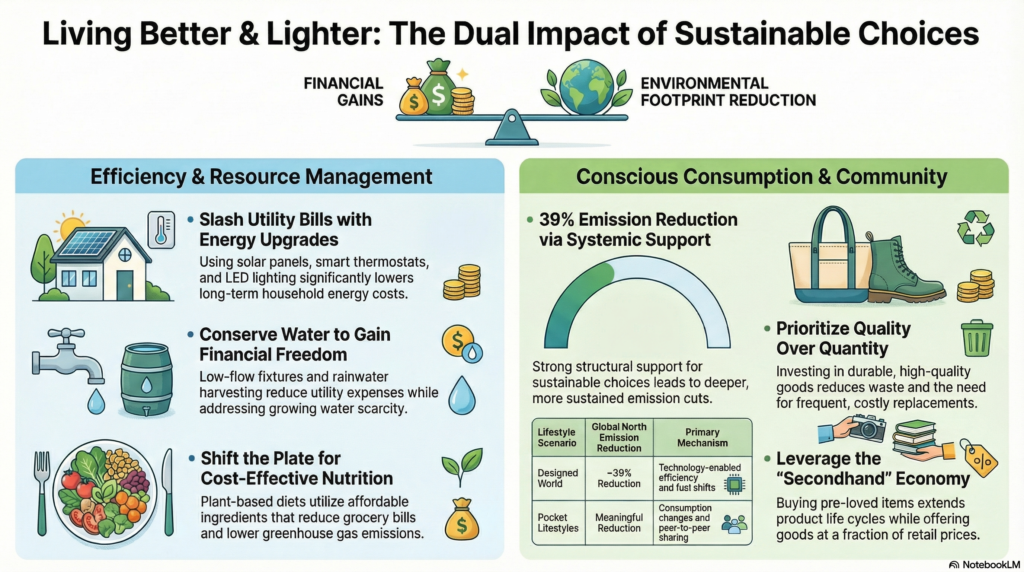
Sustainable living effectively reduces costs while benefiting the environment. By adopting energy-efficient appliances and renewable solutions like solar panels, households can go green while significantly reducing long-term utility expenses. Water conservation methods, such as low-flow fixtures and drought-resistant landscaping, further decrease expenses. Embracing a plant-based diet not only promotes personal health but also offers affordable nutrition options. Additionally, smart shopping practices, including purchasing secondhand or local goods, minimize waste and support local economies. Collectively, these strategies create a positive impact on both financial health and the planet. There are more compelling insights on achieving sustainability that could enhance your journey.
KEY TAKEAWAYS
- Sustainable living reduces utility bills by using energy-efficient appliances and solar panels, significantly lowering energy costs.
- Embracing a plant-based diet can lower grocery expenses while promoting health and reducing environmental impact.
- Carpooling and ride-sharing decrease transportation costs and emissions, fostering community connections and financial savings.
- Supporting local produce minimizes food waste and transportation emissions, enhancing nutrition and supporting local economies.
- DIY solutions, such as homemade cleaners and upcycling, save money and promote sustainable practices, reducing reliance on commercial products.
UNDERSTANDING SUSTAINABLE LIVING
Sustainable living encompasses a holistic approach to lifestyle choices aimed at minimizing environmental impact while promoting social equity and economic viability. This paradigm encourages individuals to make eco-friendly choices that not only benefit the planet but also enhance personal well-being. Understanding sustainable living involves recognizing the benefits of minimalism, which emphasizes living with less and prioritizing quality over quantity. This approach fosters waste reduction by discouraging excessive consumption and encouraging the use of renewable resources. Every year thousands of seabirds, sea turtles, seals and other marine mammals are killed after ingesting plastic or getting tangled up in it.
The integration of green technologies into everyday life further exemplifies sustainable living. Innovations such as solar panels and energy-efficient appliances contribute to a decreased reliance on fossil fuels, thereby supporting environmental sustainability while reducing long-term household energy costs. Furthermore, the rise of sustainable fashion highlights the importance of ethical consumerism, where purchasing decisions are aligned with environmental and social values. This movement promotes brands that prioritize sustainable materials and fair labor practices, encouraging consumers to support ethical production.
Composting practices also play an essential role in sustainable living. By transforming organic waste into nutrient-rich soil, individuals can greatly reduce landfill contributions while enriching their gardens or plants. Ultimately, understanding sustainable living is not merely about adopting a set of practices; it is about embracing a mindset that champions environmental stewardship, social responsibility, and economic prudence. By making informed decisions and prioritizing sustainability, individuals can cultivate a lifestyle that not only supports personal freedom but also contributes positively to the world around them.
Energy Efficiency at Home
Energy efficiency at home represents a critical component in the broader context of sustainable living. By reducing energy consumption, homeowners not only decrease their carbon footprint but also enjoy notable financial savings. Implementing energy-efficient practices can lead to a more sustainable lifestyle that empowers individuals to take control of their energy use and expenses.
Key strategies for enhancing energy efficiency at home include:
- Solar panel installation: Harnessing renewable energy reduces reliance on fossil fuels and can considerably lower electricity bills.
- Energy-efficient appliances: Upgrading to appliances with high energy ratings minimizes energy waste and contributes to a healthier environment.
- Proper insulation: Ensuring that homes are well insulated reduces the need for heating and cooling, resulting in lower energy costs.
- Smart thermostats: Utilizing programmable thermostats allows homeowners to optimize heating and cooling schedules, adapting to their lifestyle while saving energy.
- LED lighting: Switching to LED bulbs consumes less energy and lasts longer than traditional incandescent bulbs, providing a cost-effective lighting solution.
Reducing Water Consumption
Amid growing concerns about water scarcity and environmental degradation, reducing water consumption has become an essential aspect of sustainable living. Implementing effective water saving techniques not only conserves this crucial resource but also cuts costs on utility bills, thereby contributing to financial freedom.
One practical method is rainwater harvesting, which captures and stores rain for later use in irrigation or household applications. Complementing this, drought resistant landscaping minimizes the need for excessive watering by utilizing native plants that thrive in local climates. Efficient irrigation systems, such as drip irrigation, apply water directly to the roots, markedly reducing waste.
In addition, the installation of low flow fixtures in bathrooms and kitchens can lead to considerable reductions in water use without sacrificing performance. Mindful consumption practices, such as turning off taps while brushing teeth or taking shorter showers, further enhance conservation efforts. Greywater recycling systems, which repurpose wastewater from sinks and showers, can also contribute to reduced water demand.
Regular leak detection is critical in maintaining water efficiency, as even minor leaks can lead to notable water loss over time. Engaging in conservation education helps individuals and communities understand the importance of water conservation and promotes mindful landscaping that supports sustainable practices.
Embracing a Plant-Based Diet
Shifting to a plant-based diet offers numerous environmental benefits and health advantages, making it an essential component of sustainable living. This dietary alteration not only promotes better health through enhanced nutritional benefits but also greatly reduces our environmental impact. By prioritizing seasonal ingredients and local markets, individuals can embrace culinary creativity while minimizing food waste and supporting ethical sourcing.
The following points underscore the advantages of adopting a plant-based diet:
- Nutritional Benefits: Rich in vitamins, minerals, and antioxidants, plant-based foods contribute to overall health and well-being.
- Cost Savings: Plant-based meals often utilize more affordable ingredients, reducing grocery bills over time.
- Meal Planning: Organizing meals around seasonal produce allows for diverse and balanced diets while fostering mindful consumption.
- Cooking Techniques: Exploring various cooking techniques can enhance the flavors and textures of plant-based dishes, making them enjoyable and satisfying.
- Environmental Impact: Reducing meat consumption leads to lower greenhouse gas emissions and less strain on water resources.
Cutting Transportation Costs
Transportation costs can greatly impact both personal budgets and environmental sustainability. By embracing public transit options, carpooling, and ride-sharing services, individuals can reduce their expenses while minimizing their carbon footprint. These alternatives not only provide financial savings but also promote a more efficient use of resources within communities. Trashed food ends up in a landfill, where it rots and emits methane — a powerful greenhouse gas that contributes more to global warming than CO2. Toss your leftovers in a compost bin instead.
Embrace Public Transit Options
Public transit options present a practical solution for individuals seeking to reduce their transportation costs while simultaneously contributing to a more sustainable lifestyle. By opting for public transport, individuals can enjoy significant public transit benefits that not only alleviate personal financial burdens but also promote eco-friendly commuting practices.
Consider the following advantages of embracing public transit:
- Cost Savings: Reduced expenses on fuel, parking, and vehicle maintenance.
- Reduced Carbon Footprint: Mass transit systems lower per capita emissions compared to individual car usage.
- Enhanced Urban Mobility Solutions: Improved accessibility to city infrastructure, fostering community engagement.
- Support for Sustainable Transit Initiatives: Participation in local transit programs enhances funding and service expansion.
- Advocacy for Public Transport Accessibility: Engaging in mass transit advocacy helps guarantee equitable transportation alternatives for all.
Investing in public transit not only leads to personal savings but also promotes city infrastructure improvements and enhances community transit programs. By choosing sustainable transportation alternatives, individuals can actively participate in shaping a greener future, all while enjoying the freedom and flexibility that public transit offers.
Carpooling and Ride Sharing
Frequently overlooked as a viable alternative to solo driving, carpooling and ride-sharing initiatives offer significant benefits for individuals aiming to cut transportation costs. By utilizing ride-sharing apps, commuters can easily connect with others heading in the same direction, transforming their daily travels into cost-effective journeys. Carpooling benefits not only include reduced ride costs through shared mobility but also promote sustainable commuting practices that lessen environmental impact.
Furthermore, eco-friendly vehicles, often incorporated into ride-sharing programs, contribute to lower emissions, enhancing urban planning efforts aimed at creating greener cities. Community partnerships can bolster these initiatives, fostering a sense of camaraderie among participants while also providing logistical support for local ride-sharing networks.
In addition to financial savings, carpooling minimizes the burden of vehicle maintenance, as shared trips reduce wear and tear on individual cars. As transportation alternatives become increasingly essential in addressing urban congestion and pollution, embracing ride cost sharing through carpooling presents an attractive solution. Ultimately, this approach not only liberates individuals from the financial constraints of commuting but also aligns personal freedom with a commitment to sustainable living.

SMART SHOPPING PRACTICES
In my own life, the transition to a greener lifestyle wasn’t just about the “carbon footprint” it was about finding more joy and connection. For instance, when I talk about embracing a plant-based diet or buying local produce, I’m not just thinking about greenhouse gas emissions. I’m thinking about my Saturday mornings at the local farmers’ market. There is a profound sociological benefit to supporting a community-supported economy; it fosters social equity and a sense of camaraderie that you just don’t get at a massive supermarket chain.
I also frequently advocate for prioritizing quality over quantity. In my research on sustainable consumer behaviors, I’ve seen how a minimalist mindset living with less but better leads to true “conscious consumerism”. Whether it’s investing in durable, eco-friendly products or finding a unique vintage piece at a thrift store, these choices aren’t just saving us money in the long run; they are expressions of our values.
I often take my camera out to capture the interplay between nature and our city structures, and it reminds me that even in a concrete jungle, our DIY solutions like a small compost bin on a balcony or a smart thermostat are ways we nurture the Earth right where we are. These “small steps” and cumulative learning experiences are what truly drive the sustainability transition.
Smart shopping practices are essential for promoting sustainable living, as they encourage consumers to make more environmentally conscious choices. By prioritizing local produce, individuals can reduce their carbon footprint while supporting community economies. Additionally, focusing on quality over quantity and embracing secondhand shopping can greatly minimize waste and resource consumption, ultimately fostering a more sustainable lifestyle. Sustainable living means understanding how our lifestyle choices impact the world around us and finding ways for everyone to live better and lighter.
Buy Local Produce
Embracing the practice of buying local produce not only supports community farmers but also enhances the sustainability of our food systems. By opting for fresh produce from local markets, consumers can enjoy a multitude of benefits that extend beyond mere financial savings. Purchasing seasonal ingredients from local farmers reduces shipping emissions and fosters a community-supported economy. This conscious choice leads to sustainable sourcing practices that are beneficial for both the environment and personal health.
Consider the following advantages of buying local produce:
- Freshness: Local produce is often harvested at peak ripeness, ensuring peak flavor and nutrition benefits.
- Reduced Food Waste: Shorter supply chains mean less spoilage and waste, contributing to a more efficient system.
- Seasonal Variety: Engaging with local markets encourages the consumption of diverse seasonal ingredients, enhancing diets.
- Community Support: Each purchase strengthens local economies and supports farmers directly.
- Environmental Impact: Less transportation means lower carbon footprints, benefiting the planet.
In essence, by prioritizing local produce, consumers exercise their freedom to make choices that are both economically viable and environmentally responsible.
Prioritize Quality Over Quantity
Prioritizing quality over quantity is an essential strategy for consumers aiming to make sustainable choices in their shopping practices. Adopting a minimalist mindset encourages individuals to focus on essential items that serve a purpose, ultimately leading to conscious consumerism. By investing in durable items and choosing eco friendly products, shoppers can reduce waste, lower long-term expenses, and support more sustainable production practices.
Mindful purchasing is crucial in this situation, as it emphasizes the importance of selecting items that embody sustainable craftsmanship and value longevity. Rather than accumulating a multitude of low-quality goods, consumers should seek fewer, high-quality items that will stand the test of time. This shift not only supports the environment but also contributes to personal financial savings, as fewer purchases are required over time.
Moreover, prioritizing quality fosters a deeper appreciation for products and their origins, encouraging individuals to support brands that align with their values. By making informed choices and opting for items that prioritize durability and sustainability, consumers can greatly contribute to waste reduction and environmental preservation. Embracing this approach can lead to a more fulfilling and responsible lifestyle, ultimately benefiting both the individual and the planet.
Embrace Secondhand Shopping
Thrift stores, online marketplaces, and swap events have emerged as essential resources for consumers seeking sustainable alternatives to traditional retail shopping. Embracing secondhand shopping not only promotes sustainable fashion but also fosters a mindset of resourceful shopping that aligns with eco-friendly values. By choosing vintage finds, secondhand clothing, and upcycled furniture, individuals can considerably reduce their environmental impact while saving money.
Consider the following advantages of secondhand shopping:
- Cost-effective: Secondhand items often come at a fraction of the price of new products.
- Unique selections: Thrift stores and online marketplaces offer one-of-a-kind pieces that can elevate personal style.
- Reduced waste: Purchasing pre-loved items extends their life cycle, decreasing landfill contributions.
- Community engagement: Clothing swaps and community exchanges create opportunities for social interaction and shared values.
- Supporting eco-friendly brands: Many secondhand retailers focus on sustainable practices, reinforcing the importance of ethical consumption.
DIY Solutions for Savings
A growing number of individuals are discovering that DIY solutions can greatly enhance their financial well-being while promoting sustainable living practices. Engaging in upcycling projects allows people to repurpose items that would otherwise contribute to landfill waste, transforming them into useful and aesthetically pleasing products. Zero waste crafts further complement this approach by encouraging creativity and resourcefulness, effectively minimizing waste.
Homemade cleaners represent another practical avenue for those seeking eco-friendly alternatives to commercial products. By utilizing simple ingredients, individuals can create effective cleaning solutions that are both cost-efficient and non-toxic. Additionally, investing in energy-saving gadgets, such as smart thermostats and LED lighting, can lead to substantial reductions in utility bills while contributing to a greener planet.
Eco-friendly renovations are another way to enhance the sustainability of one’s living environment. Techniques such as sustainable gardening and composting techniques not only reduce waste but also promote self-sufficiency by enabling individuals to grow their own food. The implementation of DIY solar panels and rainwater harvesting systems further empowers homeowners to harness natural resources, reducing reliance on conventional energy and water supplies.
Natural pest control methods can also be employed to maintain a healthy garden without the use of harmful chemicals, fostering a more balanced ecosystem. By embracing these DIY solutions, individuals not only save money but also take meaningful steps towards a more sustainable lifestyle, aligning their personal freedom with environmental stewardship.

RELATED STUDIES ABOUT SUSTAINABLE LIVING
In the pursuit of sustainable living, individuals wield the power to transform their financial landscape while nurturing the Earth. Each conscious choice, akin to planting seeds in fertile soil, fosters both economic resilience and ecological harmony. The interconnectedness of energy efficiency, water conservation, dietary choices, and mindful consumption serves as a tapestry, illustrating the profound impact of collective action. Ultimately, embracing sustainability not only cultivates personal savings but also nurtures the planet, ensuring a legacy of health and prosperity for future generations.
Technology for Sustainable Living: The Impact of Digital Inclusion on the Health of China’s Elderly Living Alone
This study investigates the impact of digital inclusion—encompassing access to and skills in using the internet—on the mental and physical health of elderly individuals living alone in China. It aims to address a significant gap in research focused on this vulnerable demographic within a developing country context.
Key Findings:
- Positive Overall Impact: Digital inclusion significantly improves both the mental and physical health of elderly individuals living alone.
- Mental Health: A one-standard-deviation increase in digital inclusion leads to a 0.48-point decrease in depression scores (4.7% of the mean) and a 0.27-point increase in cognitive function scores (2.5% of the mean).
- Physical Health: The same increase leads to an 0.11-point improvement in Instrumental Activities of Daily Living (IADL), reflecting greater independence. A one-point increase in the digital inclusion score also results in a 0.02-point improvement in self-rated health.
- Key Mechanisms: The health benefits are primarily delivered through three channels:
- Enhanced Life Satisfaction: Digital access improves well-being by reducing information anxiety, enriching leisure activities, and boosting self-efficacy.
- Increased Use of Preventive Healthcare: Digital tools lower barriers to health information, facilitating better health management and more frequent use of preventive services like check-ups.
- Promoted Social Participation: Online communication and virtual communities help overcome physical isolation, expanding social networks and reducing loneliness.
- Heterogeneous Effects: The benefits of digital inclusion are not uniform and vary by socioeconomic status:
- Education: While digital inclusion boosts cognitive function more for the less-educated, it significantly improves IADL (daily independence) only for the more-educated.
- Income: Improvements in depression and cognitive function are greater for the high-income group. However, improvements in self-rated health are slightly greater for the low-income group. Significant IADL benefits are observed only for the high-income group.
Methodology:
- Data: The study uses longitudinal data from the China Health and Retirement Longitudinal Study (CHARLS) for 2015, 2018, and 2020.
- Sample: 4,069 individuals aged 60 and above living alone.
- Measures: Digital inclusion was measured multidimensionally (access and skills). Health outcomes included depression (CES-D), cognitive function (MMSE), self-rated health (SRH), and independence in daily activities (IADL).
- Analysis: Employed two-way fixed effects models and Two-Stage Least Squares (2SLS) to address endogeneity, with robustness checks using Propensity Score Matching (PSM) and alternative model specifications.
Policy Implications:
The findings suggest targeted interventions to maximize the health benefits of digital technology for the aging population:
- Promote Digital Literacy: Governments and community organizations should provide tailored training to help older adults, especially those with lower education and income, overcome technological barriers.
- 󠄀Improve Infrastructure: Expand affordable internet access and community network infrastructure, particularly in rural and remote areas.
- Integrate Digital Health Services: Develop and promote telemedicine and online mental health services tailored to the needs of seniors living alone, complementing traditional care.
Conclusion:
Digital inclusion is a powerful tool for enhancing the health and well-being of China’s rapidly growing population of elderly individuals living alone. By reducing isolation, improving access to information and services, and fostering social connection, digital technology can play a crucial role in supporting sustainable and healthy aging. Effective policy must address the digital divide to ensure these benefits reach all socioeconomic groups.
| REFERENCE: Yong Yan, Huixia Xing, Technology for sustainable living: The impact of digital inclusion on the health of China’s elderly living alone, SSM – Population Health, Volume 29, 2025, 101751, ISSN 2352-8273, https://doi.org/10.1016/j.ssmph.2025.101751. (https://www.sciencedirect.com/science/article/pii/S2352827325000059) |
(Path)ways to sustainable living: The impact of the SLIM scenarios on long-term emissions
This study aimed to quantify the potential impact of comprehensive sustainable lifestyle changes on long-term greenhouse gas emissions, specifically in passenger transport and residential sectors. It bridges qualitative narrative-driven scenarios with quantitative modelling to provide policymakers with nuanced, plausible pathways for demand-side climate mitigation.
Methodology:
The research employed a transdisciplinary process to develop and model Sustainable Living In Models (SLIM) scenarios.
- Qualitative Narrative Development: Through workshops with experts, advisors, and policymakers, four distinct lifestyle scenario narratives were created, based on criteria of relevance, plausibility, and divergence.
- Quantitative Modelling: Two of these narratives—Designed World and Pocket Lifestyles—were selected for quantification using the IMAGE integrated assessment model.
- Designed World: Characterized by strong top-down structural support (governments, corporations) leveraging markets and policies to enable sustainable choices (e.g., EV subsidies, building regulations).
- Pocket Lifestyles: Driven by bottom-up, peer-to-peer diffusion of sustainable practices enabled by digital technology and social trends (e.g., car-sharing apps, minimalist living).
- Scenario Translation: Detailed narratives were translated into explicit, time-dependent model inputs (adoption rates, transition speeds) for behavioral actions, with regional differentiation between the Global North and Global South.
Key Findings:
- Significant Emission Reduction Potential: Both lifestyle scenarios substantially reduce emissions compared to a “Middle-of-the-Road” (SSP2) reference scenario by 2050.
- Designed World achieves the largest reductions: ~39% for Global North and ~27% for Global South in combined transport and residential emissions.
- Pocket Lifestyles yields more modest but still meaningful reductions.
- Different Pathways to Reduction: The mechanism of reduction differs between scenarios.
- Designed World cuts emissions primarily through technology-enabled efficiency and fuel shifts (e.g., electric vehicles, heat pumps).
- Pocket Lifestyles reduces emissions more through consumption and activity changes (e.g., teleworking, mode shift to public transit, smaller homes).
- The Critical Role of Structural Support: Scenarios with strong systemic and infrastructural support (Designed World) lead to deeper and more sustained emission cuts than those relying on decentralized, peer-to-peer adoption (Pocket Lifestyles). This underscores that larger system changes are essential to fully realize the mitigation potential of lifestyle shifts.
- Equity and Regional Differentiation: The study explicitly modeled different adoption rates and contexts for the Global North and South, accounting for equity and varying capacities. This approach shows that lifestyle changes can contribute to mitigation in both regions, with potential for “leapfrogging” unsustainable infrastructure in the Global South, though burdens and benefits are not evenly distributed.
- Informing Policymaking: The SLIM approach provides policymakers not just with quantified impacts, but with the “why” and “how” behind potential futures. It illustrates that effective climate strategies require a combination of technological solutions, supportive infrastructure, and facilitated behavioral changes.
Conclusion:
Sustainable lifestyle changes are a vital component of climate change mitigation, capable of reducing transport and residential emissions significantly by mid-century. However, their full potential is best unlocked when supported by coordinated systemic changes, policies, and infrastructure. The study demonstrates the value of combining rich, qualitative narratives with robust quantitative modelling to create credible, differentiated pathways that can inform more equitable and effective climate policy.
| REFERENCE: Nicole J. van den Berg, Andries F. Hof, Vanessa Timmer, Lewis Akenji, Detlef P. van Vuuren, (Path)ways to sustainable living: The impact of the SLIM scenarios on long-term emissions, Global Environmental Change, Volume 84, 2024, 102774, ISSN 0959-3780, https://doi.org/10.1016/j.gloenvcha.2023.102774. (https://www.sciencedirect.com/science/article/pii/S0959378023001401) |
Household Niche Experimentation In Sustainability Transitions And Everyday Life: A Novel Framework With Evidence From Low-Waste Living In Melbourne
Objective: This study aims to reconceptualize the role of households in sustainability transitions by developing and testing a novel framework for deliberate household experimentation. It seeks to move beyond viewing households as passive “black boxes” and explore how homes can function as active “niches” for trialing sustainable practices, using the case of low-waste living in Melbourne, Australia.
Core Argument: Mainstream sustainability transitions research and policy often overlook the complex internal dynamics of households. This study argues that households are not merely consumers or adopters of green technology, but are critical sites where everyday practices, social relationships, and material realities shape and are shaped by broader socio-technical systems. Engaging households as deliberate experimenters offers a vital, complementary pathway for understanding and accelerating transitions.
Conceptual Framework:
The paper synthesizes insights from socio-technical transitions theory (especially niche experimentation) and social practice theory to create a four-phase framework for understanding household experimentation:
- Pre-Experiment: Understanding existing household social practices and their interplay with broader socio-technical systems (e.g., waste management infrastructure, market offerings).
- Designing the Experiment: Households consciously co-design temporary changes to routine practices (e.g., shopping bulk-only) to learn about achieving a sustainable outcome.
- Performing the Experiment: Households implement the change, navigating barriers and mobilizing agency. Barriers arise from social relationships (e.g., uncooperative family), household “entities” (e.g., lack of space, skills, or time), and misalignment with socio-technical systems (e.g., over-packaged goods).
- Learning & Advocacy: Monitoring and reflection generate lessons that can inform household practices, policy implications, and advocacy for systemic change.
Methodology:
The framework was tested through a participatory action research project with 34 households in Melbourne. Over six weeks, participants co-designed and conducted self-selected low-waste living experiments (e.g., zero plastic waste, bulk shopping, composting). Data was collected via interviews, weekly diaries, and three workshops (including one with policymakers).
Key Findings:
- Households as Active Niches: The study demonstrates that households can function as effective “protective spaces” for experimenting with sustainable practices. Experiments helped participants develop new skills, awareness, and habits, even if changes were small-scale.
- Barriers are Multifaceted and Deeply Embedded: Major obstacles to low-waste living were not just individual willpower but were rooted in:
- Social Relationships: Resistance from family members, the need to coordinate with others.
- Household Entities: Time poverty emerged as a critical, under-theorized constraint, alongside lack of space, higher costs, and the mental effort required to research alternatives.
- Socio-Technical Systems: Over-packaging by retailers, lack of accessible bulk stores, inconsistent recycling infrastructure, and poor product labeling.
- Value of Incremental, Everyday Change: For participants, successful transition was often about “small steps” and cumulative learning over time, rather than radical, immediate overhaul. Experiments provided a manageable way to start this process.
- Policy Insights from the Ground Up: Household experiments generated concrete policy recommendations, such as extended producer responsibility, bans on certain plastics, better recycling systems, and financial incentives. The process highlighted the disconnect between household realities and top-down policy design.
- Emotions and Labour Matter: The research highlighted the emotional dimensions (frustration, sadness, joy) and the often-invisible gendered household labour involved in sustaining low-waste practices.
Conclusion & Implications:
The household experimentation framework provides a valuable tool for “opening the black box” of the home in sustainability transitions. It positions households not as passive targets but as active agents of change whose everyday experiences offer crucial, grounded insights for policy.
To mainstream sustainability, transitions must be planned with an understanding of everyday life’s complexities—parenting, work schedules, care responsibilities, and social bonds. Engaging households as experimental niches allows policymakers and researchers to diagnose systemic barriers from the user’s perspective and co-design more effective, equitable, and socially embedded transition pathways.
| REFERENCE: Rob Raven, Jo Lindsay, Ruth Lane, David Reynolds, Household niche experimentation in sustainability transitions and everyday life: A novel framework with evidence from low-waste living in Melbourne, Environmental Innovation and Societal Transitions, Volume 52, 2024, 100893, ISSN 2210-4224, https://doi.org/10.1016/j.eist.2024.100893. (https://www.sciencedirect.com/science/article/pii/S2210422424000832) |
CONCLUSION
As we look toward the future, it is clear that sustainable lifestyle changes are a vital component of global climate mitigation. However, I want to emphasize that this journey is deeply personal and varies for everyone. My research has shown that things like digital inclusion can even help the elderly living alone feel more connected and manage their health better as they age sustainably. Whether we are talking about high-tech solar panels or a simple homemade non-toxic cleaner, we are all working toward the same goal: a legacy of health and prosperity for the generations that follow us.
I’ve learned that the biggest barriers aren’t always individual willpower; sometimes they are systemic, like a lack of local infrastructure or time poverty. That is why it is so important for us to advocate for systemic change while we practice our own “niche” experiments at home.
By choosing public transit or carpooling, we aren’t just cutting our own costs; we are supporting sustainable transit initiatives for our entire community. Every time we upcycle a piece of furniture or harvest rainwater, we are planting seeds for a more resilient economic and ecological future. I invite you to keep exploring, keep experimenting, and remember that your informed decisions are powerful tools for shaping a greener, freer world for everyone.