
When I look at the current state of the global markets, I don’t just see a trend in “eco-friendly” products; I see a fundamental transformation in how we define business success. In my experience as a sustainability strategist, the most exciting shift is the move away from the old “growth versus nature” binary. We are entering an era where green entrepreneurship is the primary engine of economic resilience. It’s about more than just reducing a carbon footprint; it’s about redesigning the very DNA of commerce to be regenerative by design.
From my time at the London School of Economics to advising multinational corporations, I’ve seen that the ventures that truly thrive are those that align profit motives with the preservation of natural resources. This isn’t just about ethics, it’s about strategic survival. As a cyclist and plant-based cook, I see these choices mirrored in everyday life, but on a macro level, green entrepreneurs are the ones pioneering new markets and redefining traditional models to ensure we have a functional planet to trade on in the future.
We are witnessing a profound change in the way businesses interact with the world, turning environmental stewardship into a competitive advantage.
Green entrepreneurship is fundamentally transforming the global economy by embedding sustainability into core business practices. This shift drives job creation across emerging sectors, such as renewable energy and sustainable agriculture, while fostering innovation in green technologies. Additionally, consumer demand for eco-friendly products is rising, influencing market trends and investment strategies. Businesses are increasingly held accountable for their environmental impact, encouraging the adoption of ethical practices. As challenges persist, successful ventures illustrate profitability alongside sustainability. These dynamics signal significant economic shifts, promising valuable insights into the future of green entrepreneurship and its broader implications.
KEY TAKEAWAYS
- Green entrepreneurship promotes environmental sustainability, integrating eco-friendly solutions into business models to create value for communities and shareholders alike.
- Significant job creation potential exists in sectors like renewable energy, sustainable agriculture, and eco-tourism, contributing millions of new jobs.
- The market for sustainable products is projected to exceed $12 trillion by 2030, reflecting a growing demand for eco-conscious consumer choices.
- Innovations in green technology and practices drive waste reduction and ethical sourcing, supporting a shift towards a circular economy.
- Regulatory support and funding opportunities are evolving, encouraging the growth of green entrepreneurship and its positive economic impact.
DEFINITION OF GREEN ENTREPRENEURSHIP
Green entrepreneurs are individuals and as such trying to find or list common characteristics can be a futile exercise. However, there are some general characteristics that all green entrepreneurial activity has. Green entrepreneurship, often characterized as the practice of launching and managing businesses that prioritize environmental sustainability, has emerged as a critical response to the pressing challenges posed by climate change and ecological degradation. This concept embodies an innovative approach to business that integrates sustainable practices into its core operations, aligning profit motives with the imperative of preserving natural resources and promoting social equity. At its essence, green entrepreneurship seeks to create value not only for shareholders but also for stakeholders, including the environment and communities. By focusing on eco-friendly solutions, green entrepreneurs are pioneering new markets and redefining traditional business models. These ventures often employ renewable energy sources, utilize sustainable materials, and implement waste reduction strategies, thereby minimizing their ecological footprint.
Moreover, green entrepreneurship fosters a culture of responsibility and awareness, encouraging consumers to make informed choices about their purchases. By offering products and services that are environmentally responsible, these businesses empower customers to go green and actively participate in the shift toward a more sustainable future.
In this context, green entrepreneurship represents more than just a trend; it signifies a profound change in the way businesses interact with the world. As society increasingly values sustainability, the rise of green entrepreneurs highlights the potential for economic growth that aligns with environmental stewardship. By embracing this paradigm, entrepreneurs are not only contributing to a healthier planet but also carving out a new path for economic resilience and innovation.
Economic Impact of Green Businesses
Green businesses are poised to play a transformative role in the economy, particularly through their significant potential for job creation in emerging sectors. As sustainable investment continues to grow, these enterprises not only attract capital but also drive innovation in technologies that address environmental challenges. Understanding the economic impact of green businesses highlights their dual benefit of fostering economic resilience while promoting ecological sustainability. Moreover, many green businesses integrate corporate social responsibility into their operational strategies, ensuring that environmental stewardship, ethical labor practices, and community engagement remain central to long-term economic value creation.
Job Creation Potential
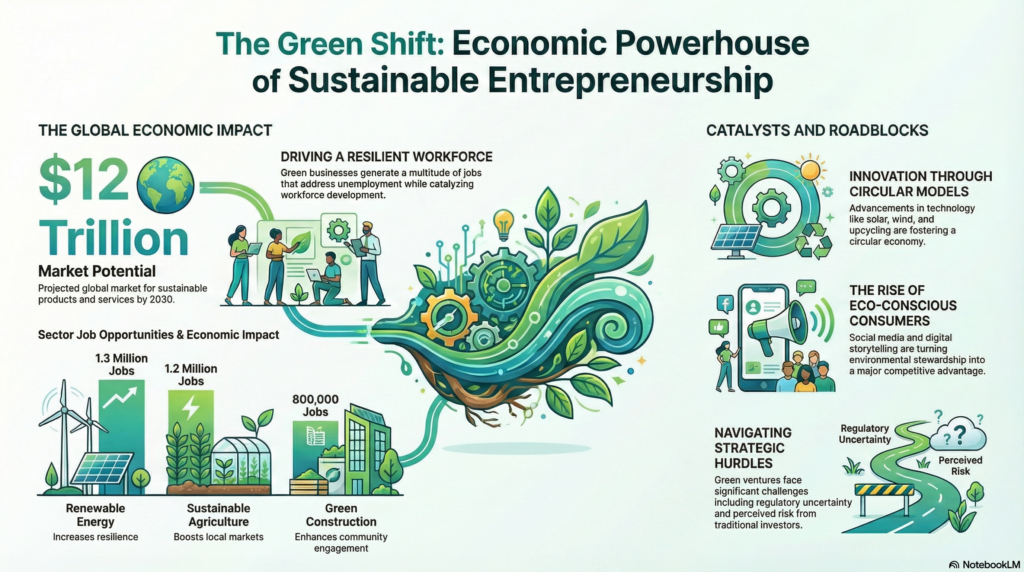
The burgeoning sector of environmentally conscious enterprises has shown remarkable potential for job creation, profoundly impacting local and national economies. As green businesses flourish, they generate a multitude of job opportunities that not only address unemployment but also catalyze workforce development. These sustainable careers often focus on enhancing the environmental impact of various industries, thereby fostering economic resilience.
The integration of entrepreneurial education and the demand for green skills are crucial in shaping a capable workforce. Community engagement plays an essential role in promoting awareness and participation in these initiatives, further bolstered by effective policy support. Additionally, as markets expand to accommodate eco-friendly products and services, the potential for job growth continues to rise.
| Sector | Job Opportunities | Impact on Economy |
| Renewable Energy | 1.3 million | Increases resilience |
| Sustainable Agriculture | 1.2 million | Boosts local markets |
| Green Construction | 800,000 | Enhances community engagement |
| Waste Management | 600,000 | Reduces environmental impact |
| Eco-Tourism | 500,000 | Promotes market expansion |
Sustainable Investment Growth
A business is the activity of buying and selling goods and services to make a profit (i.e., having an income or revenue that is greater than costs). All businesses must be financially viable. Without this basic pre-condition they cannot sustain themselves, pay their staff, and continue to produce products or offer services to the market. Some businesses ONLY care about this. Or they may only care about their staff’s well-being or their environmental impact where it affects their production, reputation, and sales, and therefore, their profits. As job opportunities in environmentally focused sectors expand, so too does the landscape of sustainable investment, reflecting a growing recognition of the economic advantages associated with green businesses. Sustainable finance is increasingly becoming a cornerstone of investment strategies, as more investors seek to align their portfolios with ethical values while pursuing financial returns. This shift is evident in the rise of impact investing, where capital is directed toward projects that not only promise profitability but also generate positive social and environmental outcomes.
The economic impact of green businesses is profound, as they stimulate innovation and create sustainable job opportunities, driving local economies while addressing global challenges such as climate change and resource depletion. Investors are recognizing that sustainable enterprises often demonstrate resilience and adaptability, positioning themselves favorably in an ever-evolving market landscape.
Moreover, the increasing demand for transparency and accountability in investing is fostering a culture in which environmental, social, and governance (ESG) criteria are prioritized. As sustainable investment continues to grow, it underscores a transformative shift in how capital is allocated, paving the way for a more sustainable and equitable global economy.
Innovation in Technologies
Driving forward the evolution of economic models, innovation in technologies is reshaping the landscape of green businesses. As the world increasingly turns to renewable energy sources, advancements in green technology are pivotal in reducing carbon footprints and fostering sustainable practices. Innovations such as solar panels and wind turbines not only contribute to cleaner energy but also create new industries centered around clean transportation and energy-efficient solutions.
The circular economy is gaining momentum, with businesses leveraging technology to enhance waste reduction and promote ethical sourcing. For instance, eco-friendly packaging solutions are emerging as key components in minimizing environmental impact while meeting consumer demand for sustainability. In agriculture, technologies in sustainable practices are optimizing resource use, improving yields, and reducing chemical dependency.
Moreover, proactive environmental policies are catalyzing innovation, encouraging businesses to adopt practices that align with ecological preservation. This synergy between technology and sustainability not only drives economic growth but also empowers entrepreneurs to pioneer solutions that resonate with the values of a freedom-seeking audience. Ultimately, the intersection of innovation and green entrepreneurship is not merely a trend; it is a transformative force redefining our global economy.
Innovations Driving Sustainable Practices
Emerging technologies and innovative practices are reshaping the landscape of sustainable entrepreneurship, offering new avenues for businesses to minimize their environmental impact. One significant advancement is the integration of renewable energy sources, such as solar and wind, which empowers enterprises to reduce their carbon footprint and reliance on fossil fuels. This shift not only aligns with global environmental policies but also enhances energy independence.
In parallel, the rise of green technology fosters a circular economy, encouraging businesses to rethink their production processes. By focusing on waste reduction and resource efficiency, companies can design products for longevity and recyclability. For instance, eco-friendly packaging solutions are gaining traction, replacing conventional materials with biodegradable or compostable alternatives, thereby diminishing plastic waste.
Sustainable agriculture is another critical innovation, where practices like vertical farming and permaculture promote ethical sourcing and local food systems. These approaches not only mitigate environmental degradation but also foster community engagement, connecting consumers with the origins of their food.
Additionally, businesses are increasingly adopting transparent supply chains, ensuring ethical sourcing practices that resonate with conscious consumers. This commitment to sustainability cultivates brand loyalty and enhances corporate responsibility.
Ultimately, innovations driving sustainable practices are not merely trends but essential components of a resilient economic model. As green entrepreneurs continue to pioneer these solutions, they pave the way for a more sustainable future, fostering a culture that prioritizes environmental stewardship while promoting freedom of choice for consumers.

CONSUMER TRENDS TOWARDS SUSTAINABILITY
In the world of strategy, we often talk about “disruptive innovation.” Today, that disruption is green. I’ve always believed that the most effective environmental solutions are those that are strategically sound optimizing resource loops while driving economic performance. When we look at job creation, for instance, the data is staggering. We aren’t just talking about a few “niche” roles; we are seeing millions of opportunities across renewable energy, sustainable agriculture, and green construction. These aren’t just jobs; they are the foundation of a new, resilient workforce.
However, as a strategist, I have to be candid about the hurdles. It isn’t all smooth sailing. Green entrepreneurs face significant regulatory uncertainty and a “perceived risk” from traditional investors who might not yet see the long-term value in circular models. I often advise businesses to look at external environmental orientation responding to stakeholder and regulatory pressures as a catalyst for green innovation performance.
Whether it’s solar startups lowering energy costs or waste management firms like Rubicon Global using data to reduce landfill reliance, the proof is in the profitability. Success in this space requires a unique mindset: one that prioritizes long-term resilience over the “quick exit” culture of traditional startups.
As consumer awareness of environmental issues grows, the rise of eco-conscious consumers is shaping market dynamics and driving demand for sustainable products. This shift is further amplified by the influence of social media, which enables consumers to share their values and preferences more widely than ever before. Understanding these trends is essential for businesses aiming to align with a more sustainable future while meeting the evolving expectations of their customers.
Rise of Eco-Conscious Consumers
The rise of eco-conscious consumers marks a significant shift in modern market dynamics, reflecting a growing awareness of environmental issues and a desire for sustainable practices. This demographic is increasingly prioritizing brands that embrace ethical production and sustainable sourcing, thereby demanding transparency in how products are made and delivered. As a result, companies are adopting green marketing strategies that highlight their commitment to eco-friendly packaging and renewable resources.
This trend is driven by a heightened commitment to conscious consumption, where consumers actively seek to minimize their carbon footprint and engage in waste reduction efforts. Environmental education plays an essential role in shaping these preferences, empowering individuals to make informed choices that align with their values.
Key characteristics of the rise of eco-conscious consumers include:
- Preference for brands utilizing eco-friendly packaging
- Support for companies practicing sustainable sourcing and ethical production
- Engagement in the circular economy to reduce waste
- Active participation in initiatives promoting renewable resources
- Advocacy for green marketing that resonates with their values
In this evolving landscape, businesses that embrace these consumer trends are poised for success, fostering a more sustainable future.
Demand for Sustainable Products
Entrepreneurs can be a significant driving force behind efforts to lower GHG emissions through their capacity to develop and propagate innovative green solutions. However, green entrepreneurs face a number of obstacles including long development timelines for clean technologies, regulatory uncertainly and difficulties connecting with industrial and research partners. There is a strong policy rationale for providing specialised supports, including dedicated financial instruments and incubation and accelerator programmes.
Amidst the growing emphasis on sustainability, the demand for sustainable products has surged, reflecting a decisive shift in consumer behavior. Today’s consumers increasingly prioritize eco-friendly materials and ethical sourcing, favoring brands that align with their values. This trend is not merely a passing phase; it signifies an evolution in the way individuals perceive their purchasing power and its impact on the environment.
As awareness of climate change and environmental degradation intensifies, consumers are becoming more discerning about the origins of the products they buy. They actively seek goods made from renewable resources and those that minimize carbon footprints. This heightened demand has prompted businesses to innovate, incorporating sustainable practices into their supply chains. Companies are now investing in eco-friendly materials, such as organic textiles and biodegradable packaging, to cater to this conscious consumer base.
Moreover, ethical sourcing practices are becoming integral to brand identity. Consumers are increasingly scrutinizing the social and environmental implications of their purchases, advocating for transparency and accountability. This transformative shift represents not only a market opportunity for green entrepreneurs but also a chance to cultivate a more sustainable global economy, where consumer choices drive meaningful change.
Influence of Social Media
Social media has emerged as a powerful catalyst in shaping consumer trends towards sustainability, amplifying the call for eco-conscious practices among brands. The interplay between social media influence and sustainable consumerism is increasingly evident, with brands harnessing innovative digital marketing strategies to engage their audiences. Through compelling brand storytelling and influencer partnerships, companies can effectively communicate their commitment to sustainability, thereby fostering deeper consumer engagement.
The rise of online community building around sustainable practices has given consumers a platform to share their values, creating a sense of belonging. This dynamic environment encourages viral campaigns that spotlight eco friendly products and sustainable practices, expanding audience awareness and reinforcing responsible consumer behavior.
Key aspects of social media’s impact on sustainability include:
- Content creation that resonates with eco-conscious values.
- Influencer partnerships that amplify authentic messages.
- Viral campaigns that inspire collective action.
- Digital marketing strategies tailored to highlight sustainability.
- Platform utilization to connect with like-minded consumers.
As brands adapt to these trends, they not only enhance their reputation but also contribute to a larger movement towards a sustainable future, aligning their objectives with the values of a growing consumer base.
Challenges Faced by Green Entrepreneurs
Frequently, green entrepreneurs encounter a unique set of challenges that can hinder their efforts to establish sustainable businesses. One of the most significant obstacles is regulatory hurdles, which can vary widely across regions and industries. Maneuvering through these regulations often requires extensive time and resources, diverting attention from core business activities. Coupled with funding challenges, many green ventures struggle to secure the necessary capital, as traditional investors may be wary of the perceived risks associated with sustainability-focused initiatives.
Market competition further complicates the landscape for green entrepreneurs. As the demand for eco-friendly products grows, so too does the influx of competitors, often leading to consumer skepticism regarding the authenticity of green claims. This skepticism can amplify awareness gaps, where potential customers are unaware of the benefits of choosing sustainable options.
Furthermore, scalability issues can arise when green entrepreneurs attempt to expand their operations. Complex supply chain dynamics may present additional hurdles, making it difficult to maintain sustainable practices while meeting increased demand. Profitability concerns also loom large; many green businesses face pressure to balance eco-conscious practices with financial viability.
To overcome these challenges, green entrepreneurs often require robust policy support and educational resources that promote sustainability. Addressing education needs within the market can cultivate a more informed consumer base, ultimately fostering a more favorable environment for green entrepreneurship to thrive. In this ever-evolving landscape, resilience and innovation are key to maneuvering through the intricate challenges faced by those committed to transforming the global economy through sustainable practices.
Case Studies of Successful Ventures
While many green entrepreneurs face considerable challenges in the pursuit of sustainability, numerous case studies illustrate that success is not only possible but increasingly attainable. Take, for instance, the rise of solar startups that have revolutionized the way communities harness renewable energy. Companies like Sunrun and SolarCity have not only made solar technology more accessible but have also created thousands of jobs in the process. Their innovative business models have demonstrated that profitability and environmental responsibility can coexist.
In the sector of waste management, ventures like Rubicon Global showcase how technology can transform traditional practices. By leveraging data analytics and software solutions, Rubicon helps businesses optimize their waste disposal processes, reducing costs while promoting sustainability. This model underscores the potential for profit in the often-overlooked waste sector.
Moreover, companies like TerraCycle have built their brand around the concept of upcycling, turning waste into a valuable resource. Their successful partnerships with major brands exemplify how corporate responsibility can drive both innovation and consumer loyalty.
Here are some notable insights from these successful ventures:
- Solar startups have considerably lowered energy costs for consumers.
- Waste management innovations can lead to reduced landfill reliance.
- Upcycling initiatives enhance brand value and customer engagement.
- Green entrepreneurship fosters job creation in emerging sectors.
- Collaboration between businesses and communities accelerates sustainable practices.
These case studies not only inspire future entrepreneurs but also highlight the transformative power of green entrepreneurship in shaping a more sustainable global economy.
Future of Green Entrepreneurship
The future of green entrepreneurship is poised for substantial growth, with projections indicating that the global market for sustainable products and services could exceed $12 trillion by 2030. This burgeoning green economy is being driven by an entrepreneurial mindset that embraces innovative sustainable practices, aiming not only to capitalize on market disruption but also to address pressing environmental challenges.
As businesses increasingly prioritize ethical sourcing and community engagement, the dialogue surrounding regulatory frameworks that encourage sustainable entrepreneurship is evolving. Governments worldwide are recognizing the need to support green initiatives, thereby creating funding opportunities that empower aspiring entrepreneurs to launch ventures that have a lasting environmental impact. This shift not only bolsters the economy but also fosters a circular economy where products are designed for longevity and recyclability.
Moreover, the rise of green entrepreneurship signals a shift in consumer behavior, with individuals becoming more conscious of their purchasing decisions. This demand for sustainable options fuels further innovation, pushing established companies to adapt or face obsolescence. Collaborative efforts among entrepreneurs, investors, and local communities can enhance the potential for transformative change, leading to thriving ecosystems that prioritize sustainability.

RELATED STUDIES ABOUT GREEN ENTREPRENEURSHIP
To summarize, green entrepreneurship represents a pivotal shift in the global economy, intertwining environmental sustainability with economic growth. As innovative practices and consumer preferences align, the potential for transformative change becomes increasingly evident. While challenges persist, the success stories of pioneering ventures illuminate pathways for future entrepreneurs. This confluence of sustainability and commerce not only fosters a healthier planet but also promises a resilient economy, ultimately redefining the very fabric of modern business landscapes.
Empowering Green Entrepreneurship Through Education: The Role Of Self-Efficacy, Financial Security, And Gender Among Ghanaian University Students
Objective: This study investigates how entrepreneurship education (EntEd) influences green entrepreneurial intentions (GrEI) among Ghanaian university students. It focuses on the mediating role of entrepreneurial self-efficacy (EntSE) and the moderating effects of gender and perceived financial security (PFS).
Methodology:
- Sample: 747 university students from multiple institutions in Ghana, collected via an online questionnaire (convenience sampling).
- Analysis: Partial Least Squares Structural Equation Modelling (PLS-SEM) was used to test the hypothesized relationships, including mediation and moderation effects.
- Key Variables:
- Independent: Entrepreneurship Education (EntEd)
- Mediator: Entrepreneurial Self-Efficacy (EntSE)
- Dependent: Green Entrepreneurial Intentions (GrEI)
- Moderators: Perceived Financial Security (PFS) and Gender.
Key Findings:
- Direct & Mediating Effects: Entrepreneurship education (EntEd) has a strong, positive direct effect on both entrepreneurial self-efficacy (EntSE) and green entrepreneurial intentions (GrEI). Furthermore, EntSE partially mediates the relationship between EntEd and GrEI, meaning education boosts green intentions partly by enhancing students’ belief in their entrepreneurial capabilities.
- Moderating Role of Financial Security (PFS): Perceived Financial Security significantly moderates the relationships. The positive effects of EntEd on both EntSE and GrEI are stronger for students who feel more financially secure. PFS also strengthens the indirect effect of EntEd on GrEI through EntSE.
- Role of Gender: No statistically significant gender differences were found in the core relationships (EntEd → EntSE, EntEd → GrEI, or the mediation path via EntSE). This suggests entrepreneurship education impacts both male and female students’ green intentions and self-efficacy similarly.
- Gendered Financial Perception: A notable difference emerged regarding PFS: its positive effect on GrEI was significant for male students but not for female students. This indicates that financial security perceptions influence entrepreneurial intentions differently based on gender.
Conclusions & Implications:
- Theoretical: The study supports and extends the Theory of Planned Behaviour and Social Cognitive Theory by validating their application in the context of green entrepreneurship. It innovatively introduces PFS as a key moderating variable.
- Practical:
- For Educators & Universities: Entrepreneurship curricula should be action-oriented, integrate financial literacy, and provide hands-on experiences to build self-efficacy. Creating supportive ecosystems (e.g., incubators, partnerships) is crucial.
- For Policymakers: Policies should prioritize comprehensive entrepreneurship education and implement financial support mechanisms (e.g., grants, loans) to alleviate perceived financial insecurity, especially for aspiring green entrepreneurs.
- Gender Considerations: While core educational impacts are similar, tailored support addressing gendered differences in financial perceptions and barriers (e.g., through targeted mentorship and networking for female students) is recommended.
Limitations & Future Research:
- The cross-sectional design limits causal inferences, and the Ghanaian student sample may affect generalizability.
- Future research should employ longitudinal designs, include more diverse gender identities, use objective financial measures, and explore sector-specific barriers to green entrepreneurship.
In summary, this research underscores that effective entrepreneurship education, combined with efforts to bolster students’ self-efficacy and financial security perceptions, is vital for fostering the next generation of green entrepreneurs in Ghana, with nuanced considerations for gender dynamics.
| REFERENCE: Harrison Paul Adjimah, Joan-Ark Manu Agyapong, Martin Kwasi Abiemo, Ernest Edem Tulasi, Empowering green entrepreneurship through education: The role of self-efficacy, financial security, and gender among Ghanaian university students, Sustainable Futures, Volume 10, 2025, 101436, ISSN 2666-1888, https://doi.org/10.1016/j.sftr.2025.101436. (https://www.sciencedirect.com/science/article/pii/S2666188825009979) |
Green Impact: Unveiling The Influence Of Social And Environmental Values On Sustainable Entrepreneurship Within Regulatory Boundaries
Objective: This study investigates how social entrepreneurship orientation (SEO) and environmental orientation (EO) influence sustainability outcomes—specifically social performance and green innovation performance (GIP)—in firms within an emerging economy. It also examines the critical moderating role of regulatory forces in these relationships, using Ecuador as the empirical context.
Methodology:
- Sample: 474 firms across multiple sectors (e.g., trade, manufacturing, services) in Ecuador.
- Analysis: Partial Least Squares Structural Equation Modelling (PLS-SEM) and hierarchical regression analysis were employed to test the hypothesized relationships.
- Key Variables:
- Independent: Dimensions of SEO (Social Innovativeness, Social Risk-Taking, Socialness, Social Proactiveness) and EO (Internal and External).
- Dependent: Social Performance and Green Innovation Performance (GIP).
- Moderator/Influence: Regulatory Forces.
Key Findings:
- Social Entrepreneurship Orientation (SEO): Among the four SEO dimensions, “Socialness” (the centrality of the social mission in strategy) was the strongest and most consistent positive predictor of a firm’s social performance. The other dimensions (social innovativeness, risk-taking, proactiveness) showed weaker or insignificant effects.
- Environmental Orientation (EO): Only the external dimension of EO (responsiveness to stakeholder and regulatory pressures) had a significant positive influence on Green Innovation Performance (GIP). The internal dimension (value-driven, intrinsic commitment) did not show a significant effect.
- Regulatory Forces: Regulatory frameworks were found to be powerful institutional drivers. They had a direct, positive influence on both social performance and GIP. The findings suggest that in Ecuador’s context, compliance and external pressures are key catalysts for sustainable practices.
- Interconnected Outcomes: Social performance positively influences GIP, indicating that firms performing well socially are also more likely to succeed in green innovation, reinforcing the synergy between social and environmental goals in sustainable entrepreneurship.
Conclusions & Implications:
- Theoretical: The study integrates SEO and EO within an institutional framework, demonstrating their distinct roles and highlighting the paramount importance of regulatory forces in shaping sustainability outcomes in emerging markets. It extends theory by applying it to Ecuador’s unique context, which constitutionally recognizes the “Rights of Nature.”
- Practical:
- For Managers & Firms: To enhance social impact, firms should deeply embed their social mission (“socialness”) into core strategy and governance. To drive green innovation, managers must actively monitor and respond to external stakeholder and regulatory pressures (external EO), for example through certifications and green supply chain management.
- For Policymakers: The study confirms that robust and well-enforced regulatory frameworks are effective tools for promoting both social and environmental performance. Policymakers should strengthen regulations while also providing targeted support (e.g., incentives, financing, compliance assistance) to help firms, especially SMEs, adopt sustainable practices.
Limitations & Future Research:
- The cross-sectional design limits causal inferences.
- The use of self-reported data may introduce bias.
- The Ecuadorian context, while rich, may limit generalizability.
- Future research should employ longitudinal designs, explore sector-specific dynamics, and investigate the role of national culture in shaping these orientations and outcomes.
In summary, this research demonstrates that in emerging economies like Ecuador, a firm’s social mission centrality, its responsiveness to external environmental pressures, and the strength of the regulatory environment are pivotal drivers for achieving both social good and green innovation. It provides a blueprint for aligning entrepreneurial strategy with institutional forces to foster sustainable development.
| REFERENCE: Hasnan Baber, Paul Sarango-Lalangui, Rayan Merkbawi, Hajar Fatorachian, Jamal Maalouf, Green impact: Unveiling the influence of social and environmental values on sustainable entrepreneurship within regulatory boundaries, Sustainable Technology and Entrepreneurship, Volume 5, Issue 1, 2026, 100121, ISSN 2773-0328, https://doi.org/10.1016/j.stae.2025.100121. (https://www.sciencedirect.com/science/article/pii/S2773032825000264) |
Eco-Innovation And Green Entrepreneurship: Transforming Challenges Into Opportunities For The Environment
Objective: This study investigates the impact of eco-innovation and green entrepreneurial orientation (GEO) on environmental awareness and sustainability practices among engineering students in Indonesia, and how these factors, in turn, influence the development of green business strategies.
Methodology:
- Sample: 283 engineering students from Universitas Muhammadiyah Jakarta, Indonesia.
- Analysis: Structural Equation Modeling using Partial Least Squares (SEM-PLS) was employed to test direct and indirect (mediating) relationships.
- Key Variables:
- Independent: Eco-Innovation, Green Entrepreneurial Orientation (GEO)
- Mediators: Environmental Awareness, Sustainability Practices
- Dependent: Green Business Strategies
Key Findings:
- Direct Effects:
- Eco-innovation and GEO both have significant positive effects on environmental awareness and sustainability practices.
- Environmental awareness has a strong, positive impact on green business strategies.
- Sustainability practices do not have a statistically significant direct effect on green business strategies.
- Mediating Effects:
- Environmental awareness successfully mediates the relationships. It is a significant pathway through which both eco-innovation and GEO influence the formulation of green business strategies.
- Sustainability practices do not act as a significant mediator between eco-innovation/GEO and green business strategies.
Conclusions & Implications:
- For Educators & Policymakers: The findings underscore the critical importance of integrating eco-innovation and green entrepreneurial orientation into engineering curricula. Fostering environmental awareness is a key mechanism for translating technical knowledge and entrepreneurial intent into actionable green business plans. Simply teaching sustainability practices is insufficient; education must focus on building a deep environmental consciousness and show how it directly connects to business strategy.
- Theoretical: The study contributes to the literature by testing a comprehensive model in the underexplored context of Indonesian engineering students. It highlights the pivotal mediating role of environmental awareness, a relationship less emphasized in prior research.
- Practical Gap Identified: The non-significant role of sustainability practices as a mediator points to a potential gap between students’ knowledge of sustainable practices and their ability to strategically apply them in a business context. This suggests a need for more experiential, hands-on learning in green entrepreneurship.
Limitations & Future Research:
- The study is limited to engineering students at one Indonesian university, which may affect generalizability.
- The cross-sectional design and reliance on self-reported data are acknowledged limitations.
- Future research should employ longitudinal designs, include students from other disciplines and regions, and investigate practical methods to bridge the gap between sustainability knowledge and strategic business application.
In summary, this research demonstrates that to cultivate innovative green entrepreneurs among engineering students, educational programs must strategically combine technical eco-innovation, a green entrepreneurial mindset, and—most crucially—a deep cultivation of environmental awareness to effectively channel these elements into viable green business strategies.
| REFERENCE: Leola Dewiyani, Arita Marini, Gusti Yarmi, Nelfiyanti, Dwi Atmanto, Sardi Salim, Desy Safitri, Parulian Irwansyah, Musril Zahari, Rezeqi Hardam Saputro, Asep Marfu, Eco-innovation and green entrepreneurship: Transforming challenges into opportunities for the environment, Cleaner Environmental Systems,Volume 19, 2025,100345, ISSN 2666-7894, https://doi.org/10.1016/j.cesys.2025.100345. (https://www.sciencedirect.com/science/article/pii/S2666789425000911) |
CONCLUSION
As we look toward a future where the market for sustainable products is projected to exceed $10 trillion by 2030, the message is clear: sustainability is no longer a luxury, it is the baseline. My work has taught me that we cannot simply “teach” sustainability practices and expect change; we have to foster a deep environmental awareness that connects directly to business strategy. We need to bridge the gap between technical knowledge and strategic application, ensuring that the next generation of entrepreneurs in places like Ghana or Indonesia has both the self-efficacy and the financial security to innovate.
Ultimately, green entrepreneurship is about freedom of choice for the consumer and the empowerment of the creator. Through social media and digital storytelling, we are building communities that demand transparency and ethical sourcing as a standard, not a bonus. As I see it, the intersection of innovation and green entrepreneurship is a transformative force that is redefining the fabric of modern business.
It’s a challenging path, requiring immense energy and resilience, but it’s the only path that leads to a healthier planet and a truly resilient global economy. Let’s continue to push for the economic incentives that drive this vital environmental innovation.