
When I first transitioned from the lecture halls of Stanford to the high-stakes environment of municipal policy consulting, I carried a somewhat idealistic view of how “green” a city could become. Over twelve years later, I have learned that environmental policy is the invisible infrastructure that dictates the quality of every breath we take and every drop of water we use. We often view “policy” as a dry collection of legislative text, but in reality, it is a living blueprint for urban survival. In my experience, the most transformative changes don’t just happen because of a new law; they happen because we’ve successfully translated a complex carbon reduction framework into an actionable strategy that a local neighborhood can actually implement.
As I look at the current landscape of urban planning, it’s clear that we are at a crossroads. We are seeing a shift where environmental sustainability is no longer a “nice-to-have” luxury for wealthy districts, but a fundamental requirement for economic resilience.
Whether it’s integrating smart waste management to curb landfill overflow or drafting regulations for eco-friendly building standards, these policies are the tools we use to build cities that can withstand the pressures of a changing climate. It’s a challenging field often bogged down by political games but it is the only way to ensure our urban centers remain livable for the next generation.
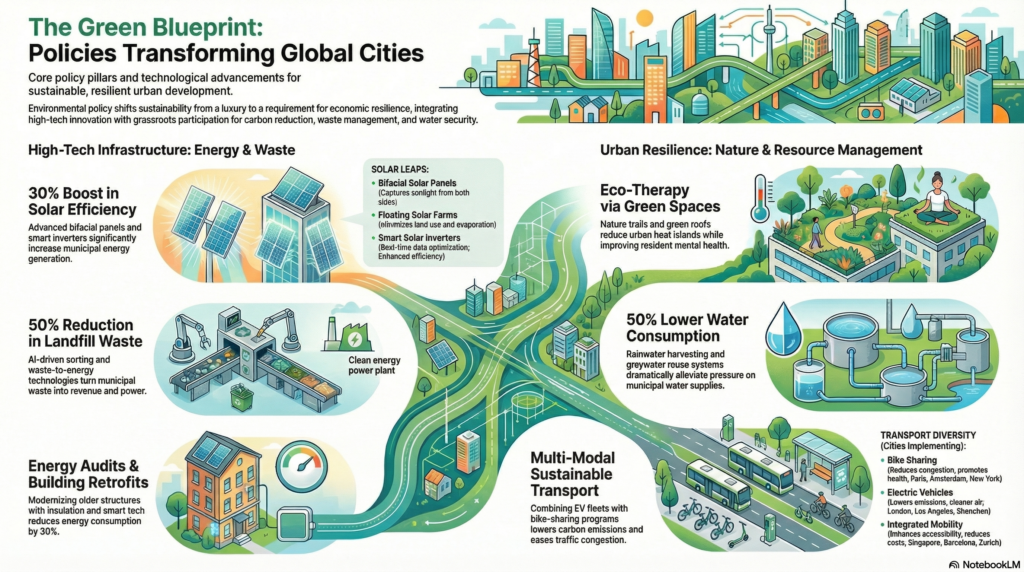
Environmental policies are reshaping cities globally by fostering sustainability and enhancing urban life. Initiatives like urban green spaces improve mental health and promote biodiversity, while renewable energy programs additionally reduce carbon footprints and boost local economies. Smart waste management reduces landfill waste through innovative recycling technologies and waste-to-energy solutions, promoting a circular economy. Sustainable transportation systems, including bike-sharing and electric vehicles, lower emissions and traffic congestion. Moreover, eco-friendly building regulations guarantee energy efficiency and attract investment. Together, these policies demonstrate a commitment to creating resilient cities. Exploring these transformative strategies reveals more opportunities for sustainable urban development.
KEY TAKEAWAYS
- Urban green spaces enhance health and community culture, promoting eco therapy and reducing urban heat islands through parks and nature trails.
- Renewable energy initiatives, particularly solar and wind, drive urban sustainability and energy independence while reducing carbon emissions.
- Smart waste management technologies, such as AI sorting and waste-to-energy solutions, significantly decrease landfill waste and promote a circular economy.
- Innovative recycling methods and smart collection systems improve efficiency and sustainability, empowering cities to better manage increasing waste from growing populations.
- Sustainable transportation solutions, including bike-sharing and electric vehicles, reduce fossil fuel reliance and greenhouse gas emissions, contributing to cleaner urban environments.
URBAN GREEN SPACES
How can urban green spaces be leveraged to enhance the quality of life in rapidly growing cities? The integration of urban gardening, green roofs, and community parks is vital in transforming concrete jungles into vibrant ecosystems. Research indicates that access to green spaces can improve physical and mental health, making eco therapy a viable strategy for urban wellness. These spaces serve as biodiversity corridors, enabling urban wildlife to thrive and fostering ecological resilience.
Nature trails and tree canopies not only provide aesthetic value but also play an important role in climate moderation, reducing urban heat islands and improving air quality. A study by the American Public Health Association highlights that individuals living near green spaces report lower stress levels and enhanced overall well-being.
Moreover, community parks can serve as venues for public art, enriching the cultural fabric of neighborhoods while promoting outdoor education. Initiatives that encourage community involvement in the design and maintenance of these areas empower residents, cultivating a sense of ownership and belonging.
Renewable Energy Initiatives
Renewable energy initiatives are essential for urban sustainability, with solar power advancements and wind energy integration playing pivotal roles in reducing carbon emissions. The implementation of these technologies not only contributes to cleaner energy production but also enhances urban energy efficiency, as cities seek to meet growing energy demands while minimizing environmental impact. By investing in these renewable solutions, cities can achieve long-term economic benefits and resilience against climate change. By encouraging residents and businesses to go green through the adoption of renewable energy technologies, cities can significantly reduce carbon emissions while strengthening long-term energy independence.
Solar Power Advancements
Amidst the pressing need for sustainable energy solutions, solar power advancements have emerged as a pivotal element in renewable energy initiatives aimed at transforming urban landscapes. The latest developments in solar panel technology and photovoltaic innovations are not merely enhancing energy efficiency but are also paving the way for cities to achieve energy autonomy. By harnessing the sun’s abundant energy, urban centers can reduce their carbon footprints and foster a sense of freedom from traditional fossil fuels.
The following table highlights key advancements in solar power technology:
| Technology | Description | Impact |
| Bifacial Solar Panels | Capture sunlight from both sides | Increased energy generation by up to 30% |
| Thin-Film Solar Cells | Lightweight and flexible solar panels | Greater installation versatility |
| Floating Solar Farms | Solar installations on water bodies | Minimizes land use and evaporation |
| Smart Solar Inverters | Optimize energy production with real-time data | Enhanced efficiency and grid integration |
These innovations not only empower cities to harness renewable energy but also inspire a commitment to sustainability, ultimately leading to a more liberated and resilient future.
Wind Energy Integration
As urban centers embrace solar power advancements to enhance their energy efficiency, the integration of wind energy emerges as another crucial component of thorough renewable energy initiatives. Wind energy, particularly through wind farm development, presents a powerful opportunity to diversify urban energy sources, reduce greenhouse gas emissions, and decrease reliance on fossil fuels.
The growing adoption of offshore wind technology illustrates this potential. Offshore wind farms harness more consistent and robust wind speeds than their land-based counterparts, enabling cities to generate significant amounts of clean energy. Data from the Global Wind Energy Council indicates that offshore wind capacity has surged over 20% annually, underscoring its critical role in meeting future energy demands.
Moreover, cities that invest in wind energy not only advance environmental sustainability but also stimulate local economies by creating jobs in manufacturing, installation, and maintenance. This shift towards renewable energy aligns with the desires of populations seeking freedom from the volatility of fossil fuel markets. By prioritizing wind energy integration, urban centers can build resilient energy systems that empower communities, foster innovation, and pave the way for a sustainable future.
Urban Energy Efficiency
In the quest for sustainable urban development, enhancing energy efficiency has emerged as a pivotal strategy for cities aiming to reduce their carbon footprints and optimize resource utilization. Urban energy efficiency initiatives not only lower greenhouse gas emissions but also promote economic resilience and social equity. Key measures include:
- Energy Audits: Conducting thorough energy audits allows municipalities to identify inefficiencies in existing buildings and infrastructure. This data-driven approach facilitates informed decision-making regarding necessary upgrades.
- Building Retrofits: Upgrading older structures through building retrofits greatly improves energy performance. By incorporating advanced insulation, energy-efficient lighting, and smart technologies, cities can dramatically lower energy consumption and enhance occupant comfort.
- Incentive Programs: Implementing financial incentives for energy-efficient upgrades encourages property owners and businesses to invest in sustainable practices. These programs can stimulate local economies while contributing to broader environmental goals.
As cities worldwide embrace these strategies, the ripple effects can be profound. Not only do they empower communities to take control of their energy use, but they also pave the way for a cleaner, more sustainable urban future. Enabling freedom through energy independence, cities can thrive in harmony with their environments.
Smart Waste Management
In my work as a policy analyst, I’ve found that the “renewable energy” or “green space” sections of a city plan are often the most debated because they require a complete rethink of how we allocate urban resources. For instance, when we talk about solar power advancements or wind energy, we aren’t just talking about panels and turbines; we are talking about energy independence and the freedom from volatile fossil fuel markets. I’ve seen firsthand how bifacial solar panels and smart inverters can transform a municipal grid, increasing energy generation by up to 30% and allowing a city to effectively “pay for itself” over time.
However, the technical side is only half the battle. The real magic happens when we engage the community. I’ve sat in countless public forums where residents were initially skeptical of new water conservation measures like rainwater harvesting or greywater reuse. But once you show the data how these systems can reduce municipal water consumption by 50% the conversation shifts from “why should we do this?” to “how soon can we start?”. This same principle applies to smart waste management. Using AI for advanced sorting or converting organic waste into biogas via anaerobic digestion isn’t just about being “green”; it’s about creating a circular economy that reduces operational costs and empowers citizens to go green in their daily lives. It is this intersection of high-tech innovation and grassroots participation that truly drives environmental sustainability.
Smart waste management is revolutionizing urban environments through the integration of innovative recycling technologies, waste-to-energy solutions, and intelligent collection systems. According to recent data, cities that adopt these strategies can reduce landfill waste by up to 50%, while simultaneously generating energy and revenue. As municipalities face increasing pressure to improve sustainability, embracing these advancements is not just beneficial, but essential for future urban resilience.
Environmental policy and law should work cohesively in addressing these issues. Effective, coherent and forward-thinking environmental policies are indispensable building blocks to an effective environmental governance system that advances progress towards sustainable development, ensures a healthy environment for present and future generations and makes global environmental goals and commitments a reality.
Innovative Recycling Technologies
Revolutionizing the way we approach waste management, innovative recycling technologies are at the forefront of creating sustainable urban environments. These advancements not only reduce landfill contributions but also promote a circular economy where materials are continuously repurposed. The integration of cutting-edge recycling technologies is vital for cities aiming to enhance their sustainability goals.
- Advanced Sorting: Utilizing artificial intelligence and machine learning, advanced sorting systems can efficiently identify and separate recyclables with remarkable accuracy. This precision minimizes contamination and optimizes recycling processes.
- Composting Techniques: Modern composting technologies transform organic waste into nutrient-rich soil amendments. Techniques such as anaerobic digestion not only divert waste from landfills but also produce biogas, which can be harnessed for energy, further contributing to sustainability.
- Smart Waste Bins: Equipped with sensors, these bins provide real-time data on waste levels, enabling efficient collection routes and schedules. Such innovations reduce operational costs while enhancing waste management efficiency.
As urban populations surge, embracing these innovative recycling technologies is essential. They empower cities to reclaim resources, reduce environmental impact, and foster a culture of sustainability, thereby affording citizens the freedom to thrive in cleaner, greener environments.

WASTE-TO-ENERGY SOLUTIONS
Waste-to-energy solutions represent a pivotal advancement in smart waste management, converting municipal solid waste into usable energy through various technologies. These solutions not only mitigate the pressing issue of landfill overflow but also harness energy, reducing reliance on fossil fuels. Incineration technologies, a predominant method in this domain, involve the combustion of waste to generate electricity and heat, effectively transforming trash into a valuable resource. Environmental policy, any measure by a government or corporation or other public or private organization regarding the effects of human activities on the environment, particularly those measures that are designed to prevent or reduce harmful effects of human activities on ecosystems.
Data from the World Bank indicates that approximately 2.01 billion tons of municipal solid waste are generated annually, with projections escalating to 3.4 billion tons by 2050. This alarming trend underscores the urgency of adopting waste-to-energy systems. Additionally, biomass conversion—utilizing organic materials such as agricultural residues—offers an alternative route to energy generation, fostering sustainability by utilizing resources that would otherwise decompose.
Investing in waste-to-energy infrastructure not only enhances energy independence but also contributes to local economies through job creation and technological innovation. By prioritizing these solutions, cities can embrace a more liberated, sustainable future, where waste is not merely discarded but transformed into a catalyst for energy and growth. As urban populations expand, the need for effective waste-to-energy strategies becomes increasingly critical.
Smart Collection Systems
The integration of intelligent collection systems represents a noteworthy advancement in urban waste management, optimizing the efficiency of waste collection processes. By leveraging data analytics and automated sorting technologies, cities are transforming how they manage waste, ultimately promoting sustainability and enhancing public health.
Key benefits of smart collection systems include:
- Enhanced Efficiency: Utilizing real-time data analytics allows waste management companies to schedule pickups based on actual container fill levels, reducing unnecessary trips and fuel consumption.
- Resource Optimization: Automated sorting technologies can remarkably improve recycling rates by efficiently separating recyclables from general waste, thereby minimizing landfill contributions.
- Cost Reduction: Cities adopting smart systems often see a decrease in operational costs, as optimized routes and reduced labor requirements lead to substantial savings.
In an era where urban populations are rapidly increasing, the need for efficient waste management is paramount. Smart collection systems not only elevate operational efficiency but also empower citizens to engage in sustainable practices. By embracing these innovations, cities can pave the way toward a cleaner, greener future, aligning with the growing demand for environmental responsibility and freedom from waste-related burdens.
Sustainable Transportation Solutions
In an era where urbanization and environmental sustainability are increasingly intertwined, sustainable transportation solutions emerge as a critical component of effective urban policy. Cities worldwide are recognizing that the adoption of innovative transportation methods not only reduces carbon footprints but also enhances the quality of life for residents. Two prominent solutions gaining traction are bike sharing programs and electric vehicles (EVs).
Bike sharing programs encourage cycling as a viable mode of transport, reducing reliance on fossil-fueled vehicles. They enhance urban mobility, decrease traffic congestion, and improve public health by promoting physical activity. Simultaneously, electric vehicles present a revolutionary opportunity for urban transport. By converting fleets to EVs, cities can greatly diminish greenhouse gas emissions and foster a cleaner urban atmosphere.
| Transportation Solution | Benefits | Cities Implementing |
| Bike Sharing Programs | Reduces congestion, promotes health | New York, Paris, Amsterdam |
| Electric Vehicles | Lowers emissions, improves air quality | Los Angeles, London, Shenzhen |
| Integrated Mobility Systems | Enhances accessibility, reduces costs | Barcelona, Singapore, Zurich |
| Public Transit Innovations | Increases efficiency, reduces travel time | Tokyo, Berlin, Toronto |
The integration of these sustainable transportation solutions not only reflects a commitment to environmental stewardship but also empowers individuals with the freedom to choose eco-friendly options. As cities embrace these revolutionary policies, they pave the way for a sustainable future where urban mobility aligns harmoniously with ecological integrity.
Water Conservation Policies
Addressing the multifaceted challenges of urbanization requires not only innovative transportation solutions but also a robust approach to water conservation policies. As cities grapple with increasing populations and dwindling water resources, effective water conservation measures become essential to guarantee sustainability and resilience.
Three pivotal strategies have emerged as effective frameworks for urban water management:
- Rainwater Harvesting: This method allows cities to capture and utilize rainwater, markedly reducing reliance on conventional water supplies. Studies indicate that implementing rainwater harvesting systems can decrease urban water consumption by up to 50%, thereby alleviating pressure on municipal resources.
- Greywater Reuse: By treating and repurposing greywater—wastewater from sinks, showers, and laundry—cities can recycle precious resources. This practice not only conserves fresh water but also promotes a circular economy, where water is reused for irrigation and non-potable applications, thereby enhancing overall urban sustainability.
- Public Awareness Campaigns: Educating citizens about the importance of water conservation is vital. Effective campaigns can lead to behavior change, promoting practices such as reduced water use in households and the adoption of water-efficient appliances.
Eco-Friendly Building Regulations
Sustainable architecture has emerged as a cornerstone of urban development, driven by the necessity for eco-friendly building regulations that mitigate environmental impacts and enhance energy efficiency. These regulations are increasingly informed by rigorous green building certifications, such as LEED (Leadership in Energy and Environmental Design) and BREEAM (Building Research Establishment Environmental Assessment Method), which serve not only as benchmarks for sustainability but also as incentives for developers and builders to adopt environmentally responsible practices.
The implementation of eco-friendly building regulations has shown promising results. For instance, cities adopting stringent energy efficiency standards have reported reductions in energy consumption by up to 30%, considerably lowering greenhouse gas emissions. Additionally, the integration of renewable energy sources, such as solar panels and wind turbines, into building designs has become a critical component of sustainable architecture, aligning with global efforts to combat climate change.
The economic advantages of these regulations cannot be overlooked. Buildings that meet green building certifications often enjoy increased property values and reduced operating costs, making them more attractive to investors. According to a report from the World Green Building Council, green-certified buildings can command a rental premium of 5-20% over traditional buildings, reflecting the market’s growing preference for sustainable options.
Community Engagement Programs
The advancement of eco-friendly building regulations has sparked a broader movement towards sustainability in urban planning, emphasizing the importance of community engagement programs. These initiatives foster a sense of ownership and responsibility among residents, guaranteeing that environmental policies resonate with the community’s values and needs. By actively involving citizens, cities can create more effective and equitable solutions. Environmental policies can help galvanise the green transition. However, they must be carefully implemented to avoid negative repercussions for the environment, local communities and the economy.
Three key components of successful community engagement programs include:
- Public Forums: These platforms encourage open dialogue between local authorities and residents, facilitating discussions on sustainability goals and gathering citizen feedback.
- Participatory Budgeting: This approach allows community members to have a direct say in how funds are allocated for environmental projects, fostering transparency and accountability.
- Community Gardens: These collaborative projects not only enhance green spaces but also promote food security and community cohesion, exemplifying the power of grassroots initiatives.
Educational initiatives and local workshops further empower residents to take part in outreach campaigns and volunteer programs, while encouraging the everyday use of eco friendly products that align personal consumption habits with broader urban sustainability goals. Such programs help cultivate a culture of sustainability, where neighborhood associations collaborate to address environmental issues collectively. By prioritizing community engagement, cities can guarantee that their sustainability efforts are not only inclusive but also deeply rooted in the aspirations of their citizens. The success of these programs ultimately hinges on the active participation of residents, driving a transformational change that aligns urban development with the principles of freedom, equity, and environmental stewardship.

RELATED STUDIES ABOUT ENVIRONMENTAL POLICIES
Despite the overwhelming evidence supporting the need for robust environmental policies, cities paradoxically continue to prioritize short-term economic gains over sustainable development. The irony lies in the realization that neglecting green initiatives ultimately undermines urban resilience and livability. As urban populations swell, the urgency for transformative policies becomes increasingly clear. Embracing eco-friendly practices not only enhances environmental health but also fortifies local economies, fostering a prosperous future. Consequently, the choice remains: adapt or face inevitable decline.
Implications Of Demographic Policies On China’s Food-Related Environmental Footprints Amid Population Ageing
Objective: To quantify how China’s population ageing and pro-natalist policies will affect future food demand and associated environmental footprints (greenhouse gas (GHG) emissions, land use, water consumption, and eutrophication) by 2050, and to assess the potential of dietary changes to mitigate resulting environmental pressures.
Key Findings:
- Dominant Role of the Ageing Population: Despite having lower per capita environmental footprints, adults aged 60+ are projected to become the largest contributors to China’s total food-related environmental footprints by around 2040, accounting for approximately 37% by 2050. This shift is driven primarily by the rapid growth in the size of the elderly population.
- Diverging Footprint Trajectories (2020-2050):
- GHG emissions, water use, and eutrophication are projected to decrease by 26%, 13%, and 12% respectively under a business-as-usual (no new policy) scenario, largely due to assumed technological improvements (declining environmental intensities) and shrinking younger populations.
- Land use footprint is projected to increase by 5%, driven by growing demand for land-intensive products like beef, which is only partially offset by technological gains.
- Impact of Demographic Policies: Compared to a no-policy baseline, China’s fertility-boosting and age-friendly policies could increase total food-related environmental footprints by 3–18% by 2050. The most aggressive fertility policy (High-Fertility Scenario) results in the largest increase (~18%).
- Land use is the most policy-sensitive indicator. Aggressive pro-natalist policies could delay the peak year of land use footprint by at least a decade, posing a significant challenge to sustainability goals.
- Potential of Dietary Mitigation: Ambitious nationwide shifts to plant-rich diets (e.g., vegetarian, vegan) could fully offset the policy-induced increases in GHG emissions, land use, and eutrophication footprints.
- Critical Trade-off: Such dietary shifts could lead to higher water consumption footprints, as plant-based foods are often water-intensive. This highlights the need for integrated policy planning.
- Drivers of Change:
- GHG reduction is primarily driven by technological improvements.
- Changes in the other three footprints are mainly due to dynamic population size and structure (ageing).
- Beef is a critical commodity, being a major and growing contributor to both GHG emissions and, especially, land use footprints.
- Production-Side Requirements: To fully counterbalance the additional environmental burden from the most impactful demographic policies, China’s food production system would require an additional ~15% improvement in technological efficiency (e.g., benchmarks from leading European nations like Ireland and Denmark).
Conclusions & Implications:
- Integrated Planning is Crucial: China’s demographic policies, while addressing ageing, will create substantial additional pressures on land use and other environmental indicators. These impacts must be explicitly considered in sustainability planning.
- Dual-Strategy Pathway: A combination of demand-side dietary transitions (toward more plant-rich patterns) and supply-side technological acceleration is necessary to mitigate environmental pressures while accommodating population changes.
- Global Supply Chain Effects: Approximately 20-25% of the associated environmental impacts (especially land use and GHG) will occur outside China via international trade, implicating global supply chains and partners in mitigation efforts.
- Model for Others: The study provides a framework for other middle-income countries undergoing similar demographic transitions to assess the environmental trade-offs of their social policies.
Methodology: The study combines an age-cohort demand model (Quadratic Almost Ideal Demand System – QUAIDS) using Chinese nutrition survey data with an environmentally extended Multi-Regional Input-Output (MRIO) model to project food demand and calculate full supply-chain environmental footprints under various demographic and dietary scenarios.
Summary Generated: This executive summary concisely presents the core problem, methodology, key quantitative results, and major policy implications of the study, highlighting the critical tension between demographic objectives and environmental sustainability in China.
| REFERENCE: Qingling Wang, Han Zhang, Kuishuang Feng, Pan He, Richard Wood, Peipei Tian, Yiming Wang, Saige Wang, Yu Liu, Huifang Liu, Heran Zheng, Implications of demographic policies on China’s food-related environmental footprints amid population ageing, Global Environmental Change, Volume 95, 2025, 103082, ISSN 0959-3780, https://doi.org/10.1016/j.gloenvcha.2025.103082. (https://www.sciencedirect.com/science/article/pii/S0959378025001190) |
Analyzing The Evolution Of Environmental Policy Themes And Governance Stakeholder Networks: A Computational Approach
Objective: To analyze the spatio-temporal evolution of environmental policy themes and the changing roles of governance stakeholders in China from 2013 to 2022, using computational text analysis of provincial policy documents.
Methodology: The study employs Natural Language Processing (NLP) and machine learning techniques on a dataset of 1,153 environmental policy documents from 31 Chinese provinces.
- Dynamic Topic Modeling (DTM): Identified and tracked the prominence of 20 key policy themes over three time windows.
- Named Entity Recognition (NER): Extracted and categorized three core stakeholders—Government, Enterprises, and the Public—from the policy texts.
- Co-occurrence Network Analysis: Mapped the relationships between themes and stakeholders across time to visualize shifts in governance structure.
Key Findings:
- Temporal Evolution of Policy Themes: Policy focus shifted significantly over the decade.
- Early Period (2013-2015): Emphasis on acute pollution control (e.g., air pollution, industrial emission reduction).
- Mid Period (2016-2020): Broader integration of ecological civilization construction and green technology development, aligning with national Five-Year Plans.
- Late Period (2021-2022): Rise of themes related to systematic ecological protection, compensation mechanisms, and ecological restoration.
- Spatial Heterogeneity (Regional Priorities):
- Northern China: Focused on air and soil pollution control, linked to industrial bases and black soil protection.
- Eastern Coastal Regions: Prioritized urban pollution governance and the development of green/energy-saving technologies.
- Western China: Emphasized forestry ecological restoration and integrated river basin management.
- Shift in Governance Model (Stakeholder Networks): A clear transition from a government-centric to a collaborative multi-stakeholder model.
- Phase 1 (Govt-Dominant): Government was the central node, with enterprises primarily linked via regulation (T8) and emission reduction (T3).
- Phase 2 (Emerging Collaboration): Enterprises became important partners, especially in green tech (T12) and urban governance (T11). Public participation remained limited.
- Phase 3 (Robust Multi-Agent Model): Enterprise and public roles expanded significantly. Networks showed strong tripartite collaboration on themes like ecological restoration (T18) and waste classification (T6), indicating a move towards participatory, market- and society-involved governance.
- Alignment with Global Trends: China’s governance transition mirrors global shifts towards network and participatory governance, integrating sustainability into economic planning (e.g., similar to EU Green Deal concepts). However, it operates within China’s unique centralized, top-down political framework.
Conclusions & Implications:
- For Policymakers: The identified thematic trends and stakeholder maps serve as a diagnostic tool. Policies should be tailored to regional priorities (e.g., green tech incentives in the Yangtze River Delta, air quality regulations in Beijing-Tianjin-Hebei) and explicitly foster multi-stakeholder collaboration through mechanisms like Public-Private Partnerships (PPPs) and public engagement programs.
- For Industry & Market Analysts: The analysis reveals clear market signals and investment opportunities, particularly in green technology sectors (renewables, energy efficiency) in leading eastern provinces.
- Methodological Contribution: The study demonstrates a novel, scalable computational social science framework for analyzing policy evolution and governance networks, moving beyond traditional qualitative analysis.
- Governance Insight: The evolution towards a multi-agent model is driven by the practical need to pool diverse resources (government authority, enterprise innovation, public oversight) to address increasingly complex environmental challenges, enhancing policy adaptability and effectiveness.
Limitations & Future Work:
- The analysis is based on policy texts, which may not fully capture implementation outcomes, power dynamics, or conflicts among stakeholders.
- Stakeholder categories (Govt, Enterprise, Public) are broad and may obscure internal heterogeneity (e.g., different types of enterprises).
- Findings are specific to China’s centralized governance context, limiting direct global generalizability.
- Future research should incorporate mixed methods (e.g., interviews, outcome data), conduct cross-national comparisons, and refine stakeholder categorizations for deeper insights.
Summary Generated: This summary captures the study’s core objective, innovative methodology, major findings on policy theme evolution and stakeholder network shift, and its practical and academic implications, highlighting China’s transition towards a more collaborative environmental governance model.
| REFERENCE: Yong Zhu, Gang Li, Analyzing the evolution of environmental policy themes and governance stakeholder networks: A computational approach, International Journal of Information Management Data Insights, Volume 5, Issue 2, 2025, 100382, ISSN 2667-0968, https://doi.org/10.1016/j.jjimei.2025.100382. (https://www.sciencedirect.com/science/article/pii/S2667096825000631) |
Unpacking The Green Box: Endogenous Preferences And Environmental Policy Stringency In European Countries
Objective:
This study investigates the determinants of Environmental Policy Stringency (EPS) in 21 European countries between 2009 and 2019, with a particular focus on the role of individual environmental preferences—a factor often overlooked in prior literature.
Key Findings:
- Environmental Preferences Drive Policy Stringency:
- Individual environmental preferences have a positive and statistically significant effect on the EPS index.
- After accounting for endogeneity (using instrumental variables), a 1% increase in environmental preferences leads to a 0.25–0.28% increase in EPS.
- The effect is stronger for market-based instruments (e.g., carbon taxes, trading schemes) and technology-support policies (e.g., green R&D), where elasticities are nearly four times higher than for the aggregate index.
- Endogeneity Matters:
- Preferences are endogenous to policy: stricter policies also shape public opinion.
- When this two-way causality is addressed using IV methods, the estimated impact of preferences on EPS increases significantly, confirming that OLS estimates were downward-biased.
- Other Significant Determinants:
- GDP per capita shows a U-shaped relationship with EPS, consistent with the Environmental Kuznets Curve.
- Coalition governments tend to implement less stringent environmental policies compared to single-party governments.
- Control of corruption, international environmental agreements, and climate variables (e.g., heating days) also positively affect EPS.
- Public debt has an inverted U-shaped effect, with an optimal debt level (around 128% of GDP) maximizing EPS.
- Disaggregated EPS Analysis:
- Preferences significantly affect market-based and technology-based EPS components but not non-market-based instruments (e.g., emission standards).
- Non-market policies are more influenced by international treaties and institutional factors.
- Robustness:
- Results hold across various model specifications, dynamic panels, and additional controls (e.g., media freedom, trade openness, government types).
Methodology:
- Uses the revised OECD EPS index and its three sub-indices.
- Measures environmental preferences using Eurobarometer survey data (share of respondents ranking climate change as the world’s most serious problem).
- Employs panel data models with fixed effects and addresses endogeneity via instrumental variables (share of students, daily internet use, and unemployment rate).
Policy Implications:
- Governments should proactively shape and respond to public environmental preferences to enhance policy legitimacy and effectiveness.
- Communication and fairness are key: Policymakers must clearly justify environmental measures and ensure costs are distributed equitably to maintain public support.
- International agreements and anti-corruption efforts are important enablers of stringent environmental policy.
- Coalition governments should be aware of their tendency toward weaker environmental policy and seek mechanisms to strengthen commitment.
Conclusion:
The study provides robust evidence that public environmental preferences are a major driver of policy stringency in Europe, especially for market and technology instruments. It underscores the importance of endogenous policy-preference dynamics and calls for more ambitious, well-communicated, and fair climate policies to accelerate the green transition.
| REFERENCE: Donatella Gatti, Gaye-Del Lo, Francisco Serranito, Unpacking the green box: Endogenous preferences and environmental policy stringency in European Countries, Ecological Economics, Volume 240, 2026, 108826, ISSN 0921-8009, https://doi.org/10.1016/j.ecolecon.2025.108826. (https://www.sciencedirect.com/science/article/pii/S092180092500309X) |
CONCLUSION
Reflecting on the evolution of these policies, I am reminded of why I spend my weekends painting landscapes. Just as a painting requires a series of deliberate layers to create a cohesive image, a sustainable city requires layers of thoughtful, integrated policies—from sustainable transportation solutions like bike-sharing to the strict enforcement of LEED and BREEAM building certifications. We cannot look at water conservation in a vacuum while ignoring energy efficiency or the vital role of urban green spaces in moderating heat islands. Everything is connected.
The reality, as some of my colleagues in the consulting world have noted, is that the “policy” part can sometimes overshadow the “environmental” part. Political cycles can be frustratingly short, and the temptation to prioritize immediate economic gains over long-term resilience is always there. But as an analyst, I see the long-term data, and the data tells us that the “green transition” is the only viable path forward. By using tools like participatory budgeting and public awareness campaigns, we can make sure these policies aren’t just top-down mandates, but a shared vision for the future. It’s about more than just numbers on a carbon report; it’s about creating a world where we can all thrive, supported by eco-friendly products and systems that respect the planet’s health. That is the goal I’ve dedicated my career to, and it is the work that keeps me optimistic for the cities of tomorrow.