When I transitioned from my Master’s at Oxford to the world of local government advising, I quickly realized that “policy” is often treated as a dry, bureaucratic hurdle. But as a policy strategist, I see these international frameworks as the vital structural blueprints for our planet’s survival. They are the “floor” upon which we build all other sustainable actions. In my line of work, navigating the complexities of environmental legislation isn’t just about compliance; it is about maximizing ecological impact within a regulated world. Whether I am cycling through the city or checking on my beehives, I am constantly reminded that nature doesn’t recognize the borders we draw on maps. This is why international cooperation is the only way forward.
Many people view agreements like the Paris Accord as distant, high-level talk, but these regulations eventually trickle down to affect how our local businesses operate and how our communities are planned. My role is to help bridge that gap, translating these complex global mandates into actionable strategies for organizations.
These policies provide the essential legal certainty that allows for green innovation to flourish. Without this global “floor,” our individual efforts would be fragmented and far less effective in the face of a changing climate.
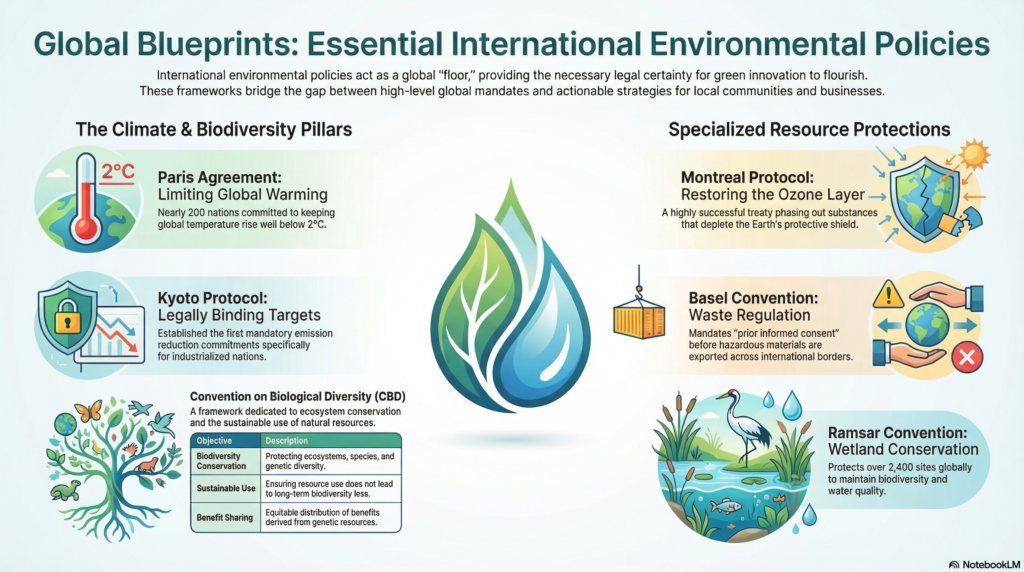
Key international environmental policies include the Paris Agreement, which aims to limit global warming through nationally determined contributions, and the Convention on Biological Diversity, focused on preserving ecosystems and sustainable resource use. The Kyoto Protocol established binding commitments for emission reductions among industrialized nations. Additionally, the United Nations Framework Convention on Climate Change facilitates global climate negotiations. The Basel Convention governs hazardous waste, while the Montreal Protocol successfully phases out ozone-depleting substances. Each of these frameworks represents critical steps toward mitigating environmental issues. Exploring these policies further reveals their profound impact on global sustainability efforts and collaborative initiatives.
KEY TAKEAWAYS
- The Paris Agreement aims to limit global warming to well below 2°C, involving nearly 200 countries with nationally determined contributions (NDCs).
- The Kyoto Protocol established legally binding emission reduction targets for industrialized nations, promoting sustainable development and ecological conservation.
- The United Nations Framework Convention on Climate Change (UNFCCC) focuses on stabilizing greenhouse gas concentrations to prevent dangerous climate change impacts.
- The Convention on Biological Diversity promotes ecosystem conservation, sustainable resource use, and equitable sharing of genetic resources since its establishment in 1992.
- The Montreal Protocol successfully phases out ozone-depleting substances, with a global commitment to restore the ozone layer by the mid-21st century.
PARIS AGREEMENT
The Paris Agreement represents a landmark international accord aimed at addressing the global challenge of climate change, with nearly 200 countries committing to limit global warming to well below 2 degrees Celsius above pre-industrial levels. This commitment underscores the necessity of climate action as a collective endeavor, recognizing that no single nation can combat this pressing issue in isolation. The agreement is predicated on the principle of global cooperation, establishing a framework that not only facilitates national commitments but also encourages transparency and accountability through a system of reporting and review.
At the heart of the Paris Agreement is the concept of nationally determined contributions (NDCs), which allows countries to set their own climate targets based on national circumstances while working towards a common goal. This flexibility is vital in fostering participation from diverse nations, particularly those with varying levels of economic development and resources. However, the effectiveness of the Paris Agreement hinges on the ambition and implementation of these NDCs, necessitating a continuous evaluation of progress and potential adjustments.
The Paris Agreement also emphasizes the importance of financial mechanisms and technology transfer, which aim to support developing nations in their climate action efforts. This multidimensional approach not only addresses the environmental crisis but also promotes sustainable development, ensuring that the quest for climate resilience aligns with economic growth and social equity. Ultimately, the Paris Agreement exemplifies the critical need for unified global efforts in tackling climate change, advocating for a sustainable future that upholds the freedoms of all individuals.
Convention on Biological Diversity
Established in 1992 during the Earth Summit in Rio de Janeiro, the Convention on Biological Diversity (CBD) aims to conserve the world’s diverse ecosystems and promote sustainable use of natural resources. The CBD recognizes that biodiversity is essential for maintaining ecosystem services that benefit humanity, including food security, climate regulation, and health.
The Convention focuses on three primary objectives: biodiversity conservation, sustainable use of its components, and the fair and equitable sharing of benefits arising from genetic resources. This framework encourages nations to develop strategies that integrate biodiversity into their economic and development plans.
| Objective | Description |
| Biodiversity Conservation | Protecting ecosystems, species, and genetic diversity. |
| Sustainable Use | Ensuring that resource use does not lead to biodiversity loss. |
| Benefit Sharing | Equitable distribution of benefits derived from genetic resources. |
The CBD has prompted significant international collaboration and policy-making, leading to numerous initiatives aimed at protecting flora and fauna. Importantly, the Aichi Biodiversity Targets, established in 2010, set ambitious goals for conservation efforts worldwide. These targets emphasize the importance of engaging local communities and indigenous peoples in biodiversity conservation initiatives.
Kyoto Protocol
International environmental policy is particularly important in times of increasing globalisation, for many environmental problems extend beyond national borders and can only be solved through international cooperation. The Kyoto Protocol, established in 1997, aimed to set legally binding commitments for industrialized countries to reduce greenhouse gas emissions, reflecting a significant step in global climate governance. Major participating countries included those in the European Union, Japan, and Canada, highlighting a coalition of nations committed to addressing climate change. However, the Protocol faced challenges such as varying national interests and the withdrawal of key players, raising questions about its overall effectiveness and legacy in international environmental policy.
Key Objectives and Goals
At the heart of the Kyoto Protocol lies a commitment to mitigate climate change through binding international agreements. Its key objectives include promoting sustainable development and facilitating a shift towards a green economy. By establishing legally binding targets for greenhouse gas emissions, the Protocol aims to guarantee climate justice while motivating nations, industries, and individuals to go green through cleaner energy choices and sustainable production practices.
Central to the Protocol’s goals is the pursuit of carbon neutrality. This ambition encourages nations to invest in renewable energy sources, fostering innovation in clean technology and reducing reliance on fossil fuels. The Kyoto Protocol also underscores the importance of ecological conservation and biodiversity preservation, recognizing that a healthy ecosystem is essential for long-term environmental stability.
Additionally, the Protocol emphasizes pollution reduction as a critical measure for protecting air and water quality, which directly impacts public health. Resource management strategies are integral to achieving these objectives, promoting efficient use of natural resources. Ultimately, the Kyoto Protocol serves not merely as a regulatory framework but as a catalyst for environmental education, empowering nations and individuals to actively participate in the global effort to combat climate change.
Major Participating Countries
A diverse coalition of nations participated in the Kyoto Protocol, reflecting a broad commitment to global climate action. Adopted in 1997 and entering into force in 2005, the protocol primarily involved industrialized countries, which were the largest historical emitters of greenhouse gases. Key participating countries included Japan, Canada, the European Union member states, and Australia, collectively representing a significant portion of global emissions. International activities and our shared global environment mean that countries worldwide have common interests that need to be addressed through international or global agreements on our environment, trade and business.
The participation of these nations underscored the importance of global cooperation in addressing climate change, as they committed to legally binding targets to reduce emissions. The United States, while initially a signatory, ultimately did not ratify the agreement, highlighting the complexities of international policy impacts and individual national interests.
Developing nations, including China and India, were not bound by the same stringent targets, reflecting the protocol’s recognition of differing capabilities and responsibilities. Their involvement, however, was vital in fostering dialogue on equitable climate solutions. Overall, the Kyoto Protocol set a precedent for future climate negotiations, emphasizing the necessity of collaborative efforts among nations to combat climate change effectively.

SUCCESSES AND CHALLENGES
In my free time, I am an amateur beekeeper, a hobby that has taught me more about delicate ecosystems than many textbooks ever could. In a hive, every member has a role, and if one part of the system fails, the whole colony is at risk. This mirrors the challenges we see in international environmental policy. For instance, while the Kyoto Protocol was a landmark step in setting binding targets, its legacy is complicated by a lack of robust enforcement and varying national interests. In my professional practice, I’ve seen how even the most well-intentioned policy can falter if it doesn’t account for the practical realities of implementation and the specific needs of developing nations.
We often talk about the “Environmental Kuznets Curve”, the idea that as countries get richer, they eventually start cleaning up their act. However, my experience suggests this isn’t an automatic process. It requires active, integrated environmental governance. For example, in Sub-Saharan Africa, trade alone doesn’t lead to sustainability; you need strong institutions to moderate that growth.
Similarly, as we look toward an international trade in hydrogen, the success of that “green” transition will depend more on infrastructure and reducing trade costs than on carbon pricing alone. Policy is the catalyst that turns economic growth into ecological preservation.
Amidst a backdrop of increasing global awareness regarding climate change, the Kyoto Protocol achieved significant successes and faced considerable challenges in its implementation. The Protocol marked a critical step in international cooperation, establishing regulatory frameworks that aimed to reduce greenhouse gas emissions. Importantly, it raised public awareness around climate issues and fostered a commitment to sustainable development among participating nations. However, its policy effectiveness was undermined by several challenges.
Key among these was the lack of robust enforcement mechanisms, which resulted in varying levels of compliance and diminished accountability. The absence of binding commitments for developing countries led to criticisms regarding environmental justice, as wealthier nations were perceived as avoiding their fair share of responsibility. In addition, funding challenges hindered efforts to promote climate resilience in vulnerable regions, exacerbating existing inequalities.
Stakeholder engagement was often insufficient, limiting the involvement of civil society and local communities. For the Kyoto Protocol to inspire meaningful change, enhancing international cooperation and addressing these challenges is essential. Ensuring equitable participation and effective enforcement will be critical for future climate agreements, fostering a global commitment to environmental justice and sustainable development.
United Nations Framework Convention on Climate Change
The United Nations Framework Convention on Climate Change (UNFCCC) serves as a pivotal international treaty aimed at addressing the escalating threats posed by climate change. Established in 1992, the UNFCCC provides a foundational framework for climate negotiations, bringing together countries to collectively combat global warming. The treaty’s principal objective is to stabilize greenhouse gas concentrations in the atmosphere, thereby preventing dangerous anthropogenic interference with the climate system. Environmental law and governance stand as pillars in the journey towards sustainable development. Recognizing the intricate connections between the environment, social dynamics, and economic dimensions, UNEP is committed to supporting countries in developing and implementing integrated environmental policies.
To elucidate the key components of the UNFCCC, the following table outlines its main features:
| Feature | Description |
| Adoption Year | 1992 |
| Signatories | 197 Parties (as of 2023) |
| Primary Goal | Limit global temperature rise to well below 2°C |
| Annual Conferences | COP (Conference of the Parties) meetings |
| Implementation Mechanism | Nationally Determined Contributions (NDCs) |
The UNFCCC facilitates a structured dialogue among nations, empowering them to share knowledge, resources, and commitments. This collaborative approach is essential, as climate change transcends national borders, necessitating a unified response. Despite several challenges—a lack of binding targets for all nations and varying levels of commitment—the framework has succeeded in raising global awareness and strengthening international cooperation through coordinated environmental policies aimed at addressing climate change. The UNFCCC remains vital in guiding efforts to mitigate climate impacts and adapt to inevitable changes, underscoring the importance of solidarity in the face of a global crisis.
Basel Convention
Established in 1989, the Basel Convention represents an essential international agreement designed to regulate the transboundary movement of hazardous waste and promote its environmentally sound management. This treaty, adopted in Basel, Switzerland, aims to reduce the generation of hazardous waste and guarantee that its disposal occurs in a manner that protects human health and the environment.
The core principle of the Basel Convention revolves around the “prior informed consent” approach. This mandates that countries must obtain permission before exporting hazardous materials across borders, thereby empowering nations to maintain control over waste management practices. The treaty also emphasizes the importance of environmentally sound technologies and methods in treating hazardous waste, encouraging industries to shift toward eco friendly products that minimize environmental and health risks.
In addressing the challenges posed by hazardous materials, the Basel Convention has been instrumental in fostering cooperation among nations. It has facilitated the establishment of regional centers, which serve as resources for capacity-building and the sharing of best practices in waste management. The convention’s effectiveness relies heavily on the commitment of member states to enforce regulations and adhere to international standards.
Moreover, the Basel Convention has evolved to address emerging issues, such as electronic waste and plastic pollution, which require adaptive regulatory frameworks. By enhancing global awareness and collaboration, this convention plays an important role in shaping sustainable waste management practices, thereby contributing to the broader agenda of environmental protection and sustainable development.
Ramsar Convention
One of the key international agreements focused on the conservation and sustainable use of wetlands is the Ramsar Convention, adopted in 1971 in Ramsar, Iran. This landmark treaty emphasizes the crucial role wetlands play in biodiversity, water quality, and climate regulation. By providing a framework for international cooperation, the Ramsar Convention encourages countries to designate and manage wetland sites of international importance, thereby facilitating wetland conservation on a global scale.
The Convention currently boasts 172 contracting parties and over 2,400 designated Ramsar sites, covering more than 250 million hectares worldwide. These sites not only serve as critical habitats for a plethora of species but also contribute considerably to local economies through fisheries, tourism, and flood control. Importantly, the Ramsar Convention promotes the concept of ecological restoration, urging nations to rehabilitate degraded wetlands and enhance their ecological functions.
Moreover, the Convention advocates for the integration of wetland conservation into national and local development policies, ensuring that economic growth does not come at the expense of critical ecosystems. This holistic approach recognizes the interdependence of human well-being and environmental health, empowering communities to engage in sustainable practices.
As climate change accelerates, the significance of the Ramsar Convention becomes increasingly evident. By fostering international collaboration and prioritizing wetland conservation, the Convention plays a pivotal role in safeguarding these essential ecosystems for future generations, ensuring they continue to provide invaluable services that sustain life on Earth.
Montreal Protocol
Recognized as a groundbreaking international treaty, the Montreal Protocol addresses the critical issue of ozone layer depletion. Adopted in 1987, this treaty aimed to phase out substances responsible for the depletion of the ozone layer, primarily chlorofluorocarbons (CFCs) and halons. The ozone layer serves as Earth’s protective shield against harmful ultraviolet radiation, which can lead to severe health and environmental consequences, including skin cancer and ecological disruption.
The success of the Montreal Protocol is largely attributed to its emphasis on global cooperation. By fostering collaboration among nations, the treaty enabled a unified response to a pressing environmental challenge. As of 2023, all 197 parties to the Protocol have committed to reducing and eliminating ozone-depleting substances, showcasing a remarkable level of international solidarity. The treaty not only provides a framework for monitoring and compliance but also supports developing countries through financial mechanisms to shift to safer alternatives.
Evidence of the Protocol’s effectiveness is compelling; the ozone layer is on track to recover by the middle of the 21st century, thanks to the collective actions taken under this agreement. Furthermore, the Montreal Protocol is often cited as a model for addressing climate change, demonstrating how global cooperation can yield significant environmental benefits. As we reflect on the importance of preserving the ozone layer, the Protocol serves as a demonstration of what can be achieved when nations unite for a common cause—protecting our planet and ensuring a free and sustainable future for all.

RELATED STUDIES ABOUT INTERNATIONAL ENVIRONMENTAL POLICIES
To sum up, these pivotal international environmental policies collectively shape the global response to pressing ecological challenges. As the adage suggests, “a stitch in time saves nine,” underscoring the importance of proactive measures in environmental governance. Through collaborative frameworks such as the Paris Agreement and the Montreal Protocol, nations can mitigate climate change, preserve biodiversity, and promote sustainable development. Continued commitment to these agreements will be essential for safeguarding the planet for future generations.
Exploring The Impact Of Economic, Climate, And Energy Policy Uncertainty On The Environmental Kuznets Curve: International Evidence
Objective: This study investigates the relationship between economic growth and environmental pollution (CO₂ emissions) within the framework of the Environmental Kuznets Curve (EKC) hypothesis. It uniquely examines how three types of policy uncertainty—Economic Policy Uncertainty (EPU), Climate Policy Uncertainty (CPU), and Energy-related Uncertainty (EUI)—affect this relationship, both directly and as moderating factors.
Key Findings:
- EKC Confirmation: The analysis confirms the existence of an inverted U-shaped EKC for the full sample of 21 countries (1997–2020), meaning environmental degradation initially increases with income but eventually declines after a certain income threshold is reached.
- Moderating Role of Uncertainty: The three uncertainty indices significantly influence the EKC relationship, but their effects vary:
- Climate Policy Uncertainty (CPU): Generally reduces CO₂ emissions. Uncertainty in climate policy appears to incentivize firms to adopt cleaner technologies, possibly due to compliance risks and reputational concerns.
- Economic Policy Uncertainty (EPU): Exhibits a moderating effect that mitigates environmental pollution, particularly in developing economies. However, in high-growth contexts, EPU can worsen emissions.
- Energy-related Uncertainty (EUI): Tends to increase CO₂ emissions. Uncertainty in energy markets (prices, policy) discourages green investments and can lead to higher environmental degradation.
- Heterogeneous Effects: The impact of uncertainties depends on a country’s economic development level and region:
- In developing countries, EPU and EUI have significant direct impacts on emissions, with EPU’s moderating effect helping to reduce pollution.
- In developed countries, CPU and EUI directly contribute to emission reductions, while EPU’s moderating effect remains significant in amplifying pollution reduction.
- European Union countries showed distinct results, with the EKC and the effects of the uncertainty moderators not being statistically significant, highlighting the unique impact of the EU’s integrated regulatory environment.
- Policy Effectiveness: The implementation of the Kyoto Protocol is empirically shown to have a significant and negative effect on CO₂ emissions, affirming the positive role of international climate agreements.
Methodology: The study employs panel data analysis using both Ordinary Least Squares (OLS) and Two-Stage Least Squares (TSLS) models to account for potential endogeneity. Robustness checks are conducted through sub-sample analyses based on income levels, geographical regions, and the inclusion of additional control variables like institutional quality and trade openness.
Conclusions & Implications:
- The EKC remains a relevant framework, but its shape and trajectory are importantly moderated by policy uncertainties.
- Policymakers, especially in developing nations, should strive to minimize economic and energy policy uncertainties to achieve better environmental outcomes.
- Climate policy, even when uncertain, can drive positive environmental action by pushing firms toward sustainable technologies.
- High-emission countries play a critical role, and targeted policies considering local uncertainty contexts are essential.
- Strengthening international climate agreements like the Kyoto Protocol is vital for global emission reduction efforts.
Research Gap Addressed: This study fills a significant gap by comprehensively integrating multiple dimensions of policy uncertainty (economic, climate, energy) into the EKC analysis, moving beyond traditional static models and offering a dynamic perspective on how volatility in the policy landscape shapes the growth-environment nexus.
| REFERENCE: Cristian Barra, Pasquale Marcello Falcone, Patrizio Giganti, Exploring the impact of economic, climate, and energy policy uncertainty on the Environmental Kuznets Curve: International evidence, International Economics, Volume 182, 2025, 100592, ISSN 2110-7017, https://doi.org/10.1016/j.inteco.2025.100592. (https://www.sciencedirect.com/science/article/pii/S2110701725000150) |
The Environmental Impact Of International Trade In Sub-Saharan Africa: Exploring The Role Of Policy And Institutions For Environmental Sustainability
Objective: This study investigates the impact of international trade on environmental degradation (CO₂ emissions) in Sub-Saharan Africa (SSA), with a specific focus on the crucial moderating role of environmental policies and institutions. It moves beyond aggregate trade to examine the separate effects of exports and imports and uses a direct measure of environmental governance—Policy and Institutions for Environmental Sustainability (PIES)—rather than general political institutions.
Key Findings:
- PIES as a Critical Moderator: The presence and strength of Policy and Institutions for Environmental Sustainability (PIES) are decisive. The harmful environmental effects of total trade, exports, and imports are significantly reduced when robust PIES are in place. International trade alone does not guarantee environmental sustainability in SSA.
- Trade’s Environmental Impact is Conditional:
- Without effective PIES, trade’s impact is ambiguous or harmful.
- With strong PIES, increases in trade openness and imports are associated with significant reductions in environmental degradation (CO₂ emissions). For example, a 1% increase in imports, combined with strong PIES, can reduce emissions by 0.19% to 0.37%, depending on the strength of institutions.
- The effect of exports on reducing emissions is statistically insignificant, even with strong PIES, suggesting SSA’s export composition or production processes may not be environmentally beneficial.
- Bidirectional Causality: A feedback loop exists between trade and the environment. There is bidirectional causality between total trade, exports, imports, and environmental degradation, meaning trade affects emissions and emissions levels also influence trade patterns.
- Trends and Context: Over the study period (2005–2020), CO₂ emissions, trade volume, and the PIES index all rose in SSA. The concurrent increase in PIES indicates growing recognition of environmental issues but suggests institutional strengthening must outpace trade growth to achieve net environmental benefits.
Methodology: The study employs panel data analysis for 24 SSA countries. It uses the Driscoll-Kraay standard error estimation as a baseline and the system Generalized Method of Moments (GMM) to address endogeneity and dynamic effects. The Dumitrescu-Hurlin causality test is used to establish causal directions.
Conclusions & Implications:
- Institutions are Paramount: For SSA countries to benefit from trade integration (like the African Continental Free Trade Area, AfCFTA) without exacerbating environmental damage, strengthening environmental institutions is non-negotiable.
- Policy Recommendations:
- Enforce Strict Environmental Regulations: Integrate environmental reviews into trade policies, ensuring production and transportation for both exports and imports adhere to sustainability standards.
- Combat Corruption in Environmental Governance: Enhance transparency, accountability, and civil society oversight to ensure PIES are effective in practice.
- Promote Green Imports: Favor policies that encourage the import of environmentally friendly goods and technologies.
- Green Export Strategy: Re-evaluate and incentivize sustainable practices in export-oriented industries.
Research Gap Addressed: This study fills a significant gap by:
- Using a specific environmental institution indicator (PIES) instead of broad political governance measures.
- Disaggregating trade into exports and imports to identify their distinct environmental impacts.
- Explicitly testing the complementary role of institutions in mitigating trade-related pollution in the SSA context.
| REFERENCE: Desmond Mbe-Nyire Mpuure, Emmanuel Duodu, Adamu Braimah Abille, Eric Atanga Ayamga, The environmental impact of international trade in Sub-Saharan Africa: Exploring the role of policy and institutions for environmental sustainability, Research in Globalization, Volume 9, 2024, 100240, ISSN 2590-051X, https://doi.org/10.1016/j.resglo.2024.100240. (https://www.sciencedirect.com/science/article/pii/S2590051X24000492) |
The Emerging International Trade In Hydrogen: Environmental Policies, Innovation, And Trade Dynamics
This study develops a novel theoretical and empirical model to analyze the future of international hydrogen trade, focusing on the roles of long-term contracts (LTCs), innovation, and policy interventions.
Key Findings:
- Hydrogen Types & Trade Dynamics
Hydrogen is categorized by production method:
- Grey/Black: from fossil fuels without carbon capture.
- Blue: from natural gas with carbon capture and storage (CCS).
- Turquoise: from methane decomposition, yielding solid carbon.
- Green: from renewable energy via electrolysis.
Early trade will be dominated by blue and turquoise hydrogen due to lower costs, but green hydrogen will gain market share over time through endogenous innovation and falling costs.
- Long-Term Contracts (LTCs) Are Central
LTCs will likely dominate early hydrogen markets due to:
- High fixed costs and long amortization periods.
- Price uncertainty and the need for stable revenue.
- Relationship-specific investments in infrastructure.
LTCs lead to sequential market entry and can result in two-way trade as comparative advantages shift over time.
- Trade Costs Are the Most Critical Factor
Transportation costs—whether by pipeline or as ammonia—significantly influence trade patterns:
- Low trade costs boost export volumes and encourage long-distance trade (e.g., ammonia shipping).
- High trade costs favor domestic production and reduce export intensity, but may increase the share of green hydrogen produced locally.
- Policy Impacts Are Asymmetric
- Trade policies and infrastructure investment have a stronger effect on hydrogen trade than carbon or innovation policies alone.
- Carbon pricing can stimulate hydrogen demand but must be high enough to incentivize low-carbon production.
- Subsidies for green hydrogen can accelerate innovation but are less impactful than reducing trade barriers.
- Market Structure & Price Dispersion
Hydrogen markets will exhibit:
- Significant price dispersion across and within countries due to LTC vintages and shifting comparative advantages.
- Limited early-adopter disadvantage (“early-adopter curse”), as prices fall quickly and later entrants benefit from innovation.
- Two-way trade flows resembling those of crude oil, with moderate distance sensitivity.
- Environmental Benefits Depend on Hydrogen Type
While hydrogen can displace up to ~10.97 Gt CO₂ annually (≈25% of 2021 global emissions), the net climate benefit depends on the production mix. Increased trade may raise the share of blue hydrogen, which carries methane leakage risks.
Methodology:
- A sequential Nash-Cournot model with LTCs and endogenous innovation.
- Simulation of 16 policy scenarios using calibrated data on demand, supply, transportation, and policies.
- Focus on extensive margin entry (project-level decisions) rather than intensive margin adjustments.
Policy Recommendations:
- Prioritize investment in hydrogen transportation infrastructure (pipelines, ammonia shipping) to lower trade costs.
- Design policies that support global innovation spillovers rather than purely domestic subsidies.
- Ensure carbon pricing frameworks account for fugitive emissions from blue and turquoise hydrogen.
- Prepare for two-way trade flows and price heterogeneity in international hydrogen markets.
Conclusion:
The emerging global hydrogen market will be shaped more by trade costs and infrastructure than by carbon policies alone. LTCs will structure early trade, creating dynamic and sometimes counterintuitive trade patterns. Policymakers and investors should focus on reducing transportation barriers and fostering innovation to unlock hydrogen’s full decarbonization potential.
| REFERENCE: Werner Antweiler, David Schlund, The emerging international trade in hydrogen: Environmental policies, innovation, and trade dynamics, Journal of Environmental Economics and Management, Volume 127, 2024, 103035, ISSN 0095-0696, https://doi.org/10.1016/j.jeem.2024.103035. (https://www.sciencedirect.com/science/article/pii/S0095069624001098) |
CONCLUSION
Reflecting on these frameworks, it is clear that “a stitch in time saves nine” is more than just an old adage; it is a fundamental principle of environmental governance. As a strategist, I believe the success of the Montreal Protocol in phasing out ozone-depleting substances proves that when nations unite for a common cause, the results are measurable and profound. It serves as the ultimate model for what we can achieve with the Paris Agreement and the UNFCCC. But we cannot simply wait for the next global summit to take place.
My philosophy has always been to blend high-level legislative goals with boots-on-the-ground implementation. These international treaties provide the direction, but the real work happens at the local level within our businesses, our city councils, and our own backyards. We must ensure that our quest for climate resilience aligns with social equity and economic growth.
By integrating these global standards into our daily professional and personal lives, we move from being mere observers of policy to active participants in a sustainable future. The goal isn’t just to follow the law; it’s to create a world where our quality of life and the planet’s health thrive in tandem.