
As an environmental policy researcher who has spent years navigating the halls of both academia and municipal planning, I have seen firsthand how the right framework can either spark a green revolution or result in a mountain of bureaucratic red tape. In my work, I often find that the most effective solutions aren’t just about the numbers on a spreadsheet; they are about understanding the human and economic incentives that drive real-world change.
Whether I’m drafting a policy brief on clean energy or experimenting with sustainable urban farming on my own rooftop, I am constantly reminded that environmental management is a delicate balance. We need the iron-clad certainty of regulations to protect our most vulnerable ecosystems, but we also need the creative freedom of voluntary initiatives to allow for the localized, technical innovations that a “one-size-fits-all” law might miss.
In this overview, we are going to dive deep into these two pillars of environmental governance. Drawing from both established management theory and practical policy applications, we will explore how regulatory and voluntary frameworks interact to shape our sustainable future. My goal is to help you see these not as opposing forces, but as a dual-engine system capable of driving meaningful ecological stewardship.
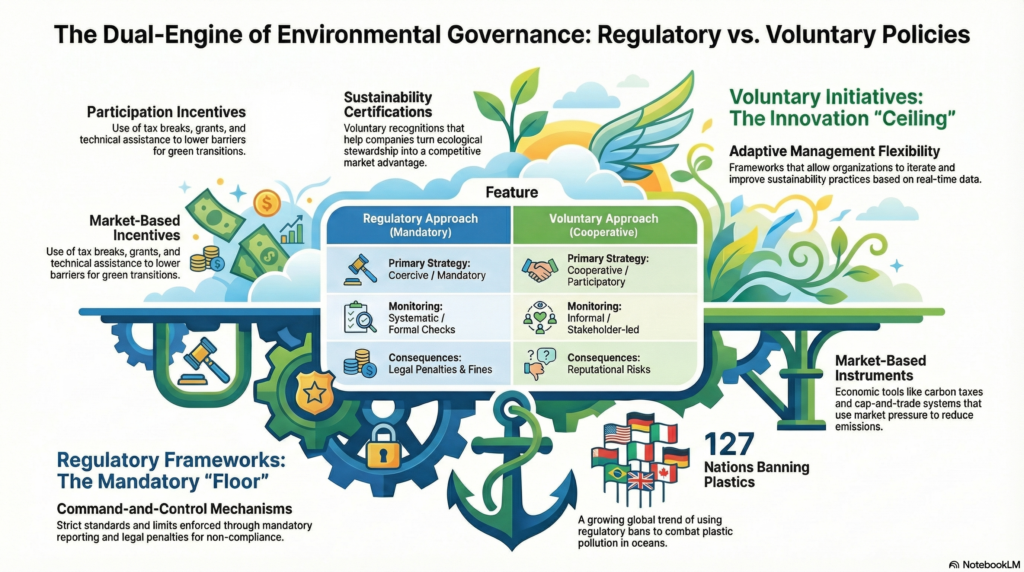
Environmental policies comprise regulatory and voluntary frameworks designed to mitigate human environmental impacts and promote sustainability. Regulatory policies enforce compliance through mechanisms like command-and-control regulations, market-based instruments, and performance standards, ensuring accountability via penalties and reporting requirements. Conversely, voluntary policies emphasize flexibility and innovation, fostering participation through agreements, corporate responsibility programs, and sustainability certifications. While regulatory measures impose strict adherence, voluntary approaches encourage tailored solutions. Both types play pivotal roles in advancing sustainability efforts, ultimately driving collaborative innovations. Exploration of their unique features reveals insights into effective environmental management strategies and stakeholder engagement.
KEY TAKEAWAYS
- Environmental policies aim to manage human impact on the environment through regulations and practices promoting sustainability and ecological integrity.
- Regulatory policies enforce compliance through command-and-control regulations, market-based instruments, and performance standards with penalties for non-compliance.
- Voluntary policies incentivize stakeholder participation through agreements, corporate responsibility programs, and sustainability certifications without formal regulatory constraints.
- Comparison between the two shows regulatory policies focus on strict compliance, while voluntary policies encourage innovation and collaboration among stakeholders.
- Flexibility and adaptability in both policy types allow for tailored approaches to local needs and ongoing improvements in response to environmental challenges.
DEFINITION OF ENVIRONMENTAL POLICIES
Environmental policies can be defined as a set of regulations, principles, and practices aimed at managing human impact on the environment. These policies serve as crucial instruments for safeguarding ecological integrity while promoting sustainable development. They are often codified through environmental legislation, which establishes legal frameworks that govern environmental protection, resource conservation, and public health.
At the core of environmental policies are policy frameworks that outline specific goals, strategies, and actions. These frameworks facilitate the implementation of regulations and provide a structured approach to addressing complex environmental issues, ensuring alignment with current environmental policies and evolving sustainability standards. These frameworks facilitate the implementation of regulations and provide a structured approach to addressing complex environmental issues. For instance, frameworks may include guidelines for pollution control, climate change mitigation, and biodiversity conservation. Effective policy frameworks are essential for ensuring that environmental legislation is not only enforceable but also adaptable to changing circumstances and scientific advancements.
Moreover, the importance of evidence-based decision-making in the formulation of environmental policies cannot be overstated. Data-driven approaches allow policymakers to assess environmental conditions, monitor compliance, and evaluate the effectiveness of regulations. This analytical rigor is crucial in fostering transparency and accountability, which are essential for gaining public trust and support.
Types of Regulatory Policies
Environmental management programs support the NIEHS Environmental Policy and the overall goal of reducing negative environmental impacts. These programs were established to assure compliance with federal, state, and local environmental regulations. Each program includes specific requirements that are documented in the NIEHS EMS Manual as well as a corresponding written plan, procedure, or instruction. Regulatory policies can be categorized into various types that target specific environmental concerns and objectives. These policies are essential for establishing a framework that governs the behavior of entities impacting the environment. However, while these regulatory frameworks aim to mitigate environmental damage, they often present compliance challenges that can hinder effective implementation.
The primary types of regulatory policies include:
- Command-and-Control Regulations: These dictate specific limits and standards that must be adhered to, often involving penalties for non-compliance.
- Market-Based Instruments: These provide economic incentives, such as cap-and-trade systems, encouraging reductions in pollution by allowing market mechanisms to drive compliance.
- Performance Standards: These set benchmarks for pollution control technologies and practices, allowing flexibility in how entities achieve compliance.
- Reporting and Disclosure Requirements: Mandating transparency regarding environmental impacts fosters accountability and informs stakeholders.
- Environmental Impact Assessments: These require evaluations of potential environmental effects before project approvals, ensuring informed decision-making.
Each type of regulatory policy comes with distinct advantages and drawbacks, particularly in their ability to balance environmental protection and economic freedom. Regulatory frameworks must be designed to minimize compliance challenges while promoting sustainable practices. An effective regulatory policy does not merely impose restrictions but rather fosters an environment where innovation can thrive, aligning economic growth with ecological stewardship. Ultimately, the goal is to create a sustainable future that respects both individual freedoms and the integrity of our natural resources.
Key Features of Regulatory Policies
Effective governance in the domain of environmental policy hinges on a set of key features that enhance the functionality and efficacy of regulatory measures. Central to these features is the emphasis on regulatory compliance, which guarantees that entities adhere to established environmental standards. This compliance is often enforced through a combination of monitoring, reporting requirements, and penalties for noncompliance, fostering a culture of accountability among businesses and individuals alike.
The equivalent of one garbage truck full of plastic waste enters the ocean every minute. So countries around the world are increasingly trying to reduce the use of single-use plastics, such as bags, bottles, and packaging, to cut down on that pollution. The list of nations that have banned plastic in some form includes: Rwanda, France, New Delhi, Jamaica, Taiwan, Morocco, Kenya, and more. According to a report by the UN, 127 countries have or are working toward plastic bans.
Another critical aspect is the clarity and specificity of regulatory frameworks. Well-defined regulations minimize ambiguity, enabling stakeholders to understand their obligations and the consequences of their actions. This clarity is instrumental in enhancing policy effectiveness, as it allows for straightforward implementation and assessment of regulatory outcomes.
Moreover, stakeholder engagement is an essential feature of effective regulatory policies. Actively involving various stakeholders, including industry representatives, environmental groups, and local communities, in the policy formulation process promotes transparency and fosters a sense of shared responsibility. This participatory approach not only strengthens public trust but also contributes to more robust and adaptable regulations that can respond to emerging environmental challenges.
Types of Voluntary Policies
Voluntary policies play an essential role in shaping environmental governance, offering alternative pathways for entities to engage in sustainable practices beyond mandated regulations. These policies are designed to encourage proactive measures that foster environmental stewardship through collaborative initiatives and stakeholder engagement. Unlike traditional regulatory mechanisms, voluntary policies allow organizations and communities the flexibility to adopt tailored approaches that align with their specific capabilities and goals.
Common types of voluntary policies include:
- Voluntary agreements: Arrangements between government entities and organizations to achieve specific environmental outcomes without formal regulations.
- Corporate responsibility programs: Initiatives that motivate companies to integrate sustainability into their operations and decision-making processes.
- Best practice guidelines: Recommendations that help businesses and communities adopt sustainable practices based on successful case studies and research.
- Community involvement initiatives: Programs that encourage local stakeholders to participate in environmental decision-making, enhancing public awareness and engagement.
- Sustainability certifications: Recognitions awarded to entities that meet specified environmental standards, promoting transparency and accountability in corporate practices.
These voluntary frameworks not only bolster public awareness but also foster a culture of responsibility that transcends mere compliance. By embracing these policies, organizations can demonstrate their commitment to environmental sustainability, enhancing their reputations while contributing positively to their communities. Ultimately, the integration of voluntary policies into environmental governance represents a significant step towards achieving a more sustainable future, driven by collective action and shared responsibility.
Key Features of Voluntary Policies
Voluntary policies are characterized by their provision of incentives that promote stakeholder participation, often resulting in greater engagement than mandatory regulations. Additionally, these policies offer flexibility and adaptability, allowing organizations to tailor their approaches to specific environmental challenges and operational contexts. This combination enhances the effectiveness of voluntary initiatives, fostering innovation and collaboration in achieving environmental goals. Most developing countries have long since established laws and formal governmental structures to address their serious environmental problems, but few have been successful in alleviating those problems. The development banks, which control resources desperately needed by the developing countries, are promoting the use of economic incentives and other market-based strategies as the key to more effective environmental protection.
Incentives for Participation
To foster greater engagement in environmental initiatives, incentives play a crucial role in shaping participation in voluntary policies. These incentives are essential for overcoming participation barriers that organizations or individuals may face when considering involvement in environmental programs. Financial incentives, such as grants, tax breaks, or subsidies, can markedly reduce the costs associated with adopting sustainable practices, thereby encouraging more participants.
Key features of incentives for participation include:
- Economic Benefits: Reducing operational costs through energy efficiency initiatives.
- Recognition Programs: Public acknowledgment of sustainable practices can enhance an organization’s reputation.
- Regulatory Relief: Participants may gain leniency in compliance with certain regulations.
- Technical Assistance: Provision of expert guidance can simplify the implementation of green initiatives.
- Networking Opportunities: Engagement with other participants fosters collaboration and information sharing.

FLEXIBILITY AND ADAPTABILITY
Flexibility and adaptability are essential characteristics of effective voluntary environmental policies, enabling stakeholders to tailor their approaches to specific circumstances and challenges. Unlike rigid regulatory frameworks, voluntary policies allow for the incorporation of adaptive strategies that evolve in response to new information, technologies, and environmental conditions. This dynamic nature fosters innovation and encourages organizations to experiment with sustainable practices that suit their unique contexts.
The following table highlights key features of flexibility and adaptability in voluntary policies:
| Feature | Description |
| Customization | Policies can be adjusted to fit local needs. |
| Innovation | Encourages the development of new technologies. |
| Stakeholder Engagement | Facilitates collaboration among diverse groups. |
| Continuous Improvement | Allows for iterative refinements based on feedback. |
| Policy Evolution | Supports ongoing adaptation to changing environmental challenges. |
Such characteristics not only enhance stakeholder commitment but also guarantee that environmental policies remain relevant and effective over time. By embracing flexibility and adaptability, voluntary environmental policies can contribute to more sustainable outcomes while respecting the autonomy of those involved.
Comparison of Regulatory and Voluntary Policies
From my perspective in the field, the debate between regulatory and voluntary policies often misses a crucial reality: the “compliance culture” is vastly different from an “innovation culture.” When we look at regulatory policies like command-and-control or market-based instruments, we are talking about the floor of the absolute minimum standards required to ensure we don’t further degrade our planet.
I’ve seen how these mandates provide the necessary accountability, especially in developed G7 nations where market-based taxes can significantly boost the Load Capacity Factor. However, as some colleagues in online forums have pointed out, overly rigid enforcement, like certain applications of the Endangered Species Act, can sometimes create perverse incentives for landowners to avoid conservation altogether. This is where my passion for policy reform comes in.
On the other hand, voluntary policies such as sustainability certifications or corporate responsibility programs act as the ceiling, pushing organizations to go beyond what is required by law. In my own research, I’ve found that the flexibility of voluntary agreements allows for “adaptive management,” where we can iterate and improve based on real-time data. This is vital for early-stage green transitions where firms might initially resist heavy regulation. By offering financial incentives like tax breaks or technical assistance, we can lower the barriers to entry and turn sustainability from a legal obligation into a competitive advantage.
The comparison between regulatory and voluntary environmental policies reveals significant differences in enforcement mechanisms, flexibility, and capacity for innovation. Regulatory policies typically impose strict compliance requirements, ensuring accountability through defined penalties, whereas voluntary policies often foster innovation by allowing organizations to tailor their approaches to sustainability. Understanding these distinctions is essential for evaluating the effectiveness and adaptability of various environmental strategies.
Enforcement Mechanisms
While both regulatory and voluntary policies aim to protect the environment, the enforcement mechanisms that underpin these approaches differ considerably in their structure and effectiveness. Regulatory policies typically rely on stringent enforcement strategies, wherein compliance challenges are addressed through established penalty frameworks. These frameworks guarantee legal implications for non-compliance, providing a clear deterrent. Monitoring systems are essential in this regard, as they enable authorities to assess adherence and allocate resources effectively.
In contrast, voluntary policies emphasize stakeholder involvement and collaboration rather than punitive measures. The enforcement mechanisms here are less formalized, often depending on the commitment of organizations to adhere to best practices. This can create variability in policy effectiveness, as the lack of robust monitoring may lead to inconsistent compliance levels.
Key differences in enforcement mechanisms include:
- Compliance Challenges: Regulatory policies face fewer challenges due to established norms.
- Enforcement Strategies: Regulatory frameworks utilize coercive approaches, while voluntary policies foster cooperation.
- Monitoring Systems: Regulatory environments often have systematic checks, while voluntary initiatives may lack.
- Penalty Frameworks: Regulatory penalties are well-defined; voluntary policies may impose reputational risks.
- Stakeholder Involvement: Voluntary policies encourage greater stakeholder engagement.
Flexibility and Innovation
Regulatory and voluntary environmental policies present distinct opportunities for flexibility and innovation, shaping how organizations approach sustainability. Regulatory frameworks often impose strict compliance requirements that can stifle creative solutions. In contrast, voluntary policies allow for adaptive management, providing organizations the latitude to experiment with various sustainability practices. This flexibility fosters policy innovation, as entities can tailor their approaches to fit specific environmental challenges and operational contexts, while remaining consistent with international environmental policies and global sustainability standards.
For instance, companies engaged in voluntary initiatives may implement cutting-edge technologies or develop unique methodologies to reduce their carbon footprint, motivated by both ethical considerations and market competitiveness. The lack of stringent regulatory mandates can encourage organizations to explore innovative practices that may not align with traditional compliance measures.
Moreover, adaptive management, which involves iterative learning and adjusting based on outcomes, is more readily embraced in voluntary settings. This approach empowers organizations to refine their strategies continuously, fostering a culture of innovation. Ultimately, while regulatory policies provide necessary oversight, voluntary policies enhance organizational freedom, facilitating a more dynamic and responsive approach to environmental sustainability. The interplay between these two types of policies can yield valuable insights, driving progress in the pursuit of environmental goals.
Impact on Sustainability Efforts
Significant advancements in environmental policies have played an integral role in shaping sustainability efforts across various sectors. These policies, both regulatory and voluntary, have catalyzed a paradigm shift toward more sustainable practices, encouraging organizations to adopt thorough sustainability metrics. This alignment not only fosters accountability but also enhances transparency, which is vital for achieving long-term sustainability goals.
The integration of environmental justice into the framework of these policies guarantees that marginalized communities are not disproportionately burdened by environmental degradation. As sustainability initiatives evolve, they increasingly reflect the interplay between economic, social, and ecological dimensions, promoting holistic development. The following aspects highlight the impact of environmental policies on sustainability efforts:
- Enhanced collaboration among stakeholders, leading to innovative solutions.
- Improved resource efficiency, reducing waste and lowering operational costs.
- Increased public awareness and engagement in sustainability practices. in sustainability practices, such as choosing eco friendly products, contributes to long-term environmental responsibility and supports organizational and community initiatives.
- Strengthened regulatory frameworks that enforce compliance and accountability.
- Promotion of equitable access to clean resources and green technologies.
As stakeholders navigate the complexities of sustainable development, the effectiveness of environmental policies will largely depend on their adaptability and responsiveness to emerging challenges. By leveraging sustainability metrics and prioritizing environmental justice, these policies can foster a more inclusive approach that not only mitigates environmental risks but also empowers communities, thereby paving the way for sustainable freedom. Ultimately, the intersection of regulatory measures and voluntary initiatives creates a robust foundation for enduring sustainability efforts, guaranteeing a resilient future for all.

RELATED STUDIES ABOUT TYPES OF ENVIRONMENTAL POLICIES
To conclude, regulatory and voluntary environmental policies serve as pivotal pillars in promoting sustainability. Regulatory policies impose mandatory measures, ensuring compliance and accountability, while voluntary policies foster flexibility and innovation through self-regulation. The juxtaposition of these approaches illuminates a spectrum of strategies, each contributing uniquely to ecological stewardship. Ultimately, the harmonious interplay between regulation and voluntary commitment catalyzes meaningful change, crafting a collective commitment to a cleaner, greener, and more sustainable planet.
Coupling Environmental Policy with Supply- or Demand-Side Interventions: Impacts on Three-Dimensional Performance
This study investigates how combining environmental regulations with supply-side (e.g., R&D tax deductions) or demand-side (e.g., consumer subsidies) interventions affects green innovation, environmental performance, and economic outcomes. Using an evolutionary game model, it analyzes the conditions under which such policy mixes lead to complementary or crowding-out effects among governments, regulated firms, and unregulated firms.
Methodology:
- Model: A tripartite evolutionary game model with three players: local governments (LG), regulated firms (RF), and unregulated firms (UF).
- Strategies: LG chooses between environmental policy combined with supply-side (ET) or demand-side (ES) interventions. RF and UF decide whether to adopt green innovation or reduce output/not innovate.
- Analysis: Stability analysis of equilibrium points, sensitivity tests on policy intensities, and numerical simulations using MATLAB.
- Parameters: Based on real-world policies like China’s Top-1000/10000 Energy-Saving Programs, R&D tax deductions, and green product subsidies.
Key Findings:
- Both Policy Mixes Can Stimulate Green Innovation:
- At least one group of firms (regulated or unregulated) adopts green innovation under both supply-side and demand-side policy mixes.
- Crowding-Out Effects Only with Demand-Side Interventions:
- Economic and environmental crowding-out (negative outcomes) occur only when environmental policy is combined with demand-side interventions.
- This happens due to output spillovers: regulated firms cut production instead of innovating, unregulated firms absorb the spillover but under-invest in green innovation, leading to higher overall energy consumption and lower economic performance.
- Complementary Effects Favor Demand-Side Mix:
- When both firm types innovate, the demand-side mix yields higher economic and environmental complementary effects.
- The supply-side mix only produces environmental complementary effects, with neutral economic performance.
- Policy Intensity Thresholds Are Critical:
- Crowding-out risks can be avoided by keeping environmental policy intensity below ~8% of regulated firms’ energy use and subsidy intensity above ~6% of product price.
- Complementary effects are maximized with higher environmental intensity, lower subsidies, or higher tax deductions.
- Policy Failure Recovery Strategies:
- In early transition stages where firms resist innovation:
- Demand-side mix: Reduce environmental targets to lower innovation pressure.
- Supply-side mix: Increase R&D subsidies or relax environmental targets.
Policy Implications:
- Avoid Crowding-Out:
- Ensure regulated firms innovate rather than cut output. Phase out inefficient capacity in polluting industries.
- Implement tiered energy-saving targets based on firm efficiency.
- Choose Policy Mix Based on Priorities:
- Economic-focused governments: Prefer demand-side interventions (e.g., green product subsidies, post-subsidy incentives).
- Budget-constrained governments: Prefer supply-side interventions (e.g., R&D tax breaks, innovation vouchers) for reliable environmental gains.
- Early-Stage Green Transitions:
- Reduce regulatory pressure or increase R&D support to overcome initial innovation reluctance.
- Invest in generic green technologies and accelerate commercialization.
Limitations & Future Research:
- Does not differentiate types of green innovation (product, process, managerial).
- Omits supply-chain dynamics and collaborative firm behaviors.
- Future work should incorporate pricing effects and broader market impacts.
Significance:
This study provides a nuanced framework for designing cross-instrumental environmental policy mixes. It offers evidence-based guidance for balancing green innovation, environmental sustainability, and economic growth, with applicability to regional and national policymakers.
| REFERENCE: Wen Hu, Xiaoxu Zhang, Jiehong Lou, Coupling environmental policy with supply- or demand-side interventions: Impacts on three-dimensional performance, Energy Strategy Reviews, Volume 62, 2025, 101907, ISSN 2211-467X, https://doi.org/10.1016/j.esr.2025.101907. (https://www.sciencedirect.com/science/article/pii/S2211467X25002706) |
Role of Market and Nonmarket-Based Environmental Policies, Energy Use, and Income on Environmental Sustainability: The Case of G7 Countries
Objective: This study investigates the impact of Gross Domestic Product (GDP), market-based environmental policies (MBP), nonmarket-based environmental policies (NMBP), renewable energy consumption (REC), and fossil energy consumption (FEC) on environmental sustainability, measured by the Load Capacity Factor (LCF), in G7 countries from 2000 to 2020.
Methodology: The research employs a Kernel-based Regularized Least Squares (KRLS) model, which effectively handles nonlinear data without strict assumptions. The analysis includes descriptive statistics, correlation analysis, nonlinearity testing (BDS test), and the evaluation of both Average Marginal Impact (AMI) and Pointwise Marginal Impact (PMI) of the explanatory variables on LCF for each G7 country (Canada, France, Germany, Italy, Japan, Great Britain, and the USA).
Key Findings:
- Model Performance: The KRLS model demonstrated high predictive performance, with R² values ranging up to approximately 99%, indicating strong explanatory power.
- Variable Impacts (by country):
- GDP: Positively impacts LCF only in the USA. It has a negative impact in France, Germany, and Japan, and is insignificant in Canada, Italy, and Great Britain.
- Market-Based Policies (MBP): Significantly increase LCF in Canada, France, Japan, and the USA, but are insignificant in Germany, Italy, and Great Britain.
- Nonmarket-Based Policies (NMBP): Significantly increase LCF only in France and the USA, showing limited effectiveness elsewhere.
- Renewable Energy (REC): Positively supports LCF in Germany, Italy, Great Britain, and the USA, but is insignificant in Canada, France, and Japan.
- Fossil Energy (FEC): Consistently harms LCF (negative impact) across all G7 countries without exception.
- Country-Specific Insights:
- Canada & Japan: Should primarily rely on MBP to improve environmental sustainability.
- France: Can benefit from both MBP and NMBP.
- Germany, Italy, & Great Britain: Should focus on promoting REC.
- USA: Has the most favorable condition, with GDP, MBP, NMBP, and REC all contributing positively to LCF.
- Nonlinear Relationships: The impacts of the factors on LCF are not linear but vary across different levels (percentiles) of LCF, as revealed by the PMI analysis. This highlights the importance of considering marginal effects for targeted policy design.
Policy Recommendations:
- Governments should prioritize the design and implementation of market-based environmental policies (e.g., taxes, trading schemes) as they show clear benefits in several countries.
- Nonmarket-based policies (e.g., standards, R&D subsidies) should be considered as supportive mechanisms, particularly where they prove effective (e.g., France, USA).
- Aggressive promotion of renewable energy through support packages, incentives, and technological innovation is crucial to enhance environmental sustainability.
- Reducing fossil fuel consumption is imperative across all G7 nations, requiring sectoral transitions and disincentives.
- Policies must be tailored to national contexts, considering the varying effectiveness of different instruments across countries and the nonlinear nature of their impacts.
Conclusion: The study fills a literature gap by simultaneously analyzing the subtypes of environmental policy stringency (MBP & NMBP) alongside key economic and energy factors, using a robust nonlinear model (KRLS) for G7 countries. It confirms that environmental policy effectiveness is heterogeneous and context-dependent. The findings provide a nuanced evidence base for policymakers to craft differentiated, effective strategies for achieving environmental sustainability in developed economies.
| REFERENCE: Mustafa Tevfik Kartal, Galib Gafarli, Dilvin Taşkın, Özer Depren, Fatih Ayhan, Role of market and nonmarket-based environmental policies, energy use, and income on environmental sustainability: The case of G7 countries, Environmental and Sustainability Indicators, Volume 28, 2025, 101006, ISSN 2665-9727, https://doi.org/10.1016/j.indic.2025.101006. (https://www.sciencedirect.com/science/article/pii/S2665972725004271) |
The Significance of Climate Policy Stringency, Environmental Taxation, and Public Debt in Addressing Climate Change Challenges
Objective: This study investigates the effectiveness of different climate policy types (sectoral, cross-sectoral, and international), environmental taxation, and public debt in reducing greenhouse gas (GHG) emissions across selected OECD countries from 1995 to 2023. It aims to inform policy design for climate change mitigation under Sustainable Development Goal 13.
Methodology: The research uses panel data econometrics, primarily Fully Modified Ordinary Least Squares (FMOLS) and Dynamic Ordinary Least Squares (DOLS) models, to analyze long-term relationships. Robustness is tested using Driscoll-Kraay standard errors and the Lewbel Two-Stage Least Squares estimator. The analysis focuses on 16 European countries, examining three distinct policy layers separately to avoid multicollinearity and isolate their individual effects.
Key Findings:
- Climate Policy Stringency is Effective: All three policy types significantly reduce GHG emissions.
- Sectoral policies (e.g., carbon pricing, standards for specific sectors like electricity and transport) are the most effective.
- International policies (e.g., participation in global initiatives, carbon disclosure) also show strong effectiveness.
- Cross-sectoral policies (e.g., national GHG targets, R&D spending) are effective but slightly less so than sectoral and international ones.
- Environmental Taxation is Highly Effective: Environmental taxes are a reliable and powerful instrument for reducing emissions, confirming the “polluter pays” principle. They are more effective than public spending in curbing GHG emissions.
- Public Debt is Environmentally Harmful: Contrary to being a potential financing tool for green initiatives, higher public debt levels are associated with increased GHG emissions. Debt pressures budgets, may lead to relaxed environmental regulations to attract investment, and postpones effective climate action.
- Public Environmental Spending is Ineffective: Government spending specifically earmarked for environmental protection shows negligible or insignificant impact on reducing emissions in the studied context. This suggests issues with misallocation, lack of targeting, or poor performance monitoring.
- Control Variables Confirm Known Trends: Economic growth (GDP per capita) and urbanization are both confirmed as drivers of increased GHG emissions in the sample countries.
Policy Recommendations:
- Prioritize Policy Stringency & Environmental Taxes: Governments should implement and strengthen sectoral and international climate policies alongside well-targeted environmental taxes. These are proven, effective tools that also generate revenue.
- Use Taxes to Finance Climate Action: Revenue from environmental taxes should be used to fund climate mitigation and adaptation, creating a sustainable financing loop without increasing fiscal pressure.
- Avoid Debt-Financed Environmental Spending: Financing climate action through increased public debt is counterproductive. Policymakers should focus on efficient fiscal instruments (like taxes) rather than debt-funded spending.
- Improve Accountability for Public Spending: If environmental public expenditure is used, it must be coupled with strict performance indicators, clear targets, and robust monitoring to ensure effectiveness.
- Maintain Focus Amid Crises: Policymakers must ensure climate action remains a priority and is not sidelined by other crises (e.g., health, military), which can erode public support for essential fiscal measures like carbon taxes.
Conclusion: The study provides evidence that a policy mix centered on stringent sectoral/international regulations and environmental taxation is key to reducing emissions. It challenges the notion that public debt and general environmental spending are viable primary tools for climate mitigation, highlighting their potential drawbacks. The findings advocate for targeted, accountable, and fiscally responsible policy instruments to address climate change effectively.
| REFERENCE: Florian Marcel Nuta, The significance of climate policy stringency, environmental taxation, and public debt in addressing climate change challenges, Journal of Environmental Management, Volume 392, 2025, 126924, ISSN 0301-4797, https://doi.org/10.1016/j.jenvman.2025.126924. (https://www.sciencedirect.com/science/article/pii/S0301479725029007) |
CONCLUSION
As we wrap up this exploration, I want to emphasize that the path to true sustainability isn’t found in choosing one policy type over the other, but in mastering the “policy mix.” My academic background at Yale taught me the theory of this interplay, but my time in the field has shown me its necessity. We have seen that while sectoral regulations and environmental taxes are perhaps our most powerful tools for immediate greenhouse gas reduction, they work best when the revenue they generate is cycled back into supporting green innovation. We must be careful, however; as recent studies suggest, relying on public debt to finance these shifts can actually be counterproductive, potentially leading to relaxed standards later on.
In my personal life, whether I’m birdwatching or tending to my rooftop garden, I see the micro-version of these global themes. My garden thrives because I follow certain “regulations” (like local water ordinances) but also because I voluntarily experiment with new, sustainable irrigation techniques that aren’t yet mandated. This same spirit of collaborative innovation is what we need at the regional and national levels. By aligning our economic growth with ecological integrity through a thoughtful combination of strict accountability and flexible creativity, we can build a resilient future. I hope this overview provides you with the clarity needed to engage with current environmental policies and advocate for a greener, more sustainable world.