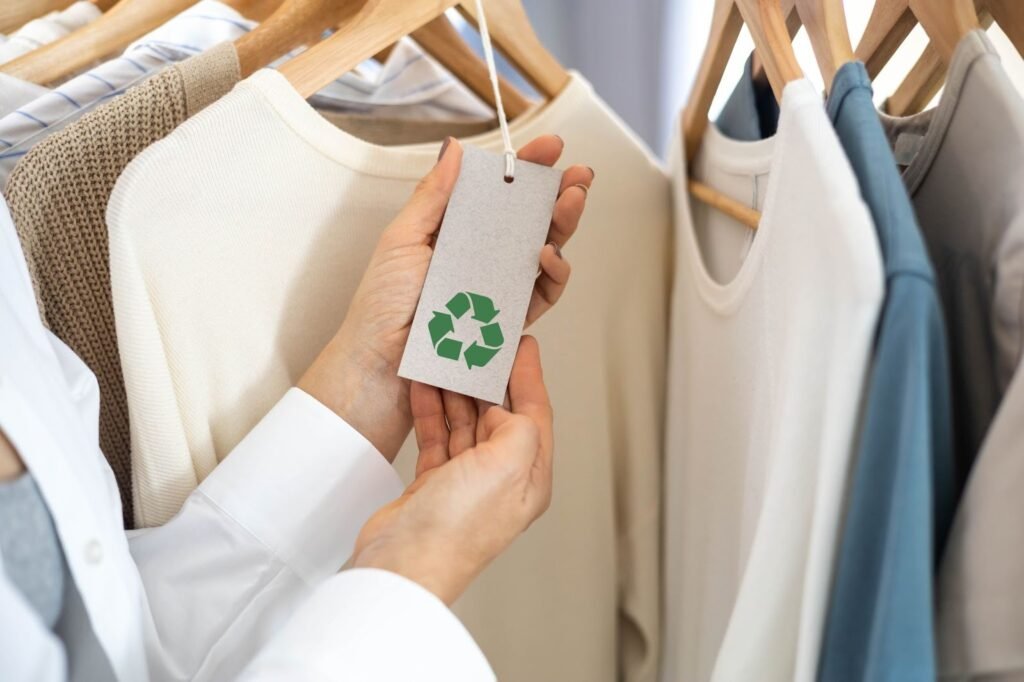
Sustainable clothing reduces your carbon footprint by prioritizing eco-friendly materials, ethical production methods, and waste reduction practices. Unlike fast fashion, which contributes greatly to global emissions, sustainable garments utilize biodegradable fibers like organic cotton and hemp, requiring less energy and water during production. These practices mitigate harmful environmental impacts while promoting longevity in apparel. Additionally, ethical production fosters transparency and fair labor, aligning consumer values with responsible choices. By supporting sustainable brands, you empower the industry to innovate. The journey towards a more sustainable wardrobe can reveal even more influential strategies to reduce your environmental footprint.
KEY TAKEAWAYS
- Sustainable clothing reduces carbon emissions by utilizing eco-friendly materials that require less energy and water during production.
- Choosing natural fibers like organic cotton and hemp minimizes reliance on synthetic materials, which contribute to pollution and waste.
- Ethical production practices ensure fair labor and safe working conditions, promoting social responsibility within the fashion industry.
- Upcycling discarded textiles reduces waste and fosters creativity, encouraging a shift away from fast fashion consumption.
- Mindful consumer choices drive demand for sustainable brands, influencing the fashion industry to adopt eco-friendly practices and reduce its carbon footprint.
UNDERSTANDING CARBON FOOTPRINT
Understanding carbon footprint is essential for evaluating the environmental impact of various industries, including clothing production. A carbon footprint quantifies the total greenhouse gas emissions associated with a product, expressed in relation to carbon dioxide equivalents. This metric is particularly vital in the fashion industry, where carbon emissions can be substantial due to factors such as raw material extraction, manufacturing processes, transportation, and disposal.
Conducting a lifecycle analysis (LCA) allows stakeholders to assess the carbon footprint throughout the entire lifecycle of clothing—from the cultivation of fibers to the final disposal of garments. This thorough approach reveals that the majority of carbon emissions occur during the production phase, often due to energy-intensive processes and the use of non-renewable resources. For instance, conventional cotton farming involves significant pesticide use and water consumption, further exacerbating its environmental impact.
The Impact of Fast Fashion
The rise of fast fashion has dramatically transformed the clothing industry, contributing to a significant increase in carbon emissions and environmental degradation and rising demand from a growing middle class across the globe with higher disposable income, and the emergence of the ‘fast fashion’ phenomenon, leading to a doubling in production over the same period. This business model, characterized by rapid production cycles and low-cost garments, prioritizes consumer demand for inexpensive clothing over sustainable practices. As a result, the fashion industry is now one of the largest polluters globally, accounting for an estimated 10% of annual carbon emissions.
Fast fashion’s environmental degradation is not solely limited to carbon emissions; it encompasses water pollution and waste generation as well. The production of synthetic fibers, often used in these garments, releases microplastics into our oceans, further exacerbating ecological harm. Additionally, the rapid turnover of clothing contributes to an alarming rate of textile waste, with millions of tons ending up in landfills each year.
The social implications of fast fashion extend beyond environmental concerns. Labor practices in the industry often exploit workers, particularly in developing countries, where low wages and unsafe working conditions prevail. This raises ethical questions about consumer responsibility and the true cost of cheap clothing.
Economic factors also play a critical role in perpetuating fast fashion. The model thrives on consumer awareness—or the lack thereof—about the environmental and social impacts of their purchases. By fostering a culture of disposability and instant gratification, fast fashion undermines sustainable alternatives. To combat this, it is essential for consumers to educate themselves and demand accountability from brands, thereby paving the way for a more sustainable and equitable fashion industry.
Benefits of Sustainable Materials
Adopting sustainable materials represents a pivotal change in the fashion industry, offering a viable alternative to the detrimental practices associated with fast fashion. The utilization of natural fibers, such as organic cotton, hemp, and linen, not only reduces the reliance on synthetic materials derived from petrochemicals but also greatly diminishes environmental impacts. These fibers are biodegradable and often require less energy and water for production, thereby lowering the overall carbon footprint of clothing. About 60 per cent of material made into clothing is plastic, which includes polyester, acrylic and nylon textiles.
Incorporating eco-friendly dyes into the manufacturing process further enhances the sustainability of garments. Conventional dyes are notorious for their toxic runoff, which contaminates waterways and harms aquatic ecosystems. In contrast, eco-friendly dyes utilize plant-based or low-impact synthetic options that maintain color vibrancy while minimizing environmental harm. This change not only fosters a healthier planet but also promotes safer working conditions for those involved in the dyeing process.
Moreover, sustainable materials contribute to the longevity of clothing. Garments made from natural fibers exhibit superior durability, meaning they are less likely to end up in landfills after a few wears. This longevity not only encourages consumers to invest in quality pieces but also aligns with a growing desire for personal expression and individuality through fashion.
Ethical Production Practices
While the choice of sustainable materials is essential, it is equally crucial to prioritize ethical production practices in the fashion industry to guarantee a thorough approach to sustainability. Ethical production not only enhances the integrity of sustainable clothing but also supports a broader movement towards social responsibility within the fashion sector.
Central to ethical production is the commitment to fair labor practices, ensuring that workers are compensated fairly and work in safe conditions. This commitment fosters a respect for human rights, allowing artisans to thrive through their craftsmanship while producing eco-friendly textiles. The integration of local production methods further amplifies this impact, as it enables communities to leverage their unique skills and resources, fostering community empowerment and economic development.
Supply chain transparency is another critical aspect of ethical production. Consumers increasingly demand clarity about the origins of their clothing, seeking assurance that their purchases contribute positively to the world. By promoting transparency, brands can build trust and encourage informed consumer choices, leading to a more conscientious marketplace.
Moreover, artisan craftsmanship often embodies a rich cultural heritage, offering unique products that tell a story. Supporting these practices not only preserves traditional skills but also nurtures a connection between consumers and the makers of their clothing.
Reducing Waste Through Upcycling
Upcycling presents a transformative approach to reducing waste in the fashion industry, turning discarded materials into valuable products. This innovative practice employs various upcycling techniques that breathe new life into textiles and garments, promoting waste reduction and sustainability. By creatively repurposing items that would otherwise end up in landfills, individuals can engage in fabric transformation, creating unique pieces that reflect personal style while minimizing environmental impact.
The act of upcycling embodies artistic expression, allowing fashion enthusiasts to explore their creativity through eco-friendly projects. Whether it’s converting a vintage dress into a modern skirt or using leftover fabric scraps to make accessories, DIY clothing serves as a demonstration of the potential of sustainable practices. These projects not only foster individual creativity but also encourage a sense of community involvement by inspiring others to adopt similar practices.
Furthermore, upcycling nurtures a culture of resourcefulness, challenging the fast-fashion paradigm that prioritizes consumption over sustainability. By advocating for waste reduction through creative endeavors, individuals can reclaim their freedom from consumerism and embrace a more responsible lifestyle.
In essence, upcycling serves as a powerful catalyst for change within the fashion industry, exemplifying how waste can be transformed into art. As more people recognize the benefits of upcycling, the potential for a more sustainable future becomes increasingly attainable, proving that fashion can be both stylish and eco-conscious.

THE ROLE OF CONSUMER CHOICES
Consumer choices greatly influence the fashion industry’s environmental impact, particularly through buying habits that prioritize sustainability. As awareness of sustainable brands increases, consumers are empowered to make informed decisions that can reduce their carbon footprint. This shift not only encourages companies to adopt eco-friendly practices but also fosters a culture of responsibility and ethical consumption.
Impact of Buying Habits
The choices individuals make in their purchasing habits greatly influence the sustainability of the fashion industry and its environmental impact. By engaging in mindful shopping and embracing conscious consumption, consumers can actively contribute to reducing their carbon footprint and promoting ethical practices within the industry. Each garment purchased carries a hidden cost, not only financially but also environmentally.
When consumers prioritize quality over quantity, they are more likely to support sustainable clothing brands that emphasize ethical production, durable materials, and reduced environmental impact. This shift is essential in a sector notorious for its resource-intensive processes and waste generation. By opting for sustainable clothing, individuals send a clear message that they value environmental responsibility over fast fashion’s fleeting trends.
Moreover, the power of collective consumer behavior cannot be underestimated. As more individuals choose sustainable options, brands are incentivized to innovate and align their practices with the growing demand for ethical products. In this way, the impact of buying habits extends beyond personal choices to influence the broader fashion ecosystem. Ultimately, adopting mindful shopping habits fosters a culture of sustainability, empowering consumers to be catalysts for change in the fashion industry and beyond.
Sustainable Brand Awareness
As individuals increasingly embrace sustainable purchasing habits, awareness of brands that prioritize eco-friendly practices becomes vital. Sustainable brand recognition is essential for consumers seeking to make informed choices that align with their values. In an era where environmental concerns dominate discussions, consumers wield significant power through their purchasing decisions, influencing market dynamics and prompting brands to adopt greener practices. it takes 3,781 liters of water to make a pair of jeans, from the production of the cotton to the delivery of the final product to the store. That equates to the emission of around 33.4 kilograms of carbon equivalent .
Eco-friendly marketing plays an important role in elevating awareness about sustainable brands. Companies that transparently communicate their commitment to sustainability are more likely to attract conscientious consumers. These brands often emphasize their use of organic materials, ethical labor practices, and reduced carbon footprints, creating a sense of trust and loyalty among their audience.
Moreover, consumer choices directly impact the growth of the sustainable fashion industry. As demand for eco-friendly products increases, brands are incentivized to innovate and enhance their sustainability efforts. This symbiotic relationship between consumers and brands fosters a marketplace conducive to environmental stewardship, where informed decisions lead to tangible reductions in carbon footprints. Ultimately, fostering sustainable brand awareness empowers consumers to exercise their freedom in shaping a more sustainable future, reinforcing the importance of mindful consumption in driving ecological change. As demand for sustainable clothing grows, consumers increasingly seek eco friendly products that reflect their environmental values and reduce the overall impact of fashion consumption.
Long-Term Benefits for the Planet
Sustainability in clothing production heralds a transformative change that promises substantial long-term benefits for the planet. As the fashion industry increasingly embraces eco-friendly technologies and sustainable practices, we witness a paradigm shift toward the use of renewable resources, which can fundamentally alter the ecological landscape. By shifting from conventional materials to sustainably sourced fibers such as organic cotton, hemp, and recycled polyester, brands can considerably reduce their environmental impact. Additionally, the incorporation of eco-friendly technologies for sustainable living, such as waterless dyeing processes and energy-efficient production methods, minimizes waste and reduces carbon emissions, contributing to a healthier atmosphere.
One of the most pressing issues of our time is the depletion of natural resources. Sustainable clothing practices mitigate this concern by utilizing renewable resources that regenerate over time, ensuring a stable supply for future generations. Additionally, the incorporation of eco-friendly technologies, such as waterless dyeing processes and energy-efficient production methods, minimizes waste and reduces carbon emissions, contributing to a healthier atmosphere.
The long-term benefits extend beyond mere resource conservation. By fostering a culture of sustainability, the clothing industry can inspire consumers to make conscientious choices, thereby cultivating a market that prioritizes ethical sourcing and production. This change not only supports environmental health but also stimulates economic growth through the creation of green jobs and the promotion of innovative practices.
Ultimately, sustainable clothing is not just a trend; it is a vital step toward a more harmonious relationship with our planet. By embracing these practices, we pave the way for a brighter, more sustainable future that aligns with the aspirations of those who cherish freedom—freedom from environmental degradation, resource scarcity, and the unsustainable practices of the past.
RELATED STUDIES ABOUT SUSTAINABLE CLOTHING
The shift to sustainable clothing symbolizes a collective effort to mend the frayed fabric of the planet. By choosing garments crafted from ethical materials and produced through responsible practices, individuals contribute to a tapestry of environmental stewardship. Each sustainable choice weaves a narrative of hope, resilience, and renewal, fostering a future where the echoes of fast fashion are replaced by the harmonious sounds of a thriving ecosystem. Embracing this movement not only lessens carbon footprints but also nurtures the Earth for future generations.
Sustainability-Driven Fashion: Unpacking Generation Z’s Second-Hand Clothing Purchase Intentions
This study investigates the factors influencing Generation Z’s intention to purchase second-hand clothing in Italy, with a focus on sustainable and circular fashion consumption.
Methodology:
- A combined theoretical framework was used, integrating the Norm Activation Model (NAM) and the Model of Goal-Directed Behaviour (MGB), supplemented by the price value construct.
- Data were collected via an online survey of 711 Italian Gen Z respondents (born 1993–2012), with 457 fully completed responses analyzed.
- Analysis was conducted using Partial Least Squares Structural Equation Modeling (PLS-SEM).
Key Findings:
- Desire and personal norms significantly positively influence purchase intention.
- Attitude, subjective norms, positive anticipated emotions, and negative anticipated emotions all positively affect desire.
- Perceived behavioural control did not significantly influence desire, suggesting that access to second-hand clothing is not a barrier for Gen Z.
- Problem awareness positively influences ascribed responsibility, which in turn strengthens personal norms.
- Price value has a strong positive effect on purchase intention, highlighting the importance of affordability.
Theoretical Contributions:
- The study is among the first to integrate NAM and MGB in the context of sustainable fashion, offering a more holistic understanding of Gen Z’s consumption drivers.
- It extends existing literature by incorporating moral and emotional dimensions alongside economic factors.
Practical Implications:
- Fashion brands should align with sustainability values, use green advertising, and emphasize eco-labeling to appeal to Gen Z.
- Marketing should highlight environmental responsibility, moral obligation, and affordability.
- Examples of successful strategies include:
- ThredUp and Depop using social media and community-driven approaches.
- Patagonia and Levi’s promoting repair, resale, and longevity.
Limitations and Future Research:
- The study is limited to Italian respondents and focuses on intention rather than actual behavior.
- Future research should explore cross-cultural comparisons, actual purchasing data, brand identity influence, and willingness to pay.
Conclusion
Generation Z’s second-hand clothing purchases are driven by moral values, social influence, anticipated emotions, and price sensitivity. Fashion companies must adopt transparent, sustainable practices and communicate their environmental and ethical commitments to engage this demographic effectively.
| REFERENCE: Anna Prisco, Irene Ricciardi, Martina Percuoco, Vincenzo Basile, Sustainability-driven fashion: Unpacking generation Z’s second-hand clothing purchase intentions, Journal of Retailing and Consumer Services, Volume 85, 2025, 104306, ISSN 0969-6989, https://doi.org/10.1016/j.jretconser.2025.104306. (https://www.sciencedirect.com/science/article/pii/S0969698925000852) |
Tackling Fashion Waste From Inside The Wardrobe: The Influence Of Personal Factors On Sustainable Clothing Use Practice
This study examines how personal factors—fashion trend sensitivity, style orientation, and frugality—influence sustainable clothing use practices (wear, care, and repair) among U.S. consumers, with the goal of extending garment life and reducing fashion waste.
Methodology:
- A quantitative survey was administered to 420 U.S. consumers, representative of the national population in age and gender.
- The study measured sustainable use practices through three dimensions: wear, care, and repair, using adapted scales.
- Data were analyzed using multi-level latent path analysis (SEM) to test the proposed model.
Key Findings:
- Fashion trend sensitivity positively influences sustainable use practices, contrary to the hypothesis that it would negatively affect them.
- Style orientation positively influences sustainable use practices, supporting the hypothesis that style-focused consumers engage more in wear, care, and repair.
- Frugality positively influences sustainable use practices, confirming that financially cautious consumers are more likely to maintain and repair clothing.
- Together, these three personal factors explain 80% of the variance in sustainable clothing use practices.
Theoretical Contributions:
- The study shifts focus from acquisition and disposal to the under-researched use phase of clothing consumption.
- It challenges the assumption that fashion trend sensitivity is inherently unsustainable, showing it can coexist with and even promote sustainable wardrobe engagement.
- Provides a validated measurement framework for sustainable wear, care, and repair practices.
Practical Implications:
- Fashion brands should promote sustainable use through:
- Marketing that encourages wardrobe organization and creative styling.
- Enhanced care labeling and maintenance guidance.
- Post-purchase services such as styling advice and repair guarantees.
- Policymakers should consider regulations that hold brands accountable for product longevity and transparency in care instructions.
Limitations and Future Research:
- Relies on self-reported data and adapted scales; future studies should develop more comprehensive measures for use-phase behaviors.
- Does not explore the relationship between purchasing habits and use practices.
- Future research could examine cross-cultural differences and the role of emotional attachment in clothing use.
Conclusion:
Sustainable clothing use is significantly influenced by fashion trend sensitivity, style orientation, and frugality. Encouraging consumers to engage more deeply with their wardrobes—through wearing, caring for, and repairing garments—can prolong clothing life, reduce waste, and lessen the environmental impact of fashion.
| REFERENCE: Cosette M. Joyner Martinez, Samira Iran, Jessica F. Dao, Tackling fashion waste from inside the wardrobe: The influence of personal factors on sustainable clothing use practice, Cleaner and Responsible Consumption, Volume 15, 2024, 100233, ISSN 2666-7843, https://doi.org/10.1016/j.clrc.2024.100233. (https://www.sciencedirect.com/science/article/pii/S2666784324000664) |
Can Information Help Bridge The Attitude-Behavior Gap In Sustainable Clothing Consumption?
This research investigates how sustainability information—its quality, content, and channels—can help bridge the attitude-behavior gap in sustainable clothing consumption among German consumers, with a focus on age-related differences.
Methodology:
- Study 1 (n = 441): Structural Equation Modeling (SEM) to test the influence of sustainable information quality, certifications, skepticism, online opinion seeking, and brand reputation on purchase intentions.
- Study 2 (n = 448): Best-Worst Scaling (BWS) analysis to identify preferences for online information channels and content across age groups (under 40 vs. 40+).
Key Findings:
- Sustainable information quality significantly increases purchase intentions and reduces consumer skepticism.
- Sustainability certifications enhance brand reputation but do not directly affect purchase intentions or skepticism.
- Online opinion seeking (e.g., influencers) positively influences purchase intentions and brand reputation.
- Consumer skepticism negatively affects purchase intentions; brand reputation reduces skepticism.
- Age matters:
- Younger consumers (<40) prefer social media channels (Instagram, YouTube) and value details about the value chain.
- Older consumers (40+) prefer traditional channels (company websites, newsletters, online forums) and prioritize material information and certifications.
- Across all ages, the company website is the most trusted channel, and sustainability certifications are the most valued content.
Theoretical Contributions:
- Extends cue utilization theory and information processing models to sustainable fashion.
- Demonstrates age-specific information preferences, refining understanding of generational differences in sustainable consumption.
- Introduces Best-Worst Scaling as an effective method for evaluating information preferences in sustainability contexts.
Practical Implications:
- Fashion brands should:
- Provide high-quality, credible information through company-owned channels (websites, newsletters).
- Use third-party certifications to build trust and transparency.
- Tailor communication by age group:
- Younger audiences: Leverage social media and influencer content.
- Older audiences: Focus on detailed, factual content via newsletters and forums.
- Incorporate visual and interactive formats (videos, Q&A sessions) to enhance engagement.
Limitations and Future Research:
- Samples limited to German online consumers; cultural and offline consumer differences not captured.
- Self-reported data may be influenced by social desirability bias.
- Future research should explore information overload, value orientations, and cross-cultural comparisons.
Conclusion:
Information can help bridge the attitude-behavior gap in sustainable clothing consumption, but mere communication is insufficient. Information must be credible, relevant, and delivered through age-appropriate channels. Fashion companies must adopt segmented, multi-channel communication strategies to effectively convert sustainable attitudes into purchasing behavior.
| REFERENCE: Teresa Ries, Alexandra Rese, Can information help bridge the attitude–behavior gap in sustainable clothing consumption?, Cleaner and Responsible Consumption, Volume 17, 2025, 100278, ISSN 2666-7843, https://doi.org/10.1016/j.clrc.2025.100278. (https://www.sciencedirect.com/science/article/pii/S2666784325000294) |