
As an electronics engineer, my daily work revolves around optimizing systems for efficiency, low power consumption, and thermal stability. In the lab, we are constantly trained to prioritize flammability standards and protect circuit boards from catastrophic thermal events. For decades, the industry’s default response to fire risk has been treating printed circuit boards, enclosures, and internal connectors with synthetic additives, particularly brominated flame retardants (BFRs).
But when you step back from the bench and look at the broader lifecycle of hardware, it becomes clear that we solved one safety problem by engineering an environmental catastrophe. When electronics reach their end-of-life, the persistent chemical bonds that made these flame retardants so resilient also make them virtually indestructible in the wild. These compounds do not simply disappear; they leach into ecosystems, bioaccumulate, and disrupt biological functions across food webs.
We cannot call a device “smart” or “innovative” if its physical footprint leaves behind toxic contaminants that persist for generations. True engineering progress requires addressing not just the operational performance of our hardware, but its ultimate chemical destiny long after it leaves the consumer’s hands.
Brominated flame retardants (BFRs) in electronics pose serious environmental toxicity risks. These substances can leach into soil and water during usage and improper disposal, harming ecosystems. BFRs are persistent, bioaccumulate, and are linked to health issues like endocrine disruption and cancer. With legislation tightening around their use, manufacturers are urged to adopt safer alternatives. Understanding the full impact of BFRs can lead you to better practices and solutions for managing electronic waste.
KEY TAKEAWAYS
- Brominated Flame Retardants (BFRs) pose significant health risks, including endocrine disruption and increased cancer risk, especially through exposure from e-waste.
- Improper recycling of electronic devices leads to BFR leaching, contaminating soil and water systems, and harming ecosystems.
- BFRs are persistent in the environment, bioaccumulating in living organisms and posing long-term toxicity risks to human health.
- Legislative measures, like the EU RoHS Directive, aim to restrict BFR use and promote safer alternatives in electronics manufacturing.
- Innovative recycling methods and community awareness campaigns are essential for managing e-waste and preventing harmful chemical release into the environment.
WHY BROMINATED FLAME RETARDANTS ARE A CONCERN IN ELECTRONICS
Although brominated flame retardants (BFRs) are effective in reducing fire hazards in electronic devices, their widespread use raises significant environmental and health concerns. The presence of brominated compounds in electronics poses essential toxicity concerns, as these chemicals can leach into the environment during production and disposal.
Studies have linked exposure to BFRs with endocrine disruption, neurodevelopmental issues, and potential carcinogenic effects. As you consider the innovation in electronics, it’s important to acknowledge that the persistence of these compounds in ecosystems can lead to bioaccumulation, adversely affecting wildlife and human health.
Moreover, regulatory scrutiny around BFRs is increasing, prompting manufacturers to seek safer alternatives. The challenge lies in balancing fire safety with environmental responsibility.
Developing innovative materials that maintain safety without compromising ecological integrity is fundamental for future electronics. Addressing these toxicity concerns isn’t just necessary; it’s a significant step toward sustainable technological advancement.
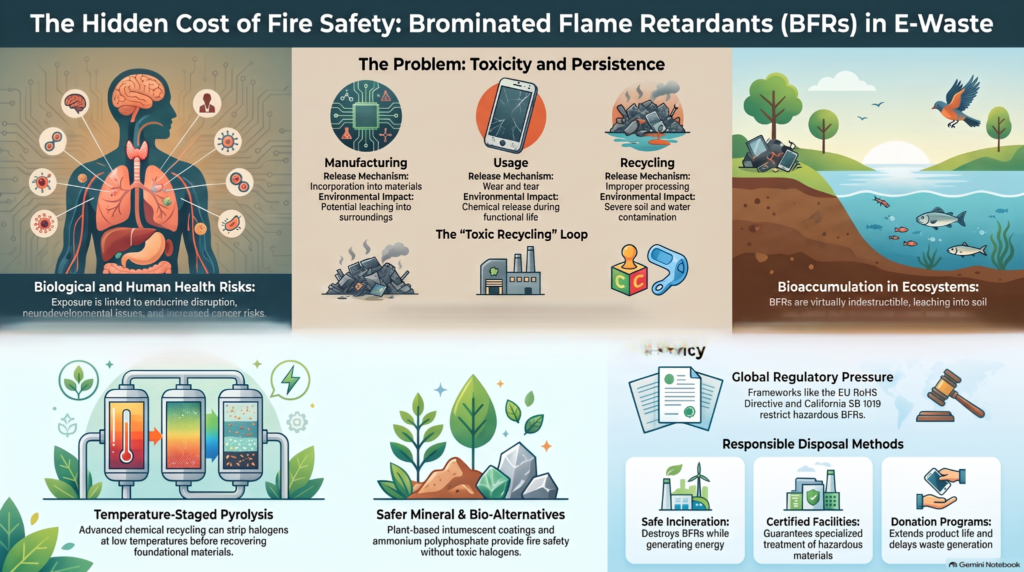
The Lifecycle of Electronic Devices and BFR Release
As electronic devices progress through their lifecycle—from production to disposal—brominated flame retardants (BFRs) can be released into the environment at various stages. In device manufacturing, BFRs are often incorporated into materials to enhance fire safety, but this can lead to leaching during use. When the devices reach the end of their life, improper recycling processes can further exacerbate BFR release, contaminating soil and water.
| Stage | BFR Release Mechanism | Environmental Impact |
| Manufacturing | Incorporation into materials | Potential leaching |
| Usage | Wear and tear | Release into the environment |
| Recycling | Improper processing | Soil and water contamination |
Understanding these stages highlights the importance of innovative recycling methods and safer manufacturing practices to reduce BFR exposure and protect the environment.
The Environmental Impact of BFRs in E-Waste
Brominated flame retardants (BFRs) are mixtures of man-made chemicals that are added to a wide variety of products, including for industrial use, to make them less flammable. They are used commonly in plastics, textiles and electrical/electronic equipment.
Brominated flame retardants (BFRs) in e-waste pose significant toxicity risks to both human health and the environment.
As you consider the challenges of e-waste disposal, it’s vital to recognize how improper handling can lead to the leaching of these harmful substances into soil and water systems.
The complexity of e-waste recycling further exacerbates these issues, making effective management essential for minimizing environmental impact.
Toxicity of BFRs
Flame retardants are a group of compounds used in a variety of consumer goods to inhibit or retard the spread of flames. Several classes of chemical compounds have such capabilities, however, the persistence of these compounds in the environment and their toxicity are crucial points for a risk assessment. Classes such as polybrominated diphenyl ethers (PBDEs) have already been banned in some parts of the world while they are still permitted and extensively used in other parts of the globe. In the need for substitutes for the toxic compounds used, new structures have been synthesized and suggested by the industry as an alternative and substitutives flame retardants. The objective of this review is to address the classes of compounds used as flame retardants in terms of their toxicity to human or non-human organisms and their persistence in the environment.
When you consider the environmental impact of electronic waste, the toxicity of brominated flame retardants (BFRs) becomes a critical concern.
These substances, prized for their fire-retardant properties, pose significant health and environmental risks. Research indicates that BFRs can bioaccumulate, leading to adverse effects in wildlife and potentially humans.
Inadequate BFR regulations worldwide exacerbate this issue, allowing for unchecked release into ecosystems. Studies have linked BFR exposure to endocrine disruption and neurodevelopmental issues, highlighting the urgency for innovative solutions.
Shifting to safer alternatives and tightening regulations could mitigate these risks. As you engage with this complex issue, consider how sustainable practices can reshape the landscape of electronic manufacturing and e-waste disposal, reducing the toxic legacy of BFRs.
E-Waste Disposal Challenges
Despite advances in recycling technology, the challenges of e-waste disposal remain intimidating, primarily due to the environmental impact of brominated flame retardants (BFRs) found in many electronic devices.
These hazardous materials complicate e-waste recycling efforts, as BFRs can leach into soil and water, posing health risks to both ecosystems and humans. Current recycling processes often fail to fully eliminate these toxic compounds, making it essential to develop innovative methods that effectively neutralize BFRs.
In addition, regulatory frameworks need to adapt to better manage these hazardous materials, promoting safer disposal practices.
How BFRs Harm Human Health
While many people may not realize it, exposure to brominated flame retardants (BFRs) poses significant health risks. These chemicals, often found in electronic waste, can lead to various detrimental health effects. Here’s what you should know:
- Endocrine Disruption: BFR exposure can interfere with hormone regulation, potentially causing reproductive issues and developmental problems.
- Neurodevelopmental Concerns: Studies indicate that BFRs may negatively impact cognitive function and behavior in children, leading to long-term learning disabilities.
- Carcinogenic Potential: Some BFRs have been linked to increased cancer risk, raising concerns about their presence in everyday products.
Understanding these health effects emphasizes the urgency of addressing BFR exposure.
As you innovate solutions for e-waste, consider the implications of these harmful substances on human health, and aim for safer alternatives.
E-WASTE DISPOSAL PRACTICES TO REDUCE TOXICITY
When I design low-power IoT devices or energy-harvesting hardware, my primary mission is to integrate sustainability directly into the physical architecture. However, navigating the chemical reality of e-waste recycling is one of our greatest engineering bottlenecks. Standard mechanical recycling methods frequently fail to isolate or neutralize hazardous organobromine additives. Instead of closing material loops cleanly, contaminated plastics are often downcycled into everyday consumer items including children’s toys unintentionally perpetuating human and environmental toxicity cycles.
This is why hardware developers must actively push for circular design principles. Rather than relying on legacy additives like polybrominated diphenyl ethers (PBDEs), we need to champion safer alternatives. Mineral-based substitutes such as ammonium polyphosphate, along with bio-derived intumescent coatings, prove that we can meet strict flammability ratings without relying on toxic halogens.
Simultaneously, supporting advanced chemical recycling techniques like temperature-staged pyrolysis that can strip out halogens before repolymerization allows us to recover foundational materials without contaminating virgin supply chains. As engineers and innovators, we must demand transparency across our supply chains, choose non-hazardous materials from the schematic phase onward, and actively design devices for safe disassembly and reclamation.
Flame Retardants are any chemicals added to manufactured materials such as plastics, textiles and surface coatings, to inhibit, suppress, or delay the production of flames and prevent the spread of fire. They have been used in many consumer and industrial products, since the 1970s, to decrease the ability of materials to ignite. Inorganic and organic flame retardant have been used. There are three primary types of organic frame retardants: bromine (Br), chlorine (Cl) and phosphate (P).
To effectively reduce the toxicity of e-waste, you should consider engaging with responsible recycling programs that guarantee safe handling of hazardous materials.
Utilizing safe disposal methods prevents harmful substances from entering the environment, while participating in e-waste collection events facilitates proper recycling and recovery of valuable components.
Responsible Recycling Programs
Responsible recycling programs play an essential role in mitigating the environmental impact of electronic waste, particularly concerning brominated flame retardants (BFRs) found in many electronic devices.
By participating in effective programs and recycling initiatives, you can greatly reduce the toxicity associated with e-waste. Here are three ways these programs make a difference:
- Collection and Sorting: They guarantee proper collection and sorting of electronic devices, segregating BFR-laden materials from recyclable components.
- Safe Processing: Responsible recycling initiatives utilize techniques that safely process and dispose of hazardous materials, minimizing environmental leakage.
- Public Awareness: These programs educate you on the importance of responsible electronic waste disposal, fostering a culture of sustainability.
Safe Disposal Methods
When disposing of electronic waste, utilizing safe methods is critical to minimizing the release of harmful brominated flame retardants (BFRs) into the environment. Innovative recycling technologies can effectively reclaim valuable materials while safely managing BFRs. These approaches can provide secure e-waste solutions that minimize environmental contamination and protect human health. You should consider the following disposal options:
| Disposal Method | Benefits |
| Recycling Technologies | Reduces landfill waste, reclaims materials |
| Safe Incineration | Destroys BFRs, generates energy |
| Certified E-Waste Facilities | Guarantees proper handling and treatment |
| Donation Programs | Extends product life, reduces waste |
E-Waste Collection Events
Participating in e-waste collection events is an effective way to assure that electronic devices are disposed of responsibly, minimizing the risk of toxic brominated flame retardants (BFRs) contaminating the environment.
By engaging in these initiatives, you contribute to a sustainable future. Here are three benefits of attending these events:
- Environmental Protection: Proper disposal prevents harmful chemicals from leaching into soil and water.
- Community Engagement: E-waste awareness campaigns foster a sense of responsibility among community members, promoting recycling initiatives.
- Resource Recovery: Many collection events assure valuable materials are reused, reducing the need for new raw materials.
New Alternatives to Brominated Flame Retardants
As the environmental and health concerns surrounding brominated flame retardants (BFRs) continue to mount, researchers are actively exploring safer alternatives that can provide equivalent fire safety without the associated risks.
Innovative materials, such as biodegradable alternatives, are gaining traction in this quest. These materials often derive from natural sources, reducing toxicity and enhancing sustainability.
For instance, intumescent coatings made from plant-based polymers offer effective flame retardancy while breaking down safely in the environment. Additionally, minerals like ammonium polyphosphate are emerging as promising substitutes, providing fire resistance without harmful side effects.
The shift towards these alternatives not only addresses ecological concerns but also aligns with consumer demand for greener products, including eco friendly products that prioritize safety and sustainability.
Legislation Impacting Brominated Flame Retardants in Electronics
While concerns over the environmental and health risks of brominated flame retardants (BFRs) escalate, legislation aimed at regulating their use in electronics is gaining momentum.
You need to stay informed about the evolving regulatory frameworks, as they greatly impact industry compliance. Here are three key developments:
- EU RoHS Directive: This restricts hazardous substances, including certain BFRs, in electronic equipment, pushing manufacturers toward safer alternatives.
- California’s SB 1019: This legislation targets BFRs in various consumer products, promoting stricter compliance standards for manufacturers operating in the state.
- Global Harmonization Initiatives: Countries are increasingly aligning their regulations on BFRs, fostering a more unified approach to electronic waste management.
These legislative actions reflect a commitment to safeguarding public health and the environment.
As an innovator, understanding these regulations will help you navigate compliance and contribute to a sustainable future in electronics.

RELATED STUDIES ABOUT BROMINATED FLAME RETARDANTS ENVIRONMENTAL TOXICITY
In summary, the pervasive use of brominated flame retardants (BFRs) in electronics poses a colossal threat to both environmental and human health. By understanding their lifecycle and impact, you can make informed choices about e-waste disposal and support safer alternatives. It’s essential to advocate for stronger legislation to mitigate this crisis. Together, we can push for a future where technology doesn’t compromise our health or the planet, ensuring a safer world for generations to come.
Legacy brominated flame retardants in children’s products in South Africa: Evidence of toxic recycling in a global circular economy
Study Overview
The study, titled “Legacy brominated flame retardants in children’s products in South Africa: Evidence of toxic recycling in a global circular economy” by Rebecca Mlelwa and Hanna-Andrea Rother (published in Heliyon, 2026), investigates the contamination of children’s plastic products in the South African market by persistent organic pollutants (POPs) originating from recycled electronic waste (WEEE).
Key Findings
- Prevalence of Contamination: Using handheld X-ray fluorescence (XRF) spectrometry, elemental bromine (Br) was detected in 38% (52 of 138) of the sampled children’s items, with concentrations ranging from 10 to 7,223 mg/kg. Antimony (Sb), a flame retardant synergist, co-occurred in 90% of the Br-positive samples.
- High-Risk Items: The highest Br concentrations (>1,000 mg/kg) were found in playtime items such as Rubik’s Cubes, a toy mobile phone, and a puzzle mat. Moderate concentrations (100–1,000 mg/kg) were detected in sunglasses, car seats, toy vehicles, toy weapons, and stethoscopes.
- Evidence of “Toxic Recycling”: The observed Br and estimated DecaBDE levels were below the 5% to 10% by weight required for intentional flame retardancy. This confirms that the chemicals are unintentional contaminants resulting from the mechanical recycling of e-waste plastics into new consumer goods.
- Regulatory Exceedances: When estimating DecaBDE concentrations, 85% of Br-positive products exceeded the Basel Convention Low POP Content Limit (LPCL) of 50 mg/kg, and 19% exceeded the higher 1,000 mg/kg limit.
Trade Dynamics & Exposure Risks
- Circular Trade Route: South Africa collects and exports shredded WEEE plastics (primarily to China) due to domestic recycling constraints, and subsequently imports finished, low-cost plastic toys and accessories manufactured with recycled materials.
- Health Hazards: Children face substantial risks of chronic exposure through direct skin contact, ingestion of contaminated household dust, and mouthing of toys. Legacy POPs-BFRs are established neurodevelopmental toxins, endocrine disruptors, and carcinogens.
Policy & Practical Recommendations
- Regulatory Upgrades: Integrate specific legal concentration limits for legacy POPs-BFRs into consumer safety legislation (such as the Consumer Protection Act and national toy safety standards).
- Targeted Border & Market Screening: Deploy portable XRF devices for rapid, cost-effective screening of imported children’s products at ports of entry and domestic retail points.
- Inter-Agency Collaboration: Establish coordinated oversight involving the Department of Forestry, Fisheries, and the Environment, the Department of Health, and the National Consumer Commission to enforce supply-chain transparency and chemical safety.
| REFERENCE: Rebecca Mlelwa, Hanna-Andrea Rother, Legacy brominated flame retardants in children’s products in South Africa: Evidence of toxic recycling in a global circular economy, Heliyon, Volume 12, Issue 11, 2026, e45106, ISSN 2405-8440, https://doi.org/10.1016/j.heliyon.2026.e45106. (https://www.sciencedirect.com/science/article/pii/S2405844026006183) |
Elucidating the role of microplastics as reservoirs of brominated flame retardants in river sediment
Study Overview
The study, titled “Elucidating the role of microplastics as reservoirs of brominated flame retardants in river sediment” by Jingxi Jin et al. (published in Journal of Hazardous Materials, 2026), investigates whether microplastics (MPs) act as major vectors or reservoirs for brominated flame retardants (BFRs) in freshwater sediment. The researchers collected sediment upstream and downstream of a wastewater treatment plant (WWTP) on the River Tame, UK, across a 12-month period to measure concentrations of eight polybrominated diphenyl ethers (PBDEs) and eight novel brominated flame retardants (NBFRs) across bulk sediment, isolated MPs, and residual sediment.
Key Findings
- Minor Contaminant Reservoir: MPs accounted for a very low fraction—typically less than 1%—of the total BFR mass in the analyzed sediments. For example, the proportion of BDE-209 associated with isolated MPs was consistently below 0.2% compared to the residual sediment matrix.
- Partitioning Dynamics: Partition coefficients (Kd) revealed a statistically significant negative correlation with the octanol–water partition coefficient (log Kow). This demonstrates that more hydrophobic, higher-log Kow BFRs (such as BDE-209 and DBDPE) partition more strongly to natural sediment particles than to MPs.
- Lack of Correlation: No statistically significant correlation was found between MP abundance and BFR sediment concentrations across sampling events, with the sole exception of a weak correlation for BDE-183 (r = 0.405, p = 0.049).
- Dominant Pollutants & Polymers:
- BFRs: BDE-209 was the dominant PBDE (median of 25 ng/g dw in bulk sediment), while decabromodiphenyl ethane (DBDPE) was the dominant NBFR (median of 16.12 ng/g dw in bulk sediment).
- Polymers: Polyvinyl chloride (PVC) was the dominant polymer among extracted MPs, showing strong episodic co-occurrence with peak DBDPE levels.
Spatial and Temporal Dynamics
- Wastewater Treatment Plant (WWTP) Impact: Downstream sediment had higher median MP abundance (101.67 vs. 81.67 MPs/kg) and higher median BDE-209 concentrations (41.6 vs. 8.6 ng/g dw, p = 0.034). However, the WWTP did not exert a statistically significant influence on overall MP abundances (p > 0.05) or on the concentrations of other target BFRs.
- Temporal Variation: Contaminant levels showed no clear seasonal trends linked to temperature or rainfall, but rather exhibited episodic spikes, most notably in November 2022.
Environmental & Risk Implications
- Sediment as the Primary Sink: Natural mineral and organic sediment particles, rather than microplastics, serve as the primary sink and mass reservoir for legacy and novel BFRs in urban riverine environments.
- Contaminant Modeling: While MPs can sorb organic pollutants, their low mass fraction in natural sediments limits their role as significant BFR carriers under typical environmental conditions, contrasting with extreme industrial or e-waste hotspots.
| REFERENCE: Jingxi Jin, Shijie Wang, Yulong Ma, Simeon Onoja, William A. Stubbings, Mohamed Abou-Elwafa Abdallah, Stuart Harrad, Elucidating the role of microplastics as reservoirs of brominated flame retardants in river sediment, Journal of Hazardous Materials, Volume 504, 2026, 141303, ISSN 0304-3894, https://doi.org/10.1016/j.jhazmat.2026.141303. (https://www.sciencedirect.com/science/article/pii/S0304389426002815) |
Impact of brominated flame retardants on the chemical recycling of polystyrene via pyrolysis
Study Overview
The study, titled “Impact of brominated flame retardants on the chemical recycling of polystyrene via pyrolysis” by Razan Alsharqawi et al. (published in Chemical Engineering Journal, 2026), investigates the pyrolysis behavior of expanded polystyrene (EPS) waste from external thermal insulation composite systems (ETICS) containing brominated flame retardants (BFRs). The authors evaluate both legacy hexabromocyclododecane (HBCD) and modern polymeric flame retardant (PolyFR) to assess whether pyrolysis can selectively separate bromine into the gas phase while preserving a high-quality, styrene-rich oil suitable for circular polystyrene production.
Key Findings
- Efficient Early Bromine Release: Quantitative TG-FTIR analysis demonstrated that approximately 90 wt% of the bromine in PolyFR is released as hydrogen bromide (HBr) below 350°C during the initial decomposition step. This dehydrobromination pathway operates independently of the polystyrene-to-flame-retardant mixture ratio.
- Preserved Product Quality: At application-relevant concentrations (0.2–0.3 wt% Br), Py-GC–MS confirmed that neither HBCD nor PolyFR compromises the product slate. Pyrolysis oil remains dominated by styrene monomer (75–78% relative peak area), dimer (7–8%), and trimer (12–13%), with no significant formation of brominated hydrocarbons.
- High-Temperature Stabilization Effects: Beyond 372°C and at elevated PolyFR contents (25–75 wt%), the decomposition deviates from simple theoretical superposition. Conjugated polyene intermediates formed from the PolyFR backbone act as radical scavengers and promote crosslinking, causing a modest stabilization of the remaining polystyrene matrix and slightly increasing solid residue.
- Temporal & Temperature Separation:
- At standard heating rates (10 K/min), HBr evolution (peaking around 265°C) is distinctly separated in time and temperature from polystyrene depolymerization (350–450°C).
- At industrial heating rates (100 K/min), HBr is rapidly released within ~3 minutes.
- Two-stage pyrolysis (Stage 1 at 350°C; Stage 2 at 450°C) achieved complete partitioning of HBr to the first stage, leaving the second-stage hydrocarbon vapors free of detectable bromine.
Industrial & Circular Economy Implications
- Overcoming the Recycling Bottleneck: Because mechanical recycling cannot eliminate hazardous HBCD or PolyFR additives, chemical recycling via pyrolysis provides a viable pathway to divert decades of accumulated ETICS insulation waste from municipal solid waste incinerators.
- Reactor & Process Design: The marked temperature separation between dehydrobromination and polymer depolymerization enables two practical engineering strategies:
- Temperature-Staged Pyrolysis: Low-temperature thermal stripping (≤350°C) to recover HBr gas, followed by high-temperature depolymerization (450°C) to produce monomer-grade oil.
- Single-Step Fast Pyrolysis: Rapid volatilization coupled with downstream inline gas scrubbing to remove HBr before oil condensation.
- Downstream Purification: Diverting the bulk of bromine into the gas phase as HBr significantly lowers the burden and cost of downstream catalytic hydrodehalogenation, bringing halogen levels closer to strict petrochemical steam-cracker specifications.
| REFERENCE: Razan Alsharqawi, Daniela Merz, Tim Kurtz, Michael Zeller, Niklas Netsch, Britta Bergfeldt, Salar Tavakkol, Dieter Stapf, Impact of brominated flame retardants on the chemical recycling of polystyrene via pyrolysis, Chemical Engineering Journal, Volume 540, 2026, 177409, ISSN 1385-8947, https://doi.org/10.1016/j.cej.2026.177409. (https://www.sciencedirect.com/science/article/pii/S1385894726048709) |
CONCLUSION
Sustainable electronics cannot simply be a marketing label for energy-efficient microchips; it must be an absolute commitment to material health from component design to decommissioning. The persistent threat posed by brominated flame retardants reminds us that technological innovation is incomplete if it harms the living environment it operates within. When e-waste is improperly burned or discarded in landfills, the toxic legacy of our designs returns to our soil, water, and communities.
We stand at a pivotal moment where green engineering principles, consumer advocacy, and stricter regulatory frameworks like the EU RoHS Directive must converge. By steering away from harmful halogenated compounds and investing in non-toxic, bio-compatible alternatives, the electronics industry can lead the transition toward a truly circular economy.
For every engineer drafting the next schematic, every policymaker enforcing chemical thresholds, and every consumer choosing certified e-waste recyclers, the collective goal must be the same: building advanced technology that functions efficiently, protects human well-being, and leaves behind a clean, habitable planet for future generations.