
Whenever I look at municipal balance sheets or regional economic forecasts, there is an invisible line item that traditional accounting consistently fails to capture: the compounded cost of contamination. In economic policy, we often talk about industrial output, job creation, and gross domestic product as the primary metrics of urban vitality. However, spending years evaluating policy designs alongside public agencies and NGOs has shown me that treating environmental pollution merely as an unfortunate ecological byproduct is a critical financial blind spot.
When toxic chemicals and particulate matter enter an urban ecosystem, they initiate an immediate fiscal drag. We aren’t just looking at environmental degradation; we are looking at ballooning public health expenditures, diminished workforce capacity, and suppressed municipal tax bases caused by falling real estate values. In my community work, whether organizing neighborhood clean-ups or running along city corridors flanked by industrial infrastructure, I see firsthand how localized pollution directly shapes the economic resilience of a neighborhood.
If we want to build resilient cities, we must stop viewing environmental standards as an administrative burden or a brake on industrial development. Instead, we have to recognize rigorous chemical and emissions management as an essential economic baseline that preserves human capital and protects long-term municipal solvency.
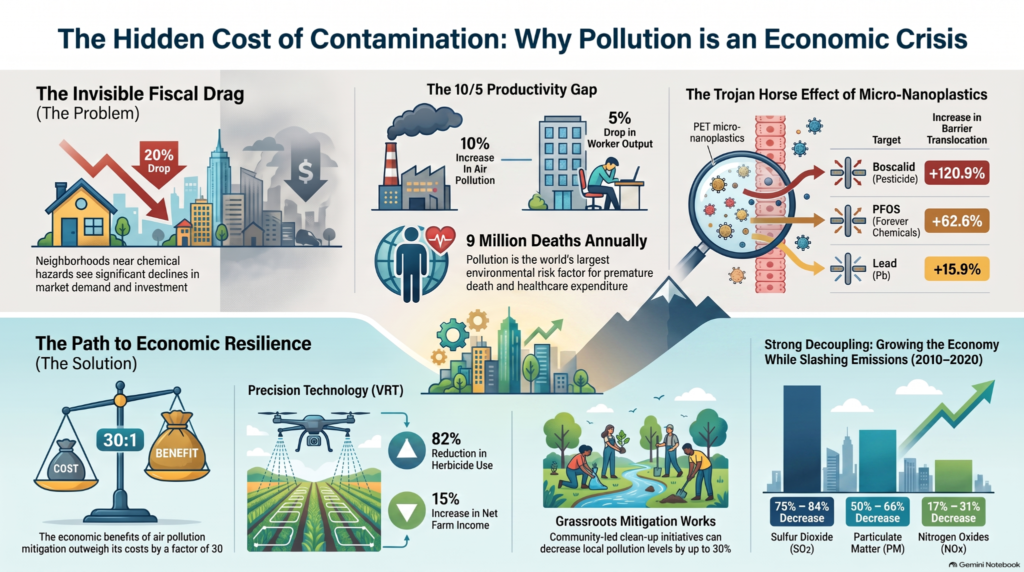
Measuring the economic impact of chemical pollutants in urban communities involves analyzing increased healthcare costs from pollution-related illnesses, lost productivity due to worker absenteeism, and declining property values. Research shows that pollution can lower property values by up to 20% and that a 10% rise in air pollution correlates with a 5% drop in worker output. Effective regulations can mitigate these costs, revealing essential insights into the broader economic implications. More findings await you ahead.
KEY TAKEAWAYS
- Chemical exposure raises healthcare costs significantly due to increased hospital visits and chronic disease management in urban communities.
- Property values near chemical hazards can decline by up to 20%, impacting local real estate markets.
- Pollution leads to higher workplace absenteeism and a 5% drop in worker productivity with every 10% increase in air pollution.
- Effective environmental regulations reduce healthcare costs and boost economic growth by attracting investment in cleaner environments.
- Community engagement and ecosystem service valuation help quantify pollution’s economic impact, guiding policy decisions and improving public health initiatives.
UNDERSTANDING THE ECONOMIC IMPACT OF CHEMICAL POLLUTANTS
Chemical pollutants significantly harm public health by causing disease like cancer, respiratory illnesses and cardiovascular problems. This substance can damage organs, disrupts the endocrine system, affect DNA, and cause both immediate issues like skin rashes and long – term chronic condition such as neurodegenerative disorders. The effect very based on chemical, the exposure (inhalation ingestion, skin contact), and the duration of exposure.
How do chemical pollutants affect the economy? The impact of chemical exposure on urban health is profound and multifaceted. High levels of pollutants can lead to increased healthcare costs and lost productivity due to illness.
For instance, communities grappling with air and water contaminants often experience higher rates of respiratory diseases and other health issues, which can result in significant economic burdens. Studies show that urban areas with elevated pollution levels face decreased property values, affecting local tax revenues and overall economic growth.
Moreover, businesses may struggle to attract talent in polluted regions, stifling innovation and job creation. Policymakers must prioritize stringent regulations and invest in sustainable practices to mitigate these impacts.
Direct Costs of Chemical Pollution on Healthcare
Pollution continues to be the world’s largest environmental risk factor for disease and premature death. It is estimated to be responsible for at least 9 million deaths a year globally.
While the long-term effects of chemical pollution on public health are widely documented, the immediate direct costs on healthcare systems demand urgent attention. You face rising healthcare costs driven by increased hospital visits, chronic disease management, and emergency care linked to pollution exposure.
A recent study suggests that urban communities bear an annual pollution burden of billions in healthcare expenditures due to respiratory illnesses, neurological disorders, and other pollution-related ailments.
To address this, innovative policies must prioritize pollution reduction and invest in cleaner technologies. By reallocating funds from reactive healthcare spending to proactive environmental policies, you can notably lower the healthcare costs associated with chemical pollutants.
Investing in community health initiatives not only mitigates the pollution burden but also enhances overall public health, creating a sustainable future. It’s essential to recognize that reducing chemical pollution can lead to considerable long-term savings for healthcare systems and improve quality of life in urban settings.
The Economic Impact of Pollution on Property Values
Air pollution is responsible for a vast array of economic costs, from the healthcare expenditures associated with pollution-related illnesses and death to the costs associated with environmental damage and lost ecosystem services. Poor air quality has also been linked to decreased workplace productivity and decreased tourism, which impacts economies across the globe. However, research also shows that the economic benefits associated with air pollution mitigation outweigh its costs by a factor of 30, providing significant support for cleaner technology and green industry development.
Pollution markedly decreases market demand for properties, as buyers often shy away from areas with known chemical hazards.
This decline in interest can lead to reduced property values, which in turn discourages neighborhood investment and revitalization efforts.
Understanding these dynamics is essential for policymakers aiming to mitigate the economic impacts of pollution on communities.
Decreased Market Demand
Chemical pollutants can greatly decrease market demand for properties located in affected areas. When you analyze market trends, you’ll notice that consumer behavior shifts dramatically in response to environmental concerns.
Potential buyers become increasingly wary of properties near pollution sources, fearing health risks and long-term implications on their investment. Data shows that neighborhoods with high pollution levels often see property values decline by as much as 20%, reflecting a tangible impact on the market.
This decline not only affects individual sellers but also stifles community growth and revitalization efforts. Policymakers must recognize these patterns and implement stringent regulations to mitigate pollution, thereby restoring consumer confidence and enhancing property values.
Addressing these issues innovatively can reinvigorate urban markets and foster sustainable development.
Neighborhood Investment Decline
As investors seek profitable opportunities, they often shy away from neighborhoods plagued by pollution, considerably contributing to a decline in local investment. This aversion negatively affects property values, limiting the financial resources necessary for community revitalization.
Data shows that areas with higher pollution levels experience a 20% reduction in property sales compared to cleaner neighborhoods, deterring potential buyers and investors alike. Innovative investment strategies must prioritize environmental remediation to rejuvenate these communities while addressing a company’s environmental sustainability strategy concerns.
How Pollution Affects Productivity
When environmental pollutants infiltrate the workplace, they can considerably diminish productivity across various sectors. Studies show that exposure to harmful chemicals leads to increased workplace absenteeism, as employees take time off due to health issues. This not only disrupts operations but also incurs significant costs for businesses.
Additionally, the presence of pollution can reduce productivity even among present workers, as cognitive functions and physical performance decline in polluted environments. For instance, research indicates that a mere 10% increase in air pollution correlates with a 5% drop in worker output.
To combat these issues, companies should advocate for innovative solutions that address pollutant sources, while policymakers must prioritize environmental health regulations. Investing in sustainable business practices and cleaner technologies can not only enhance workforce well-being but also bolster economic resilience, ultimately benefiting urban communities.
It’s essential to understand the direct link between pollution and productivity to drive effective change.
THE ROLE OF ENVIRONMENTAL REGULATIONS IN REDUCING ECONOMIC COSTS
From an energy and policy analysis standpoint, the old dogma claiming that environmental regulation inherently cripples business competitiveness is falling apart under real-world empirical scrutiny. Modern empirical modeling—such as the Environmental Kuznets Curve and decoupling elasticity assessments—demonstrates that metropolitan areas can achieve economic expansion while systematically driving down emissions. The real policy challenge is not whether we should regulate, but how precisely we target interventions. For instance, when looking at precision applications in agricultural and industrial supply chains, targeted input technologies have proven that reducing chemical volume by double digits actually improves net margins and input efficiency rather than harming yield.
In policy design, we also have to account for emerging, compounding threats like micro-nanoplastic vectors that amplify the bioavailability of toxic heavy metals and organic co-pollutants in our food and water supplies. These micro-level interactions ultimately manifest as macro-level economic liabilities across national healthcare systems.
Smarter policies must combine performance-based standards with targeted economic incentives such as structural tax credits and R&D matching grants for non-toxic input alternatives. Aligning regulatory compliance with corporate profitability allows cities to stimulate green-tech innovation, protect worker productivity, and foster an environment where capital naturally flows toward cleaner operations.
You’ll find that effective environmental regulations can greatly lower economic costs by creating a structured framework for compliance.
By implementing economic incentives, businesses are more likely to adhere to regulations, ultimately leading to reduced pollution levels and improved public health.
Analyzing these dynamics reveals how smart policy can foster both environmental sustainability and economic growth.
Regulatory Framework Effectiveness
While environmental regulations often face criticism for imposing costs on businesses, they play an essential role in mitigating the economic impacts of chemical pollutants.
Effective regulatory frameworks can markedly reduce the financial burden on urban communities through:
- Lower health care costs by decreasing pollution-related illnesses.
- Increased property values in cleaner environments, attracting investment.
- Job creation in green technology sectors as businesses innovate to comply.
- Enhanced community resilience, reducing vulnerability to pollution’s economic effects.
Addressing regulatory challenges and compliance barriers fosters an innovative landscape where economic growth aligns with environmental protection.
Economic Incentives for Compliance
Regulatory frameworks not only set standards but also create economic incentives that promote compliance among businesses. By implementing robust incentive structures, you encourage companies to adopt innovative compliance strategies that reduce chemical pollutants.
For instance, tax breaks for firms investing in eco friendly products and greener technologies can greatly lower operational costs while fostering environmental responsibility. Studies show that businesses complying with regulations often experience enhanced reputation and consumer loyalty, translating into increased market share.
Additionally, financial assistance for pollution control measures can accelerate compliance and drive sustainable practices. Ultimately, these economic incentives not only mitigate environmental harm but also stimulate economic growth, creating a win-win scenario for urban communities and the businesses that operate within them.
Effective Approaches to Assess the Economic Impact of Pollution
As industries increasingly recognize the far-reaching effects of chemical pollutants, effective approaches to evaluating their economic impact become essential.
By employing advanced pollution assessment techniques, you can uncover the true costs of contamination on urban communities. Here are four innovative methods to take into account:
- Economic Modeling: Use data-driven models to predict potential economic losses from health impacts and reduced productivity.
- Cost-Benefit Analysis: Compare the costs of implementing pollution controls with the economic benefits derived from improved public health.
- Community Surveys: Gather qualitative data from affected residents to quantify the social and economic burdens of pollution.
- Ecosystem Service Valuation: Assess the economic value of clean air, water, and biodiversity to highlight the importance of environmental preservation.
Implementing these approaches will provide a thorough understanding of the economic implications of pollution, guiding policy decisions and fostering sustainable practices.
Community Initiatives to Combat Chemical Pollution
Communities play a pivotal role in addressing chemical pollution, harnessing local knowledge and resources to implement effective initiatives. By organizing community clean ups, residents actively engage in removing pollutants from their neighborhoods, directly reducing exposure to harmful chemicals.
Recent studies indicate that these grassroots efforts can decrease local pollution levels by up to 30%, highlighting their effectiveness.
Moreover, awareness campaigns educate the public about the sources and impacts of chemical pollutants. By utilizing social media and local events, these campaigns foster informed citizenry, encouraging proactive behaviors that mitigate pollution.
Policy innovations, such as incentivizing community-led initiatives through grants or subsidies, can further amplify these efforts, creating sustainable models for urban resilience.
Ultimately, by fostering collaboration among residents, governments, and organizations, communities can’t only combat chemical pollution but also enhance their overall quality of life, proving that local action can lead to significant environmental improvements.

RELATED STUDIES ABOUT ECONOMIC IMPACT OF CHEMICAL POLLUTANTS
In conclusion, understanding the economic impact of chemical pollutants on urban communities is essential for informed policy-making. By examining direct healthcare costs, property values, and productivity losses, we can grasp the full scope of the issue. Isn’t it time we prioritize effective regulations and community initiatives to combat these pollutants? Only through a collaborative effort can we mitigate the economic burdens and foster healthier, more sustainable urban environments for everyone.
Evaluating the effectiveness of variable rate technology of herbicides and chemical fertilizers on reducing environmental pollutants, Economic Costs and energy use in wheat production
Overview and Objectives
This study evaluated the agronomic, energetic, environmental, and economic benefits of implementing Variable Rate Technology (VRT) for chemical fertilizers and herbicides in irrigated winter wheat production. Conducted during the 2023–2024 cropping season on a 6-hectare research farm in Karaj, Iran, the study compared conventional uniform application against a simulated VRT strategy guided by unmanned aerial vehicle (UAV) multispectral weed distribution mapping and field soil nutrient analyses. Life Cycle Assessment (LCA) was conducted following ISO 14040 guidelines and the ReCiPe 2016 impact assessment framework.
Input Reductions and Energy Efficiency
- Chemical Input Savings: Targeted application reduced herbicide use by 82.40% (restricting spraying to the 17.66% weed-infested area), nitrogen (N) by 22.22%, phosphorus (P) by 38.89%, and potassium (K) by 77.00% without compromising crop yields.
- Energy Consumption: Total input energy decreased by 17.89% (from 160,318.55 MJ to 131,631.57 MJ per 6 hectares), primarily due to lower indirect energy embodied in chemical fertilizers and pesticides.
- Energy Performance Metrics: VRT improved the energy ratio by 21.79% (from 5.59 to 6.81) and energy productivity by 21.79% (from 0.217 to 0.264 kg/MJ), while specific energy intensity decreased by 17.83% (from 4.60 to 3.78 MJ/kg). Net energy gain rose from 737,018.78 MJ to 765,705.76 MJ per 6 hectares.
Environmental Impact Mitigation
- Greenhouse Gas Emissions: Global warming potential dropped by 20.32% (from 22,202.74 to 17,691.21 kg CO2-equivalent per 6 hectares), driven by reductions in synthetic N fertilizer manufacturing, on-field emissions, and tractor diesel fuel.
- Ecotoxicity and Eutrophication: Variable rate herbicide application resulted in a 65.02% reduction in freshwater ecotoxicity and a 34.23% reduction in freshwater eutrophication. Terrestrial acidification decreased by 22.77%.
- Endpoint Indicators & Sensitivity: Endpoint assessments confirmed significant damage reductions across human health (DALY), ecosystem quality (species-yr), and resource scarcity (USD2013). Sensitivity analysis identified synthetic N fertilizer as the primary driver of environmental impacts across all categories.
Economic Performance
- Cost Reductions: Total production costs decreased by 8.68% (from $6,215.90 to $5,676.01 per 6 hectares, saving approximately $89.98 per hectare).
- Profitability: Net farm income increased by 14.97% (from $3,605.44 to $4,145.32 per 6 hectares).
- Economic Returns: The benefit-to-cost ratio increased from 1.58 to 1.73 (a 9.49% improvement), and the economic efficiency index rose by 9.46% (from 5.60 to 6.13 kg per dollar invested).
Conclusions and Practical Implications
Integrating UAV-based remote sensing with variable rate fertilizer and herbicide application provides a viable pathway to optimize chemical inputs, reduce agrochemical pollution, enhance energy efficiency, and improve net returns in cereal cropping systems. While the study simulated VRT equipment execution, the findings establish a quantitative baseline supporting the deployment of precision agriculture technologies and site-specific nutrient and weed management policies.
| REFERENCE: Ashkan Jalilian, Mohammad Mehdi Ghasemi, Shiva Ghaznavi, Mojdeh Sadat Khayat Moghadam, Hassan Ghasemi Mobtaker, Gholamali Dastbala, Ali Kaab, Evaluating the effectiveness of variable rate technology of herbicides and chemical fertilizers on reducing environmental pollutants, Economic Costs and energy use in wheat production, Results in Engineering, Volume 29, 2026, 108722, ISSN 2590-1230, https://doi.org/10.1016/j.rineng.2025.108722. (https://www.sciencedirect.com/science/article/pii/S2590123025047656) |
Interactions of environmentally relevant polyethylene terephthalate (PET) micro-nanoplastics with toxic elements and organic co-pollutants: Chemical corona formation and impact on toxicity and bioavailability during gastrointestinal co-ingestion
Overview and Objectives
This study investigated the interactions between environmentally relevant polyethylene terephthalate (PET) micro-nanoplastics (MNPs) and co-occurring environmental pollutants (EPs), including toxic elements (arsenic, lead, and chromium) and organic contaminants (boscalid and PFOS). The researchers modeled plastic lifecycle degradation (cryomilling followed by 21 days of UV photo-oxidation) and coupled a three-phase simulated gastrointestinal tract (GIT) digestion with an in vitro triculture small intestinal epithelium (SIE) model to quantify chemical corona formation, gastrointestinal fate, epithelial toxicity, and cellular bioavailability.
Chemical Corona Formation and Gastrointestinal Fate
- Aqueous Sorption: UV-aged PET MNPs sorbed substantial amounts of both toxic elements and organic pollutants in water (21.3% for Cr, 14.2% for As, 15.6% for Pb, 15.8% for boscalid, and 16.3% for PFOS).
- Phase-Specific Desorption Across the GIT: Desorption dynamics varied by pollutant class during simulated digestion. Toxic elements (As and Pb) desorbed progressively across the oral, gastric, and intestinal compartments (As sorption dropped to 6.5% and Pb to 5.3% in the small intestinal phase). In contrast, organic pollutants (boscalid and PFOS) exhibited minimal desorption after the oral phase and remained stably bound throughout the gastric and intestinal phases (~14% and ~13% retained sorption, respectively).
- Particle Agglomeration: Multi-angle laser diffraction showed that hydrodynamic size increased in the presence of EPs and digestive enzymes, expanding from 9.8 µm in water to 18.7 µm in small intestinal digesta, reflecting chemical corona formation and digestive protein agglomeration.
Epithelial Toxicity and Oxidative Stress
- Cytotoxicity & Barrier Integrity: Neither PET MNPs alone, EPs alone, nor the co-ingested mixture (PET MNPs + EPs) induced significant cytotoxicity (measured by LDH release) or disrupted physical barrier integrity (measured by transepithelial electrical resistance and 3 kDa/70 kDa dextran permeability).
- Synergistic Oxidative Stress: Co-exposure to PET MNPs (at 600 µg/mL target concentration) and EPs triggered a statistically significant 76.7% increase in intracellular reactive oxygen species (ROS) production in the SIE, indicating a synergistic pro-oxidant response that was absent during single-agent exposures.
Pollutant Bioavailability and Molecular Mechanisms
- Enhanced EP Translocation: The presence of PET MNPs significantly increased the translocation of most EPs across the epithelial barrier: boscalid translocation increased by up to 120.9%, PFOS by up to 62.6%, Pb by up to 15.9%, and As by 14.4%. Cr translocation remained unaffected.
- Unchanged MNP Bioavailability: The presence of EPs had no significant effect on the cellular uptake (16.5% to 17.5%) or translocation (16.2% to 18.4%) of PET MNPs across the SIE.
- Transcriptomic Downregulation of Cell Junctions: RNA sequencing revealed that co-exposure to PET MNPs and EPs altered the expression of critical cell adhesion and junction genes, including the downregulation of Jam2, Icam2, and Itgb3, alongside compensatory upregulation of Cdh5. Pathway analysis showed enrichment in cell adhesion molecules, leukocyte transendothelial migration, and mucosal immune signaling.
Conclusions and Environmental Implications
Environmentally relevant PET MNPs serve as vector carriers (“Trojan horse” effect) that form chemical coronas with co-pollutants and selectively enhance the bioavailability and intestinal translocation of toxic metals and persistent organic compounds. The resulting synergistic oxidative stress and subtle molecular disruption of epithelial junction networks highlight potential dietary and public health risks associated with the co-ingestion of micro-nanoplastics and chemical pollutants.
| REFERENCE: Satwik Majumder, Glen DeLoid, Mandeep Kaur, Eshun Gaddi, Sarah Alotaibi, Milton Das, Nubia Zuverza-Mena, Omowunmi Sadik, Jason White, Philip Demokritou, Interactions of environmentally relevant polyethylene terephthalate (PET) micro-nanoplastics with toxic elements and organic co-pollutants: Chemical corona formation and impact on toxicity and bioavailability during gastrointestinal co-ingestion, Journal of Hazardous Materials, Volume 514, 2026, 142773, ISSN 0304-3894, https://doi.org/10.1016/j.jhazmat.2026.142773. (https://www.sciencedirect.com/science/article/pii/S030438942601753X) |
Evaluating air pollution and economic impacts in Chinese megacity clusters under clean air policies
Overview and Objectives
This study investigated the relationship between economic growth and air pollutant emissions across five major Chinese megacity clusters from 2010 to 2020: Beijing-Tianjin-Hebei (BTH), Yangtze River Delta (YRD), Pearl River Delta (PRD), Fenwei Plain (FWP), and Chengdu-Chongqing (CC). Utilizing the Environmental Kuznets Curve (EKC) framework, the Tapio decoupling elasticity model, and empirical emissions-GDP functional modeling, the authors evaluated air quality improvements under clean air policies, quantified associated economic losses from fine particulate matter (PM2.5) and surface ozone (O3), and analyzed pathways toward synergistic pollution reduction and economic growth.
Key Findings on Air Pollution and Emissions Trends
- PM2.5 Reductions: Driven by the Air Pollution Prevention and Control Action Plan (APPCP) and subsequent policies, wintertime PM2.5 concentrations dropped markedly between 2015 and 2024 across all clusters, decreasing by 58.13% in BTH, 36.31% in FWP, 35.81% in YRD, 34.07% in PRD, and 31.72% in CC.
- Emergence of Complex Secondary Ozone Pollution: In contrast to particulate reductions, surface O3 pollution increased between 2015 and 2024, with levels rising by 37.58% in FWP, 31.07% in BTH, 22.41% in CC, 3.95% in YRD, and 3.49% in PRD, while the high-O3 window expanded across extended seasonal periods.
- Conventional Pollutant Abatement: Emissions of sulfur dioxide (SO2) decreased drastically (by roughly 78% to 84% across regions), nitrogen oxides (NOx) fell by 17% to 31%, and primary particulate matter (PM10 and PM2.5) dropped by 50% to 66% between 2010 and 2020.
- Volatile Organic Compound (VOC) Challenges: VOC emissions displayed a policy lag, exhibiting either minimal declines, stabilization, or net increases (such as a 25% increase in YRD and 16.7% in CC) due to dispersed industrial sources and rapid high-tech manufacturing growth.
Environmental Kuznets Curve (EKC) and Decoupling Dynamics
- Divergent Regional EKC Shapes: BTH and FWP exhibited fully inverted U-shaped EKC curves for all major pollutants (NOx, PM10, PM2.5, SO2, and VOCs). In contrast, YRD, PRD, and CC demonstrated monotonically decreasing trends for conventional pollutants, while all five clusters displayed inverted U-shaped EKC curves for VOCs with delayed turning points.
- Strong Decoupling Status: Tapio elasticity analyses confirmed that all five regions achieved a state of strong decoupling (elasticity index e < 0) for SO2, NOx, and particulate matter, indicating economic expansion without proportional emission increases. Strong decoupling for VOCs was achieved more recently across all clusters following intensified national VOC controls after 2017.
- Regional Structural Models: Empirical emissions-GDP functional modeling revealed highly nonlinear structures in post-industrial coastal clusters (YRD and PRD), a dominant linear relationship reflecting resource-dependent industries in FWP, and hybrid models in transitional regions (BTH and CC).
Quantification of Economic Losses
- PM2.5 Economic Burden: Economic damages exhibited substantial regional variations. Per capita health-related losses from PM2.5 were highest in PRD (up to 2,721 yuan/person) and BTH (averaging 1,200.58 yuan/person), whereas FWP was dominated by fuel-related economic losses (reaching 1,104 yuan/person).
- O3 Economic Impacts: Health-related losses from surface O3 escalated significantly between 2015 and 2020, surging by 125.8% in BTH (peaking at 1,689 yuan/person) and by 231.9% in CC (rising from 188 to 624 yuan/person). Fuel-related and agricultural crop losses from O3 were most pronounced in the agricultural and heavy-industry base of FWP.
Policy Recommendations
- Post-Industrial Clusters (YRD and PRD): Shift environmental governance from primary particulate controls to the precision mitigation of VOC precursors originating from high-tech manufacturing, automotive, chemical, and service sectors to alleviate secondary ozone formation.
- Resource-Dependent Regions (FWP): Accelerate structural energy system transformation by phasing out coal-intensive capacity and modernizing industrial equipment.
- Transitional and Emerging Regions (BTH and CC): Implement stringent environmental market access for incoming industrial transfers, sustain intensive multi-pollutant abatement, and establish regional collaborative prevention mechanisms.
- Synergistic VOC-NOx Management: Establish high-resolution speciated VOC emission inventories, prioritize the reduction of highly reactive VOC species, and coordinate multi-pollutant strategies with national carbon neutrality goals.
| REFERENCE: Danni Xu, Yuxuan Ma, Ziyue Fan, Bo Wang, Huipeng Zhang, Nan Wang, Xiufang Zhang, Kaihui Zhao, Evaluating air pollution and economic impacts in Chinese megacity clusters under clean air policies, iScience, Volume 29, Issue 7, 2026, 116492, ISSN 2589-0042, https://doi.org/10.1016/j.isci.2026.116492. (https://www.sciencedirect.com/science/article/pii/S2589004226018675) |
CONCLUSION
Transitioning toward a sustainable economic model requires breaking the reactive policy loop where cities absorb public health and environmental damages, only to pay tenfold later in emergency medical outlays and remediation projects. As someone who balances technical data modeling with grassroots community initiatives, I know that clean air and decontaminated soil are not luxury goods reserved for post-industrial affluence; they are foundational economic infrastructure.
Addressing urban chemical burdens requires coordinated action across every tier of governance. We need macro-level policy frameworks that accurately value natural ecosystem services, enforce multi-pollutant abatement, and eliminate regulatory loopholes that allow industrial players to privatize profits while socializing the costs of contamination.
At the same time, we must empower local municipal bodies and community-led monitoring programs to address hyper-local exposure disparities. When economic policy actively prices the true societal cost of chemical pollutants, green investments transition from ethical choices to clear market imperatives. If we construct our fiscal frameworks with this clarity, we can build dynamic, climate-resilient urban economies that foster sustainable enterprise without compromising human health or community well-being.