When I’m out kayaking on local waterways early in the morning, the calm surface of the river makes it easy to forget just how intimately our indoor routines are connected to these aquatic ecosystems. As an urban sustainability coach, I constantly analyze the hidden lifecycles of everyday products, and triclosan is one of the clearest examples of a well-intentioned convenience creating unintended downstream disruption. For years, antimicrobial formulations were heavily marketed as an essential layer of modern hygiene, convincing households that standard cleaning was insufficient without synthetic additives.
However, the reality of urban wastewater treatment is that our municipal facilities were never engineered to completely capture or break down persistent chemical compounds like triclosan before releasing effluent back into natural channels. When we wash our hands for ten seconds with specialized antibacterial washes, that compound doesn’t simply vanish; it begins a journey straight into sensitive habitats.
Reevaluating what we rinse down our sinks isn’t about giving up cleanliness, it’s about stripping away superfluous chemicals that offer marginal everyday utility while placing long-term stress on biological communities downstream.
Triclosan, an antibacterial agent found in many products, enters waterways mainly through household drains. Many wastewater treatment plants can’t fully remove it, leading to harmful effects on aquatic life. Fish experience reduced reproductive success and altered behaviors, disrupting entire ecosystems. Additionally, triclosan contributes to antibiotic resistance by promoting the survival of resistant bacteria. As concerns about its impact grow, understanding regulation and alternatives is essential for protecting both health and the environment. More insights await you ahead.
KEY TAKEAWAYS
- Triclosan enters waterways through household drains, often escaping full removal during wastewater treatment processes.
- Its presence disrupts aquatic ecosystems, harming fish populations and leading to reduced reproductive success.
- Triclosan contributes to biodiversity loss by altering species balance and nutrient cycling in aquatic environments.
- The chemical promotes antibiotic resistance in bacteria, increasing public health risks through the potential for cross-resistance with other antibiotics.
- Regulatory measures and increased consumer awareness are driving the shift towards safer, eco-friendly alternatives to triclosan in products.
WHAT IS TRICLOSAN AND WHERE CAN YOU FIND IT?
Triclosan is a synthetic antibacterial agent commonly found in a variety of consumer products, including soaps, toothpaste, and household cleaners. As you explore the market, you’ll encounter numerous antibacterial products claiming enhanced effectiveness against germs.
The primary triclosan sources include personal care items like antibacterial soaps and body washes, dental products such as toothpaste, and even certain textiles treated for antimicrobial properties.
Research indicates that while triclosan effectively reduces bacterial levels, its widespread use raises concerns about bacterial resistance and environmental impact, similar to concerns surrounding phthalates in household products and their persistence in the environment.
As you consider these antibacterial products, it’s essential to evaluate their long-term efficacy and potential consequences. The innovation in consumer goods must balance antimicrobial benefits with ecological responsibility.
How Does Triclosan Enter Our Waterways?
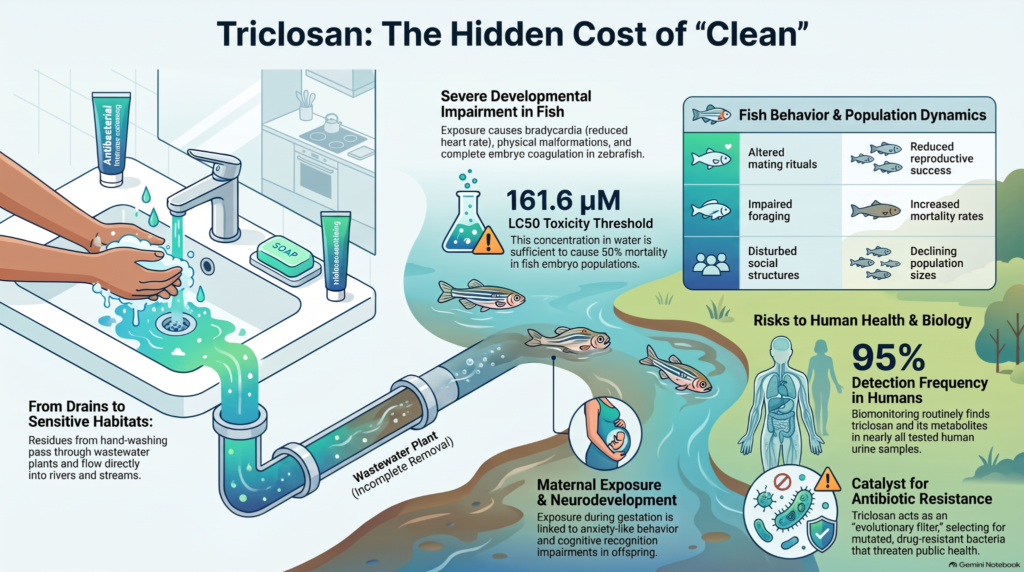
As consumers use products containing triclosan, residues often wash off into the water supply during daily activities like bathing or cleaning.
These residues enter various triclosan pathways, primarily through household drains. Once in the wastewater system, they undergo treatment processes meant to filter out contaminants.
However, many wastewater treatment facilities aren’t designed to fully remove triclosan, allowing a significant portion to pass through. Consequently, untreated or partially treated water can flow directly into rivers and streams, introducing triclosan into natural ecosystems.
This persistence raises concerns about the effectiveness of current wastewater treatment technologies in handling emerging contaminants. Innovative solutions are essential to address this issue, emphasizing the need for advanced filtration systems and bioremediation techniques that can more effectively target triclosan.
The Impact of Triclosan on Aquatic Life
Triclosan markedly affects fish populations, leading to reduced reproductive success and altered behavior.
These changes can disrupt entire aquatic ecosystems, impacting not just individual species but the balance of life in water bodies.
Understanding these effects is essential for evaluating the broader environmental implications of triclosan use.
Effects on Fish Populations
In 2008, EPA conducted a human health risk assessment for triclosan leading up to its reregistration eligibility decision (RED). This assessment was inclusive of all triclosan-related exposures whether uses were regulated by EPA or FDA. No dietary risks of concern were identified. Triclosan data from the National Health and Nutrition Examination Survey (NHANES) showed the aggregate (dietary + residential exposure) risks did not result in unreasonable adverse effects.
While numerous chemicals infiltrate aquatic ecosystems, the presence of triclosan raises significant concerns regarding its effects on fish populations. Research indicates that triclosan can alter fish behavior, impacting mating rituals and foraging efficiency. These behavioral changes can consequently affect population dynamics, leading to reduced reproductive success and increased mortality rates.
| Effect on Fish Behavior | Impact on Population Dynamics |
| Altered mating rituals | Reduced reproductive success |
| Impaired foraging | Increased mortality rates |
| Disturbed social structures | Declining population sizes |
| Increased stress levels | Disruption of ecosystem roles |
Given these findings, it’s essential to reflect on how triclosan exposure might compromise aquatic biodiversity and the long-term sustainability of fish populations in affected environments.
Disruption of Aquatic Ecosystems
The introduction of triclosan into aquatic ecosystems disrupts the delicate balance of life, affecting not just individual species but entire communities. This chemical poses significant threats to ecosystem stability, leading to biodiversity loss and long-term ecological consequences.
Key impacts include:
- Altered reproductive functions in aquatic species
- Development of antibiotic-resistant bacteria
- Changes in species composition and predator-prey dynamics
- Disruption of nutrient cycling and water quality
- Decline in sensitive species, which can destabilize entire ecosystems
As you examine these effects, it’s evident that triclosan jeopardizes not only the health of aquatic organisms but also the ecological integrity of their environments.
Addressing these challenges is vital for fostering resilient ecosystems that can thrive despite human impacts.
HOW DOES TRICLOSAN CONTRIBUTE TO ANTIBIOTIC RESISTANCE?
Looking at the science surrounding antimicrobial resistance and cellular toxicity, the case against routine triclosan use becomes even clearer. From an ecological standpoint, resilient micro-ecosystems whether the soil beds around urban beehives or the biofilm structures in local streams rely on a balanced community of diverse bacteria to manage organic matter and cycling.
Introducing broad-spectrum agents into these spaces acts as an evolutionary filter, knocking out standard strains while allowing resilient, mutated varieties to dominate. In laboratory settings, we see clear evidence of developmental disruption, from impaired larval movement and cardiovascular abnormalities in aquatic species to broader systemic concerns in cellular models.
Yet, in day-to-day household use, studies repeatedly show that washing with simple, plant-based soap and water achieves identical germ removal without the toxic baggage. The persistence of these compounds across surface water, municipal sediments, and even indoor dust underscores how design decisions in product manufacturing can trigger ripple effects throughout entire urban watersheds. Shifting toward minimal, biodegradable cleaning alternatives is an immediately actionable step that prevents unnecessary chemical runoff at the source.
Triclosan (sometimes abbreviated as TCS) is an antibacterial and antifungal agent present in some consumer products, including toothpaste, soaps, detergents, toys, and surgical cleaning treatments. It is similar in its uses and mechanism of action to triclocarban. Its efficacy as an antimicrobial agent, the risk of antimicrobial resistance, and its possible role in disrupted hormonal development remains controversial. Additional research seeks to understand its potential effects on organisms and environmental health.
Triclosan promotes antibiotic resistance by altering bacterial gene expression and fostering survival of resistant strains.
In environments contaminated with triclosan, you’ll find bacteria developing mechanisms to evade antimicrobial agents, which complicates treatment options.
Understanding this process is essential for addressing the broader implications of triclosan in both health and environmental contexts.
Mechanism of Resistance Development
As exposure to triclosan becomes more widespread, it raises critical questions about its role in promoting antibiotic resistance. Triclosan’s mechanism of action can inadvertently encourage bacterial adaptation, leading to resistance mechanisms that threaten public health.
Here’s how it contributes:
- Selection Pressure: Constant exposure selects for resistant strains.
- Genetic Mutation: Bacteria may mutate to survive triclosan’s effects.
- Plasmid Transfer: Resistance genes can be exchanged between bacteria.
- Biofilm Formation: Resistant bacteria often thrive in biofilms, complicating treatment.
- Cross-Resistance: Resistance to triclosan can confer resistance to other antibiotics.
Understanding these mechanisms underscores the urgency of reevaluating triclosan’s use in consumer products to mitigate its potential impact on antibiotic effectiveness and public health.
Environmental Impact on Bacteria
Widespread use of triclosan in various consumer products not only affects human health but also considerably impacts bacterial ecosystems in the environment. By targeting a broad spectrum of bacteria, triclosan reduces bacterial diversity, which is essential for maintaining ecosystem stability.
When you eliminate specific bacterial populations, you inadvertently create niches that allow resistant strains to thrive. This shift can foster antibiotic resistance, posing significant risks to public health and environmental integrity.
Additionally, reduced bacterial diversity disrupts fundamental ecological functions, such as nutrient cycling and organic matter decomposition. As these resilient bacteria proliferate, they can transfer resistance genes to other species, amplifying the problem.
Addressing triclosan’s environmental impact is critical for preserving both biodiversity and the effectiveness of existing antibiotics, just as reducing BPA contamination in food packaging is important for promoting safer consumer products.
Triclosan Regulations and Public Health?
Triclosan is a chemical ingredient added to many different products. The chemical has antibacterial properties that prevent or stop bacterial growth and contamination. In the past, triclosan’s germ-killing capabilities made it a common additive in many over-the-counter (OTC) antibacterial soaps and body washes.
How do current regulations on triclosan impact public health?
The evolving landscape of triclosan regulations greatly influences your health and safety. As awareness of triclosan’s potential risks grows, regulatory bodies are tightening their grip.
Here are some key aspects to evaluate:
- Limited use in consumer products**: Many countries are restricting triclosan in household items.
- Enhanced safety assessments**: Regulatory agencies are conducting thorough evaluations of its safety profile.
- Increased public awareness**: Consumers are more informed about the risks associated with triclosan, driving demand for safer alternatives.
- Potential for antibiotic resistance**: Regulations aim to mitigate the risk of antibiotic-resistant strains developing due to widespread triclosan use.
- Monitoring environmental impact**: Regulations also focus on how triclosan contaminates water sources, linking directly to public health concerns.
These regulations underscore the importance of balancing antibacterial effectiveness and public health safety.
Your choices matter in this regulatory environment.
Triclosan Alternatives: What Options Do You Have?
While triclosan has been a common antibacterial agent in various products, numerous alternatives are now available that offer effective germ-killing properties without the associated risks.
You might consider natural alternatives such as tea tree oil, which has demonstrated significant antimicrobial activity without harming aquatic ecosystems. Another option is using eco-friendly products containing essential oils like lavender or eucalyptus, which not only combat bacteria but also provide pleasant scents.
Moreover, plant-based surfactants derived from coconut or palm can effectively cleanse surfaces without the toxicity linked to triclosan.
These innovations are increasingly being embraced by manufacturers looking to meet consumer demand for safer, environmentally responsible eco friendly products. As you shift towards these alternatives, you’ll contribute to a healthier ecosystem while maintaining hygiene standards.
The changeover to natural alternatives not only promotes sustainability but also aligns with a growing movement towards conscious consumerism.
How Can We Mitigate the Impact of Triclosan on Aquatic Life?
As we become more aware of the harmful effects of triclosan on aquatic ecosystems, it’s essential to explore effective strategies for mitigating its impact.
You can play a significant role in promoting pollution reduction and supporting habitat restoration initiatives. Here are some actionable strategies:
- Advocate for greener consumer products that don’t contain triclosan.
- Participate in cleanup efforts** to remove contaminated waste from waterways.
- Support legislation aimed at regulating and limiting the use of triclosan in consumer products.
- Engage in educational programs that raise awareness about the risks associated with triclosan.
- Collaborate with local organizations focused on habitat restoration to enhance the resilience of affected aquatic ecosystems.
RELATED STUDIES ABOUT TRICLOSAN ANTIBACTERIAL CHEMICAL CONCERNS
In summary, triclosan poses significant risks to our waterways and ecosystems, creating a ripple effect that impacts aquatic life and contributes to antibiotic resistance. As awareness grows, it’s essential for you to evaluate alternatives and support regulations that protect public health. By taking these steps, you can help turn the tide against this harmful chemical and guarantee a healthier environment for future generations. Remember, every small effort counts in the fight against pollution and its far-reaching consequences.
Maternal triclosan exposure impairs female offspring neurodevelopment via MeCP2 hypomethylation and enhanced MeCP2/HDAC3 interaction
Overview and Objectives
This study investigated the neurodevelopmental toxicity and underlying epigenetic mechanisms associated with maternal exposure to triclosan (TCS) during gestation and lactation. Using a C57BL/6J murine model, researchers evaluated neurobehavioral outcomes, prefrontal cortex (PFC) pathology, synaptic integrity, and the epigenetic regulation of the Methyl CpG binding protein-2 (MeCP2) and Histone Deacetylase 3 (HDAC3) pathway in female offspring at postnatal day 42 (PND42). Dams were administered vehicle control or TCS across three dose levels: 8 mg/kg (low-dose, LTCS), 50 mg/kg (medium-dose, MTCS), and 100 mg/kg (high-dose, HTCS) from gestational day 5 through lactation day 21.
Key Behavioral and Pathological Findings
- Growth and Anxiety-Like Phenotypes: Maternal TCS exposure significantly reduced body weight in female offspring across the MTCS and HTCS cohorts. Open field testing (OFT) demonstrated marked reductions in total distance traveled, central zone entries, and central residence time, indicating heightened anxiety-like behavior and reduced exploratory drive.
- Cognitive Recognition Impairments: In the novel object recognition test (NORT), female offspring exhibited dose-dependent declines in both the Discrimination Index and Preference Index, failing to discriminate novel objects. Conversely, spatial learning and memory in the Morris water maze remained unimpaired, demonstrating region-specific vulnerability focused primarily on the PFC rather than the hippocampus.
- Neuronal and Ultrastructural Disruption: Histological and transmission electron microscopy (TEM) evaluations of the PFC revealed disorganized neuronal layering, increased pyknotic neurons, loss of Nissl bodies, swollen and vacuolated mitochondrial cristae, and dilated endoplasmic reticulum.
- Synaptic and Neurodevelopmental Deficits: TCS exposure induced a significant loss of total synaptic counts, thinning of the postsynaptic density (PSD), and presynaptic vacuolization. Western blot analysis confirmed progressive, dose-dependent downregulation of essential synaptic and neurogenic proteins: PSD95, synapsin (SYN), brain-derived neurotrophic factor (BDNF), doublecortin (DCX), and proliferating cell nuclear antigen (PCNA).
Epigenetic and Molecular Mechanisms
- MeCP2 Promoter Hypomethylation: Targeted bisulfite sequencing revealed that maternal TCS exposure significantly downregulated DNA methylation across ten CpG sites within the MeCP2 promoter region in the PFC of female offspring. This hypomethylation was most pronounced at the 8 mg/kg threshold, displaying a characteristic non-monotonic dose-response.
- Enhanced MeCP2/HDAC3 Transcriptional Repression: Hypomethylation of the promoter led to elevated protein expression and nuclear co-localization of MeCP2 and HDAC3. Reciprocal co-immunoprecipitation (Co-IP) confirmed that TCS exposure strengthened the direct binding interaction between MeCP2 and HDAC3.
- Structural Docking Interface: Protein-protein docking indicated that MeCP2 and HDAC3 form a stable corepressor complex stabilized by key residues, including Gly-41, His-43, Arg-85, Lys-175, Glu-214, and Asp-474 on MeCP2, and Asn-15, Lys-138, Glu-179, Asp-225, Asn-287, and Pro-334 on HDAC3. Hyperactivation of this complex directly represses downstream target genes essential for neurogenesis and synaptic plasticity.
Significance and Implications
The findings establish an epigenetic mechanism linking maternal environmental exposure to female offspring neurodevelopmental deficits via the MeCP2 promoter hypomethylation/HDAC3 corepressor axis. Identifying 8 mg/kg as a critical epigenetic threshold provides experimental evidence for environmental health risk assessments, guideline development, and safety limits for maternal and child exposure to antimicrobial endocrine disruptors.
| REFERENCE: Wang Hao, Li Xianjia, Chang Mengjun, Yu Shuangjie, Li Ye, Zhang Lingling, Du Yunyun, Ji jin, Yu Zexin, Fu Youjuan, Guan Suzhen, Maternal triclosan exposure impairs female offspring neurodevelopment via MeCP2 hypomethylation and enhanced MeCP2/HDAC3 interaction, Ecotoxicology and Environmental Safety, Volume 319, 2026, 120282, ISSN 0147-6513, https://doi.org/10.1016/j.ecoenv.2026.120282. (https://www.sciencedirect.com/science/article/pii/S0147651326006111) |
Comprehensive assessment of triclosan-induced toxicity: impacts on zebrafish development, mammalian cell viability and microbial activity
Overview and Objectives
This study evaluated the toxicological profile of triclosan across aquatic in vivo and mammalian in vitro models while concurrently testing its antimicrobial and antibiofilm efficacy against selected bacterial pathogens. Researchers aimed to clarify the balance between triclosan’s effectiveness as an anti-infective agent and its hazards to mammalian cell viability and vertebrate development.
Key Toxicological Findings
- Aquatic Toxicity in Zebrafish: In the Fish Embryo Acute Toxicity (FET) test using Danio rerio, triclosan exhibited an LC50 of 161.6 µM (approximately 46.8 µg/mL). Embryos exposed to 180 and 200 µM showed complete coagulation by 48 hours post-fertilization.
- Cardiovascular and Neurological Impairments: Sublethal exposure (160 µM) caused statistically significant bradycardia (reduced heart rate) and physical malformations in zebrafish larvae. In addition, triclosan significantly decreased larval locomotor activity during a 10-minute light tracking assay, indicating neuromuscular or central nervous system disruption.
- Mammalian Cytotoxicity and Cardiotoxicity: In vitro MTT assays demonstrated moderate cytotoxicity against human dermal fibroblasts (BJ) with an IC50 of 28.44 µg/mL. In rat cardiomyoblasts (H9c2), the IC50 was 25.36 µg/mL, confirming direct cardiotoxic susceptibility in mammalian cell lines.
Antimicrobial and Antibiofilm Efficacy
- Planktonic Growth Inhibition: Minimum inhibitory concentrations (MIC) ranged from 0.24 µg/mL for Lactobacillus acidophilus to 3.9 µg/mL for Enterococcus faecalis. Minimum bactericidal concentrations (MBC) reached 1.9 µg/mL for L. acidophilus and Streptococcus mutans, and 7.8 µg/mL for E. faecalis.
- Potent Biofilm Prevention: Minimum biofilm inhibitory concentration (MBIC) values ranged from 0.03 µg/mL to 0.12 µg/mL. E. faecalis demonstrated the greatest susceptibility to biofilm prevention, exhibiting an MBIC of 0.03 µg/mL.
- Biomass Reduction: Crystal violet staining revealed a dose-dependent reduction in biofilm biomass across all three strains, with significant biomass inhibition occurring at concentrations of 0.12 µg/mL and above for S. mutans and L. acidophilus.
Conclusions and Implications
Triclosan remains an effective antimicrobial and antibiofilm agent against common Gram-positive bacteria at low concentrations. However, its cytotoxicity in mammalian cells (fibroblasts and cardiomyoblasts) and its ability to cause mortality, cardiac dysfunction, and neurobehavioral impairment in aquatic models emphasize significant ecotoxicological and consumer safety concerns. These findings support the re-evaluation of triclosan formulations in consumer and healthcare products to limit persistent environmental accumulation and human exposure.
| REFERENCE: Piotr Stachurski, Łukasz Kurach, Maryna Khalavka, Maja Ptasiewicz, Wojciech Świątkowski, Renata Żelazowska, Agnieszka Magryś, Comprehensive assessment of triclosan-induced toxicity: impacts on zebrafish development, mammalian cell viability and microbial activity, Advances in Medical Sciences, Volume 70, Issue 2, 2025, Pages 367-376, ISSN 1896-1126, https://doi.org/10.1016/j.advms.2025.09.001. (https://www.sciencedirect.com/science/article/pii/S1896112625000367) |
Comprehensive overview of triclosan neurotoxicity and construction of adverse outcome pathways using a systems toxicology approach: Triclosan-induced attention-deficit hyperactivity disorder as an example
Overview and Objectives
This review and systems toxicology study examined the global status of environmental contamination and human exposure to triclosan (TCS), systematically evaluating its neurodevelopmental toxicity. Using attention-deficit/hyperactivity disorder (ADHD) as a representative endpoint, the authors constructed an Adverse Outcome Pathway (AOP) framework to delineate the multi-level biological mechanisms linking TCS exposure to neurobehavioral deficits in offspring.
Environmental Fate and Exposure Trends
- Ubiquitous Contamination: TCS is widely detected in surface water, groundwater, drinking water, wastewater treatment plant (WWTP) effluents, sediments, biosolids, and indoor dust across the globe.
- Post-Pandemic Surge: Following the COVID-19 pandemic, intensified use of personal care products and disinfectants substantially increased TCS concentrations in surface water, wastewater, and indoor dust.
- Human Biomonitoring: TCS and its metabolites are routinely found in human urine (>95% detection frequency in multiple cohorts), blood, breast milk, and amniotic fluid. Children and pregnant women frequently exhibit higher vulnerability and exposure burdens.
- Environmental Mixture Interactions: Co-exposure with microplastics (such as polypropylene and polyethylene) and other endocrine-disrupting chemicals amplifies bioaccumulation, oxidative stress, and overall neurotoxicity.
Neurotoxic Profiles and Pathological Mechanisms
- Neurodevelopmental Impairments: Epidemiological and in vivo models confirm that prenatal and perinatal TCS exposure correlates with reduced cognitive performance, impaired memory, learning deficits, social abnormalities, and ADHD-like behaviors.
- Thyroid Homeostasis Disruption: TCS lowers circulating thyroid hormone levels (such as T3 and T4), obstructing normal fetal brain development, axonal growth, and myelination.
- Oxidative Stress & Apoptosis: TCS induces reactive oxygen species (ROS) overproduction, activates the Nrf2, p38 MAPK, and JNK signaling pathways, inhibits Akt/mTOR phosphorylation, and triggers caspase-dependent apoptosis in cortical and hippocampal neurons.
- Synaptic Plasticity & Neurotransmission: Exposure disrupts prefrontal cortex (PFC) and hippocampal architecture, impairs synaptic density, deregulates microRNAs (such as miR-219 and miR-144), and alters acetylcholinesterase (AChE) activity.
Core AOP Framework: CNR1-Mediated ADHD
- Molecular Initiating Event (MIE): TCS binds strongly to Cannabinoid Receptor 1 (CNR1, binding energy -7.8 kcal/mol), upregulating CNR1 expression in the central nervous system.
- Key Events (KEs) Cascade:
- KE1: Activation of the “neuroactive ligand-receptor interaction” pathway.
- KE2: Disruption of intracellular calcium ion (Ca^2+) homeostasis via voltage-gated calcium channels.
- KE3: Modulation and impairment of chemical synaptic transmission.
- KE4: Dysregulation of key neurotransmitter levels, including deficits in prefrontal dopamine (DA) release and altered GABA/glutamate balance.
- KE5: Impairment of higher-order cognitive processing, learning, and memory.
- Adverse Outcome (AO): Clinical and behavioral manifestation of ADHD and associated cognitive deficits.
Conclusions and Recommendations
The study established a biologically plausible, high-confidence AOP linking TCS exposure to ADHD pathogenesis through the CNR1 receptor signaling cascade, integrated with auxiliary mechanisms including oxidative stress, thyroid disruption, and epigenetic alterations. Given rising post-pandemic environmental levels, the authors urge strengthened regulatory surveillance, development of advanced wastewater remediation technologies, and focused research on multi-pollutant mixture toxicities.
| REFERENCE: Jianing Shang, He Cui, Chang Shu, Linlin Zheng, Fu Liu, Yuxuan Peng, Ziyun Wei, Xiao Ni, Jieyu Liu, Comprehensive overview of triclosan neurotoxicity and construction of adverse outcome pathways using a systems toxicology approach: Triclosan-induced attention-deficit hyperactivity disorder as an example, Ecotoxicology and Environmental Safety, Volume 316, 2026, 120169, ISSN 0147-6513, https://doi.org/10.1016/j.ecoenv.2026.120169. (https://www.sciencedirect.com/science/article/pii/S0147651326004987) |
CONCLUSION
Adopting a truly sustainable lifestyle rarely requires complicated compromises; instead, it centers on making informed, intentional choices that elevate both personal health and the surrounding environment. Moving away from synthetic additives like triclosan is a prime opportunity to practice conscious consumerism. Simple, plant-derived cleansers, natural botanical oils, and straightforward hygiene practices keep our living spaces clean without turning our domestic drainpipes into conduits for environmental contamination.
The regulatory restrictions we are seeing unfold worldwide serve as a necessary validation of what ecological researchers have tracked for years. However, regulatory action is only one half of the equation; widespread shifts occur when individual households decide to phase out obsolete, persistent chemicals in favor of responsible, closed-loop solutions.
By inspecting product labels, supporting brands that prioritize ecological safety, and advocating for cleaner watershed protections, we actively protect river systems, preserve delicate aquatic food webs, and ensure that our urban communities thrive in harmony with the natural habitats connected to them.