When I first transitioned from studying environmental policy at Edinburgh to consulting directly with homeowners, I quickly realized a surprising pattern: most people assume that once they close their front doors, outdoor pollution stays outside. We tend to view our homes as protective bubbles, yet indoor air quality frequently presents a far more concentrated cocktail of synthetic chemicals than the air outside. Phthalates are one of the most pervasive examples of this hidden burden. They are embedded in flexible plastics, flooring, and hidden behind generic “fragrance” labels in everyday cleansers and personal care products.
In my work helping families audit their carbon footprints and indoor toxicity, I often see people get overwhelmed by the sheer volume of technical jargon surrounding volatile and semi-volatile organic compounds. The goal isn’t to create panic or demand that you throw away every modern convenience overnight.
Rather, understanding how these chemical plasticizers behave, how they off-gas into living spaces and accumulate in settled household dust gives you the practical leverage to make smarter, incremental choices. Reclaiming a healthier living space starts with demystifying what goes into our consumer goods so we can phase out harmful exposures with intent and ease.
Phthalates in household products greatly degrade indoor environmental quality by leaching into the air, thereby contributing to indoor air pollution. These chemicals can disrupt hormonal functions and impair respiratory health. Prolonged exposure can lead to serious health issues, particularly for vulnerable populations like children. By understanding and identifying products that contain phthalates, you’ll better protect your home’s air quality. Discovering effective strategies for reducing these harmful substances can greatly enhance your living environment.
KEY TAKEAWAYS
- Phthalates contribute to indoor air pollution by leaching from household products, affecting overall air quality.
- Prolonged exposure to phthalates can lead to respiratory problems, especially in children, impacting indoor health.
- Hormonal disruption caused by phthalates may result in reproductive issues, affecting family health dynamics.
- Poor indoor environmental quality linked to phthalates can exacerbate allergies and chronic health conditions.
- Choosing phthalate-free products improves indoor air quality, promoting a healthier living environment.
HOW TO REDUCE PHTHALATE EXPOSURE IN YOUR HOME
Although phthalates are commonly found in many household products, you can take proactive steps to minimize your exposure. Start by opting for phthalate-free products, which are increasingly available across various categories, including cleaning supplies, personal care items, and children’s toys. Research shows that these alternatives can notably reduce the risk of health concerns linked to phthalate exposure.
Additionally, choose eco friendly products and materials for your home furnishings and décor. For instance, look for furniture made from natural wood or organic textiles, as these options often avoid harmful chemicals.
When renovating, consider non-toxic paint and adhesives that don’t contain phthalates. Regularly ventilating your living spaces can also help reduce indoor pollution levels.
What Are Phthalates and Where Are They Found?
Phthalates lurk in seemingly harmless items like your plastic key ring and air freshener. The chemicals have an uncanny ability to show up in unexpected places, making their presence in plastic, vinyl, personal care products, children’s toys. They are sometimes present in undisclosed “fragrance” in cosmetics and other items.
Phthalates are a group of synthetic chemicals used to enhance the flexibility and durability of plastics. You’ll find phthalate sources in a variety of everyday products, including vinyl flooring, wall coverings, personal care items, and toys.
Their widespread use is driven by the demand for more resilient materials, but this also raises concerns about their environmental persistence. Studies show that phthalates can linger in indoor environments, leading to prolonged exposure, particularly in poorly ventilated spaces.
Research indicates that phthalates can leach from products over time, contributing to indoor air pollution and affecting overall indoor environmental quality.
As an innovative consumer, it’s essential to be aware of these sources and their long-lasting presence in your home. Understanding where phthalates are found empowers you to make informed choices, potentially reducing your exposure and promoting a healthier indoor environment.
Health Risks Associated With Phthalate Exposure
Ortho-phthalates, commonly referred to as phthalates (pronounced THAL-eights), are a class of chemicals that are used to make plastics, primarily polyvinyl chloride (PVC or vinyl), flexible. The chemicals also serve various functions in cosmetics, personal care, and cleaning products.
Phthalate exposure poses significant health risks, particularly regarding hormonal disruption and respiratory health.
Research indicates that these chemicals can interfere with endocrine function, leading to potential reproductive issues.
Additionally, studies show a correlation between phthalate exposure and respiratory problems, particularly in vulnerable populations like children.
Hormonal Disruption Effects
When you interact with household products containing phthalates, you’re not just cleaning your home; you might also be exposing yourself to substances that can disrupt hormonal balance. Research indicates that phthalates can interfere with the endocrine system, impacting reproductive health and overall well-being.
| Health Impact | Phthalates Level | Notable Studies |
| Hormonal Imbalance | Moderate to High | CDC, 2020 |
| Decreased Fertility | High | Environmental Health, 2021 |
| Developmental Issues | Moderate | Journal of Endocrinology, 2019 |
These findings highlight the importance of choosing phthalate-free products to protect your health and maintain a balanced endocrine system. Awareness and proactive choices can help minimize these risks effectively.
Respiratory Health Impacts
Although you may not realize it, the household products you use daily can greatly impact your respiratory health. Phthalate sources such as air fresheners, vinyl flooring, and personal care items release indoor pollutants that can exacerbate respiratory issues.
Research indicates that exposure to these compounds is linked to various health risks, including:
- Increased asthma symptoms
- Worsening of allergic reactions
- Reduced lung function
- Higher susceptibility to respiratory infections
These findings highlight the importance of monitoring phthalate exposure in your living space.

COMMON HOUSEHOLD PRODUCTS THAT CONTAIN PHTHALATES
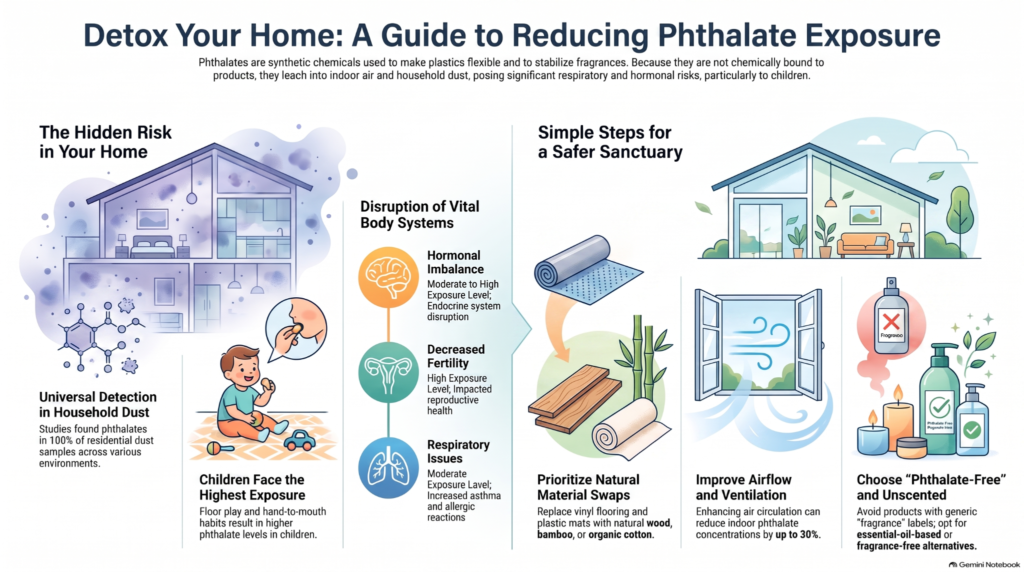
During on-site sustainability assessments, the conversation around phthalates usually clicks when we look at the flooring and kitchen surfaces. Many clients are surprised to learn that high-molecular-weight phthalates like DEHP migrate continuously out of vinyl and plasticized finishes directly into the dust that settles across our floors. If you have young children playing on carpets or crawling on synthetic mats, their hand-to-mouth habits place them at a significantly higher risk of ingestion than adults.
The data we see in residential studies consistently confirms this dynamic: indoor heat, lack of air circulation, and synthetic materials combine to create a sustained chemical reservoir. My approach to solving this isn’t about striving for impossible chemical purity, but tackling high-impact, controllable sources. Swapping out conventional vinyl mats for untreated wood, bamboo, or organic cotton textiles cuts down dust-bound contaminants at the root.
Similarly, pairing targeted lifestyle habits like choosing unfragranced or essential-oil-based products and storing food in glass rather than heating plastic containers drastically lowers indoor exposure pathways. Coupling these material swaps with active ventilation strategies dilutes lingering airborne compounds, delivering noticeable improvements in ambient indoor air quality without requiring an expensive lifestyle overhaul.
You might be surprised to learn that many common household products, like vinyl flooring and personal care items, often contain phthalates.
Research shows that phthalates enhance flexibility in materials and improve the texture of cosmetics, but this comes with potential health risks.
Understanding where these chemicals are present can help you make informed choices about the products you use daily.
Vinyl Flooring Products
Vinyl flooring products are prevalent in many households,providing a versatile and affordable flooring option. However, they often come with hidden concerns, particularly phthalate emissions, which can contribute to indoor pollution and increase concerns about formaldehyde exposure in furniture and flooring.
However, they often come with hidden concerns, particularly phthalate emissions. These chemicals can leach into your indoor environment, affecting air quality and potentially your health.
When considering vinyl flooring, you should be aware of:
- Source of Phthalates: Many vinyl flooring types use phthalates as plasticizers.
- Impact on Indoor Air Quality**: Emissions can persist long after installation.
- Health Risks: Prolonged exposure may lead to respiratory issues and hormonal disruptions.
- Alternatives: Innovative flooring options, like phthalate-free vinyl or natural materials, are emerging.
Personal Care Items
As you navigate the aisles of personal care products, it’s essential to recognize that many items, from shampoos to lotions, can contain phthalates. These chemicals are often included to enhance fragrance and texture, but their health impacts are concerning. Here’s a breakdown of common personal care items that may contain phthalates:
| Product Type | Common Use | Phthalate Concern |
| Scented Lotions | Moisturizing skin | Endocrine disruption |
| Hair Sprays | Styling and hold | Reproductive toxicity |
| Fragrant Shampoos | Cleansing hair | Allergic reactions |
Choosing phthalate-free options is vital for safeguarding your indoor environment. By being informed, you can make healthier choices in your personal care routine.
Tips to Reduce Phthalate Exposure
Reducing phthalate exposure in your home can greatly improve indoor air quality and overall health. By making informed choices, you can considerably lower your risk.
Here are four effective strategies:
- Choose phthalate free products: Opt for items labeled as phthalate-free, particularly in cleaning supplies and personal care products.
- Reduce plastic use: Prioritize glass, stainless steel, or bamboo alternatives for storage and kitchenware to minimize phthalate exposure.
- Select natural materials: Invest in furniture and textiles made from organic cotton, wool, or other natural fibers, which typically contain fewer harmful chemicals.
- Avoid vinyl: Steer clear of vinyl flooring and wall coverings, as they often contain high levels of phthalates.
Implementing these innovative strategies can lead to a healthier indoor environment, ultimately enhancing your quality of life while supporting environmental responsibility and sustainable practices.
How Ventilation Helps Reduce Phthalate Effects
Phthalates are a group of chemical compounds commonly used to increase the flexibility and durability of plastics. Beyond their application in plastics, phthalates are prevalent in various everyday products, including personal care items, household goods, and notably, cleaning products. In these products, phthalates often serve as solvents and are integral components of synthetic fragrances.
Effective ventilation plays an essential role in mitigating the harmful effects of phthalates found in household products. By enhancing ventilation effectiveness, you can greatly reduce indoor concentrations of these chemicals. Research shows that improved air circulation decreases the buildup of airborne phthalates, which are often released from plastics, fragrances, and other materials.
Using exhaust fans, opening windows, and employing air purifiers can help achieve ideal air exchange rates, effectively diluting indoor pollutants. A study indicated that households with better ventilation experienced 30% lower phthalate levels compared to those with minimal air movement.
Consider integrating smart ventilation systems that adjust based on indoor air quality measurements, providing real-time data for more targeted interventions.
Safer Alternatives to Phthalates in Household Products
Improving ventilation is just one strategy for addressing the risks associated with phthalates in household products; seeking safer alternatives is equally important.
By opting for innovative materials, you can enhance indoor environmental quality while reducing health risks. Consider these options:
- Biodegradable materials: Use products made from plant-based sources, which break down more easily and are less harmful to the environment.
- Natural fragrances: Choose items scented with essential oils instead of synthetic fragrances that may contain phthalates.
- Water-based adhesives: These can replace traditional adhesives laden with harmful chemicals, providing a safer bonding solution.
- Non-toxic finishes: Select paints and coatings free of phthalates, promoting better air quality in your home.
RELATED STUDIES ABOUT PHTHALATES IN HOUSEHOLD PRODUCTS
To sum up, addressing phthalate exposure in your home isn’t just a choice; it’s a necessity for your health and well-being. By understanding where these chemicals lurk and taking proactive steps—like improving ventilation and opting for safer alternatives—you can greatly enhance your indoor environmental quality. As research shows, small changes can lead to substantial benefits. After all, isn’t it time you reclaim your home as a sanctuary free from harmful pollutants?
Phthalate concentrations in house dust, their associations with household characteristics, and spatial distribution across rural and urban areas in southern Thailand
Overview and Objectives
This study evaluated the occurrence, spatial distribution, and key determinants of phthalate concentrations in residential dust across southern Thailand. Researchers sampled 310 households across the urban sub-district of Pak Phayun and rural Ko Mak within Phatthalung province to identify how demographic factors, housing characteristics, and environmental parameters influence indoor contamination levels prior to the monsoon season.
Key Findings
- Universal Detection: Phthalates were detected in 100% of the collected dust samples, yielding a total geometric mean phthalate concentration of 192 µg/g.
- Predominant Compounds: High-molecular-weight phthalates dominated the samples. DEHP was the most prevalent and abundant compound (detected in 99.4% to 100% of samples, reaching up to 6528 µg/g), followed by DnOP (96.5% to 97.4%) and DBP (78.1% to 88.7%).
- Sampling Distribution: Concentrations of DEHP, DnOP, and DBP were significantly higher in settled floor dust compared to multi-surface dust collected 60 cm above the floor.
Key Determinants of Phthalate Accumulation
- Household Features: The use of floor coverings such as linoleum, plastic mats, and foam mats significantly increased floor DEHP and total phthalate levels. Using plastic table covers, operating in-house businesses (like convenience stores), and recent interior repainting also showed strong positive associations with elevated phthalate concentrations.
- Consumer Product Usage: Daily application of skincare products (creams and lotions) and frequent use of floor cleaning chemicals were associated with higher indoor phthalate levels.
- Environmental & Spatial Factors: Higher indoor temperatures and relative humidity correlated with increased phthalate volatilization and dust accumulation. Urban homes, densely populated areas, and residences located within 1000 meters of gas stations or vehicle repair shops exhibited significantly higher phthalate concentrations than rural or more distant homes.
Policy and Practical Recommendations
- Regulatory Measures: Establish strict limits on phthalates in consumer goods, prohibit phthalate plasticizers in products manufactured for children, and mandate explicit product labeling.
- Household Mitigation: Improve natural ventilation to lower indoor temperatures, control indoor humidity, minimize the use of PVC/plastic floor and table covers, and physically isolate home business operations from living areas.
- Cleaning and Hygiene: Implement regular wet mopping, vacuuming, and routine handwashing before meals to reduce non-dietary ingestion and inhalation risks among vulnerable populations, particularly young children and pregnant women.
| REFERENCE: Nuttapong Laemun, Orawan Kaewboonchoo, San Suwanmanee, Yanin Limpanont, Toshio Kawai, Jitisak Premmanee, Sornsamat Boonthavivudhi, Chawannat Choojit, Somkiat Siriruttanapruk, Wissanupong Kliengchuay, Kyungho Choi, Parinya Panuwet, Kraichat Tantrakarnapa, Phthalate concentrations in house dust, their associations with household characteristics, and spatial distribution across rural and urban areas in southern Thailand, Atmospheric Environment, Volume 373, 2026, 121936, ISSN 1352-2310, https://doi.org/10.1016/j.atmosenv.2026.121936. (https://www.sciencedirect.com/science/article/pii/S1352231026001652) |
Associations of urinary phthalate metabolites with household environments among mothers and their preschool-age children
Overview and Objectives
This study investigated the associations between household environmental factors and urinary phthalate metabolite concentrations among preschool-age children (ages 3–6) and their mothers in Taiwan. Utilizing data from the Taiwan Maternal and Infant Cohort Study (TMICS) collected between 2016 and 2020, researchers analyzed 528 mother-child pairs to evaluate exposure pathways and identify specific residential determinants of phthalate burden.
Key Findings
- Child vs. Mother Exposure Disparity: Urinary concentrations of most phthalate metabolites were significantly higher in children than in their mothers, with geometric mean child-to-mother ratios greater than 1 for all compounds except mono-ethyl phthalate (MEP) and mono-2-ethylhexyl phthalate (MEHP).
- Dominant Metabolites: The highest geometric mean concentrations in children were observed for MECPP (40.95 µg/g creatinine), MnBP (35.86 µg/g creatinine), and MEHHP (24.17 µg/g creatinine). In mothers, MnBP (28.84 µg/g creatinine) and MECPP (24.75 µg/g creatinine) predominated.
- Temporal & Socioeconomic Trends: Phthalate metabolite concentrations in both mothers and children were significantly higher in summer compared to winter. Higher household income was associated with significantly lower levels of MnBP and DEHP metabolites in children.
Household Environmental Determinants
- Visible Mold and Dampness: Visible mold or mold stains on residential surfaces were significantly associated with increased urinary MnBP (+24.20%) and total DEHP metabolites (+24.88%) in children.
- Insecticide Use: The use of residential insecticide sprays was significantly associated with a 24.73% increase in urinary MnBP concentrations among children.
- Plastic Food Packaging: The use of plastic containers for food packaging was significantly associated with elevated levels of MnBP (+41.67%) and DEHP metabolites (MEHHP and MECPP) in mothers.
- Ventilation and Air Purification: Regularly opening bedroom windows and using air purifiers showed marginal protective associations with reduced MEP and MnBP levels in children.
Implications and Recommendations
- Targeted Interventions for Children: Because children experience higher internal exposure—driven by behaviors like floor play and hand-to-mouth activity—interventions should prioritize controlling indoor dampness, remediating mold, and reducing household insecticide applications.
- Maternal Exposure Reduction: Maternal phthalate burdens can be reduced by minimizing the use of plastic food containers and packaging for hot or fatty foods.
- Policy and Awareness: Strengthening regulations regarding phthalate additives in pesticides and consumer goods, along with public health education on indoor air quality and food contact materials, is essential for reducing maternal and child exposure.
| REFERENCE: Hsing-Kang Chen, Yu-Hsun Chang, Chien-Wen Sun, Ming-Tsang Wu, Mei-Lien Chen, Shu-Li Wang, Chia-Jung Hsieh, Associations of urinary phthalate metabolites with household environments among mothers and their preschool-age children, Ecotoxicology and Environmental Safety, Volume 262, 2023, 115162, ISSN 0147-6513, https://doi.org/10.1016/j.ecoenv.2023.115162. (https://www.sciencedirect.com/science/article/pii/S0147651323006668) |
Source tracing and health risk assessment of phthalate esters in household tap-water: A case study of the urban area of Quanzhou, Southeast China
Overview and Objectives
This study investigated the occurrence, compositional profiles, seasonal variations, transmission factors, and potential health risks of phthalate esters (PAEs) in household tap water. Over a 56-week monitoring period from November 2017 to December 2018, approximately 300 tap water samples were collected across six kitchen sampling stations in urban and suburban areas of Quanzhou, a subtropical industrialized city in Southeast China.
Key Findings
- Quantified Congeners: Out of 16 target PAEs analyzed via gas chromatography–mass spectrometry (GC-MS), five congeners were identified: DMP, DEP, DIBP, DBP, and DEHP.
- Concentration Levels: Total concentrations of the five PAEs ranged from 780.0 ng/L to 9180 ng/L across all samples. Mean total concentrations were 1860 ng/L in the dry season, 3220 ng/L in the normal season, and 4940 ng/L in the wet season.
- Dominant Species: DIBP and DEHP predominated across all seasons, collectively accounting for 82.2% in the dry season, 89.9% in the normal season, and 89.3% in the wet season of total PAE content. All individual DEHP measurements remained below national and international drinking water standard limits, such as 8 µg/L for China GB 5749-2022 and WHO, and 6 µg/L for US EPA.
Source Tracing and Influencing Factors
- Seasonal and Temperature Trends: PAE concentrations showed a strong positive correlation with ambient temperature, reaching correlation coefficients of 0.708 for DEHP and 0.838 for DIBP, indicating that raw river source water driven by seasonal runoff is the primary input source.
- Polarity Shifts: During the wet season, the proportion of more polar DIBP increased by 15% to 20%, while the less polar DEHP decreased by over 15%, reflecting enhanced water-driven elution into aquatic source systems.
- Transmission Dynamics: Variations in PAE concentrations among urban sampling stations supplied by the same water treatment facility correlated with pipeline transport distance, pipeline materials, pipe age, and water stagnation or residence times.
Health Risk Assessment
- Noncarcinogenic Risk via Ingestion: Hazard Quotient (HQ) assessments indicated that DEP and DBP posed no noncarcinogenic risk (HQ < 1) for both adults and children.
- Vulnerable Subpopulations: DEHP exposure presented a potential noncarcinogenic risk, particularly for children with mean HQ values ranging from 1.17 to 1.79, warranting enhanced monitoring and control of raw water sources and municipal distribution systems.
| REFERENCE: Long Wang, Jianyong Li, Jiazuo Zheng, Jing Liang, Rongli Li, Zhenbin Gong, Source tracing and health risk assessment of phthalate esters in household tap-water: A case study of the urban area of Quanzhou, Southeast China, Ecotoxicology and Environmental Safety, Volume 248, 2022, 114277, ISSN 0147-6513, https://doi.org/10.1016/j.ecoenv.2022.114277. (https://www.sciencedirect.com/science/article/pii/S0147651322011174) |
CONCLUSION
Looking at the broader trajectory of environmental standards, we have made immense strides in eliminating historical toxins from consumer supply chains, but modern synthetic additives like phthalates remain an ongoing challenge. Achieving a clean, regenerative home environment does not mean obsessing over an unattainable standard of zero plastic or letting eco-anxiety take over. It is about building everyday resilience into your household through informed consumer choices, intentional material sourcing, and proper home airflow management.
Every time you choose a certified phthalate-free detergent, replace an aging vinyl accessory with a durable natural alternative, or run a high-efficiency air filtration setup with open windows, you are directly investing in your long-term wellness.
Sustainable living is a continuous series of low-stress, high-value adjustments rather than an all-or-nothing proposition. By focusing your energy on eliminating known hormone disruptors from your primary living spaces, you can transform your home into a genuinely healthy sanctuary for you and your family.