
Whenever I transition from analyzing high-level global climate frameworks to advising on specific industrial supply chains, I am struck by how foundational chemical governance is to our broader ecological goals. You simply cannot map out a viable carbon-neutral or nature-positive roadmap without addressing the physical inputs flowing through modern manufacturing. Over nearly two decades of translating environmental science into public policy, I have watched the EU REACH regulation serve as both a global standard-bearer and an emblem of bureaucratic complexity.
On paper, the ambition is admirable: forcing accountability upstream, demanding rigorous data, and operating under the vital precautionary principle. Yet, when you look past the regulatory text and into what is actually occurring across river catchments and manufacturing hubs, a major friction point emerges. REACH was designed to safeguard our ecosystems, but it frequently operates in an isolated silo, lagging behind the cutting-edge predictive toxicology we now have at our disposal.
Balancing regulatory certainty for businesses with genuine public health protection is delicate work, much like finding steady alignment on a yoga mat; without proper balance, the whole structure collapses under its own weight. We must examine not only what REACH intended to do, but where the science indicates its architecture is falling behind.
The EU REACH regulation plays an essential role in chemical safety and pollution control by requiring extensive safety data and promoting responsible chemical management. It focuses on evaluating the risks posed by hazardous chemicals, which can disrupt ecosystems and harm human health. By encouraging safer alternatives and innovative practices, REACH drives industries toward sustainability. However, challenges like compliance costs and inconsistent enforcement persist. Exploring these complexities reveals further insight into REACH’s significance in shaping a safer chemical landscape.
KEY TAKEAWAYS
- REACH ensures comprehensive safety data for chemicals, crucial for assessing risks to human health and the environment.
- The regulation promotes responsible chemical management, aiding in effective pollution control through risk assessment and enforcement mechanisms.
- By encouraging sustainable practices and alternatives, REACH mitigates environmental impacts from hazardous chemicals, fostering eco-friendly innovations.
- Continuous improvement processes in REACH adapt regulations based on scientific evidence, enhancing chemical safety and pollution prevention.
- Stakeholder engagement under REACH enhances compliance and accountability, leading to better environmental outcomes in pollution control efforts.
BASICS OF EU REACH REGULATION
The EU REACH Regulation, which stands for Registration, Evaluation, Authorisation, and Restriction of Chemicals, is a pivotal legislative framework aimed at safeguarding human health and the environment from the risks posed by chemical substances.
REACH compliance necessitates thorough chemical registration, requiring you to provide extensive safety data for substances produced or imported. This process involves substance evaluation, where authorities assess potential risks and determine suitable management strategies.
You’ll face regulatory challenges, such as keeping up with evolving environmental standards and chemical classification norms. Industry responsibility is paramount, as stakeholders must engage actively to guarantee compliance enforcement and maintain transparency.
Regular regulatory updates confirm that you remain informed about changes affecting risk management practices. By prioritizing safety data and stakeholder engagement, you contribute to a more sustainable future while maneuvering through the complexities of the REACH framework effectively.
The Importance of Chemical Safety in Pollution Control
Understanding chemical safety is essential for effective pollution control, as it directly influences the regulatory framework you must navigate.
Through an extensive risk assessment process, you can identify potential hazards and their environmental impacts.
Regulatory Framework Overview
How can effective regulatory frameworks enhance chemical safety and, consequently, pollution control? By establishing clear guidelines and standards, these frameworks foster responsible chemical management and support Basel Convention hazardous waste chemical governance.
Here are key elements that drive their effectiveness:
- Regulatory compliance strategies that guarantee industries adhere to safety protocols.
- Enforcement mechanisms that hold companies accountable for violations.
- Transparent reporting systems that provide data on chemical usage and emissions.
- Stakeholder engagement that encourages collaboration between regulators, industries, and communities.
- Continuous improvement processes to adapt regulations based on emerging scientific evidence.
Risk Assessment Process
Effective regulatory frameworks not only set standards but also inform the risk assessment process, which is essential for guaranteeing chemical safety and reducing pollution.
By employing risk identification methods, you can pinpoint hazardous substances and evaluate their potential impacts. These methods provide the groundwork for implementing effective controls.
Exposure assessment techniques further refine this process, allowing you to quantify how, when, and to what extent people and ecosystems might be exposed to these chemicals.
This dual approach enables the identification of high-risk scenarios and supports informed decision-making.
Ultimately, a rigorous risk assessment process guarantees that innovative solutions are developed to mitigate pollution, promoting a safer environment while fostering sustainable industrial practices and addressing Rotterdam Convention chemical trade restrictions environment.
Your commitment to these principles can drive meaningful change.
Environmental Impact Mitigation
While addressing pollution control, recognizing the importance of chemical safety is essential for effective environmental impact mitigation.
By prioritizing chemical safety, you can promote eco-friendly practices and eco friendly products that greatly reduce pollution.
Consider these key aspects:
- Implementing strict chemical safety regulations
- Evaluating the lifecycle of chemicals used
- Encouraging research on non-toxic materials
- Supporting innovation in green technologies
- Educating industries on best practices for safety
Environmental Effects of Hazardous Chemicals
As industries continue to utilize hazardous chemicals, understanding their environmental effects becomes increasingly critical. Chemical exposure can lead to dire consequences, affecting ecosystems and human health alike. The release of hazardous substances into air, water, and soil can disrupt biological processes, harm wildlife, and contaminate food sources.
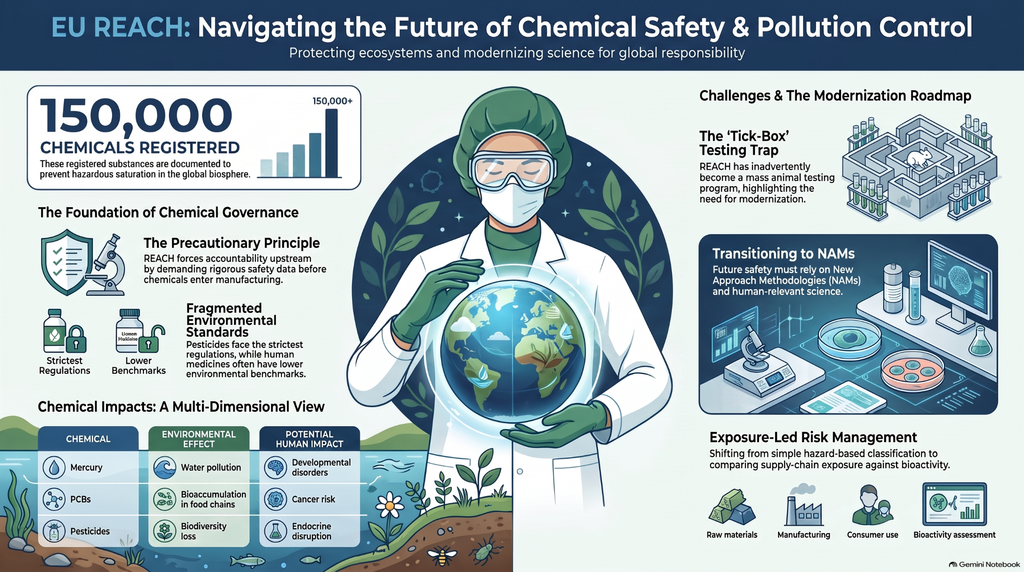
| Chemical | Environmental Effect | Potential Human Impact |
| Lead | Soil contamination | Neurological issues |
| Mercury | Water pollution | Developmental disorders |
| PCBs | Bioaccumulation in food chains | Cancer risk |
| Pesticides | Biodiversity loss | Endocrine disruption |
| Phthalates | Airborne toxicity | Reproductive health issues |

HOW REACH ENSURES SAFETY AND ENCOURAGES ALTERNATIVES
In consulting rooms and international negotiation halls alike, the central argument against tightening environmental regulations usually boils down to the fear of stifling innovation. But working alongside forward-thinking enterprises has shown me that stringent guardrails often serve as the most effective catalysts for genuine green chemistry. When REACH nudges industry away from known hazards, it sparks healthy market competition around bio-based, lower-impact formulations. However, this push for continuous improvement is currently hitting systemic walls.
For example, the persistence of a rigid, molecule-by-molecule evaluation process actively incentivizes regrettable substitution—such as swapping restricted bisphenol A for bisphenols S or F—which frustrates both researchers and regulators. Furthermore, current frameworks remain heavily reliant on legacy vertebrate animal testing protocols rather than modern, human-relevant New Approach Methodologies (NAMs) and exposure-led assessments.
We are essentially trying to solve twenty-first-century chemical complexity with twentieth-century testing architecture. If Europe genuinely seeks to lead on sustainable innovation, policy revisions must embrace group-based substance restrictions, dynamic benchmarking systems, and advanced in vitro data pipelines. Regulatory compliance cannot merely be treated as an administrative box-ticking exercise; it must actively drive clean technological transitions that protect downstream communities and preserve natural biodiversity.
REACH places responsibility on industry to manage the risks from chemicals and to provide safety information on the substances. To that end, manufacturers and importers are required to gather information on the properties of their chemical substances and to register that information in a central database in the European Chemicals Agency (ECHA). The Agency is the central point in the REACH system: it manages the databases necessary to operate the system, coordinates the in-depth evaluation of the information provided on chemicals and runs a public database where consumers and professionals can find hazard information.
REACH enhances safety by implementing rigorous chemical assessment procedures that identify hazardous substances.
It promotes safer substitution practices, encouraging industries to choose alternatives that pose less risk to health and the environment.
In addition, the regulation guarantees data transparency and accessibility, allowing stakeholders to make informed decisions about chemical use.
Enhanced Chemical Assessment Procedures
To guarantee chemical safety and promote alternative substances, the Enhanced Chemical Assessment Procedures under the EU REACH Regulation play an essential role.
These procedures are designed to rigorously evaluate chemical risk while encouraging the development of safer alternatives. You’ll appreciate their innovative approach, which includes:
- Thorough assessment methodologies
- Emphasis on data transparency
- Integration of stakeholder input
- Consideration of environmental impact
- Promotion of alternative testing methods
Promoting Safer Substitution Practices
REACH (Registration, Evaluation, Authorisation, and Restriction of Chemicals) is the EU’s comprehensive regulation designed to protect people and the environment from potential risks posed by chemicals, and to ensure the free circulation of substances on the internal market while enhancing competitiveness and innovation. In force since June 2007, REACH primarily regulates the production and use of chemical substances. It applies to all chemical substances- whether used in industrial processes or present in everyday products like cleaning supplies, paints, clothes, furniture, and electronic appliances.
The Enhanced Chemical Assessment Procedures set the stage for promoting safer substitution practices within the EU REACH framework.
By requiring thorough evaluations of chemical hazards, REACH encourages you to explore safer alternatives that minimize environmental impact. This process not only guarantees safety but also drives innovation in sustainable practices.
As you consider substitutions, REACH provides guidance on evaluating the risks of both existing and alternative substances, facilitating informed decision-making.
Data Transparency and Accessibility
How can data transparency and accessibility within the EU REACH framework enhance safety and promote the adoption of safer alternatives?
By prioritizing data sharing and ensuring information accessibility, REACH fosters a culture of innovation that empowers stakeholders. This approach can:
- Drive informed decision-making among industries
- Facilitate collaboration between research institutions and businesses
- Encourage the development of eco-friendly substances
- Reduce duplication of testing efforts, saving time and resources
- Enhance public trust in chemical safety assessments
Through these mechanisms, REACH not only safeguards public health and the environment but also inspires companies to seek safer alternatives, ultimately leading to a more sustainable future.
Embracing transparency is essential for driving progress and minimizing risks associated with hazardous substances.
Impact of REACH on Industry Practices and Innovation
REACH (Registration, Evaluation, Authorisation and Restriction of Chemicals) is a foundational European Union regulation (EC 1907/2006) that profoundly impacts the production, use, and management of chemical substances, including their effects on the environment and human health. Since its establishment in 2007, REACH has evolved, reflecting the EU’s commitment to robust chemical safety and continuous improvement. It is currently undergoing further review by the European Commission to ensure its continued effectiveness in a rapidly changing global landscape.
As industries adapt to the stringent requirements of the EU REACH regulation, many are discovering both challenges and opportunities that reshape their practices and drive innovation.
REACH compliance necessitates a shift towards sustainable practices, prompting companies to explore innovative chemical alternatives that minimize environmental impact. This change not only meets regulatory challenges but also enhances market competitiveness by aligning with consumer demand for safer products.
The economic impacts of these changes are significant; businesses investing in innovation incentives often find themselves at the forefront of emerging markets.
Adapting to REACH encourages collaboration across sectors, fostering a culture of shared knowledge and resources. By prioritizing sustainability practices, industries can navigate regulatory landscapes while enhancing their reputation.
Ultimately, the REACH framework acts as a catalyst for transformation, pushing companies to rethink their strategies and embrace a future where safety and sustainability go hand in hand.
Key Challenges and Criticisms Facing EU REACH
While the EU REACH regulation aims to enhance chemical safety and protect human health and the environment, it faces several key challenges and criticisms that can’t be overlooked.
You should be aware of these issues, as they impact the effectiveness of the regulation:
- High compliance costs for businesses, particularly SMEs.
- Insufficient data on the safety of certain chemicals, leading to regulatory criticisms about incomplete assessments.
- Inconsistencies in implementation across member states, causing confusion and uneven enforcement.
- Limited resources for regulatory bodies, which hampers the ability to monitor and enforce compliance effectively.
- Concerns about innovation stifling**, as stringent regulations may deter new chemical developments.
These challenges faced by EU REACH highlight the need for ongoing dialogue and improvement, ensuring that the regulation meets its objectives without compromising the innovation necessary for a sustainable future.
Future Directions for EU REACH and Sustainable Chemical Management
Recognizing the evolving landscape of chemical safety, the future directions for EU REACH must focus on integrating sustainable chemical management practices that not only enhance regulatory effectiveness but also promote innovation.
To achieve this, you’ll want to advocate for regulatory updates that prioritize sustainable innovations, ensuring that the chemical industry shifts towards safer, greener alternatives.
Emphasizing life-cycle assessments can help companies evaluate the environmental impact of chemicals from production to disposal, driving the development of sustainable solutions.
Collaboration between stakeholders—including industry, government, and research institutions—will be essential in fostering an ecosystem that supports innovative practices while ensuring compliance with regulations.
Moreover, implementing incentives for companies to adopt sustainable practices can stimulate investment in eco-friendly technolog
RELATED STUDIES ABOUT EU REACH REGULATION CHEMICAL SAFETY ENVIRONMENTAL EFFECTS
In summary, EU REACH plays an essential role in safeguarding chemical safety and mitigating pollution. With nearly 150,000 chemicals registered, it’s astounding to think that these regulations have led to a significant reduction in hazardous substances entering our environment. The ongoing challenges highlight the need for continuous improvement, but the framework encourages innovation and the adoption of safer alternatives. As we move forward, the commitment to sustainable chemical management remains important for both public health and environmental protection.
When similar chemicals meet different rules: Environmental standards in the licensing of medicinal and plant protection products in the EU and USA
Core Findings & Regulatory Hierarchy
Despite marked chemical, molecular, and functional similarities, human medicinal products (HMPs), veterinary medicinal products (VMPs), and plant protection products (PPPs) are governed under fragmented legal regimes. Across both the European Union and the United States, a consistent regulatory hierarchy emerges:
- Plant Protection Products face the most stringent environmental standards (High to Very High in the EU; Moderate to High in the USA).
- Veterinary Medicinal Products occupy an intermediate tier of stringency (Moderate in the EU; Low to Moderate in the USA).
- Human Medicinal Products are subject to the lowest standards (Low in the EU; Very Low in the USA).
Overall, the European Union enforces more stringent environmental licensing standards than the United States across all three evaluated product categories.
Cross-Jurisdictional Comparison
- Institutional Governance & Integration
- EU: Operates under a multi-level governance model with the European Commission acting as the bridging authority, supported by the European Medicines Agency (EMA) and European Food Safety Authority (EFSA). While vertical integration fosters upward harmonisation, decentralised Member State implementation creates potential fragmentation and enforcement gaps.
- USA: Governed via a horizontally fragmented model lacking a unified bridging body. The Food and Drug Administration (FDA) holds exclusive, preemptive authority over pharmaceuticals, while the Environmental Protection Agency (EPA) independently regulates PPPs under FIFRA.
- Public Participation
- EU: Mandatory 60-day public comment periods apply to PPP active substance evaluations, whereas public participation is entirely absent in HMP and VMP marketing authorisation procedures.
- USA: Pre-licensing public comment periods are statutorily required for PPPs under FIFRA. Public participation is generally absent for pharmaceuticals unless licensing triggers an Environmental Impact Statement (EIS) under NEPA. Across both regions, existing participation remains consultative rather than empowering.
- Environmental (Risk) Assessment: E(R)A Triggers & Decision Weight
- EU: E(R)A outcomes provide standalone statutory grounds for licensing refusal in PPPs and form an integral part of the benefit-risk balance for VMPs. For HMPs, adverse E(R)A findings or missing ecotoxicity data cannot legally justify license refusal. Testing thresholds are strict, with Phase II triggers set at surface water concentrations of 0.01 µg/L.
- USA: PPP evaluations balance environmental risks against social and economic benefits within a cost-benefit framework under FIFRA. For pharmaceuticals, E(R)A requirements under NEPA are largely procedural and systematically bypassed through broad categorical exclusions (e.g., an aquatic concentration screening threshold of 1.00 µg/L).
- Post-Authorisation & Renewal
- EU: PPP active substances require periodic re-evaluation every 10 to 15 years, with renewal contingent on updated E(R)A data. HMPs and VMPs receive indefinite marketing authorisations after initial periods, lacking mandatory cyclical E(R)A reviews.
- USA: PPPs undergo a formal 15-year registration review cycle. In contrast, human and veterinary pharmaceuticals are granted indefinite licenses with no periodic reassessment obligations.
- Substitution Obligations
- EU: Article 50 of Regulation 1107/2009 mandates comparative assessments and substitution for high-risk PPPs (“candidates for substitution”) when safer alternatives exist. No equivalent obligation applies to HMPs or VMPs.
- USA: No formal substitution obligations exist for either PPPs or pharmaceuticals.
- Legacy & Generic Products
- EU: Pre-2005 legacy HMPs and generics referencing them remain on the market without mandatory retrospective E(R)As, leaving notable data gaps for high-volume legacy drugs. Legacy VMP generics require an E(R)A.
- USA: While historical PPPs underwent reregistration mandates, legacy pharmaceuticals are not automatically reassessed, and generic HMPs routinely receive categorical exclusions.
Key Regulatory Vulnerabilities
- Prioritisation of Human Access over Environment: Public health and drug access structurally override ecological concerns in both jurisdictions. EU law prevents HMP refusal on environmental grounds regardless of toxicity findings.
- Systemic Waivers via Categorical Exclusions: The US FDA’s frequent application of categorical exclusions waives E(R)A requirements for nearly all human pharmaceuticals while failing to account for cumulative watershed loads.
- Omission of Co-Formulants: Regulating PPPs predominantly by active substance overlooks potential toxicity, persistence, and cocktail effects introduced by co-formulants and adjuvants.
Strategic Policy Recommendations
- Codify Pharmaceutical E(R)A Requirements in Law: Transition pharmaceutical testing data requirements from non-binding guidelines to enforceable primary legislation.
- Curtail Categorical Exclusions: Restrict the criteria for FDA categorical exclusions to close major environmental data gaps on human pharmaceuticals.
- Extend Substitution Obligations: Implement mandatory substitution provisions for human and veterinary pharmaceuticals when environmentally benign alternatives are available.
- Institute Cyclical License Renewals: Introduce periodic 10- to 15-year renewal requirements for pharmaceuticals, ensuring legacy products undergo modern ecotoxicity testing.
- Mandate Full-Formulation Assessments: Require E(R)As to evaluate finished commercial formulations to adequately measure the risks posed by adjuvants and mixtures.
| REFERENCE: Sophie E. Cook, Martin Scheringer, Eva Lieberherr, When similar chemicals meet different rules: Environmental standards in the licensing of medicinal and plant protection products in the EU and USA, Journal of Environmental Management, Volume 404, 2026, 129319, ISSN 0301-4797, https://doi.org/10.1016/j.jenvman.2026.129319. (https://www.sciencedirect.com/science/article/pii/S0301479726007796) |
REACHing for solutions: Essential revisions to the EU chemicals regulation to modernise safety assessment
Context & Core Problem
When enacted in 2007, the EU’s REACH regulation included a clear mandate to use animal testing only as a “last resort” and promote non-animal alternatives. In practice, REACH has evolved into the largest mass animal testing program in European history. Rather than transitioning to human-relevant modern science, the regulatory framework remains locked in a rigid, hazard-driven “tick-box” compliance system that creates disincentives for registrants to adopt New Approach Methodologies (NAMs).
The European Commission’s Chemicals Strategy for Sustainability (CSS) was intended to future-proof chemical regulation, yet current proposals—such as expanding standard animal data requirements to lower tonnages, polymers, and new hazard classes like endocrine disruptors—threaten to cause the deaths of tens of millions of additional animals without improving protection.
Proposed Reform Framework Across Three Vectors of Action
- Vector 1: Immediate Procedural Improvements by ECHA
- Reform Grouping and Read-Across: Mandate data-sharing rules beyond identical substances to structurally similar chemicals, and adopt adverse outcome pathway (AOP)-informed NAMs to screen out low-priority substances and avoid triggering unnecessary animal studies.
- Establish an Expert Scientific Committee on NAMs: Create an independent scientific advisory committee dedicated to NAMs and next-generation risk assessment (NGRA) to review testing proposals, evaluate waivers, and develop a strategic phase-out roadmap.
- Enhance Transparency and Reporting: Require Member States and ECHA to publish detailed metrics on NAM acceptance rates by endpoint, evaluate regulatory non-compliance regarding the last-resort rule, and submit an annual review tracking the integration of non-animal alternatives.
- Vector 2: Technical Annex Modifications via Delegated Acts
- Eliminate Redundant Animal Studies: Remove duplicative requirements, such as requiring both pre-natal developmental toxicity (PNDT) studies and extended one-generation reproductive toxicity studies (EOGRTS), eliminate routine two-species testing, and drop non-informative tests like avian sub-acute dietary assays.
- Implement Method-Agnostic Requirements: Frame standard information needs around the regulatory question rather than naming specific in vivo guidelines, enabling the use of Defined Approaches (DAs) and Integrated Approaches to Testing and Assessment (IATA).
- Require Universal Testing Proposals: Extend the requirement for formal testing proposals across all REACH Annex levels to ensure non-animal alternatives are exhaustively vetted before any vertebrate study can proceed.
- Freeze New Animal Testing Mandates: Prohibit the introduction of new or expanded in vivo standard requirements, redirecting resources toward completing and validating NAM frameworks.
- Vector 3: Structural Legislative Overhaul
- Strengthen Legal Language: Explicitly enshrine the ultimate phase-out of animal testing in Article 1 and establish non-animal methods as the primary default starting point under Article 13.
- Merge Dossier and Substance Evaluations: Replace procedural checklist checks with an early collaborative dialogue between registrants and ECHA experts to assess real-world exposure and risk before requesting any supplemental data.
- Adopt a Tiered NAM Prioritisation Scheme: Screen chemicals sequentially using non-animal tools:
- Step 1: Identify persistence, bioaccumulation, and mobility ((v)P, (v)B, (v)M) via computational and read-across models to classify Substances of Very High Concern (SVHCs).
- Step 2: Assess in vitro genotoxicity and mutagenicity.
- Step 3: Evaluate complex systemic toxicities and chronic effects using targeted NAM batteries.
- Common Step: Screen acute local and systemic toxicities purely through validated in vitro and defined approach methods.
- Transition to Exposure-Led Risk Management: Shift from hazard-based classification to risk-based decision-making using the Bioactivity-to-Exposure Ratio (BER), comparing in vitro points of departure ($POD_{NAM}$) directly against detailed supply-chain exposure scenarios to establish safe use.
Strategic Impact
Continuing down the current path of expanding in vivo animal testing delays regulatory decisions, strains administrative resources, and fails to capitalize on advances in human-relevant biology. Reorienting REACH toward an exposure-driven, tiered NAM framework provides an agile, scientifically superior pathway that fulfills both the safety and animal welfare mandates of the Chemicals Strategy for Sustainability.
| REFERENCE: Marina Pereira, Donna S. Macmillan, Catherine Willett, Troy Seidle, REACHing for solutions: Essential revisions to the EU chemicals regulation to modernise safety assessment, Regulatory Toxicology and Pharmacology, Volume 136, 2022, 105278, ISSN 0273-2300, https://doi.org/10.1016/j.yrtph.2022.105278. (https://www.sciencedirect.com/science/article/pii/S0273230022001659) |
Benchmarking environmental risks of plant protection products: Toward a comparative and systems-based approach in the EU pesticide regulation
Context & Core Problem
Under Regulation (EC) No. 1107/2009, the European Union conducts environmental risk assessments (ERAs) for plant protection products (PPPs) on an isolated, substance-by-substance basis. While thorough, this approach fragments regulatory data and prevents direct comparison of environmental risks across substances, crops, organism groups, and environmental compartments. Consequently, regulators cannot determine how approving a new PPP affects the broader landscape risk profile, nor can they systematically identify lower-risk alternatives to address documented biodiversity declines and widespread aquatic threshold exceedances.
Key Challenges in Current EU-ERA
- Heterogeneity of Higher-Tier Data: Semi-field, field, and mesocosm studies involve substantial ecological complexity and regional variability. These studies often test assemblages unrepresentative of natural communities, making cross-substance comparisons and national or EU-level generalisations difficult.
- Ambiguity in Risk Characterisation Ratio (RCR) Selection: Risk ratios vary widely depending on organism groups, timescales (acute vs. chronic), diverse crop uses, and FOCUS exposure steps. Higher-tier exposure models (FOCUS Steps 3 and 4) introduce multiple conflicting scenarios and mitigation factors that obscure comparative evaluations.
- Fragmented Data Infrastructure: Crucial prospective assessment data, toxicity endpoints, and exposure values are scattered across separate systems (e.g., individual EFSA conclusions, the EU Pesticides Database, and OpenFoodTox), with no centralised repository linking regulatory predictions to retrospective field-monitoring data.
The Proposed Benchmarking Framework
The authors present a 5-step, systems-based conceptual framework to standardise, rank, and continuously refine PPP risk profiles:
- 1. Data Infrastructure within Regulatory Context: Consolidate high-quality, standardised toxicological and exposure datasets from EFSA conclusions and EU repositories under existing legislative frameworks.
- 2. Risk Profile Development: Standardise input variables by calculating uniform Risk Quotients (RQs) and toxicity metrics alongside intrinsic chemical properties (persistence, mobility, bioaccumulation, and endocrine disruption potential).
- 3. Benchmarking System: Apply quantitative ranking algorithms, multi-criteria decision analysis (MCDA), multivariate clustering, and Monte Carlo sensitivity analyses to transform raw risk ratios into robust, comparable rankings across substances, uses, and taxa.
- 4. Feedback Loop & Adaptation: Dynamically update prospective models with real-world field monitoring and biomonitoring data, iteratively closing data gaps and refining risk tiers.
- 5. Decision Support & Communication Interface (DSCI): Translate ranking outputs into transparent dashboards, failure-rate plots, and risk maps to support regulatory substitution decisions and public communication.
Proof-of-Concept & Future Adaptations
- Immediate Feasibility via Tier 1 / FOCUS Step 1: Using EU-approved insecticides and acaricides as a pilot, the study illustrates that benchmarking is immediately viable without added regulatory burdens by combining standardised Tier 1 aquatic effect data with conservative FOCUS Step 1 surface water exposure calculations. This eliminates higher-tier scenario noise while reliably screening and ranking worst-case risks.
- Addressing Hazard Gaps: To prevent distorted rankings caused by narrow apical lab endpoints, the modular architecture allows future incorporation of New Approach Methodologies (NAMs), sub-lethal and multi-generational endpoints, and mixture toxicity metrics.
- Extension to Biocontrol Agents: The framework can accommodate biological and low-risk active substances alongside synthetic chemicals by integrating tailored biological parameters, such as host specificity and population-level infection dynamics.
Strategic Impact
Transitioning from isolated substance appraisals to a comparative benchmarking system shifts the EU pesticide regime toward an integrated, systems-based ERA. This framework equips authorities to prioritize high-risk dossiers, enforce evidence-based chemical substitutions, improve regulatory transparency, and align pesticide management with European biodiversity protection mandates.
| REFERENCE: Paul N. Ozoh, Johan Axelman, Annette Aldrich, Sabine Duquesne, Jonathan Jupke, Matthias Liess, Paula Scharlach, Ayesha Siddique, Susana Loureiro, Ralf B. Schäfer, Benchmarking environmental risks of plant protection products: Toward a comparative and systems-based approach in the EU pesticide regulation, Environment International, Volume 207, 2026, 110013, ISSN 0160-4120, https://doi.org/10.1016/j.envint.2025.110013. (https://www.sciencedirect.com/science/article/pii/S0160412025007640) |
CONCLUSION
Reflecting on the thousands of dossiers registered under REACH and the broader commitments under the European Green Deal, it is clear we stand at a critical crossroads. As someone dedicated to bridging the divide between academic research and actionable policymaking, I find it troubling whenever comprehensive legislative updates are delayed or abandoned due to institutional friction and intense industrial lobbying. A healthy economy and a non-toxic environment are not mutually exclusive pursuits; they are deeply codependent realities.
When I run weekend eco-workshops for children in my neighborhood, I often show them simple soil and water filtration models. Explaining to an eight-year-old how persistent chemicals enter our water tables quickly strips away regulatory jargon and lays bare our real responsibility. The EU REACH framework has undeniably prevented massive volumes of hazardous substances from saturating our biosphere, and that baseline protection should not be discounted.
However, resting on our laurels is not an option when endocrine disruptors, chemical mixtures, and pharmaceutical residues continue slipping through fragmented cracks in our legislation. Real environmental leadership requires the political courage to modernize safety assessment models, embrace systems-level comparative benchmarking, and enforce accountability with complete transparency. Our ecosystems demand policies that reflect the true urgency of the science.