
Whenever I look at a municipal water distribution diagram, I see a marvel of civil engineering—thousands of miles of underground pipes working silently to keep our taps flowing. But as an environmental engineering graduate, I also know that these networks are essentially open transport superhighways for whatever we allow into our source waters. The growing conversation around PFAS isn’t just abstract chemistry; it’s an urgent operational reality.
When I am out volunteering at local river cleanups, pulling plastic packaging and industrial debris out of the mud, it hits home how easily manufactured compounds integrate into the hydrological cycle. PFAS are often referred to as “forever chemicals” because their extremely strong carbon-fluorine bonds make them nearly impervious to natural breakdown. In standard municipal configurations, water infrastructure was designed around biological pathogens and basic turbidity—not synthetic compounds engineered specifically to resist heat, oil, and decay. Once PFAS enter source water or aquifers, typical utility filtration barely slows them down.
You cannot effectively protect your home’s water without first understanding how these industrial traces navigate treatment plants, main lines, and service pipes to reach your sink. Let’s demystify the mechanics so we can tackle the solution together.
PFAS contamination in drinking water spreads through municipal systems primarily due to industrial discharges and contaminated groundwater. These man-made chemicals can easily enter water sources, rendering traditional filtration less effective. They travel efficiently through pipes and accumulate in sediments, complicating removal efforts. As municipalities grapple with budget constraints and outdated treatment methods, the urgency to find effective strategies grows. Understanding these dynamics is essential if you want to grasp the full scope of the situation.
KEY TAKEAWAYS
- PFAS enter municipal water systems primarily through industrial discharges and contaminated groundwater sources.
- Contaminated leachate from landfills introduces PFAS into groundwater, affecting drinking water supplies.
- Runoff from firefighting foam training sites can lead to local water body contamination.
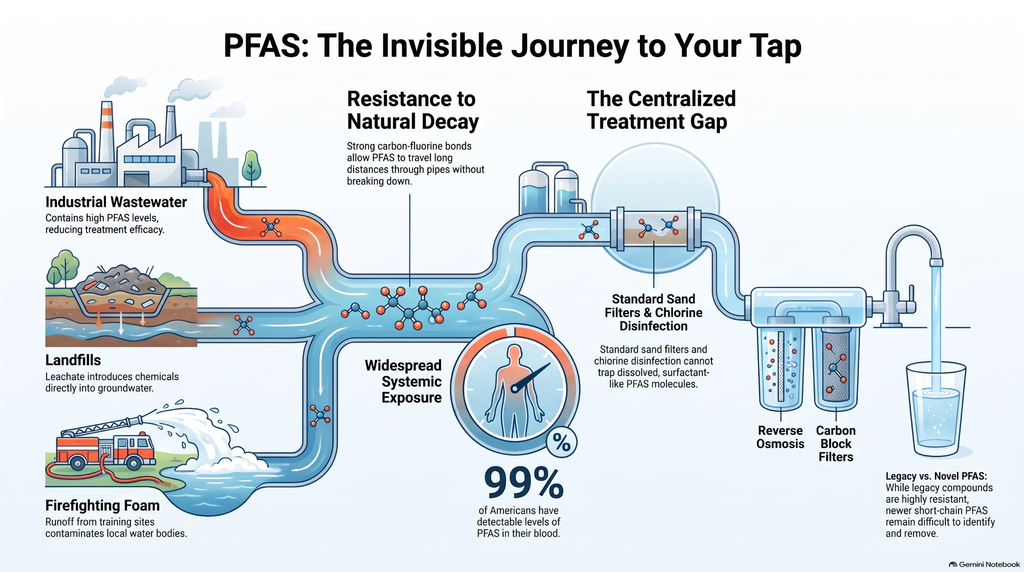
- PFAS compounds dissolve easily in water, allowing them to travel through municipal pipes and contaminate source waters.
- Their persistence and strong carbon-fluorine bonds complicate traditional filtration methods, making removal challenging.
WHAT ARE PFAS AND WHY ARE THEY A CONCERN?
PFAS, or per- and polyfluoroalkyl substances, are a group of man-made chemicals used in various industrial applications and consumer products. You’ll find PFAS sources in items like non-stick cookware, waterproof clothing, and firefighting foam.
Their unique chemical properties make them resistant to heat, water, and oil, which is why industries favor them. However, these same properties raise significant health risks, as PFAS can persist in the environment and accumulate in the human body over time.
Studies have linked PFAS exposure to various health issues, including liver damage, immune system effects, and increased cancer risk. Given the widespread use of these substances, understanding their pathways into our ecosystems and potential health impacts becomes vital.
As innovators and stakeholders, addressing PFAS contamination is essential for safeguarding public health and promoting sustainable practices in manufacturing and consumer products.
How Do PFAS Enter Municipal Water Systems?
EPA is committed to providing meaningful, understandable, and actionable information on per- and polyfluoroalkyl substances – known as PFAS – to the American public. The information provided here is intended to explain some of the important background information needed to understand the details of specific actions EPA takes to address PFAS, and other emerging events related to PFAS.
PFAS can enter municipal water systems primarily through industrial discharges and contaminated groundwater sources.
When industries release these chemicals into the environment, they often seep into nearby water supplies.
Additionally, groundwater contamination can occur from various sources, leading to widespread PFAS presence in drinking water.
Industrial Discharges and Waste
While many factors contribute to the contamination of drinking water, industrial discharges play a significant role in introducing PFAS into municipal water systems. When industries discharge wastewater, they often release hazardous materials, including PFAS. This contamination can occur through direct discharges into water bodies or via leaks in sewage systems, eventually making its way into your drinking water supply.
| Source of PFAS | Impact on Water Systems |
| Industrial Wastewater | Contains high levels of PFAS, affecting treatment efficacy |
| Landfills | Leachate can introduce PFAS into groundwater |
| Firefighting Foam | Runoff from training sites can contaminate local water bodies |
Contaminated Groundwater Sources
Contaminated groundwater sources often serve as a significant pathway for PFAS to infiltrate municipal water systems.
When you consider the various contamination sources, including industrial sites and landfills, it becomes clear how PFAS can leach into the groundwater. This contamination poses a challenge for municipal systems, as traditional filtration methods often fail to remove these persistent chemicals.
Groundwater remediation strategies are vital to address this issue effectively. By identifying and mitigating the sources of contamination, you can enhance the safety of drinking water.
Innovative approaches, such as advanced oxidation processes and adsorption techniques, are emerging to tackle PFAS in groundwater, but widespread implementation is essential for long-term protection of public health and the environment.
The Role of Industrial Discharges in PFAS Contamination
In 2025, the Illinois Environmental Protection Agency (IEPA) adopted health-based groundwater quality standards for six PFAS, including PFOA, PFOS, hexafluoropropylene oxide dimer acid (HFPO-DA), perfluorononanoic acid (PFNA), perfluorobutane sulfonic acid (PFBS), and perfluorohexane sulfonic acid (PFHxS). The standards are provided below in parts per trillion (ppt). You may have an increased risk of PFAS-related health effects when the level of PFAS in your drinking water exceeds the standards.
Industrial discharges play a significant role in the contamination of drinking water with PFAS, as these substances are often released during manufacturing processes. Many industries utilize PFAS in their products due to their unique properties, leading to unintentional release into the environment.
Poor industrial practices, such as inadequate waste management or outdated equipment, can exacerbate this issue, allowing PFAS to enter waterways.
Regulatory compliance is essential in mitigating these risks; however, many facilities may not fully adhere to existing regulations, contributing to ongoing contamination.
This lack of oversight can result in the accumulation of PFAS in sediment and groundwater, ultimately impacting drinking water sources.
How PFAS Moves Through Water Systems
As PFAS enter water systems, their unique chemical properties allow them to persist and spread rapidly through various pathways. Their strong carbon-fluorine bonds contribute to their stability, making them resistant to degradation. This PFAS behavior enables these compounds to easily dissolve in water, allowing for efficient water transport throughout municipal systems.
As water flows through pipes, PFAS can travel considerable distances, contaminating source waters and affecting drinking supplies. Moreover, these substances can adhere to sediments and biofilms, which further complicates their removal. Once PFAS infiltrate treatment systems, their persistence poses challenges for effective filtration and separation.
Understanding these dynamics is essential for developing innovative strategies to mitigate PFAS contamination. By optimizing water transport methods and enhancing monitoring techniques, you can help minimize the spread and impact of PFAS in drinking water, ultimately ensuring safer water for communities.

THE IMPACT OF WATER TREATMENT PROCESSES ON PFAS LEVELS
When you examine how PFAS bypass traditional municipal defenses, the engineering dilemma becomes obvious. Standard sediment basins and chlorine contact chambers rely on conventional physical settling and chemical disinfection. Because PFAS molecules dissolve seamlessly in water and mimic surfactants, they pass right through typical sand and gravel filters without binding or breaking down. For municipal managers facing tight capital budgets, retrofitting a centralized plant with high-pressure reverse osmosis or industrial-scale granular activated carbon is a massive, multi-million-dollar undertaking.
That leaves a significant gap between utility treatment and the tap, but it also gives us a clear roadmap for small-scale, decentralized intervention. In eco-friendly building and plumbing design, we rely heavily on multi-barrier principles. If the main municipal plant cannot capture these compounds due to legacy infrastructure constraints, the responsibility shifts to targeted point-of-use and point-of-entry systems.
Certified multi-stage filtration—pairing solid carbon block filters with high-efficiency reverse osmosis—creates an effective molecular sieve right where you draw drinking water. It is the exact approach we apply in closed-loop water systems: don’t depend entirely on a single centralized process when you can deploy reliable, accessible secondary barriers right at home.
Water treatment processes play a crucial role in determining PFAS levels in drinking water. While traditional methods like chlorination and sedimentation may not effectively reduce PFAS concentrations, advanced technologies offer promising solutions.
Techniques such as activated carbon filtration, reverse osmosis, ion exchange, and the use of a water softener can support improved household water treatment, depending on the contaminants present.
However, the efficiency of these technologies can vary based on factors like the specific PFAS compounds present and the water’s chemical composition. For instance, longer-chain PFAS molecules are generally more challenging to eliminate than their shorter counterparts.
As municipalities seek to innovate their water treatment systems, adopting a multi-barrier approach can enhance removal efficiency. This involves integrating various technologies to tackle PFAS thoroughly.
What Challenges Do Municipalities Face in Managing PFAS?
Although municipalities are increasingly aware of the dangers posed by PFAS contamination, they face significant challenges in effectively managing these persistent chemicals. One major hurdle is budget constraints, which limit their ability to invest in advanced treatment technologies and necessary infrastructure upgrades.
As you know, PFAS are notoriously difficult to remove, and municipalities often lack the funding to implement effective solutions.
Community engagement also poses a challenge. Residents may not fully understand the risks associated with PFAS or the complexity of remediation efforts. This lack of awareness can lead to public pushback against proposed initiatives or funding measures.
In addition, municipalities must navigate regulatory pressures while balancing community concerns, which can complicate decision-making processes.
Ultimately, the intersection of limited financial resources and the need for transparent communication with residents creates a formidable barrier to managing PFAS contamination effectively.
Strategies to Reduce PFAS in Drinking Water
PFAS are classified into legacy and novel PFAS. Legacy PFAS are the classical, highly fluorinated PFAS with high resistance to thermal and chemical degradation. On the other hand, novel PFAS are the newer PFAS with shorter perfluorinated carbon chains and were developed to mitigate the problems caused by legacy PFAS. Currently, only a small percentage of the novel PFAS occurring in the environment are identified.
To effectively reduce PFAS in drinking water, you need to contemplate advanced filtration technologies that can target these contaminants at the molecular level, while considering alternatives such as distilled water for specific household water needs.
Additionally, advocating for policy and regulation changes will strengthen protective measures at the municipal level.
Raising public awareness through targeted campaigns can also empower communities to demand safer water practices.
Advanced Filtration Technologies
As concerns over PFAS contamination continue to grow, advanced filtration technologies are emerging as effective strategies to mitigate these hazardous substances in drinking water.
Membrane filtration, particularly reverse osmosis, offers a robust solution by physically separating PFAS compounds from water molecules, ensuring cleaner drinking water.
Additionally, adsorption techniques using activated carbon or specialized resin can effectively capture and remove PFAS, enhancing overall water quality.
These technologies not only target a broad spectrum of PFAS compounds but also adapt to varying municipal needs.
By investing in these innovative filtration methods and choosing eco friendly products that support sustainable water management, communities can considerably reduce PFAS levels, safeguarding public health and improving water safety.
Embracing these advancements is essential for communities endeavoring to deliver clean, safe drinking water to their residents.
Policy and Regulation Changes
With increasing awareness of PFAS contamination, policymakers are now prioritizing regulatory changes to effectively tackle the presence of these harmful substances in drinking water.
You’ll see that emerging regulatory frameworks focus on stringent limits for PFAS levels, requiring water utilities to monitor and report contamination more transparently. These changes aim to address significant policy implications, including public health risks and environmental justice concerns.
By implementing innovative treatment technologies and enforcing stricter compliance, governments can guarantee safer drinking water for communities.
Additionally, fostering collaboration between federal and state agencies can enhance the effectiveness of these regulations. Embracing forward-thinking policies will ultimately lead to a more proactive approach in combating PFAS contamination in our water supply.
Public Awareness Campaigns
How can public awareness campaigns effectively reduce PFAS contamination in drinking water? Engaging the community through targeted initiatives can drive significant change.
Here are three key strategies:
- Educational Initiatives: Informing the public about PFAS sources and health risks empowers individuals to take action and advocate for safer water practices.
- Community Engagement: Organizing local forums and workshops fosters dialogue, allowing residents to share concerns and solutions, which strengthens community ties and collective action.
- Collaborative Partnerships: Partnering with local organizations and government agencies can amplify the message and reach diverse audiences, enhancing the campaign’s effectiveness.

RELATED STUDIES ABOUT PFAS CONTAMINATION IN DRINKING WATER
In summary, addressing PFAS contamination in municipal drinking water is essential for public health. Did you know that nearly 99% of Americans have detectable levels of PFAS in their blood? This statistic highlights the pervasive nature of these chemicals and the urgency for municipalities to implement effective strategies. By investing in advanced treatment technologies and improving regulatory measures, communities can work towards reducing PFAS levels, ensuring safer drinking water for all residents.
PFAS policies and reductions in drinking water contamination across the United States: Incorporated policy perspectives from Los Angeles residents
This study evaluates the relationship between state-level PFAS legislation and drinking water contamination across the United States, paired with a localized, community-engaged case study in Los Angeles (LA) examining household tap water contamination and resident perceptions.
Study Design & Methodology:
- National Policy & Monitoring Analysis: Evaluated 56,856 public water systems using EPA Unregulated Contaminant Monitoring Rule datasets across two cycles—UCMR3 (2013–2015) and UCMR5 (2023–2025)—tracking six PFAS compounds (PFBS, PFHpA, PFHxS, PFNA, PFOA, PFOS). State-level legislation (2016–2023) was categorized by total policy count and the proportion of water-focused policies.
- LA Community Engagement & Tap Testing: Collected household tap-water samples (n = 23) across Pasadena/Torrance and Central/Southeast LA analyzed for a 55-PFAS panel, alongside 6 focus groups and 7 semi-structured interviews (n = 29) examining water perceptions, mitigation behaviors, and policy demands.
Key Findings:
- Total State Policies Yield Mostly Null Reductions: Aggregate counts of state PFAS policies showed no consistent association with reduced contamination in UCMR5, yielding odds ratios near 1.00, except for a borderline reduction in PFBS (beta = -0.0003, p = 0.06).
- Water-Focused Policies Correlate with Increased Detections: A higher share of water-specific policies was significantly associated with higher odds of detecting PFBS (OR 3.79), PFHpA (OR 2.66), PFHxS (OR 3.10), and PFOS (OR 3.37). The authors interpret this not as policies causing contamination, but rather reflecting responsive legislative action in states with higher baseline contamination and expanded surveillance.
- Localized Disparities in Tap Water Quality: In LA household testing, no PFAS were detected in Pasadena or Torrance. Conversely, 50% of samples in Central/Southeast LA had detectable PFAS (mean 9.64 ng/L), driven by hotspots such as Bell Gardens, where individual PFOS levels reached 22.4 ng/L and total PFAS reached 51.3 ng/L (well exceeding federal regulatory thresholds).
- Widespread Tap Water Distrust and Adaptation: Residents across all surveyed LA communities reported high distrust in tap water fueled by sensory cues (chlorine taste, odor, discoloration) and concerns over legacy infrastructure. Distrust led to self-funded mitigation (bottled water, refill stations, home filtration), which inadvertently reduced exposure in high-burden areas but placed an economic burden on lower-income households.
Community-Driven Recommendations:
- Surveillance & Accountability: Mandate third-party independent water testing rather than relying solely on utility self-monitoring, enforce “polluter pays” mechanisms targeting industrial polluters, and require environmental contamination disclosures during real estate transactions.
- Equitable Support & Transparency: Subsidize point-of-use certified filtration systems (especially for renters), conduct multilingual, culturally tailored community workshops, and publish neighborhood-level water quality reports in plain language.
| REFERENCE: Shiwen Li, Rebecca Schielzeth, Tamar Galindo, Connie Valencia, Adam L. Smith, Lida Chatzi, Max T. Aung, PFAS policies and reductions in drinking water contamination across the United States: Incorporated policy perspectives from Los Angeles residents, Next Research, Volume 9, 2026, 101827, ISSN 3050-4759, https://doi.org/10.1016/j.nexres.2026.101827. (https://www.sciencedirect.com/science/article/pii/S3050475926005233) |
Geospatial and socioeconomic factors of PFAS contamination in private drinking water wells: Insights for monitoring and management
This study investigates the geospatial, environmental, and socioeconomic factors driving per- and polyfluoroalkyl substances (PFAS) contamination in private drinking water wells across the Commonwealth of Pennsylvania.
Study Overview & Methodology:
- Community-Science Sampling: Over a three-year period (2021–2023), researchers partnered with Penn State Extension’s Master Well Owner Network (MWON) to collect untreated tap water from 167 private wells across Pennsylvania, with 13 wells re-sampled across years to evaluate temporal variability.
- Analytical & Statistical Scope: Samples were tested for 20 target PFAS compounds following EPA Method 537.1. Tobit regression modeling (accounting for left-censored data below method detection limits) was coupled with geospatial datasets (land use, soil properties, point sources) and census block-level socioeconomic metrics from PennEnviroScreen. Findings were complemented by a county-level weighted linear regression combining the MWON data with 412 public well samples from the Pennsylvania Department of Environmental Protection (PADEP).
Key Findings:
- Widespread Occurrence & Standard Exceedances: Measurable concentrations of PFAS were detected in 65% of sampled private wells. Legacy compounds dominated occurrence: PFOS was detected in 51.5% of wells (up to 34.0 ng/L) and PFOA in 47.3% of wells (up to 62.0 ng/L). Overall, 18.0% of wells exceeded at least one health-based EPA Maximum Contaminant Level (MCL), driven primarily by PFOS (12.0%) and PFOA (11.4%) exceeding their 4.0 ng/L thresholds.
- Geospatial Hotspots & Environmental Drivers: Contamination was heavily concentrated in southeastern Pennsylvania. Developed land (impervious surfaces) served as a positive predictor for PFBA, PFHxA, PFOA, PFHxS, PFOS, and total measured PFAS. Agricultural cropland and higher pesticide application densities were significantly associated with elevated PFOA and PFBA. For soil characteristics, sandy soils (higher permeability) positively correlated with multiple PFAS, whereas soil organic carbon showed an inverse relationship, reflecting higher retention and reduced leaching.
- Temporal Fluctuations: Among the 13 re-sampled wells, total PFAS concentrations varied significantly between years (p = 0.041), exhibiting an average increase of 9.89 ng/L across sampling events, independent of annual precipitation variations.
- Socioeconomic Associations & Sampling Limitations: At the individual well level, poverty was inversely associated with several compounds (PFBA, PFHxA, PFHpA, PFOA, PFHxS, PFOS), while higher Socioeconomic Scores positively correlated with PFHxS. This reflects higher consumer product usage and density in wealthier developed areas, alongside volunteer recruitment bias that skewed heavily toward lower-poverty (63% in bottom two quartiles) and predominantly white census blocks. Conversely, at the county scale, lower socioeconomic scores trended toward higher detection frequencies when incorporating state compliance monitoring near known industrial sources.
Management & Policy Implications:
- Promote Point-of-Use Treatment: Because private wells lack federal Safe Drinking Water Act oversight, private well owners in developed or high-risk corridors should be educated on and supported in installing certified point-of-use mitigation systems, such as reverse osmosis.
- Establish Routine Monitoring Schedules: Observed year-to-year concentration increases highlight that a single baseline test is insufficient to confirm long-term water safety, underscoring the need for ongoing temporal monitoring guidelines.
- Prioritize Underrepresented Communities: Future well-testing initiatives and resource allocations must move beyond volunteer-based community networks to conduct targeted sampling and financial outreach in socioeconomically disadvantaged and racially diverse rural communities.
| REFERENCE: Kelly Kosiarski, Tamie L. Veith, Faith A. Kibuye, Jennifer Fetter, Susan Boser, John P. Vanden Heuvel, Cheryl L. Thompson, Heather E. Preisendanz, Geospatial and socioeconomic factors of PFAS contamination in private drinking water wells: Insights for monitoring and management, Journal of Environmental Management, Volume 388, 2025, 125863, ISSN 0301-4797, https://doi.org/10.1016/j.jenvman.2025.125863. (https://www.sciencedirect.com/science/article/pii/S0301479725018390) |
Examining disparities in PFAS plasma concentrations: Impact of drinking water contamination, food access, proximity to industrial facilities and superfund sites
This study evaluates how environmental contamination pathways—specifically public drinking water supplies, neighborhood food access, and proximity to Superfund sites and industrial polluters—impact internal per- and polyfluoroalkyl substances (PFAS) exposure in vulnerable urban populations across Southern California.
Study Design & Methodology:
- Study Cohorts: Utilized plasma samples and geocoded residential data from two Southern California cohorts: the Meta-AIR study nested within the Children’s Health Study (CHS; 118 young adults followed longitudinally, 88 completed follow-up) and the Study of Latino Adolescents at Risk (SOLAR; 328 overweight or obese Hispanic youth).
- Biomarker Profiling: Measured plasma concentrations across an 8-PFAS panel (PFOA, PFOS, PFNA, PFDA, PFHpS, PFHpA, PFPeS, PFHxS) using liquid chromatography coupled with high-resolution mass spectrometry (LC-HRMS).
- Spatial Exposure Linkages: Home addresses were geocoded and linked to public water system monitoring data (EPA UCMR3 and California state monitoring), census tract-level food access metrics (USDA Food Access Research Atlas), National Priorities List Superfund sites within a 3-mile radius, and EPA-identified PFAS-polluting industrial facilities.
Key Findings:
- Drinking Water Contamination Drives Systemic Burden: Among CHS participants, detections of PFOS, PFOA, and PFHxS in drinking water were significantly associated with plasma increases of 1.54 ng/mL, 0.47 ng/mL, and 1.16 ng/mL, respectively. Exceedance of the EPA Maximum Contaminant Level (MCL) for PFOA correlated with a 0.87 ng/mL elevation in plasma PFOA. No direct drinking water associations were found in the earlier SOLAR cohort, likely due to temporal differences in monitoring data and higher baseline reliance on bottled water.
- Food Insecurity Exacerbates Ingestion Risks: In the SOLAR cohort, residing in a census tract with low food access was significantly associated with elevated plasma concentrations of PFOS (+2.51 ng/mL), PFOA (+0.60 ng/mL), and PFHpS (+0.06 ng/mL). The authors attribute this to increased consumption of packaged, processed, and fast foods that rely heavily on PFAS-treated food-contact materials in neighborhoods lacking access to fresh grocery markets.
- Proximity to Superfund Sites Increases Sulfonate PFAS: Residing within 3 miles of a Superfund site was associated with elevated plasma concentrations of PFOS (+0.96 ng/mL in CHS, +1.96 ng/mL in SOLAR), PFHxS (+0.90 ng/mL), PFPeS (+0.04 ng/mL), and PFHpS (+0.05 ng/mL). This points to co-contamination issues at sites like military bases and metal-plating facilities where historical solvents (e.g., TCE) and firefighting foams co-occur.
- Cumulative Industrial Siting Impacts: Approximately 45% of participants lived in census tracts hosting at least one industrial polluter (most commonly metal coating, waste management, and electronics). In the CHS baseline cohort, each additional PFAS-polluting facility in the neighborhood corresponded to a 0.09 ng/mL increase in plasma PFOS.
Policy & Public Health Implications:
- Address Cumulative Environmental Justice Burdens: Because under-resourced and predominantly Latino communities disproportionately host polluting infrastructure and Superfund sites, remediation policies must account for cumulative multi-source exposures rather than regulating industrial, water, and waste vectors in isolation.
- Food Access as an Upstream Intervention: Expanding healthy, fresh food retail infrastructure in food deserts serves as a viable structural intervention to reduce dietary intake of PFAS derived from fluorinated fast-food and convenience packaging.
- Expand Drinking Water Biomonitoring: Strong correlations between public supply detections and internal blood concentrations reinforce the urgent need to enforce EPA MCLs, replace aging distribution lines, and expand routine testing beyond legacy compounds to encompass emerging short-chain PFAS.
| REFERENCE: Shiwen Li, Jesse A. Goodrich, Elizabeth Costello, Douglas I. Walker, Carlos Cardenas-Iniguez, Jiawen Carmen Chen, Tanya L. Alderete, Damaskini Valvi, Sarah Rock, Sandrah P. Eckel, Rob McConnell, Frank D. Gilliland, John Wilson, Beau MacDonald, David V. Conti, Adam L. Smith, Daniel L. McCurry, Amy E. Childress, Adam M.-A. Simpson, Lucy Golden-Mason, Ana C. Maretti-Mira, Zhanghua Chen, Michael I. Goran, Max Aung, Lida Chatzi, Examining disparities in PFAS plasma concentrations: Impact of drinking water contamination, food access, proximity to industrial facilities and superfund sites, Environmental Research, Volume 264, Part 1, 2025, 120370, ISSN 0013-9351, https://doi.org/10.1016/j.envres.2024.120370. (https://www.sciencedirect.com/science/article/pii/S0013935124022771) |
CONCLUSION
Fixing municipal water quality isn’t an overnight task, but feeling paralyzed by industrial contamination data won’t help either. As someone who spends time analyzing flow rates, designing greywater circuits, and finding practical ways to optimize every gallon, I believe real resilience comes from balancing large-scale advocacy with direct personal action. We absolutely must support our local water districts, vote for infrastructure bonds, and demand strict regulatory limits on upstream industrial polluters.
But while municipal systems work through the slow process of capital upgrades, you have the ability to safeguard your immediate environment. Start with what you can manage under your own roof. Testing your tap water, choosing certified filtration that specifically targets fluorinated compounds, and being conscious of the non-stick and water-resistant materials you bring into your home all make a measurable difference.
Sustainability isn’t about achieving a flawless, zero-impact bubble; it’s about making deliberate, informed choices that reduce cumulative exposure over time. Safe, clean water starts with collective infrastructure, but protecting it on a personal level is a habit we can build starting right now.