
Having spent years analyzing municipal clean air policies and advising local governments on urban emission compliance, I have seen firsthand how easy it is for regulatory frameworks to focus on abstract numbers rather than human realities. When we evaluate nitrogen dioxide (NO2) standards, we are not just balancing regional air quality indexes or industrial compliance metrics, we are directly shaping the long-term health trajectories of our most vulnerable citizens. Throughout my career, I’ve continually observed that public health initiatives often treat ambient air pollution as a uniform risk across an entire city’s population. However, the physiological impacts of chronic NO2 exposure are starkly unequal.
Children and elderly populations bear a disproportionate burden of urban combustion emissions, primarily because their respiratory and immune systems operate under unique physiological constraints. While an adult in peak health might temporarily withstand localized spikes in traffic-related combustion gases, developing lungs in children and aging vascular systems in seniors suffer compounded, long-term damage.
Bridging the gap between environmental policy and urban engineering requires us to move past broad compliance targets and look closely at how sustained exposure erodes the quality of life for those least equipped to handle it. Grounding our engineering solutions in rigorous policy analysis is the only way to ensure that clean air regulations deliver genuine protection where it is needed most.
Long-term exposure to nitrogen dioxide can lead to serious health effects, especially in children and the elderly. Children face heightened risks, such as increased asthma rates and hindered lung development, while the elderly may experience exacerbated respiratory and cardiovascular issues. Chronic exposure can result in irreversible lung damage, hypertension, and systemic inflammation. Protecting these vulnerable groups is essential for public health. To discover more about the strategies to mitigate these risks, continue exploring this topic further.
KEY TAKEAWAYS
- Long-term exposure to nitrogen dioxide can lead to chronic bronchitis and increased asthma exacerbation in children and the elderly.
- Children’s developing lungs are more vulnerable, leading to hindered lung development and higher asthma rates due to NO2 exposure.
- The elderly experience exacerbated health issues from NO2, increasing the risk of heart attacks, strokes, and systemic inflammation.
- Continuous exposure to nitrogen dioxide can contribute to cognitive impairments in children and dementia risks in elderly populations.
- Addressing NO2 levels is crucial for reducing health disparities and promoting overall well-being in vulnerable groups.
WHAT YOU NEED TO KNOW ABOUT NITROGEN DIOXIDE
Nitrogen dioxide (NO2) is a reddish-brown gas with a sharp, acrid odor, primarily produced from vehicle emissions and industrial processes. Understanding the sources of nitrogen dioxide is vital for addressing air quality issues.
Vehicles, especially those running on gasoline and diesel, are considerable contributors, releasing NO2 during combustion. Industrial activities, such as power generation and manufacturing, also emit this gas, along with VOCs that can further deteriorate urban air quality.
Exposure to elevated levels of NO2 can lead to respiratory problems and aggravate pre-existing conditions. It’s essential to monitor nitrogen dioxide concentrations in urban areas, as they can fluctuate based on traffic patterns and industrial output.
Implementing innovative technologies and stricter regulations can help mitigate these emissions. By prioritizing cleaner energy sources and enhancing public transportation, you can greatly improve air quality, reducing the health risks associated with nitrogen dioxide exposure.
Understanding these dynamics empowers you to advocate for healthier environments.
Who Is Most Vulnerable to Nitrogen Dioxide Exposure?
The main health effect of nitrogen dioxide is on the respiratory system. Inhalation of nitrogen dioxide by children increases their risk of respiratory infection and may lead to poorer lung function in later life. There is also an association between nitrogen dioxide concentrations in the air and increases in mortality and hospital admissions for respiratory disease. Nitrogen dioxide can decrease the lungs’ defences against bacteria making them more susceptible to infections. It can also aggravate asthma.
When considering who’s most vulnerable to nitrogen dioxide exposure, children and the elderly stand out.
Children’s developing respiratory systems make them particularly susceptible to the harmful effects, while age-related health issues in the elderly can exacerbate their risks.
Understanding these factors is essential for implementing effective protective measures.
Children’s Respiratory Health Risks
Children are particularly vulnerable to the health risks posed by nitrogen dioxide (NO2) exposure, especially those with pre-existing respiratory conditions or those living in urban areas with high traffic emissions.
The prevalence of asthma in children is alarming, with studies showing a direct link between NO2 exposure and increased asthma rates. This pollutant can hinder lung development, leading to long-term respiratory issues. As children’s lungs are still maturing, they’re more susceptible to irritants, which can exacerbate conditions like asthma.
Innovative interventions, such as improved air quality monitoring and urban planning, are essential in minimizing NO2 exposure. Addressing these risks not only protects children’s health but also supports healthier communities overall, fostering a safer environment for future generations.
Elderly Vulnerability Factors
As you age, your body’s ability to cope with environmental pollutants like nitrogen dioxide (NO2) diminishes, making the elderly particularly vulnerable to its adverse health effects.
This age-related susceptibility is exacerbated by several factors:
- Pre-existing conditions: Chronic respiratory diseases such as asthma or COPD can amplify NO2’s harmful impacts.
- Weakened immune response: An aging immune system struggles to combat inflammation and infection.
- Decreased lung function: Age-related decline in lung capacity makes it harder to filter out pollutants.
- Social determinants: Factors like socioeconomic status can limit access to healthcare, increasing vulnerability.
Understanding these factors is essential in mitigating risks and implementing effective public health strategies for the elderly.
Respiratory Issues From Long-Term Nitrogen Dioxide Exposure
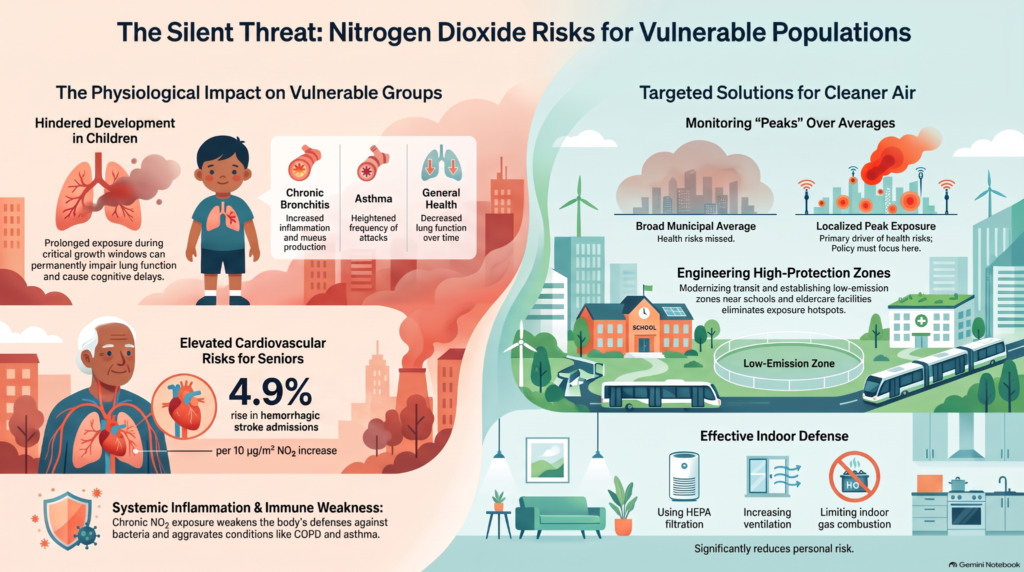
Long-term exposure to nitrogen dioxide (NO2) can lead to significant respiratory issues, particularly in vulnerable populations such as those with preexisting conditions. Research indicates that NO2 exposure is linked to chronic bronchitis and increased asthma exacerbation. The following table summarizes the impact of NO2 on respiratory health:
| Respiratory Condition | Effect of NO2 Exposure |
| Chronic Bronchitis | Increased inflammation and mucus production |
| Asthma | Heightened frequency of attacks |
| General Respiratory Health | Decreased lung function over time |
You might not realize how these effects can compound over time. Continuous exposure can result in irreversible lung damage, particularly in children and the elderly. Understanding these risks is essential for advocating for cleaner air and innovative public health policies aimed at reducing nitrogen dioxide emissions. Prioritizing respiratory health may lead to improved quality of life for these sensitive populations.
Cardiovascular Risks Associated With Nitrogen Dioxide
While you might primarily associate nitrogen dioxide (NO2) with respiratory problems, emerging research reveals significant cardiovascular risks linked to this pollutant. Long-term exposure to nitrogen dioxide toxicity has been shown to exacerbate cardiovascular inflammation, leading to serious health issues.
Here are some key points to reflect on:
- Increased risk of hypertension due to vascular damage
- Elevated levels of systemic inflammation affecting heart function
- Potential for accelerated atherosclerosis and plaque buildup
- Heightened likelihood of heart attacks and strokes
Understanding these risks is vital, especially for vulnerable populations like children and the elderly.

DEVELOPMENTAL CHALLENGES IN CHILDREN FROM NITROGEN DIOXIDE EXPOSURE
From an policy analyst’s perspective, the physiological and cardiovascular mechanisms tied to extended nitrogen dioxide exposure highlight a major gap in traditional regulatory monitoring. In municipal planning, compliance is frequently measured using regional average concentrations across broad geographical zones. Yet, empirical health studies such as research analyzing spatial pollution models and hospital admission data repeatedly demonstrate that localized peak exposures often serve as the true drivers of adverse health outcomes, particularly for pediatric asthma exacerbations, cognitive development risks, and senior cardiovascular events.
When we evaluate the cardiovascular risks associated with NO2 including systemic inflammation, accelerated vascular damage, and heightened stroke risks among older demographics, it becomes clear that ambient standards must align more closely with real-world exposure patterns. Furthermore, pediatric risks extend beyond immediate airway irritation; prolonged exposure during critical developmental windows can impair long-term lung function and hinder cognitive growth.
Engineering interventions such as modernizing public transit fleets, deploying high-efficiency filtration systems, and establishing low-emission zones near schools and eldercare facilities must be purposefully designed to eliminate these high-concentration exposure hotspots. Effective air quality policy is not simply about meeting broad municipal averages; it requires targeted engineering strategies that systematically eliminate exposure spikes in areas populated by sensitive demographic groups.
Exposure to nitrogen dioxide (NO2) can considerably disrupt children’s development, particularly during essential growth periods. Research indicates that prolonged exposure to NO2 is linked to significant developmental delays, affecting both physical and cognitive growth.
Children exposed to elevated levels of this pollutant often experience cognitive impairment, which can manifest as difficulties in learning, memory, and attention. These challenges may hinder academic performance and overall social integration, potentially leading to long-term disadvantages in adulthood.
Moreover, the neurodevelopmental impacts of NO2 exposure can exacerbate existing health disparities, especially in vulnerable populations. As you navigate the implications of air quality on child development, it’s imperative to recognize the pressing need for innovative solutions and policies aimed at reducing NO2 emissions.
Why Is Clean Air Crucial for Children and the Elderly?
Breathing air with a high concentration of NO2 can irritate airways in the human respiratory system. Such exposures over short periods can aggravate respiratory diseases, particularly asthma, leading to respiratory symptoms (such as coughing, wheezing or difficulty breathing), hospital admissions and visits to emergency rooms. Longer exposures to elevated concentrations of NO2 may contribute to the development of asthma and potentially increase susceptibility to respiratory infections. People with asthma, as well as children and the elderly are generally at greater risk for the health effects of NO2.
Clean air is essential for children and the elderly because their respiratory systems are more vulnerable to pollutants like nitrogen dioxide.
Exposure can lead to serious health risks, including respiratory infections and exacerbated asthma.
Ensuring clean air helps protect these groups from long-term health issues and supports their overall well-being.
Vulnerable Population Health Risks
Because children and the elderly are particularly susceptible to the harmful effects of nitrogen dioxide, ensuring clean air is essential for their health.
Vulnerable populations face significant health disparities that can exacerbate existing conditions.
Consider the following risks:
- Respiratory Issues: Increased vulnerability to asthma and other chronic respiratory diseases.
- Cognitive Impairment: Exposure can negatively affect cognitive development in children and lead to dementia in the elderly.
- Immune System Weakness: Both groups may experience a weakened immune response, making them more prone to infections.
- Cardiovascular Problems: Nitrogen dioxide exposure is linked to elevated risks of heart disease and stroke.
Importance of Respiratory Health
While maintaining good air quality may seem like a simple requirement, it plays an essential role in the respiratory health of children and the elderly.
Clean air is vital for promoting respiratory wellness, as pollutants like nitrogen dioxide can contribute to indoor air pollution and severely impair lung function. Children, with their developing respiratory systems, are particularly vulnerable; exposure can lead to long-term complications, including asthma and reduced lung capacity.
Similarly, the elderly often face pre-existing conditions that can be exacerbated by poor air quality. Studies have shown that sustained exposure to pollutants can hinder recovery rates from respiratory illnesses in these populations.
Consequently, prioritizing clean air isn’t just a health measure; it’s a necessary investment in the future well-being of our most vulnerable citizens.
How to Reduce Nitrogen Dioxide Exposure
Nitrogen dioxide, or NO2, is a gaseous air pollutant composed of nitrogen and oxygen and is one of a group of related gases called nitrogen oxides, or NOx. Nitrogen dioxide forms when fossil fuels such as coal, oil, methane gas (natural gas) or diesel are burned at high temperatures. NO2 and other nitrogen oxides in the outdoor air contribute to particle pollution and to the chemical reactions that make ozone. It is one of six widespread air pollutants for which there are national air quality standards to limit their levels in the outdoor air. NO2 can also form indoors when fuels like wood or gas are burned.
To effectively reduce nitrogen dioxide (NO2) exposure, it’s essential to adopt specific strategies that target its primary sources. Implementing these measures can markedly enhance your indoor air quality and protect vulnerable populations by choosing eco friendly products that help reduce exposure to harmful pollutants.
- Utilize air purification systems: Invest in high-efficiency particulate air (HEPA) filters and activated carbon filters to trap pollutants.
- Incorporate indoor plants: Certain species, like spider plants and peace lilies, can naturally absorb NO2 and improve air quality.
- Ventilate regularly: Open windows and use exhaust fans to increase fresh air circulation, especially when cooking or using gas appliances.
- Limit indoor combustion sources: Avoid smoking indoors and minimize the use of gas stoves; consider electric alternatives instead.

RELATED STUDIES ABOUT NITROGEN DIOXIDE HEALTH EFFECTS
To summarize, while you might think that nitrogen dioxide exposure is a distant concern, its long-term effects on vulnerable populations like children and the elderly are all too real. The evidence is clear: prolonged exposure can lead to serious respiratory and cardiovascular issues. Prioritizing clean air isn’t just about comfort; it’s about safeguarding the health of future generations. By taking proactive steps to reduce nitrogen dioxide exposure, you can play a crucial role in fostering a healthier environment for everyone.
Data on short-term effect of nitrogen dioxide on cardiovascular health in Wallonia, Belgium
Overview & Objective
This study evaluated the short-term impact of ambient nitrogen dioxide (NO2) exposure on hospital admissions for cardiovascular diseases (CVD) across Wallonia, Belgium, covering the period from January 1, 2008, to December 31, 2011. The primary aim was to analyze the lag effect—the delay between pollutant exposure and the onset of a cardiovascular event—and measure the excess relative risk (ERR) across various demographic groups and health conditions.
Key Data & Scope
- Geographic & Temporal Scope: Data were compiled across Wallonia (3,525,000 residents) using 10 air monitoring stations, 5 temperature stations, and official admission records from 42 regional hospitals.
- Sample Size: A total of 113,147 hospital admissions for CVD were recorded over the 4-year study period.
- Demographics: Women accounted for 45% of admissions, and 66.5% of patients were aged 65 or older.
- Disease Breakdown:
- Arrhythmia (Heart Rhythm Disorders): 46.8% (52,937 cases; 62.3% of these were atrial fibrillation/flutter)
- Ischemic Stroke: 29.1% (32,902 cases)
- Acute Myocardial Infarction (AMI / Heart Attack): 19.0% (21,491 cases)
- Haemorrhagic Stroke: 5.1% (5,817 cases)
Key Findings
- Significant Risk Increases Across Conditions: Every 10 ug/m^3 increase in NO2 concentrations resulted in statistically significant increases in hospital admissions across all measured outcomes:
- Haemorrhagic Stroke: +4.9% ERR
- Ischemic Stroke: +4.5% ERR
- Arrhythmia: +3.7% ERR
- Overall CVD: +3.5% ERR
- Acute Myocardial Infarction: +2.8% ERR
- Immediate vs. Delayed Impact (Lag Effect):
- Same-Day Impact (Lag 0): For overall CVD, arrhythmia, AMI, and ischemic stroke, the strongest association with elevated NO2 occurred on the same day of exposure (Lag 0).
- Delayed Impact (Lag 2): For haemorrhagic stroke, the peak association occurred after a 2-day delay.
- Modifying Factors (Temperature, Season, Age & Gender):
- Temperature Effect: Higher ambient temperatures (>16.3^C) significantly amplified the risk of NO2 exposure on overall CVD (6.1% ERR vs. 3.0% at lower temperatures), arrhythmia (7.5% vs. 2.2%), and AMI (6.2% vs. 3.0%).
- Seasonal Variation: NO2 concentrations peaked during winter months (January max of 26.9 ug/m^3 vs. July min of 13.1ug/m^3). However, the relative impact per unit increase of NO2 was higher during warm periods.
- Age Vulnerability: The youngest cohort (25–54 years) showed higher sensitivity for arrhythmia (+7.6% ERR), while the oldest cohort (≥ 65 years) showed higher risk for haemorrhagic stroke (+6.5% ERR).
- Gender Disparity in Stroke Risk: Women experienced a significantly higher risk of haemorrhagic stroke associated with NO2 exposure compared to men (+7.3% ERR vs. +2.3% ERR).
Actionable Takeaways
- Public Health & Policy: The findings provide quantitative evidence connecting ambient NO2 spikes to immediate cardiovascular events, offering decision-makers and health officials actionable data to formulate targeted early-warning systems, air quality interventions, and preventive healthcare measures during high-pollution and high-temperature days.
| REFERENCE: Philippe Collart, Dominique Dubourg, Alain Levêque, Natalia Bustos Sierra, Yves Coppieters, Data on short-term effect of nitrogen dioxide on cardiovascular health in Wallonia, Belgium, Data in Brief, Volume 17, 2018, Pages 172-179, ISSN 2352-3409, https://doi.org/10.1016/j.dib.2017.12.056. (https://www.sciencedirect.com/science/article/pii/S2352340917307515) |
An integrated Bayesian model for estimating the long-term health effects of air pollution by fusing modelled and measured pollution data: A case study of nitrogen dioxide concentrations in Scotland
Overview & Objective
This study proposes a novel two-stage Bayesian statistical fusion model to evaluate the long-term impact of ambient nitrogen dioxide ($\text{NO}_2$) exposure on respiratory disease hospitalizations across mainland Scotland from 2007 to 2011. The research addresses the spatial misalignment (“change of support” problem) between sparse point-level pollution measurements, regular grid-level atmospheric dispersion model outputs, and irregular small-area administrative health boundaries.
Key Methodology & Data
- Geographic & Temporal Scope: The study covered all of mainland Scotland (population ~5.2 million) across n = 1,207 Intermediate Geographies (IGs) over a 5-year period (2007–2011).
- Health Data: Annual hospital admission counts for primary diagnoses of respiratory disease (ICD-10 codes J00–J99) were extracted per IG and adjusted for age and sex demographics.
- Exposure Modeling (Stage 1 Fusion Model): Fused point-level measured NO2 concentrations (from automatic monitors and diffusion tubes) with 1 km resolution DEFRA atmospheric dispersion model outputs and environmental covariates (urban/rural classification, temperature). Predictions were aggregated to the IG level using both spatial mean and spatial maximum (peak) metrics.
- Disease Modeling (Stage 2 Health Model): A Bayesian spatio-temporal Poisson log-linear regression model evaluated disease risk, controlling for socio-economic deprivation (Job Seekers Allowance rates and median property prices) and accounting for residual spatial/temporal autocorrelation using Conditional Autoregressive (CAR) random effects.
Key Findings
- Superiority of Data Fusion for Pollution Estimation:
- The proposed Bayesian space-time linear regression fusion model (Model 1A) significantly outperformed existing methods.
- Cross-validation showed a 64% reduction in Root Mean Square Prediction Error (RMSPE) compared to using DEFRA model output alone (0.3116 vs. 0.8648) and a 25% reduction compared to a standard spatio-temporal Gaussian process model (SGH).
- Spatial Aggregation Metric Matters (Peak vs. Mean):
- Peak Concentration (Spatial Maximum): A standard deviation increase (6.84ug/m^3) in peak NO2 exposure within an IG was associated with a statistically significant 2.1% to 2.3% increase in respiratory hospital admissions.
- Average Concentration (Spatial Mean): No statistically significant relationship was found when using the spatial mean NO2 metric across an IG.
- Socio-Economic Deprivation Impact:
- Socio-economic factors showed strong, robust associations with respiratory health: a 2.35% increase in Job Seekers Allowance recipients was associated with a 20% increase in hospitalization rates, while higher property prices correlated with significantly lower admission risks.
Actionable Takeaways & Implications
- Exposure Metric Selection: Epidemiological studies traditionally rely on spatial mean pollution levels. This study demonstrates that localized peak exposure levels may be a critical driver of respiratory health risks, suggesting future health impact assessments should evaluate spatial maximum metrics.
- Reliability of Modeled Data: Although DEFRA modeled pollution concentrations contain baseline bias, using them as key inputs within a fusion framework—or even as spatial maximum proxies—yields consistent health risk estimates, providing a reliable strategy for regions with sparse monitoring networks.
| REFERENCE: Guowen Huang, Duncan Lee, Marian Scott, An integrated Bayesian model for estimating the long-term health effects of air pollution by fusing modelled and measured pollution data: A case study of nitrogen dioxide concentrations in Scotland, Spatial and Spatio-temporal Epidemiology, Volumes 14–15, 2015, Pages 63-74, ISSN 1877-5845, https://doi.org/10.1016/j.sste.2015.09.002. (https://www.sciencedirect.com/science/article/pii/S1877584515000374) |
Comprehensive review of health impacts of the exposure to nitrogen oxides (NOx), carbon dioxide (CO2), and particulate matter (PM)
Overview & Objective
This study develops and evaluates a two-stage Bayesian statistical fusion model to quantify the long-term health impact of ambient nitrogen dioxide (NO2) exposure on respiratory disease hospitalizations across mainland Scotland between 2007 and 2011. The research specifically addresses the spatial misalignment (“change of support” problem) between sparse monitoring networks, regular grid-level outputs from atmospheric dispersion models, and irregularly shaped administrative health boundaries.
Key Methodology & Data
- Geographic & Temporal Scope: The study analyzed all 1,207 Intermediate Geographies (IGs) in mainland Scotland (population ~5.2 million) annually over a 5-year period (2007–2011).
- Health Outcome Data: Annual emergency hospital admission counts for primary diagnoses of respiratory disease (ICD-10 codes J00–J99) were obtained per IG and adjusted for age and sex demographics.
- Stage 1 (Exposure Fusion Model): Fused point-level measured NO2 concentrations (from automatic monitors and diffusion tubes) with 1 km gridded DEFRA dispersion model outputs, local land use (urban/rural classifications), and annual average temperature. Point predictions were aggregated to the IG level using two spatial metrics: the spatial mean (average) and the spatial maximum (peak).
- Stage 2 (Disease Model): Employed a Bayesian spatio-temporal Poisson log-linear regression model to link the aggregated exposure metrics to respiratory hospitalizations. The model controlled for socio-economic deprivation (Job Seekers Allowance rates and median property prices) and incorporated Leroux Conditional Autoregressive (CAR) random effects to account for residual spatial and temporal autocorrelation.
Key Findings
- Superiority of Data Fusion for Exposure Estimation:
- The proposed Bayesian space-time fusion model (Model 1A) outperformed standalone dispersion model outputs and spatial-only models.
- Cross-validation demonstrated a 64% reduction in Root Mean Square Prediction Error (RMSPE) compared to using DEFRA model output alone (0.3116 vs. 0.8648) and a 25% reduction compared to a traditional spatio-temporal Gaussian process model (0.3116 vs. 0.4174).
- Impact of Spatial Aggregation Metric (Peak vs. Mean):
- Spatial Maximum (Peak Exposure): A standard deviation increase (6.84ug/m^3) in peak NO2 exposure within an IG was associated with a statistically significant 2.1% to 2.3% increase in respiratory hospital admissions.
- Spatial Mean (Average Exposure): No statistically significant relationship was observed between average NO2 concentrations and respiratory hospitalizations.
- Role of Socio-Economic Confounders:
- Socio-economic deprivation exhibited a strong relationship with health outcomes. A 2.35% increase in Job Seekers Allowance (JSA) recipients was associated with an approximate 20% increase in hospitalization rates, while higher median property prices correlated with significantly lower risk.
Actionable Takeaways
- Re-evaluating Exposure Metrics: Environmental epidemiology heavily relies on areal mean pollution concentrations. This study demonstrates that localized peak exposure within an area may be the primary driver of respiratory health risks, suggesting policy assessments should incorporate spatial maximum metrics.
- Leveraging Modeled Data: Even though standalone dispersion models (such as DEFRA) contain baseline prediction biases, integrating them into a statistical fusion framework—or using their spatial maximums directly—yields consistent health risk estimates. This provides a viable methodology for regions with sparse physical monitoring networks.
| REFERENCE: Sara Sami Taha, Souha Idoudi, Naval Alhamdan, Riham H. Ibrahim, Riham Surkatti, Abdulkarem Amhamed, Odi Fawwaz Alrebei, Comprehensive review of health impacts of the exposure to nitrogen oxides (NOx), carbon dioxide (CO2), and particulate matter (PM), Journal of Hazardous Materials Advances, Volume 19, 2025, 100771, ISSN 2772-4166, https://doi.org/10.1016/j.hazadv.2025.100771. (https://www.sciencedirect.com/science/article/pii/S2772416625001822) |
CONCLUSION
Reflecting on the broader intersection of regulatory standards, public health data, and urban design, it is evident that mitigating nitrogen dioxide exposure demands a coordinated strategy between informed citizens, policymakers, and engineers. Clean air should never be viewed as an abstract ideal or an administrative hurdle for local industries; it is a fundamental public safety requirement that directly dictates long-term health outcomes for future generations and aging communities alike.
While individual action such as utilizing indoor air purification, improving residential ventilation, and reducing indoor combustion sources provides valuable personal defense, systemic improvements rely on robust regulatory frameworks and proactive engineering innovations. In my experience advising municipalities, the most successful environmental policies are those that view economic growth and rigorous air quality standards not as competing priorities, but as complementary goals.
By implementing stricter emission limits, expanding clean energy integration, and prioritizing vulnerable populations in urban planning, cities can foster sustainable development without sacrificing community health. As we continue to refine environmental policies and engineering standards, our ultimate benchmark for success must remain clear: creating resilient urban environments where every child can grow and every senior can live without the silent threat of chronic air pollution.