
As an environmental engineer who has spent over a decade analyzing urban air quality and designing emission reduction strategies, I often see people fall into a dangerous trap: assuming that the air inside their homes is inherently safer than the air outside. We worry about heavy smog, vehicular exhaust, and industrial plumes, yet we overlook the silent, localized combustion processes happening right in our kitchens and basements.
Carbon monoxide (CO) is particularly insidious because human biology offers us no natural sensory defense against it, it is completely colorless, odorless, and non-irritating. In atmospheric field studies and indoor modeling, we treat CO as a critical priority indicator precisely because spikes occur suddenly and quietly due to incomplete combustion.
Over the years, I’ve audited residential HVAC systems and modeled indoor pollutant dispersion, and I cannot stress enough how easily a slightly miscalibrated gas stove, a blocked vent pipe, or an aging furnace can turn an enclosed living space into a hazardous environment. Understanding carbon monoxide isn’t just about memorizing safety guidelines or buying a piece of hardware; it’s about recognizing how air moves through our living spaces, understanding the chemistry of combustion, and taking proactive engineering steps to protect our households before low-level exposure impacts our long-term health.
Carbon monoxide (CO) indoor air pollution poses serious health risks that can escalate quickly. You might experience flu-like symptoms, like headaches and dizziness, that can lead to unconsciousness if exposure continues. Vulnerable individuals, such as children and the elderly, are at greater risk for severe effects. Poorly maintained appliances and inadequate ventilation contribute to CO buildup. A well-placed CO detector can provide early warnings, enhancing your safety—discover more about safeguarding your health against this silent threat.
KEY TAKEAWAYS
- Carbon monoxide exposure can lead to severe health issues, including headaches, dizziness, and long-term neurological damage, particularly in vulnerable populations.
- Common indoor sources of carbon monoxide include gas stoves, water heaters, and furnaces, often exacerbated by poor maintenance or ventilation.
- Regular inspections and maintenance of fuel-burning appliances are essential to prevent carbon monoxide buildup in homes.
- Carbon monoxide detectors provide early warnings, enabling timely evacuation and reducing the risk of severe health effects from exposure.
- Proper ventilation and indoor air quality management are crucial for minimizing carbon monoxide risks and maintaining a safe living environment.
THE HIDDEN DANGERS OF CARBON MONOXIDE EXPOSURE
Although you mightn’t see or smell carbon monoxide (CO), its presence in your home can pose serious health risks. This silent killer can infiltrate your living space through hidden sources, often without your knowledge. Appliances like gas stoves, water heaters, and even fireplaces can emit CO when they malfunction. Prolonged exposure can lead to symptoms ranging from headaches and dizziness to severe neurological damage.
You may consider yourself safe, but the insidious nature of CO exposure means you mightn’t realize the danger until it’s too late. Innovative detection solutions are essential for identifying these hidden sources before they become a problem.
Investing in CO detectors is a proactive approach to safeguarding your health. Taking these measures not only enhances your home’s safety but also empowers you to act against this dangerous pollutant.
Stay informed, stay vigilant, and protect yourself from the invisible threats that lurk within your environment.
Where Carbon Monoxide Hides in Your Home
Carbon monoxide is an odorless, colorless and toxic gas. Because it is impossible to see, taste or smell the toxic fumes, CO can kill you before you are aware it is in your home. The effects of CO exposure can vary greatly from person to person depending on age, overall health and the concentration and length of exposure.
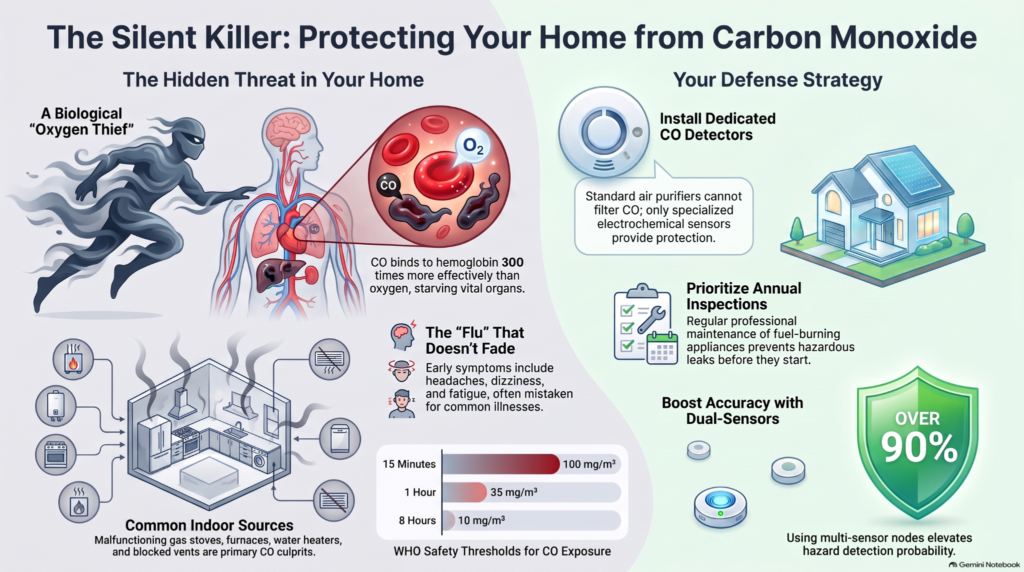
Carbon monoxide can lurk in unexpected places within your home, making it vital to know where to look. One of the primary sources is your furnace. If you neglect furnace maintenance, it can become a breeding ground for this dangerous gas. Regular servicing guarantees efficient operation and reduces the risk of carbon monoxide buildup.
Additionally, your ventilation systems play an important role. Blocked or poorly designed vents can trap carbon monoxide, preventing it from being expelled properly. Check your exhaust fans, especially in kitchens and bathrooms, to verify they’re functioning effectively.
Appliances like gas stoves and water heaters also pose risks if they aren’t adequately maintained. Always prioritize proper installation and periodic inspections to mitigate potential hazards, including exposure to nitrogen dioxide health effects.
Symptoms of Carbon Monoxide Exposure
Recognizing the symptoms of carbon monoxide exposure is critical, especially when considering the hidden sources of this toxic gas in your home.
The initial exposure effects may be subtle, often resembling flu-like symptoms such as headaches, dizziness, and fatigue. You might also experience confusion or shortness of breath, which can easily be overlooked.
As exposure continues, these symptoms can escalate, leading to more severe issues like impaired coordination or even unconsciousness.
It’s essential to prioritize symptom recognition, as delayed action can have dire consequences. You may not realize that even low-level exposure can lead to long-term cognitive impairments or chronic health issues.
Health Risks Associated With Carbon Monoxide Exposure
When you’re exposed to carbon monoxide, the health risks can be severe and often underestimated. Acute exposure can lead to headaches, dizziness, and confusion, but chronic exposure poses even greater threats.
Over time, the inhalation of this colorless, odorless gas can result in long-term effects that impact your cardiovascular and neurological systems. You may experience persistent fatigue, cognitive decline, or even heart complications, as carbon monoxide binds to hemoglobin, reducing oxygen delivery throughout your body.
The cumulative impact of low-level exposure can also exacerbate existing health conditions, particularly in vulnerable populations such as children and the elderly.
Additionally, studies indicate that prolonged contact may increase the risk of developing chronic respiratory diseases, particularly when combined with exposure to VOCs and other indoor pollutants. It’s essential to recognize these serious implications to foster a proactive approach to indoor air quality.
Understanding these health risks empowers you to make informed choices that prioritize your safety and well-being in your living environment.
How to Protect Yourself From Carbon Monoxide
Many people underestimate the importance of taking proactive measures against carbon monoxide exposure. To safeguard yourself, start by ensuring proper ventilation in your home. Open windows and doors regularly to facilitate airflow, especially when using fuel-burning appliances.
Investing in high-quality appliances, like heaters and stoves, that comply with safety standards can greatly reduce carbon monoxide risks. Choosing eco friendly products can also support safer and more sustainable choices for your home. Regular maintenance and inspections of these devices are essential to identify potential leaks or malfunctions.
Additionally, familiarize yourself with the symptoms of carbon monoxide poisoning, such as headaches, dizziness, and confusion. If you suspect exposure, exit the premises immediately and seek fresh air.
Implementing safety measures also includes educating your family about the dangers of carbon monoxide and encouraging them to recognize warning signs. By being proactive and informed, you can effectively protect yourself from the harmful effects of carbon monoxide in your living environment.

WHY A CARBON MONOXIDE DETECTOR IS A MUST-HAVE
When we look at the mechanics of indoor air pollution, a common misconception I frequently encounter even on public forums is the idea that a standard household air purifier can capture or filter out carbon monoxide. From a chemical engineering perspective, that is simply impossible. Standard HEPA filters and activated carbon beds are designed for particulate matter and certain volatile organic compounds, but CO is a small, non-polar gas molecule that passes right through consumer filtration media.
As studies in indoor air dynamics show, carbon monoxide binds to hemoglobin with an affinity roughly 300 times higher than oxygen, effectively starving vital organs at a cellular level. This is why relying on secondary treatments or waiting for symptoms to appear is a flawed strategy. In my own tinkering with DIY environmental sensors and low-cost air monitoring arrays, I’ve seen firsthand how rapidly CO concentrations can peak during localized combustion events whether from cooking, unvented heating, or poor flue draft.
The only true engineering controls for carbon monoxide are source control, rigorous maintenance of fuel-burning appliances, and mechanical dilution via fresh air ventilation. Pairing these practices with reliable electrochemical or multi-sensor detectors provides the real-time feedback loop needed to intercept high-concentration spikes before carboxyhemoglobin levels in the blood reach dangerous thresholds.
The emission of particulate matter (PM) into the air is a byproduct of any kind of cooking, but certain types of cooking release more particles than others. The danger to your health occurs when these tiny particles get inhaled deep into your lungs, causing irritation and corrosion of the alveolar wall (the air sacs where oxygen is exchanged into the blood stream) which affects your lung function.
A carbon monoxide detector is essential for early detection of this silent killer, greatly increasing your chances of survival.
By alerting you to dangerous levels of CO, it offers peace of mind that your home is safer.
Investing in this simple device is a proactive step toward protecting your health and that of your loved ones.
Early Detection Saves Lives
Because carbon monoxide (CO) is colorless and odorless, its presence in your home can be deadly without warning. Installing carbon monoxide alarms provides an essential early warning system that can save lives. These alarms detect harmful levels of CO, alerting you to evacuate before symptoms arise.
| Alarm Type | Benefits |
| Battery-Powered | Continues to work during outages |
| Smart Alarms | Sends alerts to your phone |
| Plug-In Alarms | Simple installation |
| Combination Alarms | Detects CO and smoke |
Investing in a reliable detector not only enhances safety but also empowers you to take immediate action, reducing the risk of serious health consequences from carbon monoxide exposure.
Peace of Mind
While you may not think about carbon monoxide daily, having a detector installed offers essential peace of mind. This simple device contributes greatly to your overall mental wellness and peaceful living.
Knowing that you’re protected against this invisible threat allows you to focus on what truly matters—your well-being and safety.
Consider these benefits of having a carbon monoxide detector:
- Immediate alerts in case of danger
- Enhanced safety for your family and pets
- Reduced anxiety about potential poisoning
- Increased property value with safety features
- Assurance that you’re taking proactive steps for health
Investing in a carbon monoxide detector isn’t just about safety; it’s about fostering an environment where you can thrive, free from the hidden dangers of indoor air pollution.
What to Do if Exposed to Carbon Monoxide?
Carbon monoxide (CO) is a colorless, odorless gas. It results from the incomplete combustion of carbon-containing fuels such as natural gas, gasoline, or wood, and is emitted by a wide variety of combustion sources, including motor vehicles, power plants, wildfires, and incinerators. Nationally and, particularly in urban areas, the majority of outdoor CO emissions to ambient air come from mobile sources. Carbon monoxide can also be formed through photochemical reactions in the atmosphere from methane and non-methane hydrocarbons, other volatile organic hydrocarbons in the atmosphere, and organic molecules in surface waters and soils. There are also a number of indoor sources of CO that contribute to total exposure.
If you suspect carbon monoxide exposure, recognize the symptoms immediately, such as headaches, dizziness, or confusion.
It’s vital to seek fresh air quickly to mitigate the effects of this toxic gas.
Taking swift action can markedly reduce health risks associated with carbon monoxide poisoning.
Recognize Symptoms Immediately
How can you quickly identify the symptoms of carbon monoxide exposure? Recognizing early signs is essential for your health and safety.
Carbon monoxide symptoms can be subtle, but being aware can save lives. Pay attention to these indicators:
- Headache
- Dizziness
- Nausea
- Shortness of breath
- Confusion
If you notice any of these symptoms, it’s imperative to take them seriously. Even mild symptoms can escalate rapidly.
Remember, carbon monoxide is odorless and colorless, making it insidious. Staying informed about these potential dangers empowers you to act decisively.
Seek Fresh Air Quickly
Immediately seeking fresh air is crucial when you suspect carbon monoxide exposure. This gas can displace oxygen in your bloodstream, leading to critical drops in oxygen levels.
As soon as you recognize symptoms or suspect exposure, move outside or to a well-ventilated area. Fresh air not only helps restore normal oxygen levels but also aids in flushing out carbon monoxide from your system.
If you’re unable to leave the area safely, open windows and doors to improve ventilation. Monitor your health closely; even mild symptoms warrant medical evaluation.
Innovative detection devices can provide early warnings, enhancing your safety. Prioritize fresh air access in your home to mitigate risks and guarantee a proactive approach to indoor air quality management.
RELATED STUDIES ABOUT CARBON MONOXIDE INDOOR AIR POLLUTION
In conclusion, safeguarding yourself from sneaky carbon monoxide is essential for your health and safety. Stay vigilant and check commonly overlooked areas in your home. By understanding the symptoms and risks, you can make informed decisions and take necessary precautions. Remember, investing in a reliable carbon monoxide detector is a wise way to ward off this silent threat. Prioritize protection and make your home a haven, free from the hidden hazards of carbon monoxide exposure.
Carbon monoxide as an indicator of indoor air quality
Core Thesis
Carbon monoxide (CO) is a critical indoor air pollutant capable of causing severe or fatal poisoning. Because elevated CO concentrations usually occur unexpectedly over short intervals due to incomplete combustion, traditional periodic environmental surveys fail to capture population exposure accurately. Recent advancements in sensor technology, alongside machine learning and regression modeling, make real-time CO monitoring feasible, accessible, and essential. Carbon monoxide should serve as a key priority indicator for indoor air quality (IAQ), risk management, and smart building ventilation systems.
Key Findings & Insights
1. Sources and Exposure Patterns
- Formation Mechanisms: Indoor CO stems primarily from incomplete combustion processes (e.g., fuel, gas, biomass) where oxygen availability is substoichiometric.
- Primary Indoor Sources: Significant indoor sources include unvented gas cookstoves, biomass cookstoves, ethanol fireplaces, candles, incense, mosquito coils, and waterpipe (hookah) smoking.
- Concentration Dynamics: Unlike baseline pollutants that exhibit steady indoor emissions, CO levels fluctuate rapidly—often creating acute peak exposures followed by quick decays once ventilated. High concentrations frequently occur in specialized environments like waterpipe cafés, indoor go-kart arenas, and unvented residential kitchens in developing regions.
2. Health Risks & Regulatory Standards
- Toxicity Profile: CO is a colorless, odorless, non-irritating gas with a density close to air. Its affinity for hemoglobin is roughly 300 times higher than that of oxygen, forming carboxyhemoglobin (CO-Hb) and depriving vital organs of oxygen. Unintentional CO poisoning accounts for approximately 30,000 deaths globally each year.
- WHO Guidelines: The World Health Organization (WHO) specifies exposure limits across four primary timeframes:
- 15 minutes: 100 mg m^-3
- 1 hour: 35 mg m^-3
- 8 hours: 10 mg m^-3
- 24 hours: 4 mg m^-3
- 15 minutes: 100 mg m^-3
3. Measurement Technologies
- High-Precision Reference Instruments: Non-dispersive Infrared Spectroscopy (NDIR) and Photoacoustic Spectroscopy (PAS) deliver exceptional sensitivity, accuracy, and selective time-resolved data. However, their size and cost render them impractical for widespread, routine indoor operation.
- Low-Cost Sensors:
- Electrochemical Sensors (ECS): Measure electrical current generated during the catalytic oxidation of CO to CO2. They offer reliable low-concentration measurements but require calibration to account for cross-sensitivities (e.g., to hydrogen gas).
- Metal Oxide Sensors (MOS): Detect conductivity changes caused by surface reactions between CO and adsorbed oxygen ions.
4. Sensor Reliability and Bayesian Analysis
- Sensor reliability can be evaluated using Bayesian decision models. Assuming a 10% baseline probability of a building experiencing a CO hazard, a single low-cost sensor with a 95% true-positive rate and a 10% false-positive rate yields a conditional probability of ~51.4% that an indicated alarm represents a real hazard.
- Integrating a dual-sensor arrangement (or multi-sensor node) drastically elevates the probability of accurate hazard detection to >90%, minimizing false alarms while maintaining rapid response times.
Strategic Recommendations
- Integrated Smart IAQ Monitoring: CO monitoring should not exist in isolation. For optimal IAQ management, health safety, and energy-efficient building ventilation, CO sensors should be combined with temperature, humidity, carbon dioxide (CO2), and fine particulate matter (PM2.5) sensors.
- Targeted Deployment in High-Risk Zones: Real-time CO monitoring systems must be prioritized near known combustion sources, such as commercial and residential kitchens using gas or biomass stoves, spaces with fuel-burning space heaters, and public indoor venues like hookah lounges or indoor motorsports facilities.
- Advanced Sensor Calibration & Analytics: Deploying low-cost CO sensors effectively requires sensor-specific empirical calibration, cross-sensitivity training, and machine learning integration to interpret signals accurately within smart home and building management systems.
| REFERENCE: Tunga Salthammer, Carbon monoxide as an indicator of indoor air quality, Environmental Science: Atmospheres, Volume 4, Issue 3, 2024, Pages 291-305, ISSN 2634-3606, https://doi.org/10.1039/d4ea00006d. (https://www.sciencedirect.com/science/article/pii/S2634360624000207) |
Indoor air pollution in traditional fish smokehouses in Abuesi, Ghana: Health and environmental implications
Core Thesis
Artisanal fish smoking using firewood in enclosed smokehouses in Abuesi, Ghana, generates hazardous levels of indoor air pollution. The primary operators—predominantly women, often accompanied by young children—are exposed to extreme particulate matter (PM2.5), carbon monoxide (CO), and heat stress conditions that significantly exceed local and international safety guidelines. This creates severe, long-term public health risks and occupational hazards in an economically vital sector.
Key Findings & Empirical Results
1. Air Quality & Pollutant Levels
Deploying low-cost air quality monitors across 33 traditional smokehouses over 24-hour cycles revealed severe contamination:
- Fine Particulate Matter (PM2.5): Ranged from 0.16ug/m^3 to 630.37 ug/m^3, with an overall mean of 156.84ug/m^3. During active working hours, mean levels peaked at 265.92ug/m^3—far exceeding the World Health Organization (WHO) 24-hour threshold of 25ug/m^3.
- Carbon Monoxide (CO): Concentration ranged from 2.37 ppm to 36.43 ppm, with a mean of 17.29 ppm. Active working hours saw average levels of 19.70 ppm (with daily mean peaks in individual smokehouses reaching up to 17,000 ppm before data cleaning). The mean level exceeds the WHO/USEPA 8-hour safety limit of 9 ppm.
- Ozone (O3): Varied between 2.5 ppb and 74.69 ppb (mean 19.85 ppb). A strong negative correlation (r = -0.43 to -0.56) was observed between PM2.5 and ozone. High particulate density blocks the ultraviolet (UV) radiation required for photochemical ozone creation while unburned biomass gases scavenge ozone in confined spaces.
2. Thermal & Microclimate Environment
- Temperature: Mean temperature across facilities was 33.55^C, spiking to an average of 35.15^C during active operations, with maximum peaks reaching 46.29^C. These conditions significantly exceed the WHO/OSHA occupational comfort threshold (20-26^C) and upper tolerance limit (32^C).
- Relative Humidity (RH): Averaged 48.27% to 56.74%, but showed extreme fluctuations (11.18% to 81.59%). High humidity combined with excessive heat severely impairs natural evaporative cooling (sweating), escalating heat-stress hazards.
3. Quantitative Health Risk Assessment
Using the Hazard Quotient (HQ) framework (HQ > 1 indicates elevated health risk):
- PM2.5 HQ = 6.25): Categorized as High Risk. Linked to asthma, chronic obstructive pulmonary disease (COPD), cardiovascular disease, reduced lung function, and eye/throat irritation.
- CO (HQ = 1.92): Categorized as Moderate to High Risk. Impairs tissue oxygen transport, triggering chronic headaches, fatigue, dizziness, nausea, and long-term cardiovascular stress.
- Ozone (HQ = 1.24): Categorized as Low to Moderate Risk. Contributes to airway inflammation and exacerbates underlying respiratory conditions.
Socio-Occupational Vulnerability
- Gender & Child Exposure: Fish processing in Abuesi is carried out almost exclusively by women, who work approximately 6 hours per day near open biomass fires. Young children are routinely present due to childcare necessities, exposing their developing lungs to intense toxic smoke and increasing their susceptibility to severe lower respiratory infections.
- Barriers to Clean Technology: Transitioning to Liquefied Petroleum Gas (LPG) or improved stoves remains minimal due to high fuel costs, low capital access, and cultural preferences for specific woods (e.g., mangroves) believed to enhance smoked fish flavor.
Key Recommendations & Intervention Strategies
- Engineering & Structural Modifications: retrofitting smokehouses with side vents, chimney outlets, mechanical exhaust fans, and semi-enclosed insulated designs to redirect smoke away from breathing zones and lower indoor heat buildup.
- Technology Adaptation: Developing affordable solar-drying racks (to reduce required smoking time/wood usage) and hybrid ovens combining traditional wood-smoking flavor with modern smoke-filtration mechanisms.
- Occupational Safety Protocols: Implementing scheduled rest breaks away from smoke, hydration stations to prevent heat stroke, and supplying lightweight protective masks and aprons.
- Community-Centered Awareness & Policy Support: Leveraging local cultural norms (such as traditional taboos protecting coastal waters) to promote clean air practices, backed by government subsidies for cleaner fuels (LPG) and improved cookstoves tailored for commercial food processors.
| REFERENCE: Charity Owusu, Albert Ofori, Frank Adusei-Mensah, Micheal Asare, Reginald Quansah, David K. Essumang, Indoor air pollution in traditional fish smokehouses in Abuesi, Ghana: Health and environmental implications, Journal of Industrial Safety, Volume 2, Issue 4, 2025, Pages 270-283, ISSN 2950-2764, https://doi.org/10.1016/j.jinse.2025.10.005. (https://www.sciencedirect.com/science/article/pii/S2950276425000649) |
Phenyl carbon nitride-based self-cleaning coatings: A sustainable solution for indoor air quality management
Core Thesis
Indoor air pollution from wood burning and cigarette smoking releases toxic particulate matter, soot, and carcinogenic polycyclic aromatic hydrocarbons (PAHs) that degrade air quality and cause aesthetic/structural damage to interior surfaces. Traditional titanium dioxide (TiO2) anti-pollution paints require energy-intensive ultraviolet (UV) light for activation, rendering them ineffective under standard indoor ambient lighting. Hybridizing industrial TiO2 with a visible-light-active phenyl-modified carbon nitride (PhCN) creates a sustainable, visible-light-driven self-cleaning coating that effectively degrades organic pollutants and soot under common white LED illumination.
Key Findings & Empirical Results
1. Material Architecture & Optoelectronic Properties
- Core-Shell Heterostructure: Synthesized via a solvothermal route, the material forms an inorganic-organic hybrid core-shell architecture where anatase TiO2 nanocrystals ( ∼ 9.2-10.1 nm) coat the surface of PhCN nanosheets.
- Visible-Light Sensitization: Pure TiO2 possesses a wide bandgap ( 3.2 eV) restricted to UV excitation (<400 nm). PhCN introduces aromatic phenyl groups that extend light absorption into the visible spectrum up to 600 nm (direct bandgap ∼ 2.7 eV).
- Interfacial Charge Transfer: Photoluminescence (PL) and Time-Resolved Photoluminescence (TRPL) confirm significant PL quenching (∼90%) and non-radiative decay channels in the hybrid. Photogenerated electrons transfer efficiently from the LUMO of PhCN to the conduction band of TiO2, inhibiting charge recombination and driving the continuous formation of reactive oxygen species (ROS like OH and O_2^).
2. Photocatalytic Organic Dye Degradation (Liquid Phase)
- Selective Adsorption: Due to a positive surface charge in aqueous conditions (pH < 7), the TiO2/PhCN hybrid strongly adsorbs anionic Methyl Orange (MO) and zwitterionic Rhodamine B (RhB), while repelling cationic Methylene Blue (MB).
- Degradation Kinetics: Under a standard 11 W white LED lamp:
- Rhodamine B (RhB): Rapidly degraded with a pseudo-first-order rate constant of 2.34 x 10^-2 min^-1.
- Methyl Orange (MO): Degraded at a rate of 0.665 x 10^-2 min^-1.
- Reusability: Achieved 100%, 99%, and 98% RhB degradation across three consecutive cycles.
3. Air Purification & Self-Cleaning Performance (Solid-State Coatings)
The TiO2/PhCN hybrid was drop-casted onto glass substrates (20 mg in 100L ethanol) and exposed to smoke inside a sealed chamber for 30 minutes, followed by white LED irradiation:
- Wood Smoke Removal:
- Self-Cleaning Efficiency: Reached 76.8% in 6 hours and 89% optical recovery in 18 hours.
- Rate & Decay: Exhibits a rate constant of 0.425 h^-1 with a time constant (ፐ) of $141 minutes to degrade 63% of deposited pollutants.
- Cigarette Smoke Removal:
- Self-Cleaning Efficiency: Reached 68.5% in 6 hours and 90.05% total color recovery (∆E) in 18 hours.
- Rate & Decay: Exhibits a rate constant of 0.320 h^-1 with a colorimetric time constant of 187 minutes.
- Graphitic Soot Elimination: Surface Raman spectroscopy tracking the graphitic D (1350 cm^-1) and G (1596 cm^-1) bands demonstrated rapid graphitic soot degradation with an exponential time constant of 73 minutes in Cycle 1.
- Control Comparisons: Pure TiO2 coatings showed zero visible-light self-cleaning activity, while pure PhCN coatings failed to adsorb soot effectively due to lack of porosity and surface functional groups—confirming that hybridization is essential.
4. Durability & Reusability
- Multi-Cycle Efficiency: Re-smoking and illuminating the coating over a second cycle confirmed retained self-cleaning capability.
- Surface Deactivation: The graphitic soot removal time constant lengthened to 296 minutes in Cycle 2 due to partial masking of active catalytic sites by soot-derived intermediates and subtle shifts in surface charge.
Strategic Applications & Implications
- Passive Indoor Air Purification: Serves as a low-energy alternative to conventional air purifiers when applied to indoor wall paints, wallpapers, or ceramic tiles in homes, offices, schools, and healthcare facilities.
- Cultural Heritage Preservation: Protects museum artifacts, historic documents, and building interiors from non-volatile PAH grime and dark soot staining caused by wood stoves and ambient combustion.
- UV-Free Architectural Coatings: Eliminates reliance on harmful or energy-draining artificial UV light sources by operating directly under ambient white LED lighting.
| REFERENCE: Stefania Porcu, Moulika Hazra, Riccardo Lodo, Daniele Chiriu, Pier Carlo Ricci, Phenyl carbon nitride-based self-cleaning coatings: A sustainable solution for indoor air quality management, Journal of Hazardous Materials Advances, Volume 23, 2026, 101389, ISSN 2772-4166, https://doi.org/10.1016/j.hazadv.2026.101389. (https://www.sciencedirect.com/science/article/pii/S2772416626003839) |
CONCLUSION
Ultimately, managing indoor air quality comes down to transitioning from reactive responses to intentional, proactive engineering decisions within our own homes. The scientific research surrounding carbon monoxide highlights a clear reality: because CO exposure often presents as acute, short-interval peaks rather than a steady baseline, traditional periodic checks simply aren’t enough. Emerging indoor air technologies ranging from integrated smart sensor nodes to advanced visible-light photocatalytic surface coatings are transforming how we monitor and mitigate indoor pollutants.
However, even the most sophisticated smart home integrations and advanced materials cannot replace basic foundational safety. A dedicated carbon monoxide alarm remains your primary, non-negotiable line of defense. Whether I am modeling large-scale atmospheric emissions or evaluating simple residential ventilation setups, the core principle remains identical: clean air is built on proper airflow, well-maintained equipment, and early warning systems.
By inspecting your fuel-burning appliances regularly, ensuring unimpeded exhaust pathways, flushing spaces with fresh outdoor air, and maintaining functional CO detectors, you effectively eliminate the blind spots that this invisible gas relies on. Protecting your home environment doesn’t require complex industrial equipment, but it does demand informed awareness and continuous vigilance.