
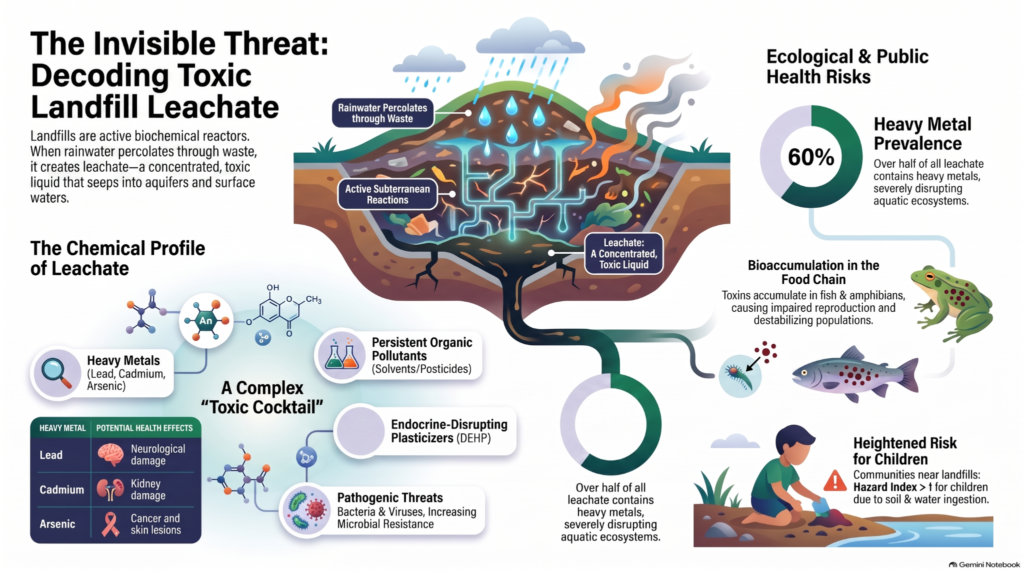
When most people toss a bag into a trash bin, waste is treated as an “out of sight, out of mind” problem. But as a field technologist who has spent years conducting on-site waste characterizations and audits across municipal and industrial sites, I see a very different reality. A landfill isn’t an inert tomb where trash simply sleeps; it operates as an active, subterranean biochemical reactor.
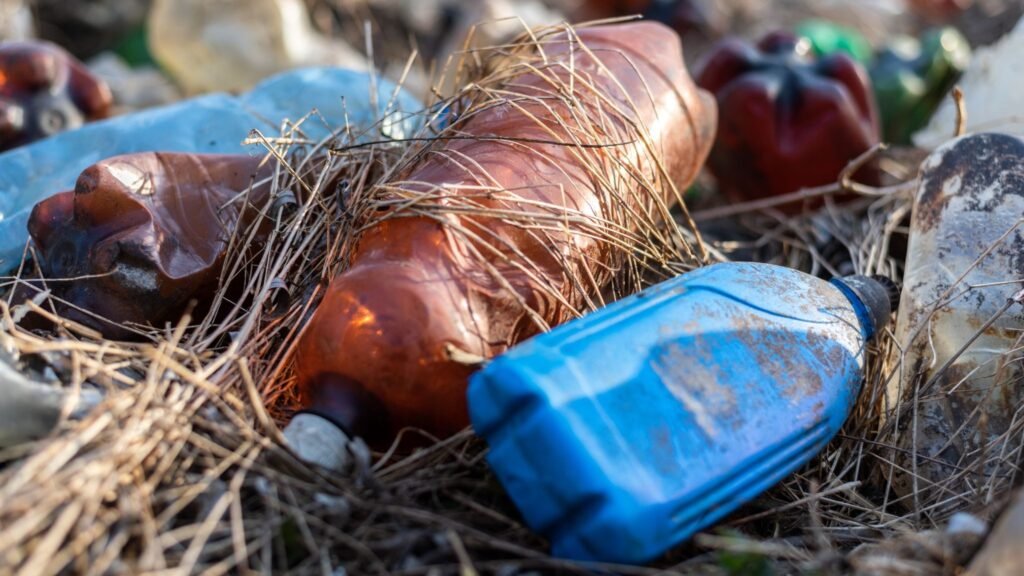
Every time rain falls over an open cell, water percolates through discarded electronics, compressed household waste, and industrial scrap, stripping out soluble contaminants along the way. The resulting fluid landfill leachate is a concentrated, noxious chemical cocktail. When I am out trail running or photographing waste pollution in local watersheds, the physical litter snagged on riverbanks is only the visible symptom.
The true invisible threat is the contaminated liquid seeping downward into aquifers and adjacent surface waters. We cannot fix our waste crisis without confronting the toxic chemistry brewing underneath our landfill caps. Understanding the behavior of these chemical compounds is not just an academic exercise; it is the frontline baseline needed to safeguard our shared water systems.
Toxic landfill leachate contains harmful chemical compounds, including heavy metals like lead and cadmium, and persistent organic pollutants such as solvents and pharmaceuticals. These substances contaminate water systems, threatening public health and aquatic life. For instance, heavy metals can accumulate in organisms, leading to neurological and kidney damage. Additionally, organic contaminants resist degradation and exacerbate toxicity in water. Understanding these impacts is essential for developing effective management strategies, and there’s much more to explore on this topic.
KEY TAKEAWAYS
- Landfill leachate contains heavy metals like lead, cadmium, mercury, and arsenic, which can contaminate water systems and harm aquatic life.
- Organic chemical contaminants in leachate include solvents and pesticides, which resist degradation and persist in water sources, posing long-term risks.
- Pathogenic microorganisms present in leachate can threaten public health and lead to waterborne diseases in affected communities.
- The quality of leachate varies based on landfill age and conditions, influencing its toxicity and potential environmental impact.
- Effective leachate treatment and monitoring strategies are essential to mitigate contamination risks and protect water resources.
WHAT IS LANDFILL LEACHATE AND HOW IS IT PRODUCED?
Leachates in landfills refer to the liquid that forms when fluids dissolve the constituent materials within waste. This process can lead to the presence of potentially toxic substances such as heavy metals, including lead, mercury, and arsenic, as well as organic compounds and pathogenic organisms. The composition of leachates can vary significantly based on landfill contents, age, and environmental factors, such as rainfall and the type of landfill liner used. Some leachates contain high concentrations of toxic elements, often exceeding safe drinking water standards by substantial margins.
Landfill leachate is a complex, often toxic liquid that forms when rainwater or other liquids percolate through waste materials in a landfill. As you explore this process, consider how leachate formation is influenced by the composition of the waste and the conditions within the landfill.
During landfill decomposition, organic materials break down anaerobically, producing gases and liquids that contribute to leachate’s toxicity. Factors such as moisture content, temperature, and the age of the landfill further impact the quantity and quality of leachate produced.
For instance, newly constructed landfills may generate different leachate characteristics compared to older sites. Understanding these dynamics is essential for developing innovative solid waste management strategies, as effective leachate treatment can mitigate environmental risks.
What Harmful Chemicals Are in Landfill Leachate?
Landfill leachate (LFL) is the liquid that has seeped through solid waste in a landfill, extracting soluble dissolved or suspended materials. When leachate escapes from landfills it can contaminate groundwater, surface waters and soil with toxic organic and inorganic pollutants; these include heavy metals and ammonia nitrogen compounds, as well as emerging pollutants such as pharmaceuticals, plasticisers and . Therefore, ensuring adequate measures are in place to monitor, prevent and treat LFL is essential for protecting human health and the environment.
Landfill leachate contains a mix of harmful chemicals that pose serious risks to water systems.
You’ll find heavy metals like lead and mercury, organic chemical contaminants, and pathogenic microorganisms that can threaten human health and the environment.
Understanding these components is essential for evaluating the overall impact of leachate on surrounding ecosystems.
Heavy Metals Presence
While you may not think about it, the presence of heavy metals in landfill leachate poses significant risks to water systems and public health. These toxic metals can leach into groundwater, threatening ecosystems and drinking water sources. Environmental regulations aim to mitigate these risks, but enforcement often lags behind.
| Heavy Metal | Potential Health Effects |
| Lead | Neurological damage |
| Cadmium | Kidney damage |
| Arsenic | Cancer, skin lesions |
| Mercury | Developmental issues |
| Chromium | Respiratory problems |
Understanding the toxicity of these heavy metals is essential for developing innovative solutions to manage leachate and protect critical water resources. By prioritizing research and adherence to regulations, we can better safeguard public health.
Organic Chemical Contaminants
When considering the impact of leachate on water systems, it’s important to recognize the variety of organic chemical contaminants that can seep into the environment.
These organic pollutants, including solvents, pesticides, and pharmaceuticals, pose significant risks to aquatic ecosystems and human health. They often resist chemical degradation, persisting in water systems and accumulating in biota.
This persistence can lead to toxic effects, disrupting biological processes and altering the natural balance of ecosystems. In addition, the complexity of these compounds complicates remediation efforts, as standard treatment methods may not effectively remove all contaminants.
Understanding the specific organic pollutants found in landfill leachate is fundamental for developing innovative strategies to mitigate their impact on our essential water resources.
Pathogenic Microorganisms Impact
Organic chemical contaminants in landfill leachate aren’t the only concern; pathogenic microorganisms present a significant threat to water systems as well.
These pathogens, including bacteria and viruses, can easily enter aquatic environments, leading to pathogen transmission that jeopardizes public health. Once in the water, they can proliferate, posing risks to both humans and wildlife.
Furthermore, the presence of these microorganisms can contribute to microbial resistance, complicating treatment processes. As traditional antibiotics become less effective against resistant strains, innovative solutions are vital to mitigate this issue.
HOW DO CONTAMINATED WATER SOURCES IMPACT THE ENVIRONMENT?
In field assessments, leachate is notorious because its composition is constantly shifting and notoriously difficult to isolate. When analyzing raw samples, you quickly realize how standard biological systems get overwhelmed. In older landfill cells, for example, the biodegradability ratio plummets, leaving behind high concentrations of ammonium and stubborn refractory organics that simple aerated ponds cannot touch. Beyond conventional pollutants, we are constantly encountering endocrine-disrupting plasticizers like bis(2-ethylhexyl) phthalate (DEHP) leaching directly from degrading plastics, alongside persistent heavy metals like cadmium, mercury, and lead.
On paper, engineered clay barriers and synthetic liners provide containment, but real-world conditions introduce tears, differential settlement, and preferential drainage pathways that threaten surrounding soils and groundwater. Field data shows that when leachate escapes, non-carcinogenic risk indexes for surrounding ecosystems and communities spike significantly.
Addressing this requires moving past standard single-stage treatment. We need integrated systems such as chemical struvite precipitation to strip ammonia followed by non-thermal plasma oxidation to mineralize toxic phenolics and bind heavy metals before this liquid ever reaches an aquatic ecosystem.
Contaminated water sources pose significant threats to ecosystems, as they disrupt the delicate balance of aquatic life and soil health. When pollutants enter water systems, they compromise water quality, leading to a cascade of negative effects. These impacts can vary depending on the types of waste entering the environment and their chemical composition. Here’s a breakdown of some critical impacts:
| Impact Type | Description |
| Aquatic Toxicity | Harmful chemicals affect fish and plant health. |
| Soil Degradation | Contaminants alter soil composition and fertility. |
| Biodiversity Loss | Species extinction occurs due to habitat changes. |
| Algal Blooms | Excess nutrients lead to harmful algal growth. |
| Water Supply Issues | Contaminated sources reduce usable freshwater. |
How Heavy Metals From Leachate Affect Aquatic Life?
Landfill leachate is contaminated liquid formed when rain or another source of water enters a landfill and comes in contact with waste, which may then flow into and contaminate local groundwater if not properly managed. Landfill leachate varies widely in composition depending on the age of the landfill and the type of waste that it contains. It usually contains both dissolved and suspended material. The generation of leachate is caused principally by precipitation percolating through waste deposited in a landfill. Once in contact with decomposing solid waste, the percolating water becomes contaminated, and if it then flows out of the waste material it is termed leachate. Additional leachate volume is produced during this decomposition of carbonaceous material producing a wide range of other materials including methane, carbon dioxide and a complex mixture of organic acids, aldehydes, alcohols and simple sugars.
Heavy metals from landfill leachate pose a significant threat to aquatic life, exacerbating problems that arise from already contaminated water sources. When these toxic metals, such as lead, mercury, and cadmium, leach into water bodies, they disrupt the delicate balance of the aquatic ecosystem.
You may not realize that heavy metal toxicity can lead to bioaccumulation in fish and other organisms, causing detrimental health effects and reduced biodiversity. As these metals accumulate in the food chain, they not only harm individual species but also destabilize entire populations.
Additionally, sensitive aquatic organisms, like amphibians and invertebrates, are particularly vulnerable to heavy metal exposure, which can result in impaired reproduction and growth. By understanding the mechanisms of heavy metal toxicity, you can advocate for innovative strategies to mitigate leachate impacts, ensuring healthier aquatic ecosystems for future generations.
How Do Organic Compounds in Landfill Leachate Contribute to Toxicity?
While you might think of landfills as mere waste repositories, the organic compounds found in landfill leachate can severely impact environmental health. These compounds contribute to organic toxicity, affecting both terrestrial and aquatic ecosystems.
Leachate exposure can lead to serious consequences, including:
- Bioaccumulation: Harmful organic compounds can accumulate in organisms, disrupting food chains.
- Eutrophication: Nutrients from leachate promote algae blooms, depleting oxygen and harming aquatic life.
- Endocrine Disruption: Certain organic compounds interfere with hormonal systems, affecting reproduction in wildlife.
- Soil Contamination: Leachate can degrade soil quality, impacting plant health and local agriculture.
Understanding these pathways is essential for addressing the broader implications of landfill leachate.
The innovations in detection and remediation strategies are necessary to mitigate the risks associated with organic toxicity and protect our water systems from the adverse effects of leachate exposure.
How Can We Manage and Treat Landfill Leachate Effectively?
How can we effectively manage and treat landfill leachate to minimize its environmental impact? The key lies in integrating innovative leachate treatment technologies with robust landfill management practices.
First, consider advanced biological treatment methods, such as anaerobic digestion, which can break down organic compounds efficiently. Complement this with physical-chemical processes like membrane filtration and activated carbon adsorption to further reduce contaminants.
Additionally, implementing a leachate recirculation system can enhance treatment efficiency while controlling the leachate volume. Regular monitoring is essential; employing real-time data analytics allows you to adjust treatment processes dynamically, optimizing performance.
Lastly, consider collaboration with research institutions to explore emerging technologies like electrochemical oxidation or phytoremediation, which could revolutionize leachate treatment.
What Does the Future Hold for Landfill Management and Water Protection?
What innovations will shape the future of landfill management and water protection? As you explore this critical area, you’ll find that integrating sustainable practices and innovative technologies is essential for enhancing environmental safety.
Here are four key developments to watch for:
- Advanced Leachate Treatment Systems: Employing cutting-edge filtration and bioremediation technologies to purify leachate before it contaminates water sources.
- Smart Monitoring Systems: Utilizing IoT devices to continuously track leachate composition, providing real-time data for proactive management.
- Landfill Mining: Extracting valuable materials from existing landfills, reducing waste while reclaiming resources.
- Circular Economy Models: Implementing systems that promote recycling and waste reduction, including the use of eco friendly products, can considerably decrease landfill reliance.
These innovations promise to revolutionize how we manage landfills, ensuring water protection while fostering a more sustainable future.
RELATED STUDIES ABOUT LANDFILL LEACHATE CHEMICAL COMPOUNDS
In summary, managing landfill leachate is essential for protecting our water systems. Did you know that around 60% of leachate can contain harmful heavy metals, which can severely impact aquatic ecosystems? By understanding the chemical compounds in leachate and their effects, we can develop effective treatment solutions. Future strategies in landfill management must prioritize water protection to mitigate these dangers, ensuring healthier environments for both wildlife and communities. It’s time to take action before it’s too late.
Bio-chemical treatment of landfill leachates with high load of organic and nitrogen compounds
Overview and Objectives
This study evaluates the feasibility of combining biological treatment and chemical precipitation to remediate complex landfill leachates collected from the Dudaim municipal solid waste site in Israel. The primary goals were removing organic carbon and nitrogen compounds while mitigating odor and emissions of volatile organic compounds (VOCs) and H2S.
Key Findings
- Raw Leachate Characteristics: The leachate displayed properties of intermediate-to-stabilized landfill waste, characterized by high salinity (TDS = 15,600 to 34,000 mg/L), elevated ammonium (NH4-N averaging 2,611 mg/L), and low biodegradability (mean BOD5/COD ratio of 0.12).
- Biological Treatment (SBR): Using an 8-month Sequencing Batch Reactor (SBR) system with alternating aerobic and anoxic stages:
- Organic Carbon Removal: The process effectively removed biodegradable organics, achieving average reductions of 84.5% for BOD5, 42.7% for COD, and 40.9% for TOC. Approximately 50% refractory organic carbon remained, indicating the need for supplementary treatment steps.
- Denitrification: Anoxic phases facilitated strong nitrate removal, achieving an average NO3-N reduction of 80.0%.
- Nitrification Limitation: Biological nitrification alone was insufficient for ammonia reduction, achieving only a 23.2% removal rate due to high free ammonia concentrations and potential chemical toxicity.
- Chemical Pretreatment (Struvite Precipitation): To address the high ammonia load, chemical precipitation of magnesium-ammonium-phosphate (MAP/struvite) was tested in a 1:1:1 Mg:NH4:PO4 molar ratio at pH 9.
- MgCl2·6H2O + Na2HPO4·7H2O achieved 80.7 ± 4.5% ammonia removal.
- MgO + H3PO4 achieved 76.8 ± 6.4% ammonia removal.
- XRD phase analysis confirmed crystalline struvite recovery, offering a circular economy route to repurpose leachate nitrogen as fertilizer.
Strategic Conclusion
Biological SBR treatment successfully eliminates biodegradable organics and nitrates to suppress odor and emissions. However, comprehensive management of high-strength leachates requires integrating chemical precipitation (struvite crystallization) for upfront ammonia removal alongside post-treatment steps for refractory organic carbon.
| REFERENCE: Ofir Zisman, Ariel Kushmaro, Asher Brenner, Bio-chemical treatment of landfill leachates with high load of organic and nitrogen compounds, Sustainable Chemistry for the Environment, Volume 5, 2024, 100061, ISSN 2949-8392, https://doi.org/10.1016/j.scenv.2024.100061. (https://www.sciencedirect.com/science/article/pii/S294983922400004X) |
Comprehensive Study of Pollution Removal from Landfill Leachate Using Non-Thermal Plasma Technology
Overview and Objectives
This study evaluates an advanced dual-stage treatment strategy to remediate high-strength, toxic landfill leachate collected from the Aradkoh landfill in Tehran, Iran. The primary objective was to overcome the limitations of conventional physicochemical and biological processes by combining standard pretreatment stages with a falling-film non-thermal plasma (NTP) reactor using dielectric barrier discharge (DBD) to achieve simultaneous mineralization of refractory organic matter, complete degradation of phenolic compounds, and immobilization or removal of hazardous heavy metals.
Key Findings
- Raw Leachate Profile: The untreated leachate exhibited high organic loading, salinity, and toxicity, with chemical oxygen demand (COD) of 2,820 mg/L, 5-day biochemical oxygen demand (BOD5) of 1,320 mg/L, total dissolved solids (TDS) of 20,861 mg/L, total suspended solids (TSS) of 2,200 mg/L, electrical conductivity (EC) of 27,000 µS/cm, phenol levels of 5.18 mg/L, and significant concentrations of toxic heavy metals including Pb, Al, Fe, Ni, Cu, Zn, Cd, and Hg.
- Pretreatment Performance: A sequential train consisting of coagulation-flocculation (optimized with aluminum sulfate, lime, and cationic polyelectrolyte), filter press dewatering, sedimentation/aeration/ozonation/chlorination, and multi-media adsorption filtration achieved substantial baseline reductions in particulate load, turbidity (48.03%), color (65.82%), COD (56.60%), and BOD5 (43.18%).
- Non-Thermal Plasma Degradation Performance:
- Organics and General Parameters: NTP exposure generated in situ reactive oxygen and nitrogen species (hydroxyl radicals, ozone, hydrogen peroxide, atomic oxygen, and nitric oxide) that drove rapid mineralization. Total overall system reductions reached 98% for COD (down to 45 mg/L), 97% for BOD5 (down to 29 mg/L), over 96% for EC and TDS, 98% for TSS, 97% for turbidity, and 93% for color. Organic degradation followed first-order kinetics with rate constants of k = 0.061 1/min (R² = 0.98) for COD and k = 0.034 1/min (R² = 0.99) for phenol.
- Phenolic Breakdown: Phenol concentrations dropped by 98.46% (from 5.18 mg/L to 0.08 mg/L) through radical attack, ring cleavage, and subsequent mineralization.
- Heavy Metal Removal: NTP-induced oxidation, precipitation, and aggregation resulted in major removals: Pb (97%), Hg (95%), Ni (94%), Cu (92%), Cd (90%), Zn (77%), Al (72%), and Fe (65%). Following treatment, most metals complied with FAO and WHO guidelines for agricultural reuse, though Cd and Pb required extended exposure up to 120 minutes for full regulatory compliance.
- Economic and Energy Efficiency: The integrated NTP system demonstrated low specific energy consumption (SEC ≈ 0.00061 Wh/mg COD/L) and an estimated total operational cost of 1.5 USD/m³, outperforming conventional solar- and ozone-based advanced oxidation processes in both removal efficiency and cost-effectiveness.
Strategic Conclusion
Integrating non-thermal plasma technology as a secondary polishing stage following conventional physical-chemical pretreatment offers a cost-effective, low-sludge, and highly potent solution for simultaneously eliminating persistent organic contaminants, phenolic toxins, and hazardous heavy metals from complex landfill leachates.
| REFERENCE: Mahdiyeh Bakhtiyari-Ramezani, Fatemeh Mohammadi, Maryam Azizi, Narges Ziveh, Fatemeh Amani, Comprehensive study of pollution removal from landfill leachate with emphasis on phenolic compounds and heavy metals using non-thermal plasma technology, Waste Management Bulletin, Volume 3, Issue 3, 2025, 100233, ISSN 2949-7507, https://doi.org/10.1016/j.wmb.2025.100233. (https://www.sciencedirect.com/science/article/pii/S2949750725000628) |
Phthalate esters in landfill leachate and soils of northeastern Iran: occurrence, spatial distribution, and environmental risk assessment
Overview and Objectives
This study investigated the occurrence, spatial distribution, and multi-pathway environmental and human health risks of six priority phthalate esters (PAEs) at the Mashhad municipal solid waste landfill in northeastern Iran. The research combined gas chromatography-mass spectrometry (GC-MS) quantification, GIS spatial modeling, and USEPA risk assessment frameworks to examine how semi-arid climatic conditions modulate PAE behavior across leachate, surface soil (0 to 5 cm), and subsurface soil (10 to 15 cm) matrices.
Key Findings
- Contamination Levels and Depth Profile:
- Leachate: Total PAE concentrations ranged from 1,362.60 to 1,974.09 ug/L (mean = 1,530 +/- 236 ug/L), identifying leachate as the primary environmental reservoir and transport medium.
- Soils: Total PAE concentrations ranged from 6.16 to 14.68 ug/g (mean = 9.5 +/- 3.78 ug/g) in surface soils and 3.46 to 9.73 ug/g (mean = 5.45 +/- 2.93 ug/g) in subsurface soils, demonstrating significant vertical attenuation with depth due to sorption to surface organic matter and clay barrier containment.
- Congener Distribution:
- High-molecular-weight, hydrophobic congeners dominated all matrices. Bis(2-ethylhexyl) phthalate (DEHP) was the most abundant compound, accounting for 61.96% of total PAEs in leachate (mean 217.45 ug/L), 46.70% in surface soil, and 45.57% in subsurface soil.
- Dioctyl phthalate (DOP) and di-isobutyl phthalate (DIBP) were secondary dominant compounds, whereas low-molecular-weight phthalates (DMP, DEP, DBP) occurred in negligible proportions due to higher volatility, aqueous solubility, and faster biodegradation.
- Geochemical and Hydrodynamic Controls:
- Leachate displayed a mildly acidic pH (6.3) and high electrical conductivity (11.88 mS/cm), conditions that enhance PAE dissolution and mobilization.
- Soils were alkaline (pH 8.8 to 8.9) with lower conductivity (7.4 to 7.86 mS/cm), which reduces sorption capacity and limits downward leaching, concentrating pollutants near the surface.
- GIS interpolation revealed distinct hotspots: leachate contamination clustered along southwestern preferential drainage paths, while soil contamination concentrated in southern and southeastern sectors with higher organic retention.
- Human Health and Ecological Risk:
- Children Vulnerability: Non-carcinogenic cumulative Hazard Index (HI) values for children reached 6.0 in surface soil and 5.5 in subsurface soil (HI > 1 indicates significant health concern), primarily driven by DEHP and DOP oral ingestion via hand-to-mouth activity, followed by dermal absorption.
- Adult Risk: Adult exposure remained below regulatory thresholds (HI = 0.7 in surface soil; HI = 0.6 in subsurface soil). Inhalation contributed negligibly across all groups.
- Ecological Risk: Risk Quotient (RQ) analysis indicated high chronic risk (RQ > 1) from DEHP, DOP, and DBP to aquatic organisms (particularly crustaceans and algae) in leachate and receiving media.
Strategic Conclusion
Landfill leachate serves as a major vector for toxic, endocrine-disrupting plasticizers in semi-arid environments. Because alkaline soils restrict vertical migration and trap high concentrations of DEHP and DOP at the surface, nearby pediatric populations and local aquatic ecosystems face heightened risks. Implementing engineered liner containment, specialized leachate treatment units, and continuous soil monitoring is essential to mitigate long-term exposure hazards.
| REFERENCE: Afsaneh Esmaeili Nasrabadi, Shiva Ghaderifar, Ziaeddin Bonyadi, Phthalate esters in landfill leachate and soils of northeastern Iran: occurrence, spatial distribution, and environmental risk assessment, Journal of Hazardous Materials Advances, Volume 22, 2026, 101221, ISSN 2772-4166, https://doi.org/10.1016/j.hazadv.2026.101221. (https://www.sciencedirect.com/science/article/pii/S2772416626002202) |
CONCLUSION
Documenting waste systems from the initial sort line to end-stage containment has taught me one fundamental truth: relying entirely on downstream end-of-pipe leachate management is a losing game. While advanced technologies like non-thermal plasma reactors, IoT-driven real-time plume monitoring, and circular struvite recovery represent massive engineering leaps forward, they are essentially remediation after the fact. The most cost-effective and ecologically sound solution is intercepting the feedstock at the source.
When we divert organic matter through decentralized composting systems, we drastically lower the moisture content and anaerobic decomposition that fuels leachate volume in the first place. When we audit commercial waste streams and eliminate hazardous materials and single-use plasticizers upstream, we cut off the source of heavy metals and persistent toxins before they ever enter a landfill cell.
Protecting our regional water tables requires a dual approach: applying rigorous, high-efficiency treatment technologies to existing landfill infrastructure while aggressively redesigning upstream resource management to ensure fewer toxic materials end up buried in the ground.