In my academic research and work modeling low-carbon power systems, one debate surfaces constantly: the true viability of natural gas as a “bridge fuel”. On paper and in controlled laboratory combustion tests, the math seems appealing. Burning methane yields significantly less carbon dioxide per megawatt-hour than coal, offering grid operators a flexible tool to balance variable renewable generation like wind and solar. However, real-world energy systems do not operate inside a sterile laboratory.
When we evaluate whole-system life cycle emissions, fugitive methane leakage completely shifts the thermodynamic and climate balance. Methane’s near-term global warming potential means that even minuscule upstream losses undermine the environmental benefits that natural gas is purported to provide.
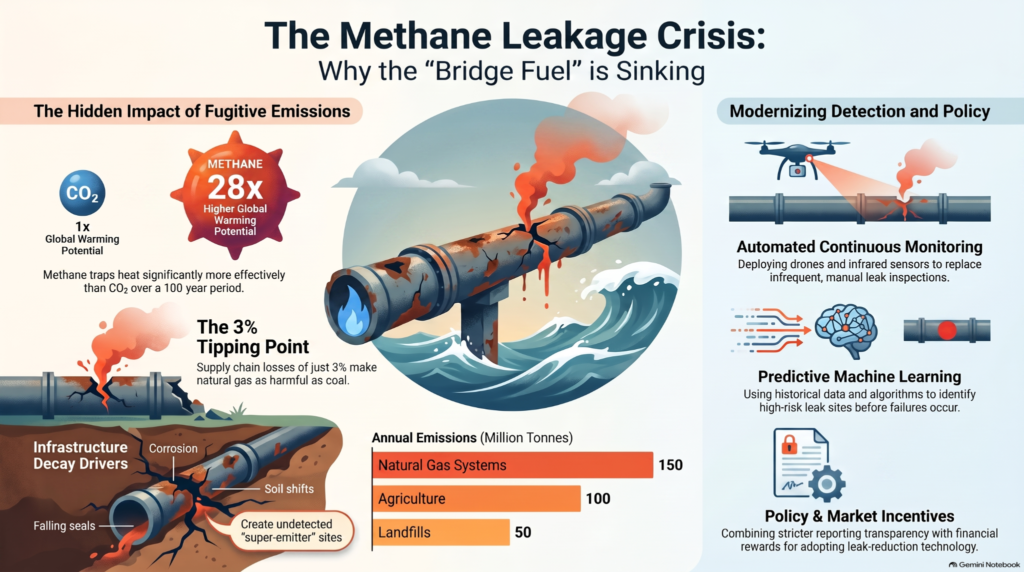
In our energy modeling, we find that supply chain losses as low as 3% can place natural gas on par with legacy fossil systems in terms of radiative forcing. If we intend to design genuinely resilient, low-carbon power grids, we must stop looking strictly at stack emissions and confront the unmeasured molecules escaping across the extraction and distribution lifecycle.
Methane leakage from natural gas systems has a significant environmental cost due to its ability to trap heat 25 times more effectively than carbon dioxide over a century. This leakage intensifies climate change, disrupts ecosystems, and threatens species survival. Equipment failures, corrosion, and inadequate maintenance lead to these emissions. Innovative technologies and stricter policies are essential for detection and mitigation. Understanding the specifics of these issues is vital for addressing the environmental impacts effectively.
KEY TAKEAWAYS
- Methane is 25 times more effective than CO2 at trapping heat, significantly contributing to climate change and extreme weather patterns.
- Leakage from natural gas systems exacerbates climate change, leading to ecosystem disruption and threatening species survival.
- Inadequate maintenance and outdated inspection technologies often result in undetected methane leaks, increasing environmental costs.
- Advanced leak detection technologies and proactive maintenance strategies can mitigate methane emissions and enhance operational efficiency.
- Stricter regulations and market incentives are necessary to promote transparency in emissions reporting and encourage investment in leak reduction solutions.
UNDERSTANDING METHANE AND ITS IMPACT ON CLIMATE CHANGE
Natural gas is a potential “bridge fuel” between the current (largely) fossil-based energy system and a renewable-dominated future energy system. It emits less carbon dioxide during combustion than other fossil fuels and can be used flexibly in many industries. Also, the use of gas turbines may allow flexible grid response in high renewable fraction grids.
While you may be familiar with carbon dioxide as a primary greenhouse gas, methane poses an equally significant threat to our climate. Methane is approximately 25 times more effective than carbon dioxide at trapping heat over a 100-year period.
Understanding methane sources is vital, as they include livestock, rice cultivation, and fossil fuel extraction. These activities contribute to elevated atmospheric concentrations, accelerating climate feedback loops that further intensify global warming.
As the planet warms, thawing permafrost releases even more methane, creating a cascading effect that challenges climate mitigation efforts. Addressing these emissions requires innovative strategies and technologies to reduce methane leakage in various sectors.
How Do Methane Leaks Occur in Natural Gas Systems?
In 2022, methane (CH4) accounted for 12% of all U.S. greenhouse gas emissions from human activities (including LULUCF emissions). Human activities emitting methane include leaks from natural gas systems and the raising of livestock. Methane is also emitted by natural sources such as termites. In addition, natural processes in soil and chemical reactions in the atmosphere help remove CH4 from the atmosphere. Methane’s lifetime in the atmosphere is much shorter than carbon dioxide (CO2), but CH4 is more efficient at trapping radiation than CO2. Pound for pound, the comparative impact of CH4 is 28 times greater than CO2 over a 100-year period.
Methane leaks in natural gas systems often stem from equipment failures and malfunctions that compromise system integrity.
Corrosion and physical damage to pipelines can exacerbate these issues, leading to unintentional emissions.
Additionally, gaps in maintenance and inspection protocols can allow small leaks to go undetected, further contributing to the environmental impact.
Equipment Failures and Malfunctions
When equipment in natural gas systems fails or malfunctions, it can lead to considerable methane leaks that pose environmental risks. These leaks often occur due to worn-out components, improper installation, or inadequate maintenance.
Implementing advanced leak detection technologies is essential for identifying these issues early, allowing for timely interventions. By conducting regular assessments and integrating real-time monitoring systems, you can pinpoint vulnerabilities and minimize leak occurrences.
Additionally, equipment upgrades play an important role in enhancing system reliability. Investing in state-of-the-art materials and technologies not only reduces the likelihood of failures but also boosts operational efficiency.
As a result, focusing on leak detection and strategic upgrades can greatly mitigate methane emissions and their consequent environmental impacts.
Pipeline Corrosion and Damage
Equipment failures and malfunctions aren’t the only contributors to methane leaks in natural gas systems; pipeline corrosion and damage also play significant roles. When pipelines corrode, their integrity diminishes, leading to potential leaks.
Factors like soil conditions, moisture, and chemical exposure accelerate corrosion, threatening the entire system. You must prioritize corrosion prevention strategies, such as applying protective coatings and using corrosion-resistant materials, to extend pipeline life and maintain integrity.
Regular monitoring and advanced technologies can help detect early signs of corrosion, enabling timely interventions. By addressing pipeline corrosion proactively, you can mitigate methane emissions and enhance the overall efficiency of natural gas systems.
This innovative approach not only protects the environment but also safeguards energy resources for the future.
Maintenance and Inspection Gaps
Despite advancements in technology, gaps in maintenance and inspection practices often lead to undetected methane leaks in natural gas systems. Inadequate maintenance strategies can result from budget constraints or prioritization of immediate operational needs over long-term sustainability.
Many operators rely on outdated inspection technologies that fail to detect small, yet substantial, leaks. Consequently, these leaks contribute to greenhouse gas emissions and environmental degradation.
Innovative approaches, such as real-time monitoring and enhanced leak detection systems, are essential to bridge these gaps. By adopting cutting-edge inspection technologies and robust maintenance strategies, you can considerably reduce methane emissions and improve the overall efficiency of natural gas systems.
Prioritizing these practices is crucial for promoting both environmental responsibility and operational integrity.
WHAT DO THE STATISTICS SAY ABOUT METHANE EMISSIONS?
When evaluating the physical infrastructure of gas systems, the engineering challenges behind fugitive emissions become glaringly apparent. During technical discussions with field engineers and utility operators, I often observe a disconnect between theoretical system integrity and physical operational decay. Real-world transmission grids consist of thousands of kilometers of aging metallurgy exposed to fluctuating pressures, ground shifts, and chemical corrosion. These conditions inevitably lead to micro-fissures, failing valve seals, and subsurface leaks that manual inspection cycles regularly overlook.
Recent literature underscores the long-tail risks of compromised geological and mechanical integrity. For example, field investigations of historical sites like the Sărmășel gas field show how initial well casing failures can interact with surrounding fault networks to generate persistent super-emitter leaks that span decades or even centuries. Relying on infrequent, manual leak inspections is no longer technically defensible.
To maintain any credibility in emissions accounting, the sector must accelerate the deployment of automated, continuous monitoring frameworks—leveraging optical gas imaging, drone-based aerial sweeps, and machine learning analytics to catch mechanical degradations before they evolve into major atmospheric emission events.
Methane is a major contributor to global warming. It has more than 80 times the global warming impact of CO2 and the rate at which it is being produced increases year on year. The atmospheric concentration of this gas has soared in recent years, and methane leaks and methane mismanagement are two of the leading contributors. These leaks are most commonly caused by equipment and pipeline seals failing.
When you look at global methane emission trends, you’ll notice a significant increase over the past few decades.
This rise has profound implications for climate change, as methane is a potent greenhouse gas.
Understanding these statistics is essential for evaluating the environmental impact and developing effective mitigation strategies.
Global Methane Emission Trends
Methane emissions have surged dramatically over the past few decades, raising alarm among environmental scientists and policymakers alike. Understanding global methane trends is essential for addressing this issue.
Recent statistics indicate the following key emission sources:
- Agriculture: Livestock and rice cultivation contribute notably, releasing methane during digestion and decomposition.
- Fossil Fuels: Natural gas extraction and distribution systems leak methane, undermining their perceived benefits over coal.
- Waste Management: Landfills produce methane as organic waste decomposes anaerobically, presenting a major challenge.
These emission sources combined account for a substantial portion of global methane, highlighting the need for innovative solutions and a broader transition toward eco friendly products to reduce leakage and enhance sustainability in various sectors.
Impact on Climate Change
As scientists increasingly analyze the data, the impact of methane emissions on climate change becomes alarmingly clear. Methane’s potency as a greenhouse gas, being over 25 times more effective than CO2 over a 100-year period, markedly contributes to atmospheric warming. This creates a dangerous climate feedback loop, exacerbating global temperatures.
Here’s a snapshot of the current situation:
| Methane Source | Annual Emissions (Million Tonnes) |
| Natural Gas Systems | 150 |
| Agriculture | 100 |
| Landfills | 50 |
These statistics illustrate the urgent need for innovative solutions to mitigate methane leakage and its profound effects on our climate. Addressing these emissions is essential for a sustainable future.
How Do Methane Emissions From Natural Gas Compare to Other Fossil Fuels?
Natural gas is often touted as a cleaner alternative to other fossil fuels, but its methane emissions raise important concerns. When comparing methane emissions from natural gas to those of other fossil fuels, you’ll find significant differences that can influence energy choices.
Consider these three key points:
- Methane Potency: Methane is over 25 times more effective than CO2 at trapping heat over a 100-year period, making its leakage particularly detrimental.
- Emission Rates: Natural gas systems can leak as much as 3-4% of their methane during production and distribution, a rate that can negate its climate benefits compared to coal or oil.
- Lifecycle Analysis: When evaluating full lifecycle emissions alongside traditional risks like sulfur dioxide coal power pollution, natural gas can appear more favorable than coal, but it remains far less sustainable than renewable energy sources.
Understanding these factors is essential for making informed decisions about energy sources and their environmental impacts.
What Are the Environmental Consequences of Methane Emissions?
The leakage of methane during natural gas production and distribution has serious environmental implications that extend beyond immediate emissions. Methane is a potent greenhouse gas, while nitrogen oxide emissions in energy generation can further contribute to air pollution and environmental degradation. Its release accelerates climate feedback mechanisms, exacerbating climate change and leading to more extreme weather patterns.
Moreover, methane emissions contribute to ecosystem disruption, impacting biodiversity and altering habitats. As temperatures rise, ecosystems struggle to adapt, threatening species survival and ecosystem services.
The ripple effect of these emissions can destabilize food chains and disrupt agricultural productivity, further straining resources. Addressing methane leakage is vital not only for mitigating climate change but also for preserving the delicate balance of ecosystems.
Innovative Technologies for Reducing Methane Emissions
While addressing methane emissions may seem intimidating, innovative technologies are emerging that can greatly reduce leakage throughout the natural gas supply chain. You can leverage these advancements to enhance leak detection and achieve significant emission reduction.
Consider the following technologies:
- Advanced Sensors: These devices utilize infrared technology to detect methane leaks quickly and accurately, allowing for prompt repairs.
- Drones: Equipped with specialized sensors, drones can survey pipelines and facilities from above, identifying leaks in hard-to-reach areas without disrupting operations.
- Machine Learning: By analyzing historical data, machine learning algorithms can predict potential leak sites, enabling companies to focus their maintenance efforts proactively.
Implementing these technologies not only helps minimize environmental impact but also enhances operational efficiency.
Embracing innovation in leak detection and emission reduction can lead to a more sustainable future in the natural gas industry.
Policy Innovations to Combat Methane Emissions
As governments and organizations recognize the urgent need to address climate change, innovative policy frameworks are emerging to effectively combat methane emissions.
You’ll find that these frameworks often combine regulatory measures with market incentives, creating a more thorough approach. For instance, stricter regulations on methane leaks in natural gas systems can be coupled with financial rewards for companies that implement advanced leak detection technologies.
Such market incentives not only encourage compliance but also stimulate investment in innovative solutions.
Additionally, policies promoting transparency in emissions reporting can enhance accountability and drive industry-wide improvements.
RELATED STUDIES ABOUT METHANE LEAKAGE FROM NATURAL GAS SYSTEMS
In the battle against climate change, the stark contrast between natural gas’s perceived cleanliness and the hidden threat of methane leakage becomes evident. While natural gas is often touted as a bridge fuel, its emissions can rival or exceed those of coal when leaks occur. By embracing innovative technologies and implementing robust policies, we can bridge this gap, reducing methane emissions and protecting our environment. The choice is clear: act now or watch our climate goals slip further away.
Long-term emission of methane and ethane to the atmosphere from hybrid natural seepage and well leakage in the Sărmăşel gas field (Romania)
This study investigates the Sărmășel gas field in the Transylvanian Basin, Romania, identifying it as an active, century-long hybrid leakage-seepage system where fugitive gas from an early 20th-century well interacts with a pre-existing natural seepage network.
Key Historical and Geological Context:
- Origin of Leakage: In 1909, exploratory drilling (Well #2) struck high-pressure shallow gas reservoirs. Following the closure of the well in 1911, subsurface pressure buildup forced gas through anticlinal strata and a local normal fault network, triggering ground bursts, craters, and burning vents 100 to 400 meters away that remain active.
- Hybrid System Mechanism: Pre-drilling records confirm natural seepage existed prior to exploration, including the Băile Sărmășel bubbling pond. The natural fault and seep system conveyed and amplified stray gas leaking from the well casing, merging anthropogenic leakage with geologic seepage.
Major Findings and Emission Quantification:
- Emission Rates (2024 Survey): Combined diffuse ground fluxes and focused crater emissions release 185.8 tonnes per year (approximately 21.2 kg per hour) of methane and approximately 0.38 tonnes per year of ethane.
- Super-Emitter Status: At more than 20 kg CH4 per hour, the site qualifies as a super-emitter under Romanian oil and gas classifications, releasing four times the national average emission factor for oil and gas facilities.
- Cumulative Historical Impact: Since 1911, ground emissions have released 10,000 to 100,000 tonnes of methane. Factoring in the direct release of Well #2 from 1909 to 1913, total atmospheric methane injection exceeds 0.8 megatonnes.
- Deep Thermogenic Evidence: While the primary reservoir gas is microbial, the systematic presence of ethane, propane, and butane across vents, soils, and groundwater supports the existence of a deeper thermogenic petroleum system in the Transylvanian Basin.
Significance and Takeaway:
Sărmășel illustrates the environmental hazard of drilling within faulted, active seepage systems, where well interventions can provoke persistent, diffuse, and unregulable fugitive emissions spanning over a century.
Techno-economic assessment of Waste-to-Energy-based Power-to-Methane systems for regional gas networks
This study presents a regional techno-economic assessment of Waste-to-Energy (WtE)-based Power-to-Methane (PtM) systems deployed across a gas distribution network in Switzerland (EnergiNova AG territory) using an hourly mixed-integer linear programming (MILP) model.
Key Findings and System Performance:
- Primary Bottleneck: Synthetic Natural Gas (SNG) production is constrained by the availability and cost of low-carbon electricity for hydrogen production, rather than by CO2 or waste heat availability.
- Seasonal Balancing: Seasonal storage (modeled as LNG) is critical to decoupling summer peak renewable generation from high winter gas demand, significantly reducing overall system costs.
- Cost Competitiveness (Case 2): Fully renewable configurations achieve a Levelized Cost of Methane (LCOM) of 0.13 to 0.24 CHF per kWh. This cost falls within a competitive range with Swiss industrial biogas (benchmark of 0.20 CHF per kWh or lower), but relies heavily on low-emission H2 imports via the European Hydrogen Backbone (covering approximately 83% of H2 demand).
- Grid-Based PtM (Case 1): SNG production using industrial grid electricity results in high LCOM values of 0.42 to 0.44 CHF per kWh, rendering it uncompetitive due to regulated electricity tariffs.
- Carbon Pricing Impact (Case 3): Under current Swiss CO2 levies of 120 CHF per tonne of CO2, importing natural gas is more economical than local SNG synthesis. Substantial carbon price increases (such as 480 CHF per tonne of CO2) are necessary to trigger local SNG production and achieve significant emissions abatement.
System Architecture and Infrastructure:
- Decentralized Methanation: The optimal architecture co-locates carbon capture and methanation at the individual WtE plants rather than building centralized conversion hubs.
- Pipeline Economics: The model prioritizes low-pressure H2 pipeline networks over CO2 pipelines, because transporting supercritical CO2 incurs significantly higher capital costs and all WtE plants already possess local CO2 surpluses.
Takeaway:
WtE-based PtM can effectively defossilize regional gas grids at costs comparable to biogas, provided there is access to low-cost hydrogen imports, seasonal storage integration, and strong carbon price signals to incentivize synthetic fuel over fossil gas imports.
CO2-compensated natural gas economically beats synthetic methane
This study evaluates the techno-economic competitiveness and supply chain emissions of two climate-neutral methane pathways supplying Europe: synthetic methane produced via renewable electricity, electrolysis, and methanation versus fossil natural gas paired with CO2 capture and permanent geological storage (CCS compensation).
Key Findings and Economic Parity:
- Independence from CO2 Supply Costs: Because 1 tonne of captured CO2 yields the exact same amount of delivered energy (5 MWh) whether used as a synthesis feedstock or for offsetting combustion emissions, the economic comparison is independent of carbon capture costs.
- Significant Cost Disadvantage: Synthetic methane remains substantially more expensive than compensated natural gas. In the baseline scenario, cost parity requires natural gas prices to reach an average of 170 EUR/MWh in 2030 and 127 EUR/MWh in 2050 across all evaluated export regions.
- Progressive Scenario Limits: Under aggressive technology cost reductions (Tech_progressive), parity requires natural gas prices of at least 74 EUR/MWh in 2030 and 52 EUR/MWh in 2050. Even the lowest-cost hybrid systems (such as in the USA, Brazil, and Namibia at 45 to 52 EUR/MWh in 2050) exceed projected normal market gas prices of 15 to 36 EUR/MWh.
- Primary Cost Drivers: The levelized cost of electricity (LCOE) dominates synthetic methane costs due to high electricity requirements for electrolysis, whereas CO2 storage costs (4 to 20 EUR per tonne of CO2, or 0.80 to 4.00 EUR/MWh of gas) contribute minimally to the natural gas path.
Supply Chain Emissions and Carbon Penalties:
- Emissions Profile: In the near term (2030), manufacturing and construction of renewable installations and electrolyzers contribute 50 to 57 kg CO2/MWh for synthetic methane, which can exceed upstream natural gas emissions unless methane leakage rates are high.
- Impact of CO2 Penalties: Applying a carbon penalty for supply chain emissions improves synthetic methane’s competitiveness only under high fugitive leakage rates (above 5%) and extreme penalty levels (often exceeding 500 to 2000 EUR per tonne of CO2 equivalent). By 2050, expected reductions in fossil supply chain leakage diminish this penalty advantage.
Strategic Takeaway:
Due to high primary renewable electricity demands and conversion inefficiencies, importing synthetic methane is economically uncompetitive compared to CO2-compensated fossil natural gas. Policy and decarbonization frameworks should prioritize scarce renewable electricity and green hydrogen for direct electrification or hard-to-abate sectors with higher abatement value rather than synthetic methane synthesis.
| REFERENCE: Wolfgang Männer, Joshua Fragoso García, Benjamin Lux, Giovanni Sansavini, Frank Sensfuß, CO2-compensated natural gas economically beats synthetic methane, Applied Energy, Volume 401, Part C, 2025, 126327, ISSN 0306-2619, https://doi.org/10.1016/j.apenergy.2025.126327. (https://www.sciencedirect.com/science/article/pii/S0306261925010578) |
CONCLUSION
Moving toward net-zero power networks requires absolute clarity regarding where we allocate capital, engineering effort, and clean electricity. While emerging alternatives like synthetic natural gas produced via Power-to-Methane systems show theoretical promise, techno-economic analyses consistently show they face severe efficiency and cost barriers compared to direct electrification or targeted carbon capture systems. Dedicating scarce renewable energy to synthesize methane simply to keep legacy distribution networks pressurized is an inefficient use of resources when deep decarbonization demands rapid, high-impact interventions.
Our priority must center on empirical transparency and immediate mitigation. We cannot engineer solutions for emissions we refuse to measure accurately. Tightening leak-detection standards, modernizing pipeline materials, and enforcing continuous remote monitoring are essential baseline actions to prevent gas infrastructure from driving near-term warming.
Natural gas cannot serve as a responsible bridge to a sustainable future if the bridge itself is leaking its most potent fuel into our atmosphere. As engineers and researchers, our mandate is to design energy systems that are scientifically sound from source to socket, ensuring that transition strategies accelerate actual decarbonization rather than prolonging hidden climate impacts.