
Over my fifteen years of consulting for municipal waste authorities, there is one distinct operational signal you never forget: the unmistakable rotten-egg stench of hydrogen sulfide (H₂S). When community members call in complaints about a nearby landfill or wastewater facility, they usually frame it purely as an unbearable odor nuisance. But from an environmental engineering perspective, that smell is just the tip of the iceberg. It serves as an immediate biochemical indicator that deep within the waste mass, anaerobic decomposition is aggressively converting sulfur compounds into a highly volatile, corrosive, and hazardous byproduct.
Too often, municipal planning treats H₂S management as an afterthought or a basic cosmetic issue handled with simple deodorizers. In reality, untreated hydrogen sulfide poses severe occupational safety hazards for field operators, accelerates the structural degradation of transport infrastructure through acid corrosion, and threatens surrounding micro-ecosystems.
Addressing it requires far more than generic calculations or assumptions copied from other sites. Every landfill cell and sewage basin operates under unique biochemical and hydrological dynamics. If we want to build resilient, circular waste infrastructure, we must look past the smell and proactively manage the biological mechanisms producing this toxic gas.
Hydrogen sulfide (H₂S) is a toxic gas generated from the anaerobic decomposition of organic waste in landfills and sewage systems. You might experience symptoms like irritation, nausea, or respiratory issues if exposed. The gas not only poses health risks but also disrupts ecosystems by depleting oxygen in water bodies. Various innovative technologies, such as smart sensors and advanced filtration systems, are now in place to monitor and reduce H₂S emissions effectively. Discover more about these solutions and their impact.
KEY TAKEAWAYS
- Hydrogen sulfide (H₂S) is produced during the anaerobic breakdown of organic materials in landfills and sewage systems.
- H₂S is released by anaerobic bacteria that thrive in oxygen-deprived environments, leading to increased emissions.
- Exposure to H₂S can cause serious health risks, including respiratory distress and neurological damage.
- Environmental effects of H₂S include disruption of microbial activity and creation of dead zones in aquatic ecosystems.
- Innovative technologies like smart sensors and advanced filtration systems can help manage and reduce H₂S emissions effectively.
WHAT IS HYDROGEN SULFIDE AND HOW IS IT PRODUCED?
Hydrogen sulfide (H₂S) is a colorless gas known for its distinctive rotten egg odor, and it plays a significant role in waste decomposition processes. Produced during the anaerobic breakdown of organic materials, H₂S forms when bacteria metabolize sulfur compounds in environments like landfills and sewage systems.
Understanding hydrogen properties is essential, as H₂S possesses a low molecular weight, making it highly volatile and easily dispersible in the atmosphere.
During waste decomposition, the interaction of organic matter with sulfur-containing compounds leads to the generation of H₂S. This gas not only serves as an indicator of microbial activity but also offers insights into the efficiency of waste management systems.
As you explore innovative solutions for waste treatment, recognizing the dynamics of hydrogen sulfide and its formation can facilitate more effective strategies for managing sulfur compounds and landfill leachate chemical compounds.
Health Risks of Hydrogen Sulfide Exposure
Hydrogen sulfide is a colorless gas which often smells like rotten eggs. It only takes a very small amount for people to be able to smell hydrogen sulfide. You may have smelled hydrogen sulfide near manure pits, coastal mud flats at low tide, or near pulp and paper mills. Hydrogen sulfide can also come from the breakdown of waste materials in a landfill.
While exposure to hydrogen sulfide (H₂S) is often associated with its foul odor, the health risks it poses are far more serious and can escalate quickly.
Initial exposure symptoms include irritation of the eyes, nose, and throat, headaches, dizziness, and nausea. As the concentration increases, you may experience respiratory distress, loss of consciousness, or even death.
Chronic exposure can lead to long-term effects, such as neurological damage, respiratory issues, and decreased cognitive function. These risks necessitate immediate action if you’re in an environment where H₂S is present.
Implementing adequate ventilation, using personal protective equipment, and monitoring H₂S levels can mitigate exposure. It’s essential to understand that even low concentrations can have significant health impacts over time, making awareness and proactive measures important.
Sources of H2S in Waste Facilities
In waste facilities, the breakdown of organic waste is a primary source of hydrogen sulfide (H₂S), with different types of waste influencing the decomposition process and the amount of gas produced.
When organic materials decompose, particularly under anaerobic conditions, H2S is released as a byproduct of microbial activity.
Understanding these processes helps you identify potential risks and implement effective management strategies.
Organic Waste Breakdown
Organic waste breakdown in waste facilities is a significant source of hydrogen sulfide (H2S), as anaerobic bacteria thrive in environments devoid of oxygen, such as landfills and compost heaps.
Understanding this process can help you innovate waste management strategies. Here are key factors contributing to H2S production:
- Composting methods: Different techniques affect microbial activity and H2S emissions.
- Microbial activity: Specific bacteria are more prone to producing H2S during the breakdown of organic matter.
- Moisture levels: Excess moisture can enhance anaerobic conditions, promoting H2S generation.
- Temperature: Warmer conditions can accelerate microbial processes, increasing H2S output.
Anaerobic Digestion Processes
Anaerobic digestion processes serve as an essential method for managing organic waste, yet they can also considerably contribute to hydrogen sulfide (H2S) emissions.
During this process, anaerobic bacteria break down organic material in the absence of oxygen, generating methane production as a byproduct. While this biogas can be harnessed as a renewable energy source, the conditions that favor anaerobic digestion also promote H2S formation.
As these bacteria metabolize sulfur-containing compounds, H2S is released, posing potential risks to both health and the environment. Understanding the balance between maximizing methane production and minimizing H2S emissions is vital for innovation in waste management practices.
ENVIRONMENTAL EFFECTS OF HYDROGEN SULFIDE EMISSIONS
When managing anaerobic systems whether an industrial-scale anaerobic digester or a standard municipal landfill cell, engineers constantly balance maximizing biogas yield with controlling dangerous contaminants like H₂S. In real-world facilities, relying strictly on chemical oxidation reagents like sodium hypochlorite or hydrogen peroxide frequently strains municipal budgets due to recurring chemical costs, specialized storage requirements, and aggressive sludge generation.
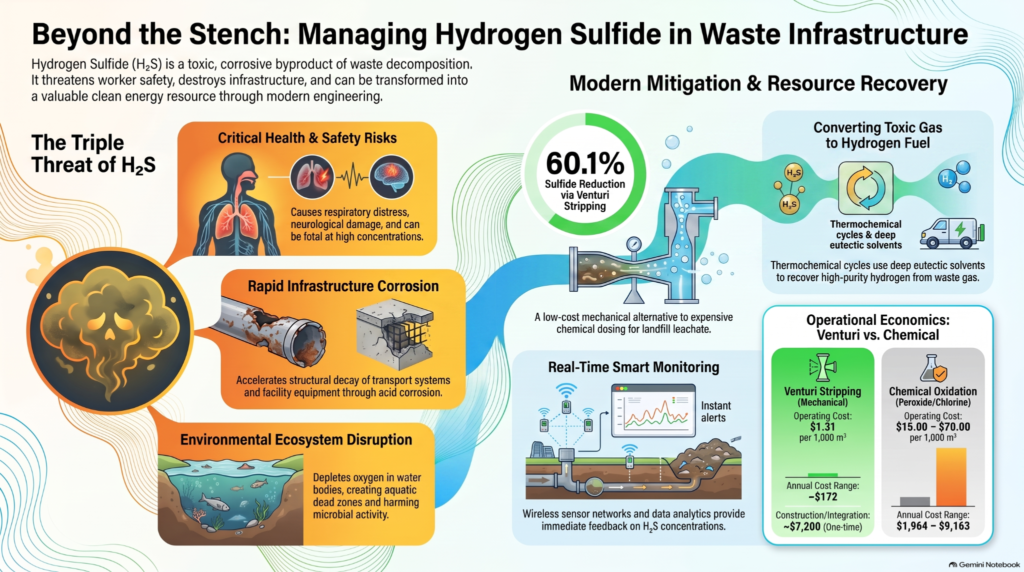
This operational bottleneck is why physical pre-treatment and smart mechanistic engineering are gaining serious traction. For instance, recent field applications like the venturi-based hydrogen sulfide stripping system deployed at Ottawa’s Trail Road Waste Facility prove how simple hydrodynamic design can transform treatment economics. By stripping volatile dissolved sulfides directly out of landfill leachate during pump transfer, the facility cut total sulfide levels by an average of 60.1% while maintaining an operating cost of roughly 1.31 CAD per 1,000 m³ a tiny fraction of typical chemical dosing methods.
Coupled with emerging nanoscale materials like defect-engineered graphene adsorbents that lower reaction barriers to capture sulfur, we are moving toward metal-free, low-maintenance strategies that protect downstream waste-to-energy equipment without bankrupting public utility programs.
Hydrogen sulfide is toxic to humans and most other animals by inhibiting cellular respiration in a manner similar to hydrogen cyanide. When it is inhaled or its salts are ingested in high amounts, damage to organs occurs rapidly with symptoms ranging from breathing difficulties to convulsions and death. Despite this, the human body produces small amounts of this sulfide and its mineral salts, and uses it as a signalling molecule.
Hydrogen sulfide emissions pose significant health risks to humans, potentially leading to respiratory issues and neurological effects.
Furthermore, these emissions can disrupt local ecosystems, affecting plant and animal life.
Understanding these impacts is essential for developing effective management strategies.
Health Risks To Humans
While many may not realize it, exposure to hydrogen sulfide can pose significant health risks, particularly in environments where waste decomposition occurs. Understanding these risks is essential for your safety and well-being.
Health monitoring and adherence to exposure guidelines are vital in mitigating potential harm.
Consider the following health risks associated with hydrogen sulfide exposure:
- Respiratory Issues: Shortness of breath and irritation of the airways.
- Neurological Effects: Headaches, dizziness, and potential loss of consciousness.
- Gastrointestinal Distress: Nausea and vomiting, particularly with high concentrations.
- Long-term Health Effects: Possible chronic respiratory conditions and neurological damage.
Being informed about these risks can empower you to take preventive measures in environments where hydrogen sulfide is present.
Impact On Ecosystems
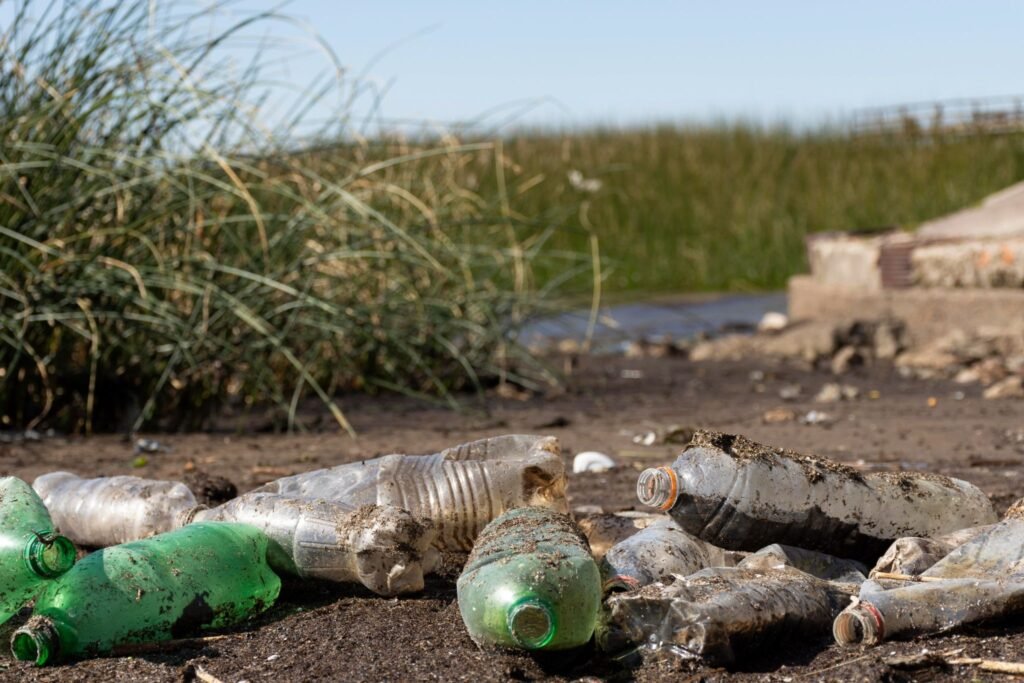
Exposure to hydrogen sulfide doesn’t just pose risks to human health; it also greatly impacts ecosystems. Elevated levels of this gas disrupt ecosystem balance by harming essential microbial activity.
Microbes play a significant role in nutrient cycling, and their impairment can lead to reduced soil fertility and hinder plant growth. Aquatic ecosystems are equally affected, as hydrogen sulfide can create dead zones by depleting oxygen levels, making it difficult for aquatic life to thrive.
When these ecosystems falter, the consequences ripple through food webs, affecting species diversity and stability. To foster innovation in environmental management, we must address hydrogen sulfide emissions to protect these intricate systems, ensuring resilience and sustainability for future generations.
Innovative Technologies for Tracking H2S Levels
As the urgency to monitor hydrogen sulfide (H2S) levels in waste decomposition sites increases, innovative technologies are emerging to enhance detection and tracking capabilities.
Real-time monitoring systems are essential for ensuring safety and minimizing environmental impact. Here are some key advancements in sensor technology for tracking H2S levels:
- Smart Sensors: These devices utilize advanced algorithms to provide immediate feedback on H2S concentrations.
- Wireless Networks: They enable data transmission from remote locations, allowing for thorough monitoring across extensive sites.
- Data Analytics Platforms: These systems analyze collected data, offering predictive insights and trend analysis for effective management.
- Mobile Applications: Users can access real-time information on H2S levels, ensuring timely responses to potential hazards.
How to Reduce H2S Emissions Effectively
To effectively reduce hydrogen sulfide (H2S) emissions from waste decomposition, implementing a combination of technological and operational strategies is crucial.
One innovative approach involves utilizing advanced landfill gas management systems that can capture and process landfill gases, minimizing H2S release. By employing anaerobic digesters, you can enhance organic waste breakdown while simultaneously reducing H2S emissions.
Additionally, regularly monitoring and maintaining your waste management facilities guarantees maximum performance and early detection of potential H2S issues.
Training staff on H2S mitigation strategies fosters a culture of safety and awareness, enabling swift responses to any emissions. Incorporating biofilters, activated carbon systems, or eco friendly products can also greatly lower H2S concentrations in gas streams.
Future Trends in Waste Management and H2S Control
Hydrogen sulfide (H2S) is often identified as a potential culprit of odors and nuisance complaints near municipal solid waste (MSW) landfills. Some base their complaints on information found on the Internet as fact. As experts, let’s start by saying data from other landfills or pulled from an AI browser summary online will not provide accurate answers. H2S concentrations vary widely and are unique to individual landfills.
While advancements in waste management technologies continue to evolve, a critical focus remains on reducing hydrogen sulfide (H2S) emissions effectively.
As you explore future trends, consider the following waste innovations and emission regulations that will shape the industry:
- Enhanced anaerobic digestion: This technology optimizes waste decomposition, reducing H2S production.
- Advanced filtration systems: Implementing cutting-edge filters can capture and neutralize H2S before it escapes into the environment.
- Real-time monitoring: Smart sensors will provide data on H2S levels, ensuring compliance with emission regulations and allowing for immediate action.
- Waste-to-energy solutions: Converting organic waste into energy not only reduces landfill use but also minimizes H2S generation.
RELATED STUDIES ABOUT HYDROGEN SULFIDE FROM WASTE DECOMPOSITION
In managing hydrogen sulfide emissions, think of waste facilities as a garden. Just as a gardener must regularly prune to prevent overgrowth, effective H2S management requires continuous monitoring and proactive strategies. With innovative technologies and a commitment to reducing emissions, we can cultivate a healthier environment. By tackling this issue head-on, you’re not only protecting public health but also nurturing the planet for future generations. The effort you put into this “garden” pays off in cleaner air and safer communities.
Evaluating hydrogen sulfide removal from municipal landfill leachate using a venturi stripping system
Overview and Objective
This study evaluates the performance, process dynamics, and economics of an in-line, venturi-based hydrogen sulfide stripping system (HSSS) installed at the City of Ottawa’s Trail Road Waste Facility in Ontario, Canada. The system was deployed as a low-cost pretreatment to remove dissolved hydrogen sulfide (H2S) from municipal solid waste landfill leachate prior to tanker transport and downstream municipal wastewater treatment, mitigating severe infrastructure corrosion, odors, and occupational hazards.
Key Findings and Performance
- Stripping Efficiency: Over an 18-month monitoring period, the HSSS achieved an average total sulfide (TS) reduction of 60.1% (ranging from 1.3% to 97.9%) and removed 65.9% of the strippable H2S fraction. At influent TS concentrations below 10 g/m3, removal efficiency reached up to 79.4%.
- Chemical and Speciation Effects: Aeration caused an average leachate pH increase of 0.17 +/- 0.09 due to concurrent CO2 stripping. Because higher pH shifts volatile H2S into non-volatile bisulfide (HS-), rapid, single-stage stripping is essential before speciation limits removal.
- Environmental and Operational Drivers: TS removal strongly correlated with raw leachate TS concentrations (r = 0.929, p < 0.01). In contrast, sulfate levels and ambient air temperatures showed negative correlations with removal, with the highest stripping performance occurring at temperatures <= 5 deg C due to reduced microbial sulfate reduction in cold waste cells. A 3-day rolling rainfall correlated strongly with leachate BOD increases.
Process Modeling (SUMO)
- The SUMO process model accurately predicted leachate pH increases (0.5 to 0.6 units) and total alkalinity within +/- 5%, showing that carbonate chemistry was well simulated.
- However, the model systematically underpredicted TS stripping by 44.7 +/- 7.6% at the average pH of 7.68.
- This divergence is attributed to unmodeled hydrodynamic factors, complex leachate matrices (surfactants), and extensive bubble-retention foaming, which likely provided secondary downstream stripping inside tanker trucks.
Economic and Operational Evaluation
- Low Capital Expenditure: The system required approximately 10,000 CAD (~7,200 USD) to construct and integrate into the existing conveyance system.
- Minimal Operating Costs: Annual operating costs were approximately 172 CAD/year (translating to 1.31 CAD per 1,000 m3 of leachate treated), which accounts strictly for the extra electrical power consumed by a 6.6-minute increase in pump runtime per tanker fill due to hydraulic head loss.
- Comparison to Chemical Alternatives: Conventional chemical oxidation (using reagents such as hydrogen peroxide, sodium hypochlorite, or ferric chloride) costs between $15 and $70 CAD per 1,000 m3 of leachate (1,964 to 9,163 CAD/year), without factoring in chemical storage, handling infrastructure, and sludge generation costs.
Strategic Value
The venturi-based HSSS provides a low-cost, low-maintenance mechanical alternative to chemical dosing for landfill leachate H2S abatement. In addition, the substantial foaming generated during operation suggests a potential dual-benefit application to concurrently separate PFAS via foam fractionation.
| REFERENCE: Patrick M. D’Aoust, Pawel J. Szulc, Dwight Houweling, Evaluating hydrogen sulfide removal from municipal landfill leachate using a venturi stripping system, Waste Management, Volume 211, 2026, 115288, ISSN 0956-053X, https://doi.org/10.1016/j.wasman.2025.115288. (https://www.sciencedirect.com/science/article/pii/S0956053X25006993) |
Defect size engineering in pyridinic-N-doped graphene surfaces for hydrogen sulfide adsorption and dissociation: A first-principles study
Overview and Research Objective
This study investigates how vacancy defect size at pyridinic-nitrogen (pyridinic-N) sites in graphene controls hydrogen sulfide (H2S) capture and catalytic dissociation. Using dispersion-corrected density functional theory (DFT-D3), climbing-image nudged elastic band (CI-NEB) methods, and machine learning force field accelerated ab initio molecular dynamics (MLFF-AIMD), the authors evaluated six defect vacancy models (1C6, 2C6, 3C6, 6C6, 7C6, and infinity-C6) to establish design principles for metal-free desulfurization in biogas and fuel-cell applications.
Key Findings
- Physisorption and Component Compensation:
- Initial H2S adsorption across all defect sizes is dispersion-dominated physisorption, with adsorption energy (Ead) consistently clustered between -0.4 and -0.3 eV.
- Energy decomposition reveals a “component compensation” mechanism: as vacancy size grows, the non-dispersion contribution stabilizes while the dispersion term weakens, maintaining a nearly constant overall Ead.
- Pre-Activation and Barrier Lowering:
- For small-to-medium vacancies (1C6 to 6C6), the S-H dissociation barrier remains clustered around 0.87 +/- 0.05 eV.
- Enlarging the defect significantly lowers the activation barrier to 0.79 eV for 7C6 and 0.61 eV for infinity-C6 (edge-like vacancy).
- This reduction is driven by pre-activation: larger defects allow H2S to sit deeper in the graphene plane, shortening the N…H distance, pre-elongating the S-H bond, and increasing H-1s/N-2p orbital overlap before bond cleavage.
- Thermal Stability:
- MLFF-AIMD simulations at 500 K over 10 ps confirmed that H2S remains adsorbed on the defect site without desorbing or undergoing major reorientation, verifying thermal robustness under operating temperatures.
Strategic Value and Guidelines
Enlarging the carbon vacancy adjacent to pyridinic-N sites accelerates H2S dissociation kinetics by lowering the reaction barrier without sacrificing initial binding stability. This establishes a clear, metal-free structural engineering guideline for designing high-performance carbon adsorbents to protect solid oxide fuel cells (SOFCs) from sulfur poisoning.
| REFERENCE: Taishi Naito, Takaya Fujisaki, Yuta Tsuji, Aleksandar Tsekov Staykov, Yusuke Shiratori, Keiji Yashiro, Defect size engineering in pyridinic-N-doped graphene surfaces for hydrogen sulfide adsorption and dissociation: A first-principles study, Results in Surfaces and Interfaces, Volume 23, 2026, 100787, ISSN 2666-8459, https://doi.org/10.1016/j.rsurfi.2026.100787. (https://www.sciencedirect.com/science/article/pii/S2666845926000796) |
Promoting the hydrogen sulfide–iodine thermochemical cycle with deep eutectic solvents: An experimental and theoretical study
Overview and Purpose
This study investigates the promotion of the hydrogen sulfide-iodine (H2S-I2) thermochemical cycle using deep eutectic solvents (DES) as both catalytic media and solvents. The cycle converts toxic and corrosive H2S waste gas into hydrogen iodide (HI), a primary precursor for downstream clean hydrogen (H2) and elemental sulfur recovery, providing an alternative to the energy-intensive Claus process. Through combined experimental testing and M06-2X/def2-TZVP quantum chemical calculations, the authors evaluated a choline chloride-ethylene glycol aqueous formulation (ChCl:2EG, 70:30 v/v DES:H2O) against conventional aqueous media and alternative DES mixtures (ChCl:2Urea and ChCl:pTSA).
Key Findings and Experimental Performance
- Solvent Selection and Phase Stability: The 70:30 v/v aqueous ChCl:2EG mixture maintained high phase homogeneity, lowered viscosity to facilitate gas-liquid contact, and eliminated the need for chemical solubilizers (such as potassium iodide) by naturally enhancing I2 dissolution. In contrast, ChCl:2Urea exhibited room-temperature crystallization and low reactivity, while ChCl:pTSA showed extreme acidity unsuitable for standard monitoring.
- Enhanced HI Yield and Synergistic Catalysis: In the aqueous ChCl:2EG medium at 1000 ppm H2S, the H+/H2S molar ratio reached 6.39 +/- 0.35, closely matching the theoretical maximum ratio of 6.0 for the low-concentration pathway (H2S + 3I2 + 2H2O -> SO2 + 6HI). Control experiments proved that neither H2S nor I2 reacts alone and that combining ChCl and EG yields a synergistic catalytic effect exceeding individual components.
- Product Speciation Validation: Independent titrations confirmed that HI accounts for >90% of total generated protons (H+), with the remainder originating from dissolved SO2 byproduct existing as sulfurous acid (H2SO3). I2 conversion reached 75% in the aqueous DES compared to 60% in water under identical conditions.
- Operational Parameters:
- Temperature: At low H2S concentrations (1000 ppm), increasing temperature from 25 deg C to 80 deg C decreased reaction rates due to reduced gas solubility and lower medium viscosity. At high concentrations (8990 ppm), elevated temperature accelerated reaction kinetics.
- Mixing Strategy: While ultrasound sonication accelerated apparent H+ production by inducing acoustic cavitation and secondary sonolytic radical pathways, mechanical stirring produced superior reproducibility, stability, and scalability.
- Catalyst Stability and Recyclability: Post-reaction FTIR-ATR and 1H NMR spectroscopy confirmed that ChCl:2EG retained complete chemical and structural integrity without forming degradation byproducts, verifying its function as a stable, regenerable catalyst.
Reaction Mechanism and Quantum Chemistry
- 6-Membered Ring Catalysis: DFT calculations revealed that aqueous ChCl:2EG actively participates in the reaction coordinate via covalent interactions and double hydrogen-atom transfers through a 6-membered ring transition state.
- Substantial Barrier Lowering: The DES-mediated catalytic pathway drastically lowers the standard Gibbs free energy activation barriers (Delta-G-dagger) of the rate-limiting steps:
- Low H2S concentration regime (HSOH formation): reduced from 104.67 kcal/mol (aqueous non-mediated) to 40.32 kcal/mol (6-membered ring mechanism).
- High H2S concentration regime (HSSH formation): reduced from 88.79 kcal/mol to 60.79 kcal/mol.
- Pathway Selectivity: The DES selectively favors the low-concentration, SO2-producing pathway because water participates effectively in stabilizing polar hydrogen-bonding networks across the transition state.
Strategic Value
The aqueous ChCl:2EG system offers a non-toxic, biodegradable, and highly efficient catalytic medium for capturing and converting industrial H2S waste streams into hydrogen iodide. When coupled with existing HI decomposition technologies, this process establishes an efficient, circular-economy route for industrial desulfurization and clean hydrogen recovery.
| REFERENCE: Andres Cardenas-Alvarez, Carolina Arias-Gallego, S.Mani Sarathy, Khalid Hazazi, Manuel Monge-Palacios, Shashank S. Nagaraja, Promoting the hydrogen sulfide–iodine thermochemical cycle with deep eutectic solvents: An experimental and theoretical study, Chemical Engineering Journal Advances, Volume 27, 2026, 101319, ISSN 2666-8211, https://doi.org/10.1016/j.ceja.2026.101319. (https://www.sciencedirect.com/science/article/pii/S2666821126002875) |
CONCLUSION
Looking toward the future of solid waste engineering, our baseline definition of success must evolve. Mitigating H₂S solely to prevent regulatory fines or placate community odor grievances is an outdated model. Modern circular engineering asks a bolder question: how do we transform this problematic, corrosive waste stream into a value-added asset?
Exciting advancements in thermochemical processing highlight this shift. Recent breakthroughs utilizing deep eutectic solvents (such as aqueous choline chloride-ethylene glycol formulations) demonstrate that we can catalyze industrial H₂S waste streams into hydrogen iodide ($HI$) with remarkably low activation energy barriers. When integrated with established decomposition cycles, this gives us a clean pathway to recover high-purity hydrogen fuel and elemental sulfur directly from toxic waste gases.
By pairing continuous sensor networks with these closed-loop chemical cycles, municipal solid waste facilities can transition from hazardous liability centers into reliable hubs of clean energy generation. Managing hydrogen sulfide effectively is no longer just about safe containment; it represents a major frontier in turning waste decomposition into practical, sustainable resource recovery.