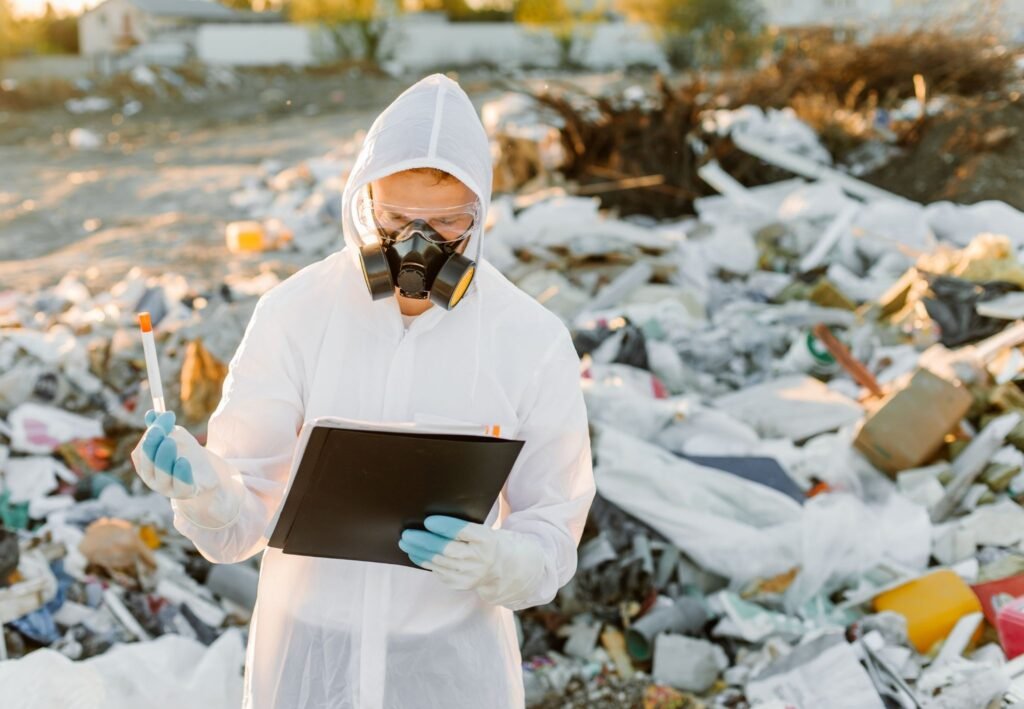
Whenever I walk through an industrial processing floor or conduct an on-site waste characterization audit, there is a distinct, sharp signature in the air that immediately signals an unmanaged nitrogen stream. Most public conversations around solid waste center almost entirely on methane, carbon footprints, or visible plastic pollution. While those priorities are undeniably vital, focusing exclusively on carbon ignores the aggressive, cascading impacts of ammonia emissions (NH3).
During my early career in manufacturing compliance, I quickly learned that airborne ammonia isn’t merely an offensive odor issue; it is a major regulatory and environmental indicator of volatile biological instability. In solid waste systems, high-moisture organic material breaks down rapidly under oxygen-depleted conditions, off-gassing reactive nitrogen that travels into local air basins and adjacent waterways.
It reacts in the atmosphere to form fine secondary particulate matter that compromises community respiratory health, while simultaneously threatening vulnerable aquatic habitats through acid-base imbalances and sudden eutrophication. Bridging the gap between strict environmental policy and everyday operational practice requires us to track these invisible nitrogen flows with the same technical rigor we apply to carbon, ensuring our waste systems truly protect public health from source to sink.
Ammonia emissions from solid waste can severely impact air quality and water bodies. As nitrogen-rich organic materials decompose, they release ammonia, which can cause respiratory issues for humans and contribute to fine particulate matter in the air. In water, elevated ammonia levels harm aquatic life, disrupt pH balance, and promote harmful algae growth. These consequences highlight the importance of effective waste management strategies. Discover how innovative practices can further reduce ammonia emissions and protect our environment.
KEY TAKEAWAYS
- Ammonia emissions from solid waste contribute to poor air quality, leading to respiratory issues and exacerbating conditions like asthma and bronchitis.
- Elevated ammonia levels in the air can form fine particulate matter that penetrates deep into the lungs, posing health risks to humans.
- Ammonia contamination in water bodies can cause respiratory distress and mortality in aquatic life, disrupting ecosystem balance.
- Increased ammonia levels can alter water pH, affecting the solubility of harmful substances and promoting harmful algal blooms.
- Effective waste management practices, like composting and anaerobic digestion, can significantly mitigate ammonia emissions and protect air and water quality.
UNDERSTANDING AMMONIA EMISSIONS: WHAT ARE THEY AND HOW DO THEY OCCUR?
Ammonia (NH3) is a common toxicant derived from wastes (see Figure 1), fertilizers and natural processes. Ammonia nitrogen includes both the ionized form (ammonium, NH4+) and the unionized form (ammonia, NH3). An increase in pH favors formation of the more toxic unionized form (NH3), while a decrease favors the ionized (NH4+) form. Temperature also affects the toxicity of ammonia to aquatic life.
Ammonia emissions represent an important environmental concern, particularly in the context of solid waste management. You need to understand that ammonia originates from various ammonia sources, including agricultural activities, industrial processes, and, importantly, the decomposition of organic waste.
During this decomposition, nitrogen compounds break down through biological and chemical emission processes, releasing ammonia into the atmosphere. This release occurs under anaerobic conditions, where bacteria convert organic material into simpler compounds.
Factors like temperature, moisture, and the carbon-to-nitrogen ratio greatly influence these processes and the subsequent ammonia output.
As you explore innovative solutions, recognizing the intricate relationship between these emission processes and the overall waste management strategy becomes essential. By addressing ammonia emissions proactively, you can contribute to improving air quality and mitigating environmental impacts.
Understanding these dynamics can guide effective interventions and promote sustainable waste management practices.
Sources of Ammonia Emissions From Solid Waste Decomposition
How do various factors contribute to ammonia emissions from the decomposition of solid waste? Understanding these sources is essential for effective landfill practices and minimizing environmental impacts, especially because hydrogen sulfide from waste decomposition can also be released when organic materials break down under oxygen-limited conditions. Here are three key contributors:
- Waste Composition: Organic materials, particularly nitrogen-rich substances like food waste and yard debris, break down more rapidly, releasing ammonia during decomposition.
- Moisture Levels: High moisture content accelerates microbial activity, which can lead to increased ammonia production. Conversely, overly dry conditions may limit decomposition rates.
- Temperature: Elevated temperatures enhance microbial metabolism, further promoting ammonia release. Seasonal variations can greatly impact the rate of decomposition and resulting emissions.
How Ammonia Affects Air Quality and Human Health
While many mightn’t realize it, ammonia emissions from solid waste can greatly impact air quality and human health. Elevated levels of ammonia in the atmosphere lead to ammonia toxicity, which can exacerbate respiratory issues, particularly in vulnerable populations such as children and the elderly.
Research indicates that inhaling ammonia can irritate the respiratory tract, triggering conditions like asthma or bronchitis.
Moreover, ammonia interacts with other airborne pollutants, forming fine particulate matter that can penetrate deep into the lungs, further complicating health outcomes. You might be surprised to learn that even low concentrations of ammonia can contribute to allergic reactions and chronic respiratory diseases.
Addressing ammonia emissions is essential for improving air quality and protecting public health. Innovating waste management practices to minimize ammonia release won’t only enhance environmental standards but also guarantee healthier living conditions for everyone.
How Ammonia Emissions Contaminate Water Bodies
When solid waste decomposes, it often releases ammonia, which can considerably contaminate nearby water bodies. Ammonia toxicity poses significant risks to aquatic ecosystems, leading to various forms of water pollution. Understanding how these emissions affect water quality is essential for innovative environmental management strategies, particularly because contaminated runoff may contain landfill leachate chemical compounds that can further threaten aquatic ecosystems.
Here are three key ways ammonia emissions contaminate water bodies:
- Direct Toxicity: Elevated ammonia levels can harm aquatic life, particularly fish, leading to respiratory distress and mortality.
- Altered pH Levels: Ammonia can increase the pH of water, affecting the solubility of harmful substances and disrupting the natural balance of aquatic ecosystems.
- Nutrient Imbalance: Ammonia encourages the growth of certain algae, which can lead to imbalances in nutrient cycles, impacting the overall health of water bodies.
Addressing these issues is critical for preserving water quality and ensuring sustainable ecosystems.
Ammonia’s Role in Eutrophication of Aquatic Ecosystems
Ammonia (NH3) is a gas that only stays in the atmosphere for a few hours once emitted. However, when ammonia mixes with other gases in the atmosphere, such as nitrogen oxides and sulphur dioxide, it can form particulate matter (PM) which can exist for several days and be transported large distances. PM formed through this process are classed as secondary pollutants and therefore not included in the PM emissions estimations reported in this release. However, there are major health concerns linked to exposure to PM concentrations. Therefore, estimating ammonia emissions is important to help us understand how much secondary PM derived from ammonia contributes to the total PM concentrations.
Ammonia emissions not only contaminate water bodies but also play a significant role in the process of eutrophication, where excess nutrients lead to harmful algal blooms. When ammonia enters aquatic ecosystems, it acts as a fertilizer, promoting the rapid growth of algae at the expense of other organisms.
This eutrophication process reduces oxygen levels in the water, creating dead zones where aquatic biodiversity can’t thrive. As algal blooms proliferate, they block sunlight, hindering photosynthesis in submerged plants, which are vital for maintaining ecological balance.
The decay of these blooms further depletes oxygen, exacerbating the decline of fish and other aquatic species. You can see how ammonia-driven eutrophication not only impacts water quality but also threatens the intricate web of life within aquatic environments.
Innovative strategies to mitigate ammonia emissions are essential for preserving aquatic biodiversity and ensuring healthy ecosystems for future generations.
HOW CAN WE MANAGE WASTE TO CUT DOWN AMMONIA EMISSIONS?
From an engineering and waste auditing perspective, managing ammonia emissions is where theoretical sustainability meets real-world process design. When reviewing facility data, the primary failure point is almost always poor stream segregation at the source. When nitrogen-dense organic fractions such as commercial food waste and processing byproducts are mixed into standard municipal streams or buried in stagnant landfill piles, biological decay triggers massive volatilization under variable temperatures and moisture spikes.
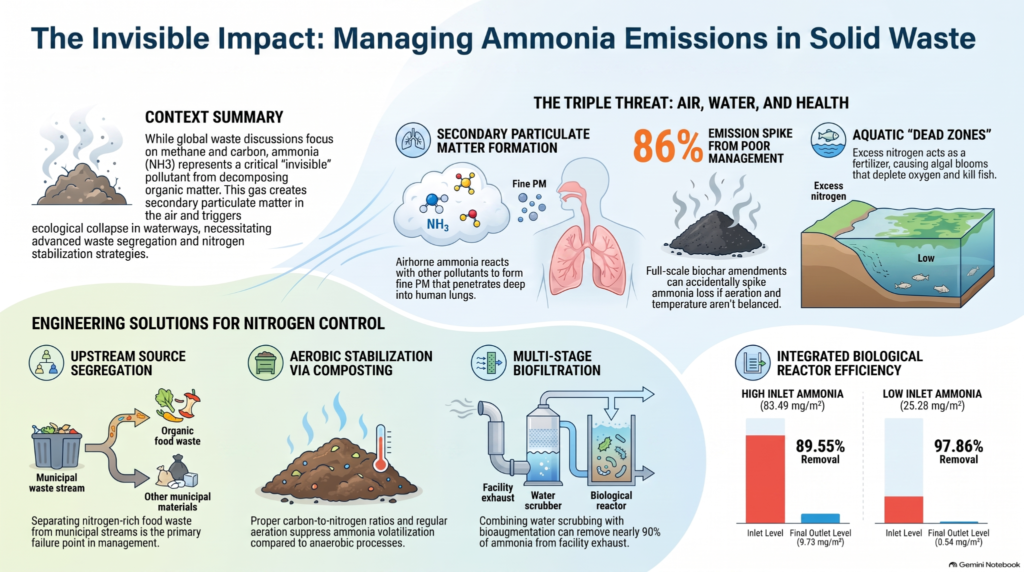
However, solving this is rarely as simple as deploying an off-the-shelf treatment. As recent industrial-scale research demonstrates, even promising interventions like biochar amendment during digestate co-composting can introduce major engineering trade-offs: while biochar insulates piles to meet thermal pathogen-reduction thresholds, high aeration and temperatures can spike ammonia emissions by up to 86%, placing heavy load demands on downstream scrubbers and biofilters.
This proves why holistic mass balance and upstream process control are essential. Whether optimizing microbial inoculants to stabilize nitrogen directly in composting matrices or tuning anaerobic digester feedstocks to balance carbon-to-nitrogen ratios, we cannot view waste processing as a single, isolated step. We must design closed-loop systems with integrated multi-stage biofiltration that actively trap and convert reactive nitrogen into stable, usable resources.
Ammonia is an inorganic chemical compound of nitrogen and hydrogen with the formula NH3. A stable binary hydride and the simplest pnictogen hydride, ammonia is a colourless gas with a distinctive pungent smell. It is widely used in fertilizers, refrigerants, explosives, cleaning agents, and is a precursor for numerous chemicals. Renewable ammonia is considered as an important energy carrier in future energy systems. Biologically, it is a common nitrogenous waste, and it contributes significantly to the nutritional needs of terrestrial organisms by serving as a precursor to fertilisers. Around 70% of ammonia produced industrially is used to make fertilisers in various forms and composition, such as urea and diammonium phosphate. Ammonia in pure form is also applied directly into the soil.
To effectively cut down ammonia emissions from solid waste, you should consider implementing waste segregation practices.
By separating organic materials from other waste, you can considerably reduce ammonia release during decomposition.
Additionally, composting and anaerobic digestion of these organic materials can further minimize emissions while promoting resource recovery.
Waste Segregation Practices
Effective waste segregation practices can greatly reduce ammonia emissions from solid waste by ensuring that organic materials are properly managed.
Implementing efficient waste sorting techniques not only minimizes emissions but also maximizes recycling benefits.
Here are three key strategies:
- Separate Organic Waste: Designate bins for organic materials to prevent them from mixing with recyclables or non-biodegradable waste.
- Educate Communities: Conduct workshops to inform residents about the importance of waste segregation and its impact on ammonia emissions.
- Utilize Technology: Invest in smart waste management systems that monitor waste sorting efficiency and provide real-time feedback.
Composting Organic Materials
While many people may view composting as a simple way to manage organic waste, it serves as an essential strategy for reducing ammonia emissions. By employing effective composting techniques, you can transform food scraps and yard waste into nutrient-rich soil amendments, minimizing the release of ammonia into the atmosphere.
The composting benefits extend beyond waste reduction; it fosters aerobic decomposition, which limits the production of ammonia compared to anaerobic processes. Techniques such as maintaining proper carbon-to-nitrogen ratios and regular aeration not only enhance compost quality but also suppress ammonia volatilization.
Implementing these strategies creates a more sustainable waste management system, ultimately improving air and water quality while promoting eco friendly products and environmental resilience. Embrace composting as an innovative solution to combat ammonia emissions effectively.
Implementing Anaerobic Digestion
Implementing anaerobic digestion can markedly reduce ammonia emissions by harnessing the natural breakdown of organic materials in an oxygen-free environment.
This innovative approach utilizes anaerobic technology to convert waste into valuable resources while minimizing harmful emissions.
To effectively manage waste and cut down ammonia emissions, consider these key strategies:
- Enhance feedstock selection**: Focus on high-carbon materials to improve methane production and limit nitrogen release.
- Control operating conditions**: Maintain ideal temperature and pH levels to maximize microbial activity and efficiency.
- Integrate with other waste management practices**: Combine anaerobic digestion with composting or recycling to create a holistic waste management system.
Future Innovations for Reducing Ammonia Emissions
As researchers explore innovative technologies, several promising strategies are emerging to considerably reduce ammonia emissions from solid waste management.
One such approach is the use of advanced biofilters, which incorporate specific microbial communities that efficiently convert ammonia into harmless compounds. These systems can be integrated into existing waste processing facilities, ensuring minimal disruption while enhancing emission reduction.
Another innovative technology involves ammonia capture systems that employ selective catalytic reduction (SCR). By using catalysts, these systems can convert ammonia into nitrogen and water vapor, effectively mitigating its release into the atmosphere.
Additionally, nutrient management practices, such as optimizing organic waste composition, can considerably lower ammonia volatilization during decomposition.
Implementing these strategies can lead to substantial reductions in ammonia emissions, ultimately improving air and water quality.
Investing in these innovative technologies not only addresses environmental concerns but also fosters sustainable waste management practices for the future.
RELATED STUDIES ABOUT AMMONIA EMISSIONS FROM SOLID WASTE
In tackling ammonia emissions from solid waste, you’re not just addressing a technical issue; you’re safeguarding the air you inhale and the waters you cherish. By implementing effective waste management strategies, you can turn the tide against pollution, fostering healthier ecosystems and communities. Embrace innovative solutions, and together, we can transform the choking haze of ammonia into a refreshing change, ensuring a vibrant future for generations to come. Your actions today can sow the seeds for a cleaner tomorrow.
Evaluation of composting enhancement and an integrated reactor for ammonia emission mitigation in livestock production systems
This study evaluated two independent strategies for mitigating nitrogen loss and gaseous emissions from livestock waste: composting enhancement (upstream source reduction) and an integrated modular reactor (downstream exhaust gas treatment).
Composting Module (Source Reduction)
- Consortium Formulation: A thermotolerant microbial consortium consisting of Cytobacillus firmus (YA10), Bhargavaea sp. (YS5), and Achromobacter xylosoxidans (H2) was optimized at a 2:1:3 volumetric ratio.
- Gaseous Emissions: Inoculation reduced cumulative ammonia (NH3) emissions by approximately 12%—with peak emissions significantly suppressed during the thermophilic phase—and decreased nitrous oxide (N2O) emissions by 8%.
- Nitrogen Retention: Total nitrogen loss was 39% lower in the inoculated group compared to the uninoculated control (p < 0.05). This was driven by the rapid microbial conversion of volatile ammonium (NH4+-N) into stable oxidized forms (nitrite NO2–N and nitrate NO3–N).
Integrated Reactor Module (Exhaust Gas Treatment)
- System Architecture: A sequential treatment train combining two-stage biotrickling filters, UV photolysis, plasma oxidation, a biological deodorization box, and activated carbon. The biological filters were inoculated with a facultative consortium of Klebsiella sp. (N6) and Enterobacter cloacae (N7 and N8) in a 1:1:2 ratio.
- High Inlet Ammonia (83.49 mg/m³): Water scrubbing alone achieved a 61.46% removal efficiency, while full bioaugmentation reached 79.55%. The combined configuration (Stage 1 bioaugmentation + Stage 2 water scrubbing) achieved the highest performance at 89.55% removal efficiency, reducing outlet ammonia to 8.73 mg/m³.
- Low Inlet Ammonia (25.28 mg/m³): The combined configuration achieved a 97.86% removal efficiency, reducing outlet ammonia to 0.54 mg/m³.
Key Takeaways & Limitations
- System Complementarity: Upstream composting inoculation stabilizes nitrogen at the source, which lowers volatile gas loads entering downstream biofilters and scrubbers.
- Scope: Both approaches were tested independently under short-term, laboratory-scale controlled conditions without physical coupling. Long-term operational stability and performance under realistic farm-scale load fluctuations require further validation.
| REFERENCE: Chundi Xie, Xiaoli Han, Xueyan Li, Kun Liu, Jian Wu, Zhuqing Ren, Evaluation of composting enhancement and an integrated reactor for ammonia emission mitigation in livestock production systems, Environmental Technology & Innovation, 2026, 105106, ISSN 2352-1864, https://doi.org/10.1016/j.eti.2026.105106. (https://www.sciencedirect.com/science/article/pii/S2352186426003640) |
Full-scale co-composting of low-biodegradable digestate from the source-selected organic fraction of municipal solid waste with wood-derived biochar: Insights on process performance, gaseous emissions, and engineering implications
This full-scale industrial study evaluated the co-composting of low-biodegradable digestate from the anaerobic digestion of source-selected organic municipal solid waste (OFMSW) amended with 10% wood-derived biochar (dry matter basis) in forced-aerated tunnels over a 10-day period.
Thermal Performance and Sanitation
- Heat Retention: The biochar-amended pile reached and sustained temperatures near 70°C for 4 consecutive days, successfully meeting regulatory compost sanitation and pathogen reduction standards.
- Control Behavior: The unamended control pile suffered a rapid temperature drop after day 2, failing to maintain standard sanitation temperatures.
- Mechanism: Biochar functioned primarily as a thermal insulator rather than an accelerator of organic matter decomposition, enabling heat retention in a low-biodegradability substrate.
Gaseous Emissions Trade-Off
- Ammonia (NH3): Biochar amendment increased cumulative NH3 emissions by 86% (6.53 vs. 3.51 kg NH3 per megagram of digestate). This increase was driven by sustained high pile temperatures and an automated 62% increase in fresh airflow triggered by the SCADA cooling system.
- Volatile Organic Compounds (VOCs): Total VOC emissions increased by 273% (2.87 vs. 0.77 kg C-VOC per megagram of digestate), primarily consisting of ketones, terpenes, and sulfur compounds.
- Odour: Cumulative odour emissions rose by 704% (5.5E7 vs. 6.8E6 odour units per megagram of digestate) due to enhanced stripping of ammonia and volatile organic compounds.
- Greenhouse Gases: Methane emissions were slightly higher with biochar (0.45 vs. 0.32 kg CH4 per megagram of digestate) due to an initial release of residual gas, while nitrous oxide emissions remained minimal in both treatments (around 3.5 to 3.6 mg N2O per megagram of digestate).
End-Product Quality and Carbon Removal
- Compost Quality: Both treatments produced stable compost with a Dynamic Respiration Index below 0.5 g O2 per kg total solids per hour, no detectable Salmonella, and safe levels of E. coli.
- Metal Dilution: Biochar addition diluted heavy metal concentrations, enabling Class A classification for most regulated metals.
- Net Carbon Balance: Accounting for the permanent carbon storage of biochar over 100 years yielded a net negative footprint of -350.5 kg CO2eq per megagram of digestate, compared to +9.6 kg CO2eq for the control.
Engineering Implications
- Full-Scale vs. Lab Scale: Unlike laboratory studies where biochar often reduces ammonia loss, full-scale industrial operations experience higher volatilization due to thermal insulation and automated high aeration rates.
- Off-Gas Treatment: Composting facilities adopting biochar must dimension downstream gas scrubbers and biofilters to handle higher peak loads of ammonia, VOCs, and odours.
| REFERENCE: Elena Olivera-Begué, Daniel González, Joeri Kaal, Marta Camps-Arbestain, Antoni Sánchez, Full-scale co-composting of low-biodegradable digestate from the source-selected organic fraction of municipal solid waste with wood-derived biochar: Insights on process performance, gaseous emissions, and engineering implications, Results in Engineering, Volume 29, 2026, 109494, ISSN 2590-1230, https://doi.org/10.1016/j.rineng.2026.109494. (https://www.sciencedirect.com/science/article/pii/S2590123026005347) |
Projection of greenhouse gas emission reduction from municipal solid waste management using thermal technology in Surabaya City: A path toward 2050 national climate goals
This study evaluates long-term greenhouse gas (GHG) emission reduction pathways for municipal solid waste (MSW) management in Surabaya, Indonesia, through 2050 using IPCC lifecycle methodologies. It assesses the potential of thermal waste-to-energy (WtE) technology—specifically gasification—alongside increased recycling to counteract emission rebounds from urban growth and align with Indonesia’s Net Zero Emissions (NZE) goals.
Waste Projections and Emission Rebound
- Generation Growth: Annual MSW generation in Surabaya is projected to increase by 15.85%, rising from 811,255.10 tons in 2020 to 939,804.10 tons in 2050.
- Rebound Effect: If gasification capacity remains frozen at the initial 1,000 tons/day level, net GHG emissions will decline from 1,004,951.50 tons CO2-eq in 2020 to 155,462.45 tons CO2-eq in 2025, but rebound to 255,595.81 tons CO2-eq by 2050 (even with a 30% recycling rate). This rebound is caused by an increasing fraction of unmanaged waste diverted to landfills (41.78% in 2035).
Thermal Capacity Expansion Pathways
- Moderate Expansion (Scenarios 2 & 3): Increasing gasification capacity to 1,250 tons/day in 2035 and 1,500 tons/day in 2050 lowers net citywide MSW emissions to 71,650.12 tons CO2-eq and 32,465.04 tons CO2-eq, respectively.
- Maximum Decarbonization (Scenario 4): Replacing the 500 tons/day landfill gas (LFG) facility with an expanded 2,000 tons/day gasification plant achieves a net-negative emission level of -117,401.40 tons CO2-eq by 2050. This scenario mirrors Indonesia’s Low Carbon Compatible Pathway (LCCP) national targets.
- Recycling Sensitivity: In Scenario 4, achieving the full 30% recycling target yields -117,401.63 tons CO2-eq in net savings, whereas a 20% rate yields -41,208.98 tons CO2-eq, and a 10% rate flips the net balance back to positive (+49,590.91 tons CO2-eq).
Technical and Implementation Challenges
- Waste Moisture and Sorting: High moisture content in the organic fraction (52.22% vs. the optimal 15% to 30% range) and mixed feeding reduce gasification efficiency by 20% to 30%, necessitating covered transfer stations and improved source separation.
- Financing and Tariffs: The Build-Operate-Transfer (BOT) model requires sustainable financing, including household retribution fee adjustments and the integration of municipal tipping fees into national grid electricity tariffs.
- Community Integration: Meeting the critical 30% recycling baseline requires formal integration of the informal waste sector (waste pickers and community Waste Banks) and enforcement of Extended Producer Responsibility (EPR) policies.
| REFERENCE: Yunus Fransiscus Liem, Aulia Ulfah Farahdiba, Aditya Prana Iswara, Projection of greenhouse gas emission reduction from municipal solid waste management using thermal technology in Surabaya City: A path toward 2050 national climate goals, Waste Management Bulletin, Volume 4, Issue 3, 2026, 100321, ISSN 2949-7507, https://doi.org/10.1016/j.wmb.2026.100321. (https://www.sciencedirect.com/science/article/pii/S2949750726000428) |
CONCLUSION
Mitigating ammonia emissions from solid waste is not just about staying within regulatory discharge limits; it is an imperative step toward building a genuinely circular bioeconomy. As urban populations expand and waste generation surges, relying on outdated end-of-pipe landfilling or unoptimized processing will only drive emission rebounds and strain our ecosystems further. Addressing this challenge requires an intentional alignment of robust policy, industrial accountability, and everyday operational discipline.
Frameworks like Extended Producer Responsibility (EPR) must push beyond packaging recyclability to incentivize comprehensive organic waste management and proper regional infrastructure. At the same time, industrial facilities, municipalities, and local communities need practical tools to divert and stabilize nitrogen-rich feedstocks before they ever reach an unmanaged state.
Real environmental progress does not come from passive compliance; it comes from measuring material inputs accurately, optimizing daily biological processes, and viewing every waste stream as a resource to be recovered rather than an emission to be vented. When we implement closed-loop organics recovery and robust emission mitigation strategies, we protect our atmospheric health, preserve our freshwater networks, and take an essential step toward measurable, long-term environmental balance.