
When we think about urban sustainability, our minds naturally drift toward solar panels, zero-waste meal prep, public transit, or reusable coffee cups. Yet, throughout my twelve years of researching metropolitan living behaviors, I’ve found that our indoor environments remain the most overlooked frontier of daily wellness. We spend up to ninety percent of our time inside our apartments and homes, meticulously curating our spaces to feel like peaceful, restorative sanctuaries. However, the modern aesthetic often comes with an invisible trade-off: volatile chemical off-gassing.
Whenever I walk into a newly renovated apartment or unpack flat-pack furniture, that distinctive, sharp smell is not just a sign of brand-new decor, it is chemical volatile organic compounds actively interacting with our domestic air quality. Formaldehyde remains one of the most widespread industrial binders in modern manufacturing, quietly lingering in the background of our daily routines.
True environmental stewardship is not just about our external footprint; it begins right where we sleep, cook, and breathe. Understanding how these chemical compounds behave allows us to shift from passive consumers into proactive stewards of our personal living spaces, making deliberate, healthier choices that protect our respiratory well-being without falling into alarmism.
Formaldehyde, a colorless gas with a strong odor, commonly hides in furniture and flooring, considerably affecting indoor air quality. It’s found in composite wood products and adhesives, emitting harmful substances that irritate your eyes and throat while posing long-term health risks. Symptoms like headaches and respiratory issues can arise from exposure, especially in poorly ventilated spaces. By understanding its sources and impacts, you’ll discover effective strategies to reduce exposure and improve your home’s air quality.
KEY TAKEAWAYS
- Formaldehyde is a colorless gas commonly found in furniture and flooring materials, contributing to indoor air pollution.
- Common sources of formaldehyde emissions include composite wood products, adhesives, and certain textiles used in household items.
- Exposure to formaldehyde can cause health issues such as respiratory problems, skin irritations, and increased cancer risk.
- Improving indoor ventilation and choosing low-emission products can significantly reduce formaldehyde exposure and improve air quality.
- Awareness of formaldehyde sources and symptoms of exposure is essential for maintaining a safe indoor environment.
WHAT IS FORMALDEHYDE AND WHERE IS IT FOUND?
Formaldehyde is a colorless chemical with a strong odor (some describe it as “pickle-like”) that is often used in manufacturing a variety of products including pressed-wood, adhesives, fabrics, and insulation materials. It is also used as an industrial disinfectant, fungicide, and germicide. While it is man-made, it can also occur naturally; it is produced by the metabolic processes of most living organisms, albeit in small amounts. At room temperature, formaldehyde becomes a gas, making it part of a larger group of chemicals called volatile organic compounds (VOCs). It is found in gas stoves and open fireplaces, as well as outdoors in automobile emissions.
Formaldehyde is a colorless gas with a strong, pungent odor, commonly used in various household products. You’ll find it in numerous formaldehyde sources, including pressed wood products, glues, and insulation materials. It’s prevalent in furniture, flooring, and cabinetry, where it often serves as a bonding agent.
While these materials offer convenience and affordability, they also contribute to indoor pollutants that can affect air quality. Renovating or redecorating your home can exacerbate formaldehyde exposure, especially in poorly ventilated spaces.
Everyday activities, like cooking or using cleaning products, can release more of this gas into your environment. Understanding where formaldehyde resides helps you take proactive steps to minimize exposure.
Opting for low-emission or formaldehyde-free products is one innovative way to enhance indoor air quality. By being aware of these sources, you empower yourself to create a healthier living space.
How Does Formaldehyde Affect Indoor Air Quality?
Sources of formaldehyde in the home include building materials, smoking, household products, and the use of un-vented, fuel-burning appliances, like gas stoves or kerosene space heaters. Formaldehyde, by itself or in combination with other chemicals, serves a number of purposes in manufactured products. For example, it is used to add permanent-press qualities to clothing and draperies, as a component of glues and adhesives, and as a preservative in some paints and coating products.
Formaldehyde emissions from common sources like furniture and flooring can greatly impact indoor air quality.
When you breathe in this chemical, it can lead to various health issues, ranging from irritation of the eyes and throat to more severe respiratory problems.
Understanding these effects is essential for maintaining a healthy indoor environment.
Sources of Formaldehyde Emissions
When you consider the air quality in your home, it’s essential to recognize that various everyday materials can release formaldehyde into the indoor environment.
Common formaldehyde sources include composite wood products, such as particleboard and plywood, often used in furniture and flooring. These materials can emit significant levels of formaldehyde, especially when new.
Other culprits include adhesives, paints, and certain textiles, which may also contribute to elevated emission levels. Even household products, like cleaning supplies and air fresheners, can harbor this volatile organic compound.
Understanding these sources empowers you to make informed choices, reducing formaldehyde exposure and improving your indoor air quality while promoting environmental responsibility.
Health Effects of Exposure
Formaldehyde affects different people in different ways, but even people who don’t have a history of asthma or other sensitivity to chemicals can experience wheezing, coughing and other respiratory symptoms, as well as eye, nose and throat irritation, skin reactions, headaches and more. People with existing respiratory conditions are especially at risk, as are children and the elderly.
While you may not notice it at first, exposure to formaldehyde can greatly impact your indoor air quality and overall health. The health risks associated with this compound often depend on exposure duration and concentration levels.
Prolonged exposure can lead to significant health issues, including:
- Respiratory problems, like asthma and bronchitis
- Skin irritations and allergic reactions
- Eye, nose, and throat irritation
- Increased risk of cancer, particularly nasopharyngeal
- Neurotoxic effects, impacting cognitive function
Addressing these risks is essential for creating a safer indoor environment.
What Are the Symptoms of Formaldehyde Exposure?
How can you recognize the symptoms of formaldehyde exposure? The exposure effects can manifest in various ways, impacting both your respiratory and neurological systems.
Common symptoms include irritation of the eyes, nose, and throat, which can lead to discomfort and persistent coughing. You might also experience headaches, dizziness, or fatigue, signaling that your body is reacting to this chemical irritant.
In more severe cases, you could develop skin rashes or allergic reactions, highlighting the importance of symptom recognition. Pay attention to these signs, especially if you spend time in environments with new furniture or flooring.
Understanding these symptoms aids in identifying potential exposure and taking proactive measures to mitigate risks. By recognizing these early warning signals, you empower yourself to create a healthier indoor space, reducing the likelihood of long-term health complications associated with formaldehyde.
What Are Common Sources of Formaldehyde in Furniture and Flooring?
Formaldehyde lurks in many common materials used in furniture and flooring, posing a potential risk to indoor air quality.
Understanding its sources is essential for making informed decisions about your home environment. Here are some common culprits you might encounter:
- Particleboard: Often used in affordable furniture, it can release formaldehyde over time.
- Plywood: The adhesives used in manufacturing can contain significant formaldehyde levels.
- Medium-density fiberboard (MDF): A popular choice for cabinetry, it’s also a major source of emissions.
- Vinyl flooring: Some variants use formaldehyde-based adhesives, contributing to indoor pollution.
- Carpet pads: Certain types may emit formaldehyde, especially if made from synthetic materials.
HOW CAN YOU REDUCE FORMALDEHYDE EXPOSURE AT HOME?
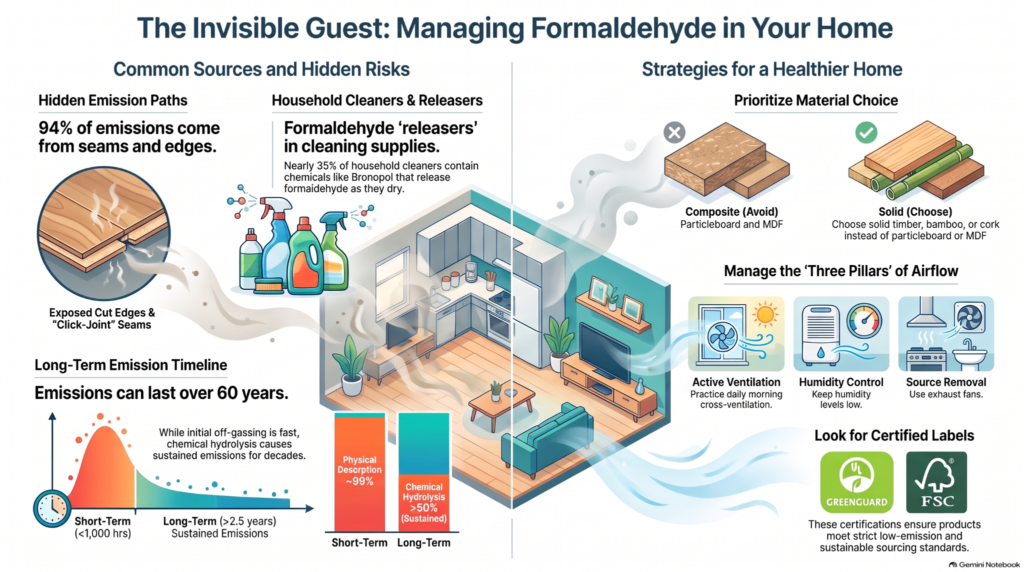
As an environmental researcher, looking at home decor means peering straight into the material lifecycle and industrial supply chains. It is easy to assume that after a few weeks of unboxing a laminate desk or laying engineered flooring, the off-gassing period is behind us. However, peer-reviewed modeling reveals a far more complex dynamic: standard composite wood products emit formaldehyde not just via initial surface vaporization, but through the ongoing, long-term breakdown of urea-formaldehyde resins deep within unsealed joints and raw edges over several years.
In urban households, this chemical persistence is amplified by everyday consumer items even standard cleaning agents often carry chemical preservatives and releasers that quietly generate indoor emissions long after drying on surfaces. When advising urbanites on sustainable home design, I strongly advocate for circular and durable material alternatives.
Choosing solid timber, natural wool upholstery, or second-hand vintage pieces that have long finished their primary off-gassing cycle offers an elegant, low-impact solution. Furthermore, simple physical interventions like applying non-toxic sealants along exposed cabinetry seams, utilizing activated charcoal filters, and keeping indoor humidity low drastically reduce ambient concentrations. Creating a clean indoor ecosystem is about marrying smart material selections with consistent airflow management.
To reduce formaldehyde exposure at home, you should choose low-emission products when purchasing furniture and flooring.
Additionally, improving indoor ventilation can help disperse harmful chemicals and enhance air quality.
These steps can considerably minimize your risk of exposure and create a healthier living environment.
Choose Low-Emission Products
Choosing low-emission products is an essential step in minimizing formaldehyde exposure within your home environment.
By opting for sustainable materials, eco friendly products, and eco-friendly options, you can greatly reduce indoor pollution.
Here are some choices to ponder:
- Furniture made from solid wood** instead of particleboard
- Natural fiber upholstery such as cotton or wool
- Low-VOC finishes for cabinets and surfaces
- Bamboo or cork flooring, which have lower emissions
- Non-toxic adhesives and sealants in construction and renovation
Improve Indoor Ventilation
How can you effectively reduce formaldehyde exposure in your home?
Improving indoor ventilation is essential. Start by implementing airflow strategies that enhance the circulation of fresh air. Open windows and doors whenever possible to allow outdoor air to dilute indoor pollutants.
Consider investing in advanced ventilation systems equipped with filters designed to capture formaldehyde and other volatile organic compounds.
Utilizing exhaust fans in kitchens and bathrooms can also help remove airborne contaminants.
Additionally, keeping humidity levels low further reduces formaldehyde emissions from furnishings.
Regularly check and maintain your ventilation systems to guarantee peak performance.
How to Choose Low-Formaldehyde or Formaldehyde-Free Products?
What should you look for when selecting low-formaldehyde or formaldehyde-free products? Prioritizing eco-friendly materials, sustainable sourcing, and sustainable clothing can contribute to a healthier indoor environment while supporting environmentally responsible choices.
Here are some key indicators to guide your choices:
- Certification Labels: Look for products certified by organizations like GREENGUARD or the Forest Stewardship Council (FSC).
- Material Composition: Choose items made from solid wood, bamboo, or other natural fibers that emit minimal formaldehyde.
- Emission Standards: Opt for products that comply with strict emission standards, such as California Proposition 65.
- Manufacturer Transparency: Seek brands that openly disclose their sourcing and production processes.
- Durability and Lifespan: Consider high-quality items that last longer, reducing the need for replacements and waste.
Why Is Ventilation Key to Reducing Indoor Pollution?
While many indoor pollutants can be mitigated through careful product selection, effective ventilation remains essential for maintaining a healthy living environment.
Ventilation systems play a vital role in improving air quality by facilitating air circulation, which helps disperse harmful substances like formaldehyde. Without adequate airflow, these pollutants can accumulate, leading to increased exposure and potential health risks.
Proper ventilation not only reduces the concentration of indoor contaminants but also promotes moisture control, minimizing mold growth and structural damage.
By integrating advanced ventilation solutions, you can enhance the exchange of stale, polluted air with fresh, clean air, thereby creating a safer indoor atmosphere.
Moreover, strategically placed vents or air purifiers can optimize air circulation, ensuring that every corner of your space benefits from improved air quality.
Prioritizing ventilation is a proactive step toward fostering a healthier, more innovative living space, allowing you to enjoy your environment without compromise.
RELATED STUDIES ABOUT FORMALDEHYDE EXPOSURE IN FURNITURE AND FLOORING
In summary, understanding formaldehyde exposure is essential for maintaining a healthy home environment. By recognizing its sources, symptoms, and the importance of ventilation, you can take proactive steps to reduce indoor pollution. Why settle for less when you can choose low-formaldehyde or formaldehyde-free options? With informed choices and proper ventilation, you can greatly improve your indoor air quality and protect your health from harmful pollutants. Prioritizing your well-being starts with understanding your surroundings.
An improved mechanism-based model for predicting the long-term formaldehyde emissions from composite wood products with exposed edges and seams
CORE OBJECTIVE
Standard physical mass-transfer models assume formaldehyde emission is governed strictly by initial mobile concentration, diffusion, and partition coefficients. These models fail over multi-year periods because they ignore the ongoing chemical generation of formaldehyde via urea-formaldehyde (UF) resin hydrolysis. This study develops and validates a fully-analytical mechanism-based model combining physical diffusion with a pseudo-first-order chemical reaction rate constant to accurately project long-term emissions from composite wood products.
KEY FINDINGS
- Exposed Path Dominance: For laminate flooring assemblies, exposed cut edges and unsealed “click-joint” seams contributed roughly 94% of total formaldehyde emissions, while top-surface emission was negligible.
- Physical vs. Chemical Emission Dynamics:
- Short-Term (< 1,000 hours): Physical desorption dominates (approx. 99% of total emissions); chemical contribution is negligible (< 2%).
- Long-Term (> 2.5 years): Chemical production from hydrolysis equals and eventually overtakes physical emission, causing sustained, elevated indoor concentrations over the product lifecycle.
- Model Accuracy: Over a 1.5-year environmental chamber test, the mechanism-based model showed strong agreement with experimental data (r2 = 0.89), significantly outperforming the standard physical model (r2 = 0.58), double-exponential decay model (r2 = 0.74), and power-law model (r2 = 0.85).
- Testing Time Requirements: Standard 28-day chamber testing cannot capture long-term chemical kinetics. A minimum test period of 3 months is necessary to extract reliable model parameters (relative deviation < 6% compared to 1-year data).
- Cross-Validation: The analytical model was successfully validated against literature data for raw particleboard (r2 = 0.90 to 0.95) and multi-component wood furniture (relative deviation < 4%).
MODEL PARAMETERS & PROJECTIONS
- Reaction Rate Constant (R): 10^-9 to 10^-8 1/s
- Diffusion Coefficient (Dm): 10^-12 to 10^-10 m2/s
- Partition Coefficient (K): 10^4 to 10^6
- 60-Year Emission Projection: Total emittable mass was projected at 5.0 x 10^5 ug under test conditions, with approximately 50% released within the first 12 years.
PRACTICAL IMPLICATIONS
- Health Risk Assessments: Conventional 28-day testing severely underestimates lifetime human exposure and cancer risk by omitting the secondary generation of formaldehyde over time.
- Product Engineering: Sealing cut edges and tightening joint/seam designs are essential controls to curb emissions from composite wood installations.
| REFERENCE: Zhangcan He, Jianyin Xiong, Kazukiyo Kumagai, Wenhao Chen, An improved mechanism-based model for predicting the long-term formaldehyde emissions from composite wood products with exposed edges and seams, Environment International, Volume 132, 2019, 105086, ISSN 0160-4120, https://doi.org/10.1016/j.envint.2019.105086. (https://www.sciencedirect.com/science/article/pii/S0160412019311146) |
Formaldehyde releasers in cleaning products: Mapping an indoor issue
CORE OBJECTIVE
Direct regulatory restrictions on formaldehyde have driven manufacturers to substitute it with formaldehyde releasers—compounds functioning as preservatives or biocides in consumer products. This review synthesizes global regulatory structures, product occurrence inventories, chemical degradation mechanisms (focusing on Bronopol), analytical challenges, and emission dynamics to assess how these releasers act as unrecognized secondary sources of indoor air contamination.
KEY FINDINGS
- Product Prevalence: Household cleaning products account for 34.2% of consumer products containing formaldehyde releasers, with typical formulation concentrations ranging between 0.2% and 0.3% w/w.
- Market Share of Bronopol: 2-Bromo-2-nitropropane-1,3-diol (Bronopol) is the dominant releaser in household cleaning products, representing 45.8% of identified occurrences.
- Chemical Degradation Pathways:
- Bronopol degrades in aqueous solution primarily through retro-aldolization, yielding reactive intermediates and up to 3 moles of formaldehyde per mole of parent compound.
- Degradation rates increase significantly with alkaline pH, elevated temperature (such as 40°C), and the presence of surfactants like sodium dodecyl sulfate.
- Unique Multi-Phase Emission Dynamics:
- Volatile ingredients (like terpenes) spike within 30 minutes and decay quickly.
- Formaldehyde from releasers exhibits an initial 50-minute surge followed by a persistent quasi-steady state after 2 hours, demonstrating sustained secondary generation from dried surface residues.
- Analytical Limitations: No existing method enables simultaneous, single-run quantification of parent releasers, intermediate breakdown products, and emitted formaldehyde without introducing matrix or sample-aging biases.
REGULATORY COMPARISON
- European Union: Enforces harmonized rules via REACH, CLP, Detergents Regulation, and the Biocidal Products Regulation (BPR), but a regulatory grey zone persists when releasers act purely as preservatives rather than registered biocides.
- United States: Relies on indirect oversight through FHSA and FIFRA; explicit registration is triggered only when disinfectant or antimicrobial claims are made on the product label.
- China: Controls formaldehyde through technical standards (HJ 458-2009, GB 38508-2020, GB 14930.1-2022) focused on VOC limits and food-contact safety, but lacks dedicated standards for releasers in general household cleaners.
KEY RESEARCH PRIORITIES
- Analytical Integration: Development of unified reversed-phase HPLC-UV workflows with DNPH derivatization to capture parent releasers, reaction intermediates, and free formaldehyde simultaneously.
- Multi-Phase Fate Tracking: Research into the deposition, surface stability, and delayed off-gassing behavior of semi-volatile releasers on indoor materials.
- Exposure Assessment: Updating chemical safety policies to regulate household formulations based on real-use secondary emission kinetics rather than initial parent compound toxicity alone.
| REFERENCE: Frederic Thevenet, Gabriel Rossignol, S. Angulo-Milhem, Melanie Nicolas, Marie Verriele, Formaldehyde releasers in cleaning products: Mapping an indoor issue, Journal of Hazardous Materials, Volume 504, 2026, 141393, ISSN 0304-3894, https://doi.org/10.1016/j.jhazmat.2026.141393. (https://www.sciencedirect.com/science/article/pii/S0304389426003717) |
EXECUTIVE SUMMARY
Side streams from flooring laminate production – Characterisation and recycling in biocomposite formulations for injection moulding
CORE OBJECTIVE
During flooring laminate manufacturing, substantial volumes of particulate side streams are generated and conventionally incinerated for energy recovery. This study evaluates the feasibility of valorizing these industrial side streams by compounding them with polylactic acid (PLA) and thermomechanical pulp (TMP) fibres into high-performance biocomposites for injection moulding, utilizing finite element (FE) analysis to demonstrate real-world material savings.
KEY FINDINGS
- Side Stream Selection and Safety:
- Saw unit dust (S1) and laminate section dust (S2) contained phenol-formaldehyde (PF) and melamine-formaldehyde (MF) resins alongside inorganic additives (Al2O3, CaCO3), rendering them hazardous for thermoplastic processing due to potential volatile release during heating.
- Profiling section dust (S3), derived mainly from high-density fibreboard (HDF), showed low ash content (0.38% at 525°C), high wood extractive content (2.22%), and no detectable release of toxic phenolic compounds, making it suitable for composite compounding.
- Mechanical and Melt Flow Properties:
- Tensile Modulus: Incorporating S3 and TMP fibres increased stiffness by over 60%, elevating the elastic modulus from 3598 MPa in neat PLA to 5800 MPa in a formulation with 70 wt% PLA, 20 wt% TMP fibres, and 10 wt% S3.
- Tensile Strength: Adding unextracted S3 caused a moderate reduction in tensile strength (down to 58 MPa for the 10 wt% S3 blend and 47 MPa for 30 wt% S3, compared to 66 MPa for neat PLA) due to waxes interfering with interfacial adhesion between the wood particles and polymer matrix.
- Processability: While TMP fibres alone drastically reduced melt flow index (MFI ~1.5 g/10 min), the inherent waxes in S3 acted as a natural processing aid, restoring the composite MFI to 4.5 g/10 min (close to neat PLA at ~6.2 g/10 min).
- Finite Element Simulation and Dematerialization:
- Linear-elastic FE analysis on an injection-moulded chair model subjected to a 90 kg static load demonstrated that higher composite stiffness significantly suppressed seat deflection and avoided structural failure.
- Replacing neat PLA with the PLA/TMP/S3 biocomposite allowed wall thickness reduction from 40 mm to 35 mm, saving approximately 12% in material volume while maintaining identical load-bearing performance.
FORMULATION COMPARISON
- Neat PLA: Modulus = 3598 MPa, Tensile Strength = 66.0 MPa, MFI = 6.2 g/10 min
- PLA + 30 wt% TMP: Modulus = 5866 MPa, Tensile Strength = 69.0 MPa, MFI ~1.5 g/10 min
- PLA + 20 wt% TMP + 10 wt% S3: Modulus = 5800 MPa, Tensile Strength = 58.0 MPa, MFI = 4.5 g/10 min
- PLA + 30 wt% S3: Modulus ~5600 MPa, Tensile Strength = 47.2 MPa, MFI = 76.0 g/10 min
STRATEGIC IMPLICATIONS
- Circular Valorization: Recycling HDF profiling dust into injection-mouldable thermoplastics upgrades a low-value industrial waste stream into a functional reinforcement/filler, bypassing incineration.
- Material Efficiency: The elevated stiffness of wood-reinforced biocomposites enables thin-wall structural component design, reducing raw material demand and lowering product carbon footprints.
| REFERENCE: Gary Chinga-Carrasco, Chiara Zarna, Sandra Rodríguez-Fabià, Ingebjørg Leirset, Mihaela Tanase-Opedal, Dag Molteberg, Andreas Echtermeyer, Leif Kåre Hindersland, Side streams from flooring laminate production – Characterisation and recycling in biocomposite formulations for injection moulding, Composites Part A: Applied Science and Manufacturing, Volume 153, 2022, 106723, ISSN 1359-835X, https://doi.org/10.1016/j.compositesa.2021.106723. (https://www.sciencedirect.com/science/article/pii/S1359835X21004383) |
CONCLUSION
Cultivating an eco-conscious home is an intentional, iterative journey rather than an overnight overhaul. We do not need to discard all our belongings or live in clinical isolation to stay healthy. Instead, building a truly sustainable lifestyle means developing practical daily habits: practicing cross-ventilation every morning, using exhaust fans while cooking, keeping interior humidity balanced, and seeking verified certifications like GREENGUARD or FSC when purchasing new home goods.
Throughout my academic research and fieldwork, I have seen how small, deliberate shifts in consumer demand encourage entire industries to move away from hazardous binders toward regenerative biocomposites and circular manufacturing. By treating indoor air quality as an essential pillar of environmental responsibility, we reconnect our domestic routines with holistic health.
Open your windows, let fresh air circulate through your rooms, and invest in resilient, non-toxic materials that support both personal well-being and the broader planet. Sustainable living is entirely accessible when we approach our spaces with curiosity, mindfulness, and practical action.