
In over fifteen years of conducting field surveys across fragile tropical and subtropical habitats, I’ve learned that nature rarely thrives in neat, sterile lines. When I walk along field edges, botanical gardens, or agricultural buffers with my camera and notebook, the quiet absence of native wildflowers is often the first warning sign of a compromised ecosystem. Far too often, casual observers dismiss spontaneous field margins as “useless weeds,” failing to realize that these flowering forbs are the primary life-support system for our native insect communities.
When synthetic herbicides are broadly applied to eliminate unwanted vegetation, the damage extends well beyond targeted agricultural pests. We inadvertently sever the delicate evolutionary links between endemic flora and the bees, butterflies, and beetles that depend on them. A landscape stripped of floral diversity might look clean from an industrial standpoint, but ecologically, it becomes a food desert. Protecting our biodiversity starts with rethinking our relationship with these wild corridors.
As conservationists, growers, and community members, we must recognize that maintaining diverse vegetative margins is not an obstacle to productivity, but rather the very foundation of resilient pollination networks and long-term ecological balance.
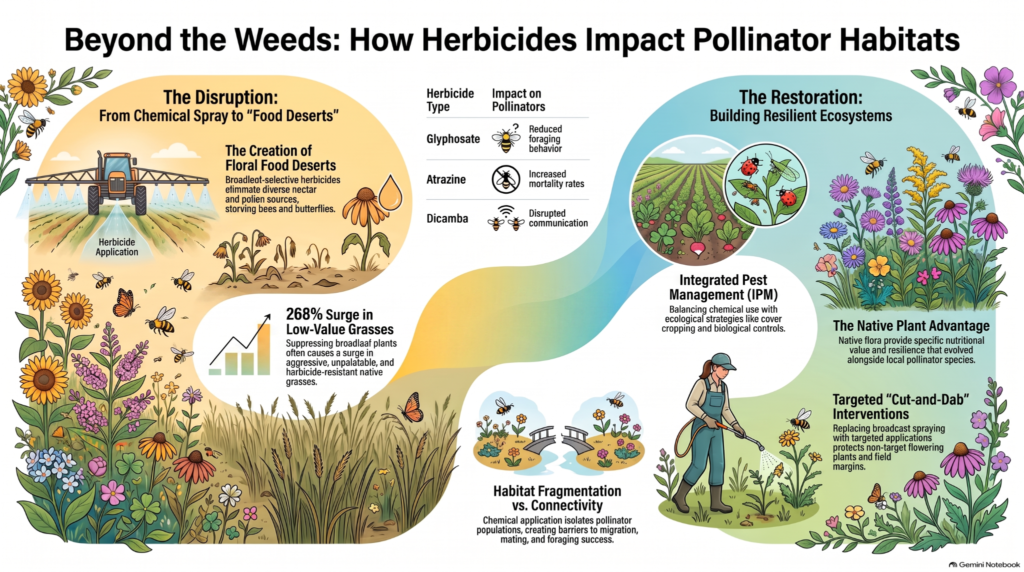
Herbicide use greatly reduces plant species diversity, which ultimately disrupts pollinator habitats. When specific weeds are targeted, it creates monocultures, leading to fewer nectar and pollen sources for bees and butterflies. This loss impacts pollinator health, making it difficult for them to thrive and reproduce. As the ecosystem becomes simpler, these essential species struggle to find food during vital life stages. Exploring sustainable practices could help preserve both plant diversity and important pollinator populations.
KEY TAKEAWAYS
- Herbicides reduce plant species diversity, diminishing nectar and pollen sources crucial for pollinator survival and health.
- Loss of diverse flora leads to fragmented habitats, isolating pollinator populations and increasing competition for limited resources.
- Simplified ecosystems from herbicide use limit adaptive foraging behaviors, affecting pollinator access to food during critical life stages.
- Reduced floral diversity weakens ecosystem resilience, negatively impacting pollinator populations and agricultural productivity.
- Strategies like integrated pest management can mitigate herbicide impacts, promoting plant diversity and healthier pollinator habitats.
WHY PLANT DIVERSITY MATTERS FOR POLLINATOR HEALTH
While you may not immediately connect plant diversity with pollinator health, the two are intricately linked in ecosystems. Diverse plant species provide varied nectar and pollen sources, which are essential for different pollinator behaviors.
When you foster a rich tapestry of flora, you enhance food availability, supporting not just bees, but butterflies, birds, and other important pollinators. This biodiversity plays an essential role in ecosystem resilience, allowing environments to withstand changes and recover from disturbances.
You’ll notice that healthier pollinator populations lead to better plant reproduction, creating a feedback loop that bolsters ecosystem stability.
The interplay between diverse plants and pollinators underlines the need for innovative conservation strategies. By prioritizing plant diversity, you’re not just protecting individual species; you’re nurturing the intricate web of life that sustains agricultural productivity and natural habitats.
Understanding this relationship is key to fostering a sustainable future for both our ecosystems and ourselves.
How Herbicides Disrupt Plant Species Diversity
As you explore the impact of herbicides on plant species diversity, you’ll quickly notice that these chemicals can greatly alter ecosystem dynamics.
Herbicides often target specific weeds, but their broader effects can lead to an unexpected rise in herbicide resistance among plants. This resistance can result in a monoculture scenario, where only a few tolerant species thrive, causing an ecosystem imbalance and highlighting the broader human impact on biodiversity.
You may observe that the loss of diverse plant life diminishes habitats essential for various organisms, disrupting the intricate web of relationships that sustain biodiversity. Additionally, as native flora is replaced by resistant species, the overall resilience of the ecosystem weakens.
This erosion of diversity not only affects plant health but can also cascade through the food web, impacting various ecological functions. Understanding these disruptions is vital for innovative approaches to maintaining ecological integrity in the face of herbicide usage.
The Impact of Herbicides on Pollinator Populations
Herbicides are chemicals used to manipulate or control undesirable vegetation. Herbicide application occurs most frequently in row-crop farming, where they are applied before or during planting to maximize crop productivity by minimizing other vegetation. They also may be applied to crops in the fall, to improve harvesting.
Herbicides don’t just affect plants; they also pose a significant risk to pollinators like bees and butterflies.
When these chemicals are applied, they can be toxic to pollinators, while simultaneously reducing the diversity of flowering plants that serve as essential foraging resources.
Additionally, habitat fragmentation caused by herbicide use can isolate pollinator populations, further threatening their survival and the ecosystems they support.
Herbicide Toxicity to Pollinators
Herbicides play a pivotal role in modern agriculture by controlling unwanted vegetation, yet their application extends ecological consequences beyond target weeds. In plant communities, herbicide exposure can reduce species richness, alter functional composition and drive shifts in abundance that cascade through trophic networks. Effects range from acute phytotoxicity and suppressed germination to chronic impacts on flowering time and reproductive success. Insect communities respond both directly, through contact toxicity or systemic uptake in treated plants, and indirectly, via changes in habitat structure, food availability and plant nutritional quality. Altered plant diversity, residual herbicide drift and sub-lethal exposures can disrupt herbivore performance, pollinator services and natural enemy populations. Understanding these dynamics is critical for balancing crop productivity with conservation of biodiversity, sustainable pest management and ecosystem resilience.
Although many people may not realize it, the use of herbicides can considerably disrupt pollinator populations, which are essential for ecosystem health and agricultural productivity. Herbicide formulation effects play an important role in determining toxicity levels that can lead to significant pollinator behavior changes. Different formulations can affect the sensory mechanisms of bees and other pollinators, decreasing their foraging efficiency and navigation capabilities.
| Herbicide Type | Impact on Pollinators |
| Glyphosate | Reduced foraging behavior |
| 2,4-D | Altered navigation skills |
| Atrazine | Increased mortality rates |
| Dicamba | Disrupted communication |
Understanding these impacts is critical for developing sustainable agricultural practices that support both crop production and pollinator health.
Loss of Foraging Resources
When agricultural landscapes are treated with herbicides, you may not immediately notice the subsequent loss of foraging resources that pollinators rely on. This decline directly impacts their foraging strategies and overall health.
Key changes include:
- Reduced floral diversity**: Herbicides eliminate a variety of flowering plants, diminishing vital nectar and pollen sources.
- Altered resource availability**: The timing of bloom periods may shift, leaving pollinators without food during critical life stages.
- Decreased habitat complexity**: Simplified ecosystems fail to support diverse pollinator species, limiting their adaptive foraging behaviors.
- Increased competition: Remaining resources become scarce, intensifying competition among pollinators and stressing populations.
Understanding these dynamics is essential for developing innovative agricultural practices that support both crop yields and pollinator health.
Habitat Fragmentation Effects
The loss of foraging resources isn’t the only consequence of herbicide application; it also contributes greatly to habitat fragmentation, further endangering pollinator populations. As you analyze the impact, consider how reduced habitat connectivity disrupts species migration patterns. Fragmented landscapes isolate pollinators, making it harder for them to find food and mates.
| Factor | Impact on Pollinators |
| Habitat Connectivity | Essential for foraging success |
| Fragmentation | Limits movement and diversity |
| Herbicide Use | Decreases plant diversity |
| Species Migration | Hindered by barriers |
| Pollinator Health | Declines due to isolation |
HERBICIDES THAT THREATEN KEY PLANT SPECIES FOR POLLINATORS
Out in the field, the downstream reality of herbicide application is something we monitor with growing urgency. During citizen science biodiversity workshops, I often show volunteers how selective chemical treatments alter whole botanical communities. Broadleaf-selective herbicides are frequently deployed with the intention of cleaning up invasive weeds, but broad foliar spraying routinely extirpates the delicate native forbs that supply seasonal pollen and nectar. The recent empirical data in conservation biology confirms what many field practitioners observe: blanket herbicide use often backfires by selecting for aggressive, chemical-tolerant grasses or resistant weed species rather than restoring ecological balance.
Instead of creating a balanced habitat, we end up creating homogeneous monocultures that fragment pollinator flight corridors and strip foraging bees of crucial micronutrients. While precise, targeted interventions—such as cut-and-dab applications for woody invasives—remain a necessary tool in a restoration ecologist’s kit, widespread broadcast spraying simply carries too high a collateral cost.
We cannot afford to overlook drift vulnerabilities and non-target impacts when managing productive lands. Conserving functional pollinator communities requires us to prioritize targeted weed management and protect native flowering plants at all costs.
As you explore the impact of herbicides on ecosystems, it becomes clear that certain chemicals pose a significant threat to key plant species that serve as important resources for pollinators.
Understanding how these herbicides undermine biodiversity is fundamental for fostering sustainable habitats.
Consider these four key herbicides:
- Glyphosate: Often linked to declining populations of clover and milkweed, both crucial for many pollinators.
- Atrazine: Disrupts the growth of native grasses, threatening food sources for herbivorous insects.
- 2,4-D: Targets broadleaf plants, which includes many flowering species vital for pollinator foraging.
- Dicamba: Known for its volatility, it can damage non-target plants, further reducing pollinator habitats.
These herbicides interact with plant species through various herbicide resistance mechanisms, potentially leading to monocultures that lack the diversity important for thriving pollinator populations.
How Farmers Can Preserve Plant Diversity
The community diversity and the functional diversity of wild plants in agroecosystems, especially in field edges, fallow fields, and other semi-natural habitats, provide us with ecosystem and agricultural production services, such as agricultural pest control and soil and water conservation. The diversity of wild plants in agroecosystems is an important part of global biodiversity. It is noteworthy that herbicides have changed the species composition of weed communities, the number of plants sensitive to herbicides has decreased, and the number of plants resistant to herbicides has increased in farmlands. Herbicides are widely used in farmlands worldwide to increase crop yield and farm labour efficiency, so the effect on the wild plant community is unlikely to cease as herbicide use in agricultural production. However, the full amount of the applied herbicides does not reach the targets; a large proportion of herbicides drift and run off from sprayed fields towards adjacent non-target areas.
To preserve plant diversity, you can implement crop rotation practices that enhance soil health and reduce reliance on herbicides.
Integrating native plants into your farming system not only supports local ecosystems but also improves resilience against pests and diseases.
Crop Rotation Practices
Crop rotation practices greatly influence plant species diversity on farms. By implementing sustainable practices, you can actively enhance biodiversity, which is essential for maintaining healthy ecosystems.
Here are four key benefits you’ll notice:
- Soil Health Improvement: Different crops contribute varied nutrients, promoting rich soil.
- Pest Control: Rotating crops disrupts pest life cycles, reducing reliance on herbicides.
- Weed Suppression: Diverse plant species minimize weed establishment, allowing native flora to thrive.
- Pollinator Support: A variety of flowering plants attracts diverse pollinators, enhancing crop yields.
Native Plant Integration
Integrating native plants into agricultural systems not only preserves plant diversity but also enhances the resilience of farming ecosystems.
By incorporating native species, you can create habitats that support beneficial insects and pollinators, essential for crop production, while also contributing to urban biodiversity. Native plants also improve soil health, reduce erosion, and enhance water retention, leading to sustainable farming practices.
These native plant benefits directly contribute to ecosystem resilience, allowing your farm to better withstand climate variability and pest pressures. Additionally, embracing native flora fosters a more diverse landscape, which can attract a range of pollinators.
As you innovate and adapt, consider planting native species to not only maintain agricultural productivity but also bolster the ecological integrity of your farming environment.
Why Native Plants Are Crucial for Our Pollinators
Although many people may not realize it, native plants play a pivotal role in supporting pollinator populations. Their unique characteristics foster essential pollinator relationships, enhancing biodiversity.
Here’s why you should prioritize native plants:
- Adaptation: Native plants have evolved alongside local pollinators, making them more effective in attracting and sustaining these species.
- Nutritional Value: They provide the specific nectar and pollen that many pollinators depend on for survival, promoting healthy populations.
- Habitat Support: Native plants create diverse ecosystems that offer shelter and breeding grounds, essential for pollinator life cycles.
- Resilience: These plants are often more resistant to pests and diseases, reducing the need for herbicides that can harm pollinator habitats.
Future Directions for Sustainable Herbicide Use in Agriculture
The relationship between agriculture and herbicide use is increasingly scrutinized, especially in light of the vital role native plants play in supporting pollinator populations.
To move toward sustainable practices, you’ll want to reflect on integrated pest management (IPM) as a holistic approach. IPM emphasizes the use of multiple strategies, balancing chemical controls with ecological principles. By incorporating herbicide alternatives, like cover cropping, biological controls, and eco friendly products, you can reduce reliance on synthetic chemicals and enhance biodiversity.
Additionally, adopting precision agriculture techniques can allow for targeted applications of herbicides, minimizing their impact on non-target species. Investing in research to develop eco-friendly formulations and understanding their interactions with local ecosystems will be essential.
As you explore these future directions, remember that fostering collaboration among farmers, scientists, and policymakers can lead to innovative solutions that support both agricultural productivity and thriving pollinator habitats. Embrace this interdisciplinary approach for a more sustainable agricultural future.
RELATED STUDIES ABOUT HERBICIDE EFFECTS ON PLANT SPECIES DIVERSITY
As you navigate the complex relationship between herbicide use and plant diversity, remember that a thriving ecosystem is like a symphony—each species plays an important note. Protecting plant diversity isn’t just critical for pollinators; it’s essential for our food security and the health of our planet. By adopting sustainable practices, you’re not only safeguarding our buzzing allies but also ensuring a rich tapestry of life for generations to come. Let’s cultivate a harmonious balance in agriculture.
Assessing the non-target effects of herbicides on field margin plant communities after controlling for soil, climate, local context and landscape metrics
Overview & Objective
Field margins serve as critical semi-natural refuges for farmland biodiversity and key ecosystem services, yet they remain vulnerable to non-target impacts from adjacent agricultural practices. Using a nationwide monitoring network in France, this study evaluates the non-target impacts of agricultural practices—particularly herbicide application—on field margin flora after controlling for confounding environmental factors across multiple spatial scales (soil properties, climate, landscape metrics, and local margin management).
Methodology & Data Scope
- Dataset: Analyzed 518 commercial agricultural fields (23.7% organic) monitored annually between 2013 and 2018 across 22 French regions. Crops included arable cereal crops (337 fields), vineyards (104 fields), and market gardening (50 fields).
- Vegetation Metrics: Assessed 186 focal plant species across ten 1 m² quadrats per margin, measuring:
- Plant species richness
- Species evenness (Pielou’s index)
- Proportion of nature-value plants (rare weeds and disturbance-sensitive species)
- Proportion of grasses vs. dicotyledonous species
- Analytical Approach: Deployed a sequential 5-step hierarchical generalized linear mixed model framework to isolate agricultural practice effects (Treatment Frequency Index [TFI], application timing, fertilizer type/dose) only after parcel conditions, soil, landscape composition (1 km radius), and margin dimensions/management were accounted for.
Key Findings
- Intensity Over Timing: Total herbicide use intensity (TFI) directly decreased overall plant species richness and significantly lowered the proportion of nature-value species across all crops, while increasing grass dominance. The time elapsed since the last herbicide application had no significant effect, indicating that herbicide impacts accumulate over the medium-to-long term rather than acting merely as short-term disturbances.
- Spectrum-Specific Effects:
- Dicotyledon Herbicides: Significantly reduced species richness in cereal field margins.
- Grass Herbicides: Significantly reduced species evenness in cereal margins, favoring dominance by a few tolerant or resistant species.
- Non-Herbicide Pesticides & Copper: Non-herbicide pesticide pressure and copper applications negatively affected species richness in specific cropping systems (such as cereals and vineyards).
- Spillover & Drift Vulnerability: Higher pesticide spillover risk (driven by wind exposure and slope topography) consistently reduced species richness, evenness, and nature-value plant representation.
- Fertilization Influence: Mineral nitrogen fertilization reduced nature-value plant presence in cereals, whereas organic and organo-mineral fertilization fostered species richness and protected nature-value flora.
- Landscape & Margin Context: Surrounding semi-natural habitats—particularly adjacent grasslands and broader landscape crop diversity—exerted a strong positive influence on nature-value plant retention and overall species richness.
Strategic Implications
- Prioritize Field-Core Reduction: Reducing in-field herbicide use intensity serves as a direct lever for conserving field margin floristic diversity, outperforming changes to margin-specific cutting or mowing regimes.
- Mitigate Drift Risk: Implementing drift-reduction measures (such as targeted precision spraying and anti-drift nozzles) is vital for shielding adjacent non-target flora and preserving broader trophic networks (e.g., pollinators and pest natural enemies).
- Integrate Organic Inputs and Semi-Natural Buffers: Combining organic fertilization practices with the preservation of neighboring grasslands reinforces the resilience of high-value ecological communities in agricultural landscapes.
| REFERENCE: Laura Henckel, Guillaume Fried, Jean-Philippe Guillemin, Isis Poinas, Christine N. Meynard, Benoit Ricci, Assessing the non-target effects of herbicides on field margin plant communities after controlling for soil, climate, local context and landscape metrics, Agriculture, Ecosystems & Environment, Volume 400, 2026, 110190, ISSN 0167-8809, https://doi.org/10.1016/j.agee.2025.110190. (https://www.sciencedirect.com/science/article/pii/S0167880925007224) |
Selective herbicides extirpate forbs more effectively than alien plants, facilitating dominance of aggressive low grazing value grasses
Overview & Purpose
Broadleaf-selective herbicides are frequently utilized to manage rangeland weed invasions, operating under the assumption that suppressing alien forbs will release palatable grasses and improve pasture quality. This 4-year field study evaluated the unintended ecological consequences of sequential broadcast herbicide applications used to control Campuloclinium macrocephalum (pompom weed) across two distinct grassland habitats in Gauteng, South Africa: a dry upland site (Swartkops) and a degraded wetland site (Rietvlei).
Methodology & Scope
- Experimental Layout: 28 randomized treatments replicated across 84 plots (5 × 5 m) per site, evaluated from 2005 to 2008.
- Treatments Evaluated: Eight selective herbicides (2,4-D amine, 2,4-D/dicamba/MCPA mixture, dicamba, diuron, MCPA, metsulfuron-methyl, picloram, and triclopyr) applied annually in summer or autumn, alongside manual hoeing (twice per year) and untreated control plots.
- Vegetation Monitoring: Fixed-transect line intercept sampling tracking species richness ($S$), abundance (intercept count), and cover (canopy cover for forbs, basal cover for graminoids).
Key Findings
- Severe Native Forb Loss & Extirpation:
- Native forbs were acutely susceptible to broadleaf-selective herbicides. At the dry site, 89 out of 105 species (66% forbs) were extirpated from individual plots, and 36 species (80% forbs) suffered complete local extinction.
- Species persistence was largely determined by initial population size rather than true physiological tolerance; rare-to-occasional forbs suffered extirpation rates up to 88%.
- Geophytes and low-growing creeping species displayed higher survival than erect chamaephytes and hemicryptophytes, likely benefiting from canopy sheltering by taller graminoids.
- Herbicide Release of Low-Value “Increaser” Grasses:
- Rather than promoting palatable forage species (“Decreasers”), the suppression of broadleaf competition caused an herbicide-release surge in aggressive, unpalatable “Increaser II” native grasses.
- At the dry site, Hyparrhenia hirta abundance surged by 268% despite severe drought periods.
- Herbicide Ineffectiveness & Re-Invasion:
- None of the eight herbicides successfully eradicated C. macrocephalum after three years of applications due to rapid post-treatment seedling recruitment.
- Dense weed infestations returned, suggesting that eliminating native forbs weakens community ecological resilience and leaves vacant niches that facilitate re-invasion.
- Widespread Drift Homogenization:
- Significant differences between specific herbicide chemical treatments and controls were obscured across plots. AgDISP atmospheric modeling indicated herbicide drift traveled 70–125 m downwind under ambient test conditions, homogenizing damage across the trial blocks.
- Compounding Hydrological & Climate Stress:
- At the wetland site, sustained groundwater drawdown paired with severe drought led to a collapse of native wetland grasses (Imperata cylindrica, Leersia hexandra), accelerating replacement by terrestrial H. hirta.
Strategic & Management Implications
- Re-evaluate Veld Quality Assumptions: Herbicide use alone does not restore rangeland grazing value. In the absence of viable Decreaser grass seed sources, eliminating forbs simply converts diverse veld into unpalatable, monospecific Increaser grass swards.
- Abandon Broadcast Spraying for Heavy Infestations: Blanket foliar spraying of dense rangeland weed stands causes disproportionate collateral loss of native plant diversity while failing to achieve long-term weed eradication.
- Adopt Targeted Interventions: Chemical control should be restricted to early-detection spot-spraying with drift-reducing nozzles. For established landscape-level infestations, resources should be reallocated toward biological control, integrated resting/burning schedules, and active floristic restoration.
| REFERENCE: J.M. Goodall, E.T.F. Witkowski, Selective herbicides extirpate forbs more effectively than alien plants, facilitating dominance of aggressive low grazing value grasses, South African Journal of Botany, Volume 181, 2025, Pages 523-536, ISSN 0254-6299, https://doi.org/10.1016/j.sajb.2025.04.018. (https://www.sciencedirect.com/science/article/pii/S025462992500208X) |
Off-target: Herbicides in cereal fields favour competitive weeds over non-target species
Overview & Purpose
Weed diversity supports critical agroecosystem functions—including wildlife habitat, pollinator support, and soil health—yet agricultural pesticides heavily alter weed community structure. Using field-level farmer application records across conventional cereal fields in western France, this study evaluates the specific impacts of herbicides, fungicides, and insecticides on weed abundance, species richness, community turnover, and species competitiveness.
Methodology & Data Scope
- Study Area & Sample: 96 conventional winter cereal fields monitored over four cropping seasons (2017–2020) in the LTSER “Zone Atelier Plaine & Val de Sèvre” platform (France).
- Pesticide Metrics: Evaluated both the Treatment Frequency Index (TFI) (application intensity/frequency relative to standard doses) and the Quantity of Active Ingredient (QA) (total chemical mass load per hectare, g/ha) across herbicides, fungicides, and insecticides.
- Vegetation Surveys: 182 weed species recorded (122 in field centers, 165 in field margins) via standardized quadrats along field transects.
- Statistical Modeling: Linear mixed-effects models (LMMs), partial distance-based redundancy analysis (dbRDA) using Canberra distances, and abundance-based $\beta$-diversity partitioning (turnover vs. nestedness) via partial Mantel tests.
Key Findings
- Disproportionate Suppression of Non-Competitive Flora:
- Herbicide use was the primary driver structuring in-field weed communities.
- Both herbicide TFI and QA significantly reduced the abundance of non-competitive, low-impact weed species (Mercurialis annua, Polygonum aviculare, Atriplex patula, Chenopodium album, Veronica persica).
- Conversely, herbicide inputs had no significant effect on the abundance of aggressive, competitive weeds (Lolium multiflorum, Alopecurus myosuroides, Galium aparine, Bromus hordeaceus, Elytrigia repens).
- ẞMechanisms of Community Shift (beta-Diversity):
- Weed communities shifted gradually along the herbicide gradient without distinct tipping points.
- Herbicide QA significantly increased species turnover (beta_Bal) and total community dissimilarity without altering nestedness (beta_Gra), demonstrating that herbicides actively replace sensitive non-target species with persistent, competitive weeds (driven by inherent tolerance and evolved resistance).
- Fungicide & Insecticide Effects:
- Higher fungicide TFI significantly reduced overall weed abundance and species richness (likely via indirect disruption of mutualistic soil mycorrhizal networks and direct physiological stress), whereas fungicide QA showed no effect.
- Direct foliar insecticides showed no measurable impact on weed community metrics.
- Fertilizer & Metric Influences:
- Mineral nitrogen application increased weed abundance without reducing species richness, acting as a secondary driver compared to herbicides.
- For herbicides, QA served as a stronger predictor of suppression and community turnover than TFI, reflecting the direct toxic mass load delivered to plants.
Strategic Implications
- Reassessing Chemical Efficiency: Blanket herbicide regimens are largely ineffective against the most problematic weed targets while systematically eradicating benign species that support farmland biodiversity.
- Trophic & Pollination Risks: Replacing diverse, low-competitiveness broadleaf flora with dense stands of resistant grass weeds degrades ecological networks and increases extinction risks across dependent insect pollinators.
- Shift to Agroecological Control: Reducing total herbicide and fungicide chemical loads—supplemented by diversified crop rotations, mechanical weeding, and targeted intervention—is necessary to curb resistant weed dominance and restore ecosystem services.
| REFERENCE:Ségolène Humann-Guilleminot, Vincent Bretagnolle, Sabrina Gaba, Off-target: Herbicides in cereal fields favour competitive weeds over non-target species, Agriculture, Ecosystems & Environment, Volume 397, 2026, 110026, ISSN 0167-8809, https://doi.org/10.1016/j.agee.2025.110026. (https://www.sciencedirect.com/science/article/pii/S0167880925005584) |
CONCLUSION
Looking at the broader trajectory of habitat restoration, moving beyond chemical dependence is one of the most vital challenges of our time. Ecological resilience isn’t built on synthetic inputs; it is cultivated through intentional biodiversity, healthy soil dynamics, and intact trophic relationships. In my work with local communities and student-led biodiversity initiatives, I’ve seen firsthand how rapidly native pollinators rebound when agricultural landscapes embrace hedgerows, native flowering buffers, and integrated pest management.
A flourishing ecosystem is a shared responsibility that unites farmers, researchers, policy planners, and citizen scientists. When we choose sustainable land management—such as crop rotation, non-chemical weed control, and the reintroduction of native flora—we actively rebuild the foraging grounds that our food systems and wild ecosystems rely upon.
Balancing agricultural yields with ecological preservation is entirely achievable, provided we treat biodiversity as an essential partner rather than an inconvenience. By safeguarding our native plant communities today, we ensure that our agricultural systems, wildlife habitats, and wild spaces remain vibrant and healthy for the generations to come.