Over the last twelve years working across soil remediation projects in Southeast Asia, I’ve stood on hundreds of agricultural plots that looked, at least on the surface, entirely healthy. The crops were green, the soil was dark, and the farmers were proud of their yields. But when you get the laboratory ICP-MS results back and see heavy metal spikes, reality hits hard. Cadmium is what I call a “ghost contaminant.” Unlike lead or crude oil, which often leave visible scarring, foul odors, or stark structural degradation, cadmium sneaks into the soil matrix completely unnoticed.
What bothers me most as an environmental engineer is how we’ve historically treated agricultural ground. In traditional civil engineering, soil is just a structural substrate something you compact, pave over, or anchor concrete into. In industrial agriculture, it’s too often treated as a simple vessel for synthetic fertilizers. But soil is a living, breathing ecosystem. When cadmium enters this matrix through rock phosphate fertilizers, atmospheric fallout, or industrial runoff, it doesn’t just sit there inertly.
It disrupts the delicate chemistry of the root zone and hitches a ride straight into our food system. We need a radical shift in how we view land health. If we don’t start respecting soil chemistry with the same rigor we apply to structural engineering, the silent accumulation of heavy metals will continue to jeopardize our food security and public health from the ground up.
Cadmium enters agricultural soil from various sources like industrial emissions, improper waste disposal, and contaminated fertilizers. Once in the soil, it can be absorbed by crops, leading to compromised nutrient uptake and diminished crop quality. This bioaccumulation poses significant health risks when consumed by humans, including kidney impairment and potential carcinogenic effects. Understanding the dynamics of cadmium in the food chain is essential for safeguarding food safety and health, and there’s more to explore on mitigation strategies and community efforts.
KEY TAKEAWAYS
- Cadmium enters agricultural soil primarily through industrial emissions, improper waste disposal, and contaminated fertilizers and pesticides.
- Atmospheric deposition can settle cadmium particles on agricultural lands, leading to soil contamination.
- Once in the soil, cadmium can be absorbed by crops, disrupting nutrient uptake and affecting food quality.
- Crops that accumulate cadmium can transfer it to humans via the food chain, posing health risks.
- Regular soil testing and sustainable agricultural practices can help mitigate cadmium’s impact on food safety.
WHAT IS CADMIUM AND WHY SHOULD WE CARE?
Cadmium exposure can occur in and outside the garden. Cadmium is usually found at very low levels in soils, but hotspots from man-made sources may also exist. Below are some of the main sources that release cadmium into the environment. Once in the environment, we can be exposed in a few different ways (see exposure section to the right).
Cadmium, a toxic heavy metal, poses significant risks to agricultural soil and, consequently, to food safety and human health. Its properties, including solubility and mobility, allow cadmium to infiltrate soil systems easily, leading to long-term environmental persistence.
This metal doesn’t break down easily, accumulating in the soil and entering the food chain through crops. You might wonder why this matters. As cadmium accumulates, it can adversely affect plant growth and nutrient uptake, ultimately impacting the quality of food you consume.
The potential for bioaccumulation means that even small amounts can become concentrated in tissues over time, posing serious health risks for humans when ingested. Understanding cadmium’s characteristics and its lasting presence in the environment is essential for developing innovative agricultural practices that mitigate its effects.
Major Sources of Cadmium Pollution in Agriculture
Understanding the sources of cadmium pollution in agriculture is essential for addressing its impact on soil health and food safety. One of the primary contributors is industrial emissions, particularly from smelting and manufacturing processes. These activities release cadmium particles into the atmosphere, which can settle on agricultural lands, contaminating the soil.
Additionally, improper waste disposal practices further exacerbate the issue, contributing to lead contamination in soil and groundwater. When industries dispose of cadmium-laden waste without adequate controls, it can leach into the soil and groundwater.
Fertilizers and pesticides, especially those derived from phosphate rock, can also introduce cadmium into the agricultural ecosystem, as they often contain trace amounts of this toxic metal.
How Cadmium Affects Crop Quality and Human Health
Cadmium disrupts the absorption of essential nutrients in crops, leading to diminished quality and yield.
You might wonder how this accumulation of cadmium not only affects plant health but also poses significant risks to human health through the food chain.
Additionally, consider the long-term environmental impact that cadmium contamination could have on soil health and biodiversity.
Crop Nutrient Absorption Disruption
As crops absorb nutrients from the soil, the presence of cadmium can greatly disrupt this fundamental process, leading to diminished quality and safety of the harvest.
Cadmium interferes with nutrient competition, making it harder for crops to uptake essential minerals like zinc and iron. This disruption is rooted in soil chemistry; cadmium alters the bioavailability of these nutrients, effectively locking them away from plant roots.
When crops struggle to absorb key nutrients, their growth and yield decline, affecting overall agricultural productivity. Additionally, the imbalance in nutrient uptake can lead to deficiencies in the produce, ultimately impacting food quality.
Understanding these interactions is important for developing innovative solutions to mitigate cadmium’s adverse effects and enhance crop resilience.
Human Health Risks
When crops absorb cadmium alongside essential nutrients, the implications for human health become increasingly concerning. The presence of cadmium in your food can lead to significant health risks, primarily due to cadmium toxicity. Understanding these risks is important for making informed dietary choices.
Consider the following health implications:
- Impaired kidney function
- Increased risk of bone diseases
- Compromised immune response
- Potential carcinogenic effects
- Reproductive health issues
As you navigate food choices, awareness of cadmium levels in crops becomes essential.
Innovative agricultural practices and soil management techniques are necessary to reduce cadmium uptake. By prioritizing crop quality, you can contribute to minimizing these health risks and promoting a healthier food chain.
LONG-TERM ENVIRONMENTAL IMPACT
When you read academic papers on soil remediation, it’s easy to get lost in ideal conditions controlled temperatures, uniform soil textures, and perfect pH levels. But out in the field, ground conditions are chaotic. Working on land rehabilitation in monsoon-prone regions taught me quickly that managing cadmium isn’t just a chemical puzzle; it’s a hydrological one.
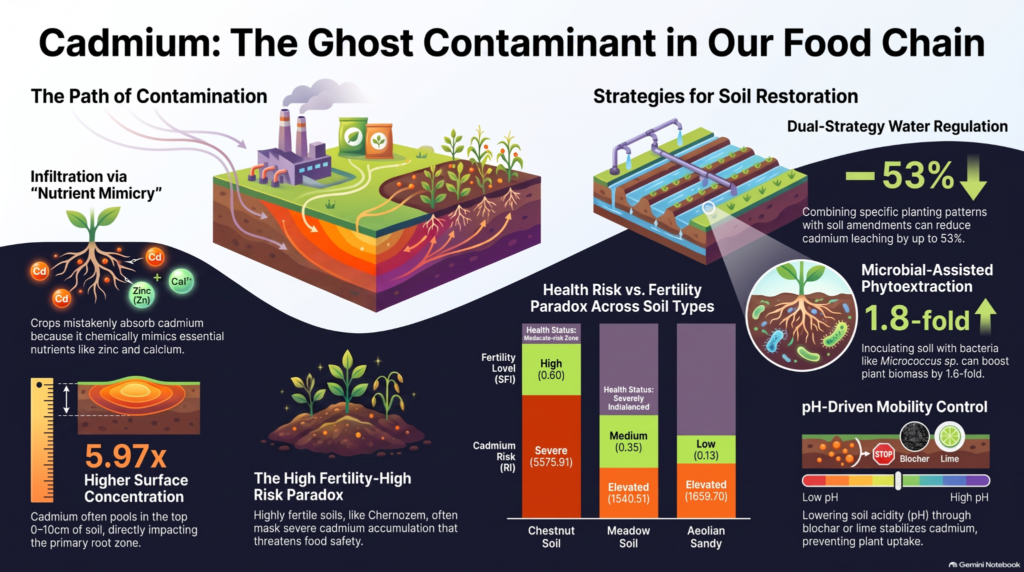
Take soil pH and water dynamics, for instance. Cadmium mobility in soil increases drastically as the pH drops. I’ve worked on farmland where poor irrigation management combined with heavy nitrogen fertilization acidified the topsoil, turning dormant, mineral-bound cadmium into highly bioavailable ions ready to be sucked up by crop roots. The real challenge is that cadmium closely mimics essential nutrients like zinc and calcium at the plant’s root transporters. The crop literally can’t tell the difference, absorbing a toxic heavy metal while missing out on critical nutrients.
This is why chemical stabilization alone isn’t a silver bullet. You can dump lime or biochar into a field, but if intense rainfall washes away the topsoil or creates preferential flow paths through the soil profile, that cadmium is moving straight into local waterways or deeper root zones. In my field projects, the breakthroughs always come when we combine soil amendments with smart physical practices like managing pore-scale water movement and using targeted vegetation strategies. Tackling cadmium requires us to act like both chemists and fluid dynamics engineers simultaneously.
Although many farmers endeavor to cultivate high-quality crops, the long-term presence of cadmium in agricultural soil poses a persistent threat to both crop health and human well-being.
This toxic metal contributes to soil degradation, leading to diminished fertility and impaired plant growth. As cadmium accumulates, it disrupts nutrient uptake in crops, reducing yield quality and posing risks to those who consume them.
Additionally, cadmium’s infiltration into the food chain creates an ecosystem imbalance, where not only crops but also microorganisms and beneficial insects are adversely affected.
You must consider these long-term impacts. Innovative strategies for soil remediation and sustainable farming practices are critical to mitigate cadmium’s effects and guarantee a healthier environment for future generations.
How Cadmium Enters the Food Chain Through Plant Uptake?
Cadmium (Cd) contamination poses a serious threat to global food safety. As a toxic and carcinogenic heavy metal, cadmium can accumulate in agricultural soils through industrialization and urbanization before entering the human food chain. Rice is especially vulnerable because it absorbs more cadmium than other major cereal crops, making it one of the largest dietary sources of cadmium exposure for nearly half the world’s population.
Cadmium, a toxic heavy metal, infiltrates the food chain primarily through plant uptake, posing considerable risks to human health. Understanding this process is vital for addressing soil contamination and its effects.
You should consider the following factors that contribute to plant absorption of cadmium:
- Soil properties: pH levels and organic matter can enhance cadmium solubility.
- Plant species: Certain plants are more efficient at uptaking cadmium.
- Nutrient interactions: The presence of other minerals can either inhibit or promote cadmium absorption.
- Environmental conditions: Moisture and temperature markedly influence cadmium mobility in soils.
- Agricultural practices: Fertilizer and pesticide use may exacerbate cadmium levels in the soil.
Regulatory Measures and Guidelines for Cadmium in Agriculture
Heavy metal contamination of soil has become a serious concern for the environment and human health. Among heavy metals, cadmium (Cd) is a highly toxic, carcinogenic and non-essential trace element found in soil. It has deleterious effects on soil organisms even at low concentrations. According to the priority list of the Agency for Toxic Substances and Disease Registry (ATSDR), Cd is ranked seventh among toxic heavy metals.
Given the potential health risks associated with cadmium in agricultural settings, regulatory measures and guidelines are essential for mitigating its impact.
You should understand the importance of robust regulatory frameworks that address cadmium levels in soil, ensuring that agricultural practices prioritize soil safety.
Current guidelines often specify permissible cadmium concentrations, encouraging soil testing and monitoring. These regulations not only protect consumer health but also promote sustainable farming practices.
You might wonder how these frameworks can adapt to innovative agricultural techniques. As new technologies emerge, regulatory bodies must evolve, incorporating data-driven approaches to assess cadmium levels accurately.
Moreover, fostering collaboration between farmers, scientists, and policymakers can enhance compliance and awareness.
How to Lower Cadmium Levels in Soil
To effectively lower cadmium levels in soil, implementing a combination of strategies is essential.
You can adopt innovative remediation techniques and utilize specific soil amendments to combat this issue. Here are some effective approaches:
- Phytoremediation: Use plants that absorb cadmium, such as sunflowers, to extract it from the soil.
- Soil amendments: Incorporate organic matter like compost or biochar, along with eco friendly products, to enhance soil health and reduce cadmium uptake by crops.
- pH adjustment: Modify soil pH to limit cadmium solubility, making it less available for plant uptake.
- Crop rotation: Rotate with crops that are less susceptible to cadmium accumulation, helping to break the cycle.
- Controlled irrigation: Implement precise watering techniques to minimize cadmium leaching into crops.
Protecting Yourself From Cadmium Exposure
Exposure to cadmium can pose serious health risks, making it essential to take proactive measures for protection.
Start by utilizing personal protective equipment when gardening or working in contaminated areas. Gloves, masks, and protective clothing can minimize direct contact with cadmium-laden soil.
Consider the sources of your food; some crops, especially leafy vegetables and grains, may absorb cadmium. Make dietary adjustments by prioritizing organic produce and diversifying your diet to include low-cadmium options like fruits and legumes.
Regularly test your soil and water for heavy metals determination in soil, ensuring that you’re aware of potential risks in your environment.
Additionally, stay informed about agricultural practices in your area, advocating for sustainable techniques that reduce cadmium uptake in crops.
RELATED STUDIES ABOUT CADMIUM IN AGRICULTURAL SOIL
In summary, understanding cadmium’s role in agriculture is essential for safeguarding both crop quality and human health. This toxic metal sneaks into our food chain like a thief in the night, often unnoticed until it’s too late. By staying informed about its sources and effects, you can take proactive steps to mitigate exposure. Supporting regulatory measures and adopting soil management practices can help guarantee a safer, healthier future for both you and the environment.
Soil health index–based assessment of cadmium ecological risk–fertility coupling in seasonally frozen agricultural soils
Overview
This study evaluates the complex interaction between heavy metal contamination (specifically Cadmium, Cd) and soil fertility across seasonally frozen agricultural soils surrounding the Greater Khingan Range in northeastern China. Investigating 370 soil profiles across five major cropland soil types during the non-freezing season, the authors developed a novel, process-constrained Soil Health Index (SHI). The framework balances environmental protection with agricultural production by integrating potential ecological risks with soil fertility parameters.
Key Findings
1. Pronounced Cadmium (Cd) Accumulation
- Severe Enrichment: Cd concentrations reached 40–146 times regional background levels, making it the dominant ecological risk factor across all evaluated soil types.
- Surface Layer Pooling: A distinct depth profile emerged where Cd concentrations in the surface plow layer (0–10 cm) were 2.98–5.97 times higher than at 30–40 cm depth.
- Mechanism: Statistical trends align with freeze-thaw-driven processes (e.g., cryosuction, solute transport during thawing, aggregate disruption), though surface inputs and tillage also play a role.
2. The “High Fertility–High Risk” Paradox
- Structural mismatches exist between soil quality and ecological safety. Fertile soil types (such as Chernozem and Chestnut Soil) exhibited high Soil Fertility Index (SFI) scores but simultaneously suffered from severe Cd potential ecological risk (RI).
- Unsupervised machine learning—Self-Organizing Feature Mapping (SOFM) and Hierarchical Cluster Analysis (HCA)—revealed distinct grouping patterns:
- Freeze-Thaw Sensitive / Co-varying: Cd and Ni.
- Lithogenic / Stable: Cr and Cu (controlled primarily by parent material).
- Complex / Anthropogenic: Pb, Hg, and As.
3. Soil Health Index (SHI) Framework & Risk Zoning
By combining standardized risk indicators (1/RI) and fertility metrics (SFI) via Principal Component Analysis (PCA weights: w_SFI = 0.76, w_RI = 0.24), the study categorized soils to guide management priorities:
- Chestnut Soil: High SFI Level (0.60), Severe Cd Risk (RI = 5575.91), SHI Score of 0.60. Categorized as Moderate-risk zone (High fertility / High risk).
- Chernozem: Medium-High SFI Level (0.38), High Cd Risk (RI = 2250.72), SHI Score of 0.38. Categorized as Moderate-risk zone (Fertility-Risk Tradeoff).
- Dark Brown Soil: Medium-High SFI Level (0.39), Elevated Risk (RI = 1633.80), SHI Score of 0.39. Categorized as Moderate-risk zone.
- Meadow Soil: Medium SFI Level (0.35), Elevated Risk (RI = 1540.51), SHI Score of 0.35. Categorized as Moderate-risk zone (Severely imbalanced coupling).
- Aeolian Sandy Soil: Low SFI Level (0.13), Elevated Risk (RI = 1659.70), SHI Score of 0.13. Categorized as High-risk zone (Low fertility / Poor structure).
Strategic & Policy Implications
- Shift from Yield-Only Focus: Managing high-fertility croplands solely for yield via conventional fertilization can inadvertently amplify long-term heavy metal bio-availability and food safety risks.
- Targeted Interventions:
- For High Fertility / High Risk Soils: Focus on in-situ Cd immobilization (e.g., biochar or phosphate amendments), adopting low-Cd-accumulating crop cultivars, and optimizing fertilizer practices.
- For Low Fertility / Moderate Risk Soils: Focus on soil structure restoration, organic matter enhancement, and wind erosion control alongside contamination monitoring.
- Critical Action Window: Remediation and stabilization efforts should be strategically timed around the spring thaw period, when soil moisture and pore connectivity are highest.
| REFERENCE: Haoqin Yang, Haibing Wang, Hejun Zuo, Shichao Chen, Xiya Liu, Chengxian Liao, Xue Chen, Xu Liu, Siqi Li, Soil health index–based assessment of cadmium ecological risk–fertility coupling in seasonally frozen agricultural soils, Journal of Hazardous Materials, Volume 507, 2026, 141657, ISSN 0304-3894, https://doi.org/10.1016/j.jhazmat.2026.141657. (https://www.sciencedirect.com/science/article/pii/S0304389426006357) |
Cadmium-resistant bacteria inoculation enhances growth and cadmium phytoextraction efficiency of Celosia argentea L. in contaminated agricultural soil
Overview
This study evaluates the role of cadmium (Cd)-resistant bacterial strains in boosting the growth, oxidative stress tolerance, and Cd phytoextraction capacity of Celosia argentea L. (commonly known as cockscomb), an ornamental accumulator plant. Using highly Cd-contaminated agricultural soil (27.56 mg kg⁻¹) collected near a zinc mining area in Tak Province, Thailand, the researchers tested two specific bacterial strains:
- Micrococcus sp. MU1: An indole-3-acetic acid (IAA)-producing strain that also exhibits 1-aminocyclopropane-1-carboxylate (ACC) deaminase activity.
- Paenarthrobacter sp. TM6: An exopolysaccharide (EPS)-producing strain capable of binding heavy metals.
Key Findings
1. Plant Growth Promotion & Photosynthetic Performance
- Early Growth Boost: At 1 month of cultivation, both bacterial strains significantly enhanced growth parameters compared to the uninoculated control:
- Micrococcus sp. MU1: Increased root length, shoot length, and dry biomass by 2.2-, 1.5-, and 1.8-fold, respectively.
- Paenarthrobacter sp. TM6: Increased root length, shoot length, and dry biomass by 1.8-, 1.4-, and 1.5-fold, respectively.
- Photosynthetic Pigments: Inoculation increased chlorophyll a, chlorophyll b, and carotenoid contents during the first month. Micrococcus sp. demonstrated a superior ability to stimulate growth and photosynthetic pigments compared to Paenarthrobacter sp., largely due to its high IAA production.
- Late-Stage Suppression: Plant growth and pigment contents declined at 2 months relative to 1 month across all treatments, reflecting chronic, cumulative toxicity from high Cd accumulation within plant tissues.
2. Stress Tolerance & Soil Microbial Activity
- Oxidative Stress Relief: Inoculation doubled the Total Antioxidant Capacity (%TAC) of C. argentea at both 1 and 2 months compared to the control, helping the plant scavenge reactive oxygen species (ROS) induced by Cd.
- Rhizosphere Activity: Both strains elevated overall soil microbial activity (measured via FDA hydrolysis), with Micrococcus sp. achieving higher stimulation (1.6-fold at 1 month) due to increased root elongation and root exudate production.
3. Cadmium Accumulation & Bioavailability
- Preferential Shoot Accumulation: Cd accumulated at higher concentrations in shoot tissues than in roots, increasing progressively over the 2-month period.
- Enhanced Bioavailability:
- Paenarthrobacter sp. increased bioavailable Cd in the soil (from 6.18 to 8.22 mg kg⁻¹ at 1 month) via EPS-mediated metal complexation.
- Micrococcus sp. increased Cd availability by lowering rhizosphere soil pH (from 7.75 to 6.97 after 2 months) through root-microbe interactions that stimulated organic acid exudation.
4. Phytoremediation Performance Indices
Bacterial inoculation markedly enhanced key phytoremediation parameters at both 1 and 2 months:
- Shoot Uptake (SU) & Root Uptake (RU): Shoot uptake was substantially higher than root uptake across all treatments. At 2 months, Micrococcus sp. achieved the highest shoot uptake (44.75 µg plant⁻¹) compared to the uninoculated control (19.74 µg plant⁻¹).
- Translocation Factor (TF): Maintained values >1.0 across all treatments, confirming efficient root-to-shoot transfer of Cd. Inoculation significantly increased TF, peaking at 1.38 with Micrococcus sp. at 1 month.
- Bioaccumulation Factor (BF): Remained <1.0 due to the extremely high initial Cd concentration in the soil, though inoculation significantly increased BF compared to the control.
Strategic Implications & Future Directions
- Safe Remediation Option: Using an ornamental, non-edible plant like C. argentea prevents toxic heavy metals from entering the human food chain while maintaining aesthetic value in contaminated landscapes.
- Synergistic Inoculants: Micrococcus sp. (IAA producer) primarily drives plant growth and biomass accumulation, whereas Paenarthrobacter sp. (EPS producer) enhances metal availability.
- Consortium Strategy: Combining these two strains into a bacterial consortium is recommended for future applications to capture dual benefits: maximizing plant biomass while optimizing Cd bioavailability.
- Field Validation: Future research should evaluate bacterial-assisted phytoextraction under multi-metal field conditions and optimize re-application schedules during extended growing seasons.
| REFERENCE: Soiratchaneekorn Ruanchaiman, Paramita Punwong, Witchaya Rongsayamanont, Monthira Yuttitham, Benjaphorn Prapagdee, Cadmium-resistant bacteria inoculation enhances growth and cadmium phytoextraction efficiency of Celosia argentea L. in contaminated agricultural soil, Case Studies in Chemical and Environmental Engineering, Volume 13, 2026, 101390, ISSN 2666-0164, https://doi.org/10.1016/j.cscee.2026.101390. (https://www.sciencedirect.com/science/article/pii/S2666016426000708) |
Dual-strategy regulation of soil water dynamics: Integrating planting patterns and amendments to mitigate cadmium and arsenic migration in agricultural soils
Overview
This field-scale study investigates how actively controlling soil hydrological pathways can mitigate the co-migration of cadmium (Cd) and arsenic (As) in agricultural soils. Conducted in a mining-impacted region in Lanping, Yunnan, China, the study evaluated a dual-strategy approach:
- Planting Pattern Optimization (PPO): Combining potato intercropped with the hyperaccumulator Sedum plumbizincicola and rotated with winter ryegrass.
- Soil Amendment (SA): Applying biochar (2%) and superabsorbent polymer (SAP, 0.1% to 0.2%).
The authors proved that controlling soil water movement (surface runoff and vertical leaching) effectively halts contaminant transport under variable natural rainfall conditions.
Key Findings
1. Dual-Strategy Performance in Reducing Contaminant Migration
- PPO Alone: Reduced horizontal migration (surface runoff and soil erosion losses) of Cd by 14% to 41% and As by 36%.
- Combined Strategy (PPO + SA): Achieved superior performance, reducing total horizontal migration by 47% and total vertical leaching by up to 53% for Cd and 49% for As.
2. Distinct Mechanisms of Water Control
- Horizontal Pathways (Runoff & Sediment): PPO increased vegetation coverage, directly decreasing surface runoff by 18% and sediment loss by 30%. Sediment loss was the single primary driver for horizontal contaminant flux, particularly for As.
- Vertical Pathways (Leaching & Infiltration): SAP expanded to form hydrogels at the pore scale, increasing soil saturated water content by 45% to 96% and blocking macropore water infiltration. Biochar increased soil pH, reducing the bioavailable fraction of both metals.
3. Contrasting Element & Pathway Speciation
- Pathways: Particulate-bound forms dominated horizontal runoff, whereas dissolved forms dominated vertical leaching.
- Element Divergence: Cd exhibited higher distribution coefficients (Kd) and preferred aqueous-phase migration and plant uptake. Conversely, As bound tightly to fine soil particles, making sediment erosion its primary migration vector.
4. Agricultural & Food Safety Benefits
- Biochar and SAP reduced Cd and As bio-accumulation in edible crops. In the combined treatment using intercropping with 2% Biochar and 0.1% SAP:
- Potato tuber Cd and As contents dropped by 46% and 29%, respectively.
- Contaminant extraction by S. plumbizincicola shoot biomass increased by 22% for Cd and 25% for As due to increased root zone soil moisture retention.
Strategic & Practical Implications
- Shift to Hydrological Management: Instead of focusing purely on chemical stabilization, managing water flow vectors (runoff and leaching) provides a more controllable leverage point under unpredictable climate/rainfall events.
- Contaminant-Specific Priorities:
- For Arsenic (As): Prioritize erosion and sediment control (PPO and SAP) to halt particulate transport.
- For Cadmium (Cd): Prioritize aqueous mobility control (Biochar for pH adjustment) combined with hyperaccumulator phytoextraction.
- Caveat on Hyperaccumulators: Intercropping S. plumbizincicola alone can alter rhizosphere redox and organic acid levels, slightly increasing surface As leaching (+28%). Therefore, hyperaccumulators must be combined with soil amendments (SAP/biochar) to prevent unintended leaching spikes.
| REFERENCE: Jiangdi Deng, Toe Toe Maw, Shihong Tang, Xinran Liang, Wenjin Yan, Bo Li, Yongmei He, Yuan Li, Zuran Li, Dual-strategy regulation of soil water dynamics: Integrating planting patterns and amendments to mitigate cadmium and arsenic migration in agricultural soils, Ecotoxicology and Environmental Safety, Volume 302, 2025, 118713, ISSN 0147-6513, https://doi.org/10.1016/j.ecoenv.2025.118713. (https://www.sciencedirect.com/science/article/pii/S0147651325010589) |
CONCLUSION
Looking at the data on heavy metal contamination can easily leave you feeling overwhelmed, but after spending over a decade in the field, I remain deeply optimistic. The truth is, soil has an extraordinary capacity to heal when we give it the right biological and engineering support. We are moving away from brute-force “dig-and-dump” remediation methods toward sophisticated, nature-based solutions that restore land while keeping it productive.
In my work and backyard composting experiments alike, I’m constantly reminded that healthy soil is rich in organic matter and teeming with microbial life. Today, field-tested innovations like biochar applications, plant-microbe consortiums, and hyperaccumulator intercropping are proving that we can bind cadmium in place or safely draw it out without destroying the soil structure. But these technical solutions only work if we break down the silos between engineers, agronomists, and local farming communities.
Soil health is the silent foundation of global climate resilience. When we protect the ground beneath our feet from heavy metal toxicity, we aren’t just improving crop yields for this season; we are safeguarding groundwater, preserving biodiversity, and protecting human lives for generations. It’s time we give soil the engineering respect, research investment, and daily care it truly deserves.