
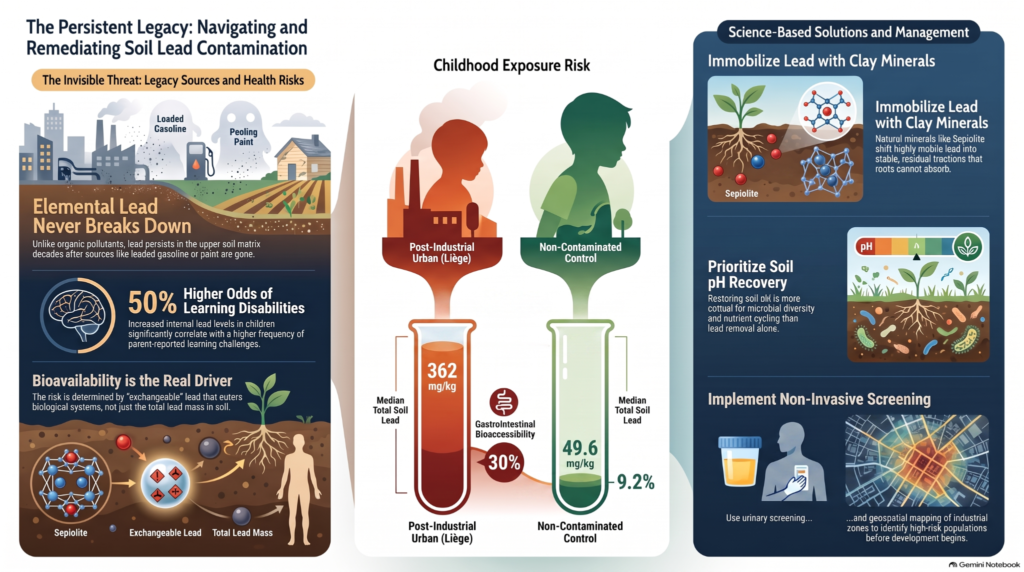
When evaluating environmental risk, it is easy to view soil as a static backdrop. In reality, it operates as a dynamic storage medium that archives decades of anthropogenic decisions. In my work analyzing soil degradation patterns across post-industrial and urban corridors, lead contamination stands out because of its remarkable persistence. Unlike organic pollutants that break down over time, elemental lead remains embedded within the upper soil matrix long after the original emission sources such as legacy lead-based paint, historical emissions, or leaded fuels have ceased operation.
From an engineering and land-use perspective, the core challenge lies in mapping diffuse contamination. Standard spatial models often assume uniform decay rates for pollutants, but urban soil legacy data demonstrates extreme spatial variability. A single municipal lot can show baseline background levels of 20 to 40 ppm on one corner and jump to thousands of ppm near an old structural foundation where lead paint weathered into the ground.
As climate stressors accelerate soil erosion, urban runoff, and prolonged drought cycles, these legacy contaminants risk becoming re-mobilized through fugitive dust airborne transport or storm-driven sediment displacement. Addressing soil lead requires moving past basic hazard identification to building risk-aware spatial frameworks that directly inform municipal zoning, site development, and public health policies.
Lead contamination in soil is a serious issue that stems from lead-based paints, leaded gasoline, and industrial activities. These sources pose significant risks, especially to vulnerable populations, leading to neurotoxic effects and long-term developmental problems. Identifying contamination involves observing unusual plant growth and conducting soil tests. Effective remediation techniques and preventive measures are essential in mitigating risks. By exploring solutions and community strategies, you’ll gain a deeper understanding of how to combat lead contamination effectively.
KEY TAKEAWAYS
- Lead contamination in soil primarily stems from historical lead-based paints, leaded gasoline, industrial activities, and lead-containing pesticides used in agriculture.
- Vulnerable populations, particularly children, face significant health risks from lead exposure, including cognitive impairment and developmental delays.
- Long-term exposure to lead can lead to serious health issues such as cardiovascular diseases and behavioral problems, impacting quality of life and academic performance.
- Effective remediation techniques include phytoremediation, soil amendments, and excavation to safely remove contaminated soil and reduce lead bioavailability.
- Community awareness initiatives, regular soil testing, and policy advocacy are essential for addressing lead contamination and protecting public health.
WHY LEAD CONTAMINATION IS A SERIOUS PROBLEM
Although lead contamination might seem like a distant issue, it poses a significant threat to public health and the environment. You may not realize that lead exposure can have dire consequences, particularly for vulnerable populations, including children and low-income communities.
This disproportionate impact raises critical concerns about environmental justice, as marginalized groups often reside in areas with higher lead levels in soil. Lead’s neurotoxic effects can hinder cognitive development and result in long-term health problems, perpetuating cycles of disadvantage.
Furthermore, the persistence of lead in the environment complicates remediation efforts, requiring innovative solutions to manage contaminated sites effectively. Addressing lead contamination isn’t just a matter of public safety; it’s an ethical imperative that demands attention.
The Main Sources of Lead Contamination in Soil
Lead can be found naturally at low levels in soil. However, most lead that people come into contact with comes from human activities, such as the historical use of leaded gasoline, release of lead from industrial facilities, and lead-based paint in older homes and buildings. Because lead is an element, it continues to exist in the environment, even after the original lead source is gone. High lead levels in soil can increase people’s contact with lead and therefore their exposure. Exposure means lead gets into your body – often through ingesting it or breathing it in. In fact, humans are often exposed to lead without realizing it.
Understanding the main sources of lead contamination in soil is essential for addressing this issue effectively.
Industrial activities and emissions, along with residues from lead-based paints, greatly contribute to the problem.
Industrial Activities And Emissions
Industrial activities and emissions are important contributors to lead contamination in soil, as they release various pollutants that settle into the ground. Factories, smelters, and mining operations often emit lead particles, which can accumulate over time and pose serious health risks.
Regulatory policies aimed at reducing industrial emissions are essential, yet enforcement varies greatly across regions. You might wonder how these emissions infiltrate soil; they can occur through direct deposition, runoff, or even atmospheric transport.
Innovations in pollution control technologies can help mitigate these effects, but without robust regulations and compliance, lead levels in soil can remain dangerously high.
Ultimately, addressing industrial emissions and enhancing regulatory frameworks are critical steps toward safeguarding our environment and public health.
Lead-Based Paint Residues
Lead-based paint residues are a primary source of lead contamination in soil, especially in urban areas where older buildings are prevalent. As paint deteriorates over time, it chips and flakes, releasing lead particles that settle into the surrounding soil.
These lead hazards pose serious health risks, particularly for children who may ingest contaminated soil during play. Innovative remediation strategies, such as soil replacement and phytoremediation, can help mitigate these risks, but awareness is essential.
Understanding the connection between paint deterioration and lead contamination enables you to make informed decisions about property renovations and environmental safety. By addressing lead-based paint issues proactively, you can markedly reduce the long-term impact on both human health and the environment.
Identifying Lead Contamination: Signs and Testing Methods
Lead is naturally present in all soils. It generally occurs in the range of 15 to 40 parts lead per million parts of soil (ppm), or 15 to 40 milligrams lead per kilogram of soil (mg/kg). Pollution can increase soil lead levels to several thousand ppm. The major cause of soil lead contamination in populated areas is the weathering, chipping, scraping, sanding, and sand-blasting of structures bearing lead-based paint.
To identify lead contamination in soil, you’ll want to look for common indicators like unusual plant growth or flaking paint nearby.
Effective testing techniques, such as soil sampling and lab analysis, provide accurate assessments of lead levels.
Understanding these signs and methods is essential for ensuring both environmental safety and personal health.
Common Contamination Indicators
While many may not realize it, recognizing signs of lead contamination in soil is essential for ensuring environmental and personal safety. Common indicators include unusual plant health, such as stunted growth or discoloration, which can signal underlying soil issues.
If you suspect contamination, soil sampling is vital for a thorough contamination assessment. This process involves collecting soil from various depths and locations to accurately reflect potential lead levels.
Visual cues, like the presence of older structures or heavy traffic areas, can also suggest contamination sources. By actively monitoring these signs, you can make informed decisions about remediation and safeguard health.
Understanding these indicators not only protects you but also fosters a sustainable environment for future generations.
Effective Testing Techniques
When evaluating soil for lead contamination, employing effective testing techniques is fundamental for accurate results. You need to choose methods that provide reliable data for thorough contamination analysis, including heavy metals determination in soil.
Here are some innovative techniques to take into account:
- X-ray fluorescence (XRF) for rapid, non-destructive testing.
- Laboratory soil testing for precise quantitative analysis.
- Field testing kits for immediate assessments.
- Composite sampling to analyze multiple areas simultaneously.
- Geospatial analysis to map contamination spread effectively.
These techniques not only enhance your soil testing capabilities but also guarantee you can identify lead contamination swiftly and accurately.
HOW LEAD AFFECTS HUMAN HEALTH AND DEVELOPMENT
Looking at soil contamination strictly through total heavy metal concentration rarely tells the whole story. As analysts, we must evaluate bioavailability—how much of that lead is actually in an exchangeable chemical form that can enter biological systems. Recent epidemiological and toxicokinetic research highlights this complexity. For instance, studies in post-industrial urban centers like Liège demonstrate that gastrointestinal bioaccessible lead—rather than total soil mass—serves as the real driver for elevated urinary lead levels in children, particularly when paired with socioeconomic vulnerabilities like older housing stock or indirect dust exposure.
Simultaneously, environmental conditions radically alter how lead behaves underground. Controlled studies examining industrial stressors reveal that soil acidification acts as a primary catalyst for microbial community disruption, weakening bacterial diversity and nutrient cycling faster than lead exposure alone. When acid conditions coincide with lead contamination, the mobility of heavy metals increases, making environmental remediation even more urgent.
This is where climate-smart engineering strategies come into play. Heavy excavation and soil replacement are expensive and disruptive. Instead, empirical research points toward in-situ passivation technologies using natural clay minerals like sepiolite or bentonite. In neutral agricultural soils, these minerals effectively shift highly mobile exchangeable lead into stable residual fractions, trapping heavy metals within root systems and preventing translocation into plant shoots or edible food crops. By pairing natural mineral additives with plant-root buffering mechanisms, we can engineer stable, low-cost remediation strategies that preserve soil structure while mitigating food-chain risks.
Lead contamination poses significant risks to human health and development, particularly in children whose bodies and brains are still developing. Lead exposure can lead to severe developmental delays and cognitive impairment, hindering academic and social skills.
Prenatal risks also arise, as maternal exposure can affect fetal growth and brain development, increasing the likelihood of neurological damage. Childhood exposure to lead, often from contaminated soil, can result in long-term health consequences that impact public health and environmental justice efforts.
The ramifications extend beyond individual health, affecting community well-being and economic stability. As you explore innovative solutions to mitigate these risks, it’s vital to understand the profound effects of lead on human development.
Prioritizing awareness and action can help protect future generations from the insidious impact of lead contamination, ensuring healthier environments and fostering equitable opportunities for all.
Effective Remediation Techniques for Contaminated Soil
The risks posed by lead exposure highlight the urgent need for effective remediation techniques to address contaminated soil.
You can explore a variety of innovative remediation strategies including bioremediation of soil, that offer promising results, including:
- Phytoremediation: Utilizing plants to absorb and stabilize lead from the soil.
- Soil amendments: Adding materials like biochar or compost to bind lead and reduce its bioavailability.
- Excavation and disposal: Removing contaminated soil for safe disposal or treatment.
- Solidification/stabilization: Chemically treating lead to minimize its mobility in the soil.
- Electrokinetic remediation: Applying electrical currents to mobilize lead ions for extraction.
These techniques not only mitigate lead contamination but also enhance soil health and ecosystem function.
Best Practices for Preventing Lead Contamination
To effectively prevent lead contamination in soil, it’s essential to adopt proactive measures that address potential sources of exposure.
Start by conducting regular soil testing, especially in areas with a history of industrial activity or lead-based paint. This data allows for informed soil management decisions.
Implementing preventive measures such as using clean fill when landscaping or gardening can greatly reduce exposure risks.
Additionally, promote the use of native plants that can help remediate lead-contaminated soil while enhancing local ecosystems.
Encourage responsible disposal of materials that may contain lead, like batteries or old paint.
Educating your community about the dangers of lead and the importance of maintaining a clean environment can foster collective action, including choosing eco friendly products whenever possible.
Finally, establish buffer zones around high-risk areas to limit direct contact with contaminated soil.
Community Support for Addressing Lead Contamination
Lead-based paint is the most likely source of contamination. If your house was built before 1970, its paint may contain up to 50% lead. Levels of lead in domestic paint steadily decreased between 1965 and 1992.
Effective community support plays an essential role in tackling lead contamination issues. By fostering collaboration and innovation, communities can markedly mitigate risks associated with lead exposure.
Through various community initiatives, you can raise public awareness and drive actionable change. Consider the following strategies to make an impact:
- Organize local workshops to educate residents about lead risks.
- Create community gardens with lead-safe practices to promote safe soil use.
- Develop partnerships with local organizations for remediation efforts.
- Advocate for policy changes that prioritize soil testing in vulnerable areas.
- Launch social media campaigns to share information and resources.
These efforts not only enhance public awareness but also empower you and your neighbors to take proactive steps.
RELATED STUDIES ABOUT LEAD CONTAMINATION IN SOIL
In conclusion, tackling lead contamination is essential for community health and environmental harmony. By understanding sources, recognizing risks, and implementing effective remediation, you can foster a safer, sustainable space. Prioritizing prevention practices and promoting public participation helps protect future generations from lead’s lingering legacy. Together, let’s aim for a safer soil solution, ensuring everyone can thrive in a healthier habitat while safeguarding our shared surroundings against the silent threat of lead contamination.
Interactive effects of lead (Pb) contamination and soil acidification on the structure and composition of fungal and bacterial communities
Overview
This study investigates the individual and interactive impacts of lead (Pb) contamination and soil acidification on bacterial and fungal communities across three belowground compartments: bulk soil, rhizosphere, and roots. Using black spruce (Picea mariana) seedlings grown in natural boreal forest soil under controlled greenhouse conditions, the authors evaluated how these co-occurring industrial stressors alter microbial diversity, community composition, and functional taxa involved in nutrient cycling.
Key Findings
- Primary Driver of Microbial Shifts:
- Soil acidification is the dominant factor driving changes in bacterial community structure and diversity across all compartments, accounting for 15% to 44% of total variance. Acidification significantly reduced bacterial Shannon diversity (0.22 units) and species richness (158 species) in soil.
- Lead (Pb) exposure played a secondary role, causing slight shifts in bacterial alpha diversity without significantly reordering overall community composition (R^2 < 6%).
- Differential Kingdom Sensitivity:
- Bacteria were highly sensitive to pH drops, showing significant declines in key plant-beneficial and nitrogen-cycling taxa such as Bradyrhizobium and the Burkholderia-Caballeronia-Paraburkholderia group.
- Fungi exhibited greater overall stability and resistance to both stressors. Acidification slightly increased fungal diversity, whereas high Pb exposure reduced it. High Pb concentrations enriched metal-tolerant fungal taxa (e.g., Thelephora and Umbelopsis), which helped maintain overall fungal community functionality.
- Compartmental Buffering Along the Soil-Root Continuum:
- Stress impacts were strongest in bulk soil, moderate in the rhizosphere, and minimal within the roots.
- Root-associated microbial communities demonstrated high resilience, likely buffered by plant root exudates and host protection that mitigate direct chemical toxicity.
Core Data & Methodological Summary
- Experimental Model: Black spruce (Picea mariana) grown in natural forest soil
- Tested Factors:
- Acidification: Acidified vs. Non-acidified (H2SO4, lowering pH by ~1 unit)
- Pb Contamination: Control (0 ppm), Low (30 ppm), High (600 ppm)
- Sequencing Markers: 16S rRNA gene for bacteria and ITS2 region for fungi
- Bacterial Response: Significant drop in soil richness (p < 0.0001) and Shannon diversity (p < 0.0001) under acid
- Fungal Response: Shift in diversity; relative abundance of metal-tolerant taxa (Thelephora, Umbelopsis) increased under elevated Pb
Environmental & Management Implications
- Prioritize pH Recovery in Restoration: Remediation and environmental management near industrial sites (e.g., smelters, mines) should prioritize controlling acid deposition and restoring soil pH, as acidification poses a much greater threat to soil microbial diversity and biogeochemical cycling than historical Pb accumulation alone.
- Plant Host Mitigation: Boreal coniferous species like black spruce facilitate rhizosphere resilience by harboring metal-tolerant ectomycorrhizal fungi and protecting root endospheres, providing a natural buffer against combined abiotic pollution.
| REFERENCE: Elsa Dejoie, Maxime Thomas, Nicole J. Fenton, Annie DesRochers, Christine Martineau, Fabio Gennaretti, Interactive effects of lead (Pb) contamination and soil acidification on the structure and composition of fungal and bacterial communities, Applied Soil Ecology, Volume 225, 2026, 107245, ISSN 0929-1393, https://doi.org/10.1016/j.apsoil.2026.107245. (https://www.sciencedirect.com/science/article/pii/S0929139326004658) |
Impact of soil lead on children’s urinary levels and parent-reported learning disabilities in areas of diffuse contamination
Overview
This study evaluates the health impacts of chronic lead (Pb) exposure from diffuse, legacy soil contamination among 172 children aged 6 to 11 in Wallonia, Belgium. The research compares a post-industrial city area (“Liège”, median soil Pb ~ 362 mg/kg) with non-contaminated control regions (median soil Pb ~ 49.6 mg/kg). By combining human biomonitoring, oral bioaccessibility testing via the Unified BARGE Method (UBM), toxicokinetic modeling (O’Flaherty model), and epidemiological surveys, the authors assess how soil Pb affects children’s internal dose and its relationship with parent-reported learning disabilities (PRLD).
Key Findings
- Soil Contamination as an Internal Exposure Driver:
- Soil Pb content significantly increases children’s urinary lead (UPb) levels in the post-industrial Liège area, where 8.4% of children exceeded the regional reference value (RV95 = 1.8 µg/L), compared to only 1% in the control area.
- Physiologically based biokinetic (PBK) modeling indicates that soil Pb becomes a biometrologically quantifiable contributor to internal lead doses at gastrointestinal bioaccessible soil Pb concentrations above 120 to 140 mg/kg.
- Confounding Environmental and Behavioral Determinants:
- Beyond soil contamination, indoor and lifestyle factors substantially influence internal lead exposure.
- Exposure to passive smoking and living in older dwellings (built before 1980) exerted positive impacts on UPb levels equivalent to approximately 2 to 3 times and 2/3 of the effect caused by a 1000 mg/kg increase in total soil Pb, respectively. Infrequent vacuuming, pet ownership, and inadequate produce washing also contributed to higher UPb levels.
- Intersection of Exposure, Social Vulnerability, and Learning Outcomes:
- Higher UPb levels were significantly associated with a greater frequency of parent-reported learning disabilities (PRLD) in Liège (0.99 µg/L with PRLD vs. 0.85 µg/L without), whereas no such link appeared in the control group.
- Logistic regression models identified lower parental education attainment as the strongest overall predictor of reported learning disabilities (increasing odds ~ 4-fold), followed by higher UPb levels (a 1 µg/L increase in UPb raised the odds by 50%) and lower socioeconomic status.
- Validation of Non-Invasive Biomonitoring:
- The toxicokinetic model demonstrated strong performance, predicting measured UPb concentrations within a 31% relative error when normalized for urine creatinine.
- UPb (adjusted for creatinine or density dilution) serves as an effective, non-invasive alternative biomarker to blood sampling for population-level screening in legacy-contaminated environments.
Core Data & Methodological Summary
- Cohort: 172 children aged 6 to 11 years (71 from Liège, 101 from Control areas).
- Soil Contamination Profile:
- Liège Area: Median Total Pb = 362 mg/kg; Gastric bioaccessible Pb = 193 mg/kg (51%); Gastrointestinal bioaccessible Pb = 121 mg/kg (30%).
- Control Area: Median Total Pb = 49.6 mg/kg; Gastric bioaccessible Pb = 10.0 mg/kg (30%); Gastrointestinal bioaccessible Pb = 3.73 mg/kg (9.2%).
- Biological Range: UPb across all participants ranged from 0.02 to 6.55 µg/L.
- Predictive Models: Robust multivariable linear regressions accounted for up to 50% of variance (R^2 = 0.50) in children’s UPb using soil Pb, creatinine, passive smoking, dwelling age, income, and hygiene habits.
Policy & Public Health Implications
- Dual-Burden Interventions: Risk management policies in post-industrial urban centers must simultaneously address soil remediation and social vulnerability, as neurodevelopmental risks stem from the combined burden of environmental pollutants and lower socioeconomic status.
- Targeted Behavioral Guidance: Public health initiatives should emphasize reducing hand-to-mouth soil contact and dust ingestion in high-risk zones (bioaccessible Pb > 180 mg/kg), encouraging frequent indoor cleaning, smoking cessation, and thorough produce washing.
- Screening Strategies: Environmental health authorities should implement non-invasive urinary screening (paired with creatinine testing) alongside exposure-PBK modeling to evaluate population-level risks before undertaking logistically invasive blood-sampling campaigns.
| REFERENCE: Jérôme C.J. Petit, Aubry Vandeuren, Benoit Pereira, Thomas Gastellu, Ludovic Herbrich, Pablo Padilla, Marie Peeters, Cécile Kech, Heidi Demaegdt, Pierre Delmelle, Pierre Jacquemin, Impact of soil lead on children’s urinary levels and parent-reported learning disabilities in areas of diffuse contamination, Environment International, Volume 213, 2026, 110356, ISSN 0160-4120, https://doi.org/10.1016/j.envint.2026.110356. (https://www.sciencedirect.com/science/article/pii/S0160412026003144) |
Clay minerals alleviate lead contamination induced by soil speciation and oat translocation in neutral and saline soils
Overview
This study evaluates the remediation efficacy of three abundant and cost-effective clay minerals—palygorskite (Pa), sepiolite (Sep), and bentonite (Be)—in immobilizing lead (Pb) in agricultural soils and suppressing its bioaccumulation in crops. Conducted in the Hetao Irrigation District of Inner Mongolia, China, the field experiment evaluated oat (Avena sativa L.) cultivation across two distinct soil pH environments: neutral non-saline soil and slightly saline soil. The research focuses on soil Pb speciation transformations, environmental drivers, and the step-by-step translocation of Pb along the soil–root–shoot–grain pathway.
Key Findings
- Soil pH-Dependent Pb Immobilization:
- Clay minerals significantly reduced total soil Pb concentrations (12% to 26% reduction in neutral soil vs. 2% to 15% in saline soil) and altered Pb speciation from bioavailable to stable fractions.
- Sepiolite (Sep) proved to be the most effective amendment. In neutral soil, Sep reduced the highly mobile exchangeable Pb fraction (EX-Pb) by 24% while increasing the stable residual fraction (RE-Pb) by 16%. In saline soil, the corresponding shifts were a 9% decrease in EX-Pb and a 10% increase in RE-Pb.
- Divergent Environmental Drivers across Soil Types:
- Redundancy Analysis (RDA) revealed that the environmental drivers of Pb speciation transformation vary by soil condition.
- In neutral soil, Pb speciation shifts were primarily driven by soil pH, total nitrogen (TN), and alkali-hydrolyzable nitrogen (AH-N).
- In saline soil, available phosphorus (AP) and exchangeable potassium (Ex-K) were the dominant governing factors, with overall Pb speciation showing lower responsiveness to soil physicochemical properties compared to neutral soil.
- Enhanced Root Retention and Restricted Translocation:
- Clay minerals promoted Pb compartmentalization and retention within oat roots, increasing root Pb content by 32% to 79% in neutral soil and 15% to 82% in saline soil.
- By restricting Pb transport from roots to shoots, clay mineral application significantly suppressed Pb accumulation in edible grains, achieving a 42% to 59% reduction in grain Pb content in neutral soil and a 5% to 14% reduction in saline soil.
Core Data & Methodological Summary
- Location & Crop: Hetao Irrigation District, Inner Mongolia, China; ‘Mengyan 1’ oat variety.
- Soil Classifications: Neutral non-saline soil (pH 6.91, salinity 0.95 g/kg) and slightly saline soil (pH 8.40, salinity 2.90 g/kg).
- Amendments Applied: Palygorskite (Pa), Sepiolite (Sep), and Bentonite (Be), each applied at a rate of 7,500 kg/ha alongside an untreated control (CK).
- Pb Distribution Hierarchy: Consistently followed the pattern of Roots > Shoots > Grains across all treatments.
- Translocation Invalidation: Translocation factors from root-to-shoot (TF Root-Shoot, 7% to 25%) and shoot-to-grain (TF Shoot-Grain, 5% to 13%) were substantially lowered by clay mineral treatments, with Sep demonstrating the strongest inhibition.
Practical & Agronomic Implications
- Remediation Selection: Sepiolite (Sep) is identified as a stable, highly efficient amendment for immobilizing Pb and minimizing food-chain contamination risks in heavy metal-polluted agricultural lands.
- Soil Management Sensitivity: In-situ passivation technology using clay minerals is substantially more effective in neutral soils than in saline/alkaline soils. Agricultural soil management policies must adjust amendment strategies based on baseline soil salinity and pH.
- Safe Utilization of Dual-Purpose Crops: By restricting heavy metal translocation to grains, clay mineral application supports the safe agricultural utilization of dual-purpose grain-and-forage crops like oats in moderately contaminated soils.
| REFERENCE: Ru Zhang, Dongdong Xue, Yao Huo, Ruiying Lu, Xiaoyu Guo, Yongning Wang, Xiquan Wang, Baoping Zhao, Clay minerals alleviate lead contamination induced by soil speciation and oat translocation in neutral and saline soils, Ecotoxicology and Environmental Safety, Volume 321, 2026, 120452, ISSN 0147-6513, https://doi.org/10.1016/j.ecoenv.2026.120452. (https://www.sciencedirect.com/science/article/pii/S0147651326007815) |
CONCLUSION
Addressing legacy lead contamination is ultimately a data integration challenge that spans engineering, environmental science, and municipal policy. A common misconception in public forums is that heavy metals can simply be covered up or ignored if land isn’t actively farmed. However, as land-use demands shift and climate volatility increases, unmonitored soil contamination poses an ongoing systemic risk to communities. Sustainable soil management requires policy-aware strategies that translate complex laboratory analyses into actionable spatial guidelines.
This means moving toward non-invasive population screening, spatial mapping of historical industrial zones, and localized soil amendments tailored to baseline soil pH and salinity levels. As research confirms, in-situ clay mineral treatments behave differently depending on whether soil is neutral or saline, proving that blanket remediation policies are rarely effective. We need region-specific interventions that account for baseline soil chemistry, land-use history, and local social vulnerabilities.
When urban planners, environmental engineers, and local health authorities share unified soil data dashboards, we can proactively restrict exposure risks before developmental projects begin. Protecting long-term soil productivity isn’t just about cleaning up the past; it’s about engineering resilient land-use systems capable of safely supporting communities for decades to come.