
When people think of industrial air pollution, they usually picture thick black smoke billowing out of factory smokestacks. But through years of setting up real-time sensor networks and sifting through atmospheric data, I’ve learned that some of the most dangerous airborne threats are completely invisible to the naked eye. Chlorofluorocarbons (CFCs) are a classic example.
Chemically stable, odorless, and non-flammable, they were long considered engineering marvels for cooling systems, solvent cleaning, and foam manufacturing. Yet, those exact properties allow them to drift upward unchecked, slowly degrading our planet’s stratospheric shield. While many assume the CFC conversation ended with 20th-century policy wins like the Montreal Protocol, modern ground measurements and satellite telemetry paint a much more complex picture.
Legacy industrial equipment, unmonitored foam insulation, and improper end-of-life disposal continue to leak halogenated compounds into the atmosphere. Tracking these diffuse emissions in real time remains a massive technical hurdle for environmental technologists. To truly mitigate these lingering sources, we need to bridge the gap between static regulatory compliance and active, continuous air quality monitoring. Bringing open, high-resolution sensor data to light is our best weapon for identifying remaining industrial leaks before they quietly compound our global environmental footprint.
Chlorofluorocarbons (CFCs) contaminate the air in industrial processes mainly through refrigeration systems, aerosol propellants, and foam production. Common sources include leaks from improperly maintained refrigeration units and emissions from aerosol sprays and cleaning agents. Additionally, foam fabrication often involves CFCs, contributing considerably to air pollution. Stricter regulations aim to curb these emissions, but challenges remain in compliance and technological updates. Discover how these elements interact further and what solutions are emerging to combat these issues.
KEY TAKEAWAYS
- CFC emissions in industrial processes primarily arise from the use of solvents in cleaning and manufacturing applications.
- Foam production processes commonly utilize CFCs, significantly contributing to air contamination.
- Refrigeration systems often release CFCs due to leaks caused by improper maintenance and system disposal.
- Consumer products, including aerosol sprays and cleaning agents, inadvertently contribute to CFC air contamination during use.
- Stricter regulations, such as the Montreal Protocol, aim to reduce CFC emissions from industrial sources significantly.
HOW CFCS ARE USED IN INDUSTRIAL PROCESSES
Although chlorofluorocarbons (CFCs) are often criticized for their environmental impact, they still play a significant role in various industrial processes. You’ll find that CFC applications are prevalent in refrigeration, air conditioning, and aerosol propellants due to their effective thermodynamic properties. Their stability and non-flammability make them a go-to choice for manufacturers seeking reliable solutions.
However, as innovation pushes forward, industries are increasingly exploring CFC alternatives. Hydrofluorocarbons (HFCs) and other low-global-warming-potential substances are being developed to reduce environmental harm without sacrificing performance. These alternatives offer promising efficiency in cooling applications, yet they come with their own set of challenges, such as cost and availability.
As an industry professional, you must weigh the benefits and drawbacks of CFCs against emerging technologies. The shift towards sustainable options is essential not just for compliance but also for future-proofing your operations.
Major Sources of Chlorofluorocarbon Emissions
As in simpler alkanes, carbons in CFCs bond with tetrahedral symmetry. Because the fluorine and chlorine atoms differ greatly in size and effective charge from hydrogen and from each other, methane-derived CFCs deviate from perfect tetrahedral symmetry.
Chlorofluorocarbon emissions primarily stem from three major sources: industrial processes, consumer products, and refrigeration systems. Understanding these CFC sources is essential for addressing industrial emissions effectively.
| Source | Key Contributors |
| Industrial Processes | Solvent use, foam production |
| Consumer Products | Aerosol sprays, cleaning agents |
| Refrigeration Systems | Leakages from cooling systems |
In industrial settings, solvents containing CFCs contribute considerably to air contamination. Consumers unknowingly release CFCs through everyday products like aerosol sprays and certain cleaners. While refrigeration systems are often highlighted, their contribution mainly lies in leaks rather than regular operations.
CFCS From Refrigeration and Air Conditioning
As refrigeration and air conditioning systems operate, they can inadvertently release chlorofluorocarbons (CFCs) into the atmosphere, contributing considerably to environmental contamination.
These emissions often stem from equipment leaks, improper maintenance, or system disposal. Understanding the scale of this issue is vital for innovating solutions that prioritize refrigerant safety and environmental integrity.
Fortunately, the industry is moving toward CFC alternatives, such as hydrofluorocarbons (HFCs) and natural refrigerants.
These substitutes offer lower global warming potential and reduce ozone depletion risks. However, shifting requires rigorous evaluation of their long-term safety and environmental impacts.
To mitigate CFC emissions effectively, regular system maintenance and leak detection are essential.
By embracing innovative technologies and adopting best practices, you can greatly minimize the release of harmful substances.
Ultimately, prioritizing CFC alternatives and robust refrigerant safety measures will pave the way for a more sustainable future in refrigeration and air conditioning.
CFCs in Foam Blowing Agents: An Overlooked Contributor
Many people overlook the use of chlorofluorocarbons (CFCs) in foam blowing agents, yet this sector notably contributes to CFC contamination. In foam formulation, CFCs serve as effective agents, but their environmental impact can’t be ignored.
Consider these factors:
- Ozone Depletion: CFCs greatly harm the ozone layer.
- Regulatory Pressure: Stricter regulations are emerging worldwide.
- Innovation Opportunities: There’s a growing market for sustainable foam alternatives.
- Consumer Awareness: More people are demanding eco-friendly products.
Transitioning to emission alternatives isn’t just a regulatory requirement; it’s an opportunity for innovation.
By embracing sustainable foam formulation, you can reduce your carbon footprint and position your business as a leader in environmental responsibility.
It’s crucial to act now and explore these alternatives to guarantee a healthier planet for future generations.
CFCs and Their Impact on Air Quality
CFCs considerably compromise air quality, releasing harmful substances that contribute to both outdoor and indoor pollution, including carbon monoxide indoor air pollution. When you consider the widespread use of CFCs in various industrial processes, it’s clear that their environmental impact is significant.
These compounds persist in the atmosphere, leading to ozone depletion and exacerbating climate change. As a result, you’re not only facing immediate air quality issues but also long-term ecological consequences.
Fortunately, there’s a growing shift towards CFC alternatives. Innovative technologies and materials are emerging, aiming to reduce the reliance on these harmful substances.
By adopting these alternatives, industries can mitigate their environmental footprint and enhance air quality. You have the power to advocate for and implement these changes, promoting a healthier environment for yourself and future generations.
Embracing CFC alternatives isn’t just a trend; it’s a necessary step toward sustainable industrial practices that prioritize air quality and ecological well-being.

KEY REGULATIONS IMPACTING CFC EMISSION CONTROL
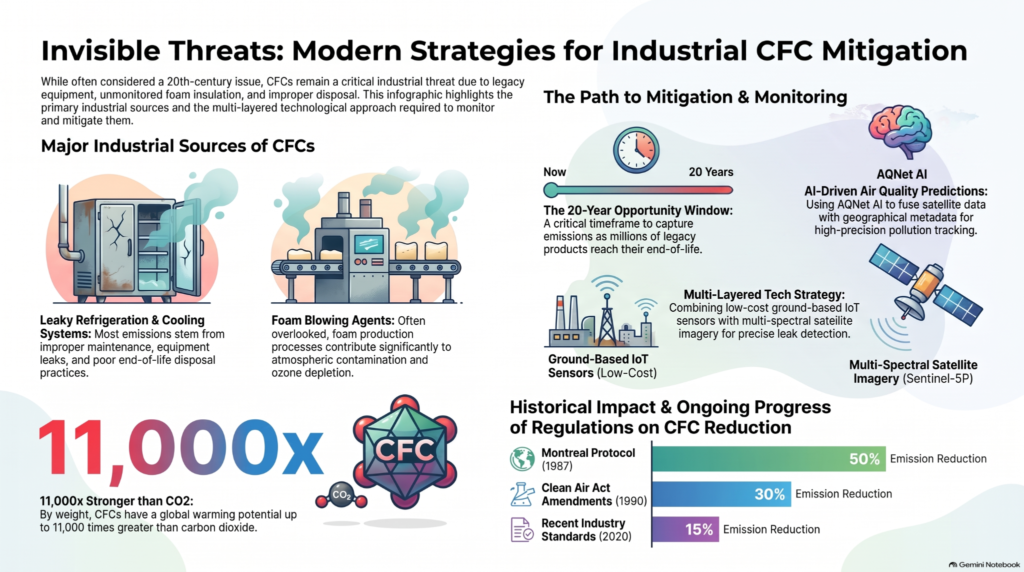
In the field, tracking volatile compounds across vast industrial zones requires moving past traditional single-point sampling. What makes CFC emissions so frustrating from a sensor perspective is their sheer longevity and atmospheric mobility. Heavy as these molecules are, turbulent mixing carries them into higher atmospheric layers where solar UV rays break them down into destructive chlorine radicals. Detecting these subtle leaks before they diffuse requires a modern multi-layered technology strategy combining low-cost IoT ground arrays with multi-spectral satellite imagery and machine learning models.
In recent years, integrating satellite coverage from platforms like Sentinel-5P alongside advanced predictive neural networks (like AQNet) has changed how we visualize atmospheric transport. However, remote sensing alone isn’t a silver bullet. Satellite models often require ground-truth calibration from localized IoT sensors, especially in complex topographies or coastal microclimates where local wind patterns skew optical estimates.
For plant managers and environmental engineers, maintaining real-time telemetry on aging chillers, solvent degreasing lines, and foam fabrication facilities isn’t just about passing audits, it’s about immediate anomaly detection. When continuous monitoring flags a sudden micro-spike in localized compounds, maintenance teams can fix seals instantly rather than letting kilograms of harmful refrigerants bleed out unnoticed over several months.
Decades ago, CFCs were identified as detrimental to the stratospheric ozone and are being effectively phased out by the Clean Air Act and the 1987 international treaty known as the Montreal Protocol. These chemicals are now also known to be greenhouse gases with a global warming potential up to 11,000 times as strong as carbon dioxide by weight. Unfortunately, millions of products such as refrigerators, air conditioners, fire extinguishers and aerosol cans that contain CFCs are still in use around the world and are nearing the end of their usable lives. The next 10-20 years present a unique one-time opportunity to prevent emissions from these products as they are retired and therefore mitigate ozone damage and global climate change.
Understanding the key regulations surrounding CFC emission control is essential for grasping how these substances are managed.
The Montreal Protocol stands out as a landmark agreement, while the Clean Air Act and specific industry regulations further shape emission standards.
Together, these frameworks create a thorough approach to mitigating CFC contamination and protecting air quality.
Montreal Protocol Significance
CFC molecules are indeed several times heavier than air. Nevertheless, thousands of measurements from balloons, aircraft, and satellites demonstrate that the CFCs are actually present in the stratosphere. This is because winds and other air motions mix the atmosphere to altitudes far above the top of the stratosphere much faster than molecules can settle according to their weight. Gases such as CFCs that do not dissolve in water and that are relatively unreactive in the lower atmosphere are mixed relatively quickly and therefore reach the stratosphere regardless of their weight.
Although the threat posed by chlorofluorocarbons (CFCs) to the ozone layer was evident for decades, the Montreal Protocol emerged as a crucial international agreement aimed at mitigating this environmental crisis.
This landmark treaty exemplifies global cooperation, uniting nations to phase out CFCs and protect our atmosphere.
You should recognize its significance through the following points:
- Ozone layer recovery: A crucial step towards healing our planet.
- Innovation in alternatives: Encouraging development of safer substances.
- Economic benefits: Stimulating green technology markets.
- Global unity: Fostering collaboration for a sustainable future.
Clean Air Act Provisions
The Clean Air Act plays a pivotal role in regulating chlorofluorocarbon emissions, establishing a framework that not only addresses air quality but also targets substances harmful to the ozone layer.
By implementing strict regulations on CFC production and use, the Act compels industries to prioritize clean air initiatives. Businesses must engage in regulatory compliance, adopting innovative practices to minimize emissions. This includes monitoring emissions, reporting data, and shifting to alternative substances with lower environmental impact.
The Act also encourages research into new technologies for CFC reduction, fostering a culture of environmental responsibility. As a result, you’re empowered to contribute to a sustainable future while maintaining compliance with key regulations that safeguard both health and the planet.
Industry-Specific Emission Standards
As industries increasingly face pressure to comply with environmental regulations, specific emission standards targeting chlorofluorocarbon (CFC) emissions have become essential for effective control.
These standards not only guarantee regulatory compliance but also drive innovation in emission reduction technologies, including sulfur dioxide emissions control.
To make a real impact, consider these key areas:
- Adoption of Alternative Substances: Shift towards eco-friendly refrigerants.
- Advanced Leak Detection: Implement cutting-edge monitoring systems to minimize emissions.
- Process Optimization: Streamline operations to reduce CFC usage.
- Employee Training: Equip staff with knowledge on best practices for emission management.
How Effective Are Current Regulations on CFC Emissions?
How effective are current regulations on CFC emissions in mitigating environmental damage? While progress has been made, the challenge remains significant. Regulatory effectiveness hinges on stringent enforcement and innovation in emission reduction technologies.
Here’s a snapshot of the current landscape:
| Regulation Type | Emission Reduction (%) | Implementation Year |
| Montreal Protocol | 50% | 1987 |
| Clean Air Act Amendments | 30% | 1990 |
| Recent Industry Standards | 15% | 2020 |
These regulations show a commitment to reducing CFC emissions, yet gaps in compliance exist. Industries often struggle with outdated technologies, leading to insufficient emission reductions. To truly mitigate environmental impact, you need to advocate for more innovative solutions and better enforcement mechanisms. Continued advancements in technology and stricter regulatory frameworks are vital for achieving substantial emission reductions in the long run.
RELATED STUDIES ABOUT CHLOROFLUOROCARBON AIR CONTAMINATION
In summary, understanding the sources and impacts of chlorofluorocarbons in industrial processes is vital for protecting our air quality. Like a silent thief, CFCs sneak into our environment, undermining efforts to combat pollution. While regulations are in place, their effectiveness remains a pressing concern. It’s essential to stay informed and advocate for stronger measures to curb emissions. Together, we can turn the tide against these harmful substances and safeguard our atmosphere for future generations.
Inference of Young Groundwater Ages and Modern Proportions in West Hawai’i Aquifers
Context & Management Significance
Groundwater on Hawai’i Island is a vital natural resource supplying nearly all fresh potable water demands for residents. The island’s western aquifers—comprising the Waimea, ‘Anaeho‘omalu, Kīholo, Keauhou, and Kealakekua systems—are hydrogeologically complex, driven by overlapping volcanoes, dynamic saltwater interface dynamics, and steep hydraulic head gradients (high-low head divides).
Accurate groundwater management, estimation of sustainable yields, and water quality protection require precise knowledge of residence times, flow paths, and modern vs. premodern water proportions. Modern waters (<70 years old) are uniquely vulnerable to anthropogenic surface activities and land-use impacts. This study, published in the Journal of Hydrology (2022) by Okuhata et al., represents the first multi-tracer investigation executed in West Hawai’i to evaluate young groundwater ages, tracer dynamics, and contamination relationships.
Core Findings & Quantitative Data
- Presence of Modern Groundwater & Apparent Ages:
- Anthropogenic transient tracers (CFC-11, CFC-12, CFC-113, SF6, and ^3H/^3He) were detected across basal wells, high-level wells, and submarine groundwater discharge (SGD) sites, proving the presence of young groundwater recharged within the last 70 years.
- Apparent transient tracer ages derived across all methods range from 7 to 83 years, with a overall median age of 53 years for the modern component.
- Groundwater Mixing Proportions (Binary Mixing Models):
- Piston flow models fail to capture aquifer behavior; groundwater exists primarily as binary mixtures composed of modern water (<70 years old) and older, premodern groundwater recharged prior to 1953 (the onset of atmospheric nuclear testing and industrial tracer emissions).
- Binary mixing analysis indicates an average modern water fraction of 28% across the region.
- Spatial Variation: Nearshore coastal samples exhibit larger fractions of young water (up to 75%–88%), whereas inland high-level wells exhibit significantly lower modern fractions (often <10%–20%).
- Impact on Coastal Water Quality & Nitrate Dynamics:
- An inverse relationship was identified between apparent groundwater age and nitrate (NO}^-) concentrations, with nitrate levels decreasing by approximately 0.01 mg/L} per year of age.
- Higher nitrate concentrations correspond directly to groundwater recharged within the past 70 years, reflecting regional population growth, land development, and expanded anthropogenic inputs over recent decades.
Environmental & Methodological Challenges
Implementing environmental tracer dating in volcanic oceanic island settings introduces specific geochemical complexities that require rigorous corrections:
- Magmatic & Hydrothermal Helium Bias (^3H}/^3He):
- Volcanic degassing from Hualālai volcano introduces mantle/crustal terrigenic helium (^4He_terr), elevating R/RA ratios (up to 3.2) and making water appear older than its true age.
- Standard continental crustal corrections (2 x 10^-8) overcorrect the data, yielding skewed apparent ages (76–107 years). Applying a site-specific Hualālai magmatic ratio (1.25 x 10^-5) successfully aligns tritium/helium ages (58–83 years) with CFC-12 ages (RMSE = 10 years).
- Volcanic SF6 Contamination:
- Multi-tracer evaluation showed widespread SF6 enrichment above atmospheric equilibrium curves, confirming that sulfur hexafluoride is naturally or terrigenically released from volcanic deposits. Consequently, SF6 is unreliable for dating in this volcanic setting.
- Coastal Dynamics & Tidal Aeration:
- Nearshore basal wells and SGD sites are subject to tidal pumping, shallow pumping depths, and potential seawater intrusion, which introduce present-day atmospheric air or modern seawater, artificially skewing coastal samples toward younger apparent ages and higher modern fractions.
Key Strategic Recommendations for Aquifer Management
- Adopt Multi-Tracer Frameworks: Single-tracer studies in volcanic oceanic islands are prone to severe misinterpretation due to volcanic gas contributions and mixing dynamics; future monitoring must utilize combined CFC and corrected ^3H}/^3He protocols.
- Transition to Next-Generation Tracers: As atmospheric concentrations of CFCs and bomb-peak tritium continue to decline toward background levels, their utility for dating local recharge is diminishing. Future characterization must integrate radiocarbon (^14C) and intermediate-to-old age isotopes to quantify the dominant premodern groundwater reservoir.
- Integrate Age-Contaminant Frameworks: Coastal vulnerability models, wastewater planning, and nutrient management strategies in West Hawai’i must factor in residence times, as shallow nearshore zones receive rapidly transported, modern recharge carrying peak anthropogenic contaminant loads.
| REFERENCE: Brytne K. Okuhata, Donald M. Thomas, Henrietta Dulai, Brian N. Popp, Jonghyun Lee, Aly I. El-Kadi, Inference of young groundwater ages and modern groundwater proportions using chlorofluorocarbon and tritium/helium-3 tracers from West Hawai‘i Island, Journal of Hydrology, Volume 609, 2022, 127755, ISSN 0022-1694, https://doi.org/10.1016/j.jhydrol.2022.127755. (https://www.sciencedirect.com/science/article/pii/S0022169422003304) |
Heavy Metal Contamination in Informal E-Waste Recycling Communities in Chattogram City, Bangladesh
Context & Operational Scope
This study, published in the Journal of Hazardous Materials Advances (2025) by Abedin et al., provides a comprehensive assessment of heavy metal contamination resulting from informal electronic waste (e-waste) recycling in Chattogram City, Bangladesh. Approximately 95% of e-waste in Chattogram originates from the Chittagong Ship Breaking Yard, where discarded electronics are processed without formal recycling infrastructure, environmental controls, or personal protective equipment (PPE).
To quantify cross-compartmental environmental degradation, the authors collected 64 samples across four media—indoor air particulate matter (PM), surface soil, groundwater, and drinking water—from eight informal recycling sites, alongside 10 baseline samples from an unexposed control site (Sadarghat). Nine heavy metals (Cu, Cr, Cd, Pb, Ni, Hg, As, Mn, and Zn) were quantified using Inductively Coupled Plasma-Mass Spectrometry (ICP-MS).
Core Findings & Quantitative Contamination Profiles
- Environmental Concentrations vs. Regulatory Limits:
- Indoor Air PM: Heavy metal concentrations in indoor air PM at exposed sites were significantly higher than control sites (p < 0.05 or p < 0.01) but remained below U.S. OSHA Permissible Exposure Limits.
- Surface Soil: Average concentrations of Chromium (Cr: 169.14 mg/kg) and Arsenic (As: 17.77 mg/kg) at exposed sites exceeded USEPA Regional Screening Levels by 8.5 times and 5.9 times, respectively. Furthermore, residues of Cu, Cd, Pb, Ni, Hg, and Zn exceeded Chinese agricultural soil risk screening standards by 1.7 to 14.6 times.
- Groundwater: Highly degraded by leaching. Mean concentrations of Cr (0.0563 mg/L), Pb (0.1960 mg/L), Ni (0.2090 mg/L), Hg (0.0017 mg/L), and Mn (0.6390 mg/L) all exceeded Bangladesh Environmental Conservation Rules (ECR 2023) Maximum Allowable Limits (MAL). Lead (Pb) exceeded local and WHO safety limits by 19.6 times.
- Drinking Water: Derived from hand-pumped tube wells, drinking water showed lower overall contamination than groundwater. However, Pb (0.0168 mg/L) and Mn (0.704 mg/L) exceeded ECR/WHO limits by 1.7 times and 1.8 times, respectively.
- Environmental & Ecological Risk Indices:
- Contamination Factor (Cf^i): Lead (Pb) exhibited a very high contamination factor (Cf^i = 19.64 > 6) in groundwater, representing Class-IV contamination.
- Pollution Load Index (PLI): PLI values exceeded the baseline threshold of 1.0 across surface soil (PLI = 1.49), groundwater (PLI = 3.02), and drinking water (PLI = 1.72), signaling severe overall site quality deterioration driven by anthropogenic activities.
- Potential Ecological Risk Index (PERI): Groundwater presented a moderate potential ecological risk (PERI = 190.85), with Pb posing a considerable individual risk factor (Er^i = 98.18) and Hg posing a moderate risk factor (Er^i = 67.88).
- Geoaccumulation Index (I_geo): Groundwater Pb reached Class-V (heavy contamination, 3 le I_geo < 4). Soil Cr reflected Class-II (uncontaminated to moderately contaminated, 0 le I_geo < 1).
Migration Pathways & Source Attribution
- Inter-Matrix Correlation Analysis: Statistical analysis using Spearman’s Rho (r_s) confirmed strong inter-compartmental migration pathways:
- Indoor air PM concentrations of Cu, Cr, Cd, Pb, Ni, and Hg correlated significantly (p < 0.01) with surface soil concentrations, confirming atmospheric deposition as a primary driver of soil pollution.
- All nine heavy metals in surface soil correlated positively and significantly (p < 0.01) with groundwater concentrations, proving that rainwater infiltration and surface leaching facilitate the vertical migration of toxic metals into subsurface aquifers.
- Groundwater serves as the primary regional sink and vector for dispersing heavy metals throughout the surrounding ecosystem.
Policy Implications & Interventions
The findings underscore an urgent need for institutional interventions to prevent long-term ecological damage and worker exposure in Bangladesh:
- Engineering Controls & Worker Safety: Enforce mandatory occupational safety standards, requiring respiratory protection, gloves, local exhaust ventilation systems, and mechanical dismantling tools to suppress airborne particulate inhalation.
- Regulatory Oversight & Formalization: Transition from unregulated informal dismantling toward formal, regulated e-waste collection, segregation, and processing networks supported by strict ECR compliance enforcement.
- Environmental Monitoring & Remediation: Establish long-term groundwater and soil monitoring protocols around informal dump sites and implement containment measures to prevent runoff and leachate infiltration into potable drinking sources.
| REFERENCE: Md. Jainal Abedin, Supat Wangwongwatana, Md. Nurul Huda Bhuiyan, Mohammad Moniruzzaman, Saowanee Norkaew, Quanyin Tan, Li Liang, Assessments of heavy metal contamination found in environmental samples from informal e-waste recycling communities in Chattogram City, Bangladesh, Journal of Hazardous Materials Advances, Volume 19, 2025, 100845, ISSN 2772-4166, https://doi.org/10.1016/j.hazadv.2025.100845. (https://www.sciencedirect.com/science/article/pii/S2772416625002566) |
Predicting Air Quality via Multimodal AI and Satellite Imagery
Overview
Ground-based monitoring stations provide localized air quality measurements, but their spatial coverage is limited. Satellites offer broad coverage, but estimating surface-level pollution purely from satellite images presents accuracy challenges.
This study introduces AQNet (Air Quality Network), a novel multimodal artificial intelligence architecture designed to estimate ground-level air pollutant distributions with high precision across areas lacking physical monitoring infrastructure. By fusing multi-spectral satellite imagery, low-resolution satellite atmospheric data, and static spatial/geographical tabular metrics, AQNet predicts key pollutant levels and calculates a unified Air Quality Index (alpha).
Key Architectural Features
AQNet integrates three complementary data streams:
- Sentinel-2 Satellite Imagery: Uses a MobileNetV3 backbone to process 12-band multi-spectral satellite imagery (120×120 pixels at 10m effective resolution). MobileNetV3 achieved similar or superior predictive accuracy (R2 = 0.596) compared to heavy backbones like ResNet50 or ConvNeXt while reducing runtime by more than half (4 hours vs. 9–13 hours).
- Sentinel-5P Satellite Data: Uses a 2-layer Convolutional Neural Network (CNN) to process low-resolution (5×3.5km) tropospheric column density images for nitrogen dioxide (NO2) mapped to a 10x10km grid.
- Tabular & Geographical Metadata: Uses a Fully Connected Network (FCN) to integrate 8 local parameters:
- Altitude and population density (numerical).
- Area type: Rural, Suburban, Urban (binary).
- Station type: Traffic, Industrial, Background (binary).
The extracted features from the satellite backbones merge in a Satellite Head, which is then concatenated with the 32 output features from the Tabular FCN inside a Regression Head to predict target pollutants.
Dataset & Key Empirical Findings
The authors compiled a new dataset of 1,316 continental European monitoring stations featuring concurrent measurements for three major pollutants: NO2, Ozone (O3), and Particulate Matter (PM10).
Feature-Pollutant Relationships:
- Altitude: Highly correlated with pollutant shifts (R2 = 0.87 for O3; R2 = 0.85 for NO2). As altitude increases, O3 concentrations increase sharply, whereas NO2 and PM10 decline toward zero.
- Population Density: Higher density correlates with increased NO2 and lower O3. PM10 shows minimal direct correlation with population density alone (R2 = 0.0001).
- Area & Station Classification: Urban and traffic environments strongly increase NO2 and PM10 levels. Rural environments exhibit lower NO2 and PM10 but significantly higher O3.
Performance Metrics & Model Evaluation
AQNet was evaluated against baseline methods from literature (Scheibenreif et al., 2022), including purely satellite-based models, local metadata models, and OpenStreetMap-based models.
Model Performance Summary:
- Satellite Baseline (Satellite + ResNet50): R2 = 0.57 +/- 0.04 | MAE = 5.50 +/- 0.14 | MSE = 38.47 +/- 3.32
- AQNet (No Tabular, MobileNetV3): R2 = 0.61 +/- 0.05 | MAE = 3.93 +/- 0.28 | MSE = 28.49 +/- 4.76
- AQNet (3-Pollutant Output): R2 = 0.55 +/- 0.07 | MAE = 4.37 +/- 0.34 | MSE = 33.59 +/- 5.19
- AQNet-single (NO2 Output Only): R2 = 0.66 +/- 0.06 | MAE = 3.72 +/- 0.34 | MSE = 25.28 +/- 4.98
- Key Insight: Adding tabular metadata consistently improves accuracy and error metrics across configurations. Focusing on a single output target (AQNet-single) yields the strongest performance (R2 = 0.66), representing a ~15.8% performance gain over standard satellite-only baselines.
Air Quality Index (alpha) and Out-of-Distribution (OOD) Testing
Index Formulation: AQNet uses predicted pollutant concentrations against WHO target threshold values (NO2 = 10, O3 = 60, PM10 = 15 ug/m3) to calculate a composite index (alpha).
- alpha = 0: No predicted pollution.
- 0 <= alpha <= 1: Moderate pollution present.
- alpha > 1: Unhealthy overall pollution levels.
UK & Ireland Testing: AQNet was tested on an out-of-distribution set of 36 monitoring stations across Great Britain and Ireland.
- The model demonstrated strong relative predictive tracking and tight error bounds (interquartile range of 18%).
- Overall pollution metrics (alpha) were systematically overestimated by approximately 20% on average.
- This tendency to overpredict poor air quality stems from training on continental European data, missing island meteorological variables (e.g., wind speed, humidity), and the absence of specific regional land-cover inputs.
Limitations & Future Scope
- Meteorological Data Integration: Current iterations do not account for wind speed, rainfall, temperature, or atmospheric transport dynamics.
- Short-Term Dynamics: The current dataset aggregates pollution values across a 2.5-year average. Future iterations will target higher temporal resolution (daily or seasonal forecasts).
- Multi-Task Optimization: Simultaneous multi-pollutant prediction underperformed single-pollutant prediction. Future enhancements aim to adopt specialized multi-task loss weighting architectures.
- Expanded Satellite Targets: Incorporating Sentinel-5P layers specifically for O3 and particulate indicators rather than relying solely on NO2 column density.
| REFERENCE: Andrew Rowley, Oktay Karakuş, Predicting air quality via multimodal AI and satellite imagery, Remote Sensing of Environment, Volume 293, 2023, 113609, ISSN 0034-4257, https://doi.org/10.1016/j.rse.2023.113609. (https://www.sciencedirect.com/science/article/pii/S0034425723001608) |
CONCLUSION
Looking at the road ahead, tackling chlorofluorocarbon emissions is ultimately an engineering and data transparency challenge. We are sitting on a critical 10-to-20-year window as millions of legacy industrial cooling units, fire suppression systems, and building insulation foams reach the end of their lifecycle. If these systems are decommissioned blindly without active monitoring and strict recovery protocols, decades of atmospheric recovery could be needlessly delayed.
Technology gives us the tools to prevent that outcome. By fusing open-source hardware sensors, high-resolution satellite arrays, and predictive spatial AI, we can build transparent environmental data pipelines that leave no room for hidden leaks.
Cleaner air isn’t going to happen through passive policy alone; it requires actionable, real-time insights that hold industrial operations accountable while empowering engineers to build better, leak-free systems. Accessible environmental data is the catalyst that transforms complex atmospheric chemistry into practical, everyday solutions on the ground.