When I design DIY solar battery setups or test energy-efficient smart home hardware, I am constantly amazed by how much power we can pack into compact lithium-ion cells. A huge part of that energy density and thermal stability historically comes down to one element: cobalt. But as someone who advocates for truly sustainable electronics, I always tell people that our clean-energy transition cannot turn a blind eye to where these raw materials originate.
We celebrate electric vehicles and lightweight smart devices as triumphs of green engineering, yet their supply chains often tell a much darker story. The chemical reality of cobalt extraction is deeply unsettling. From open-pit surface mines that strip fertile topsoil to toxic tailings leaking heavy metals like arsenic and lead into community rivers, the upstream footprint of our gadgets is severe.
It creates a painful paradox: we adopt rechargeable technology to reduce emissions, while the extraction process contaminates groundwater and devastates local biodiversity on the ground. Understanding this hidden ecological cost is not about dismissing renewable technology; it is about holding our hardware designs to a higher standard of environmental accountability from day one.
Cobalt mining generates toxic waste that greatly harms the environment and disrupts ecosystems. These operations can lead to contaminated water sources, affecting both aquatic and human life. Toxic chemicals may leach into the soil, impacting local agriculture and creating health risks for surrounding communities. Additionally, habitat destruction threatens biodiversity and contributes to ecosystem imbalances. By understanding these impacts, you can explore better practices and innovative solutions aimed at minimizing this damage.
KEY TAKEAWAYS
- Cobalt mining generates toxic waste, including heavy metals like lead and arsenic, which can contaminate soil and water sources.
- Acid mine drainage from sulfuric acid use leads to significant water contamination, harming aquatic ecosystems and local wildlife.
- Habitat destruction from mining operations threatens biodiversity and disrupts local ecosystems, leading to fragmented habitats and reduced genetic diversity.
- Chemical runoff from mining processes can adversely affect local agriculture, compromising food safety and human health in surrounding communities.
- Implementing improved waste management and cleaner mining technologies is essential to mitigate environmental damage and protect local ecosystems.
THE ROLE OF COBALT IN MODERN TECHNOLOGY
Cobalt plays an essential role in modern technology, particularly in the production of rechargeable batteries that power everything from smartphones to electric vehicles. As you explore cobalt applications, you’ll find its significance in lithium-ion batteries, which are integral to technological advancements in energy storage.
These batteries offer high energy density and longevity, vital for devices that require reliability and efficiency. Moreover, cobalt enhances battery performance by improving thermal stability and charging speed, making it a preferred choice for manufacturers.
Its unique properties contribute to the miniaturization of electronics, allowing for the development of lighter and more compact devices. In addition to batteries, cobalt is utilized in superalloys and catalysts, further showcasing its versatility.
As innovation drives the demand for more efficient energy solutions, understanding cobalt’s role in these advancements becomes essential for anticipating future technological trends and lithium ion battery chemical pollution.
How Do We Mine Cobalt?
Cobalt is fast turning from a miracle metal to a deadly chemical as toxic dumping is devastating landscapes, polluting water, and contaminating crops. High concentrations of cobalt have even been linked to the death of crops and worms, which are vital for soil fertility.
When it comes to cobalt mining, various techniques are employed, each with distinct implications for the environment.
You’ll find that surface mining, underground methods, and artisanal practices all contribute to the extraction process in different ways.
Understanding these methods is essential for evaluating their environmental impact and sustainability.
Surface Mining Techniques
Surface mining techniques play an essential role in extracting cobalt from the Earth’s crust. These methods involve removing overburden to access cobalt-rich deposits, but they can lead to significant surface disturbance.
To optimize extraction while minimizing environmental impact, several strategies are employed:
- Selective removal: Targeting specific ore layers to reduce unnecessary disruption.
- Erosion control: Implementing barriers and vegetation to stabilize soil and prevent runoff.
- Waste management: Properly managing tailings to limit toxic leachate.
- Rehabilitation: Restoring mined areas to promote ecosystem recovery post-extraction.
Underground Mining Methods
One of the primary methods for extracting cobalt from beneath the Earth’s surface is through underground mining. This technique involves shaft sinking, where vertical shafts are created to access deeper ore deposits.
You’ll find that this method allows for targeted ore extraction, minimizing surface disturbance compared to open-pit mining. Advanced drilling techniques and mechanized equipment enhance efficiency, making it possible to extract cobalt with lower environmental impact.
However, underground mining also presents challenges, such as ventilation and groundwater management, which require innovative solutions to mitigate ecological risks.
Artisanal Mining Practices
Artisanal mining practices represent a significant alternative to industrial methods for cobalt extraction, particularly in regions with rich mineral deposits. These artisanal methods often engage local communities, allowing them to participate directly in the mining process.
However, while they provide economic opportunities, they also raise environmental concerns.
Key characteristics of artisanal mining include:
- Small-scale operations: Typically run by individuals or small groups.
- Limited technology use: Often relies on manual tools and traditional techniques.
- Environmental impact: Can lead to soil degradation and water contamination.
- Social dynamics: Influences local economies and community structures.
Understanding these factors is essential for evaluating the balance between economic benefits and environmental sustainability in cobalt mining.
What Are the Health Risks of Cobalt Mining?
How do the health risks associated with cobalt mining impact local communities?
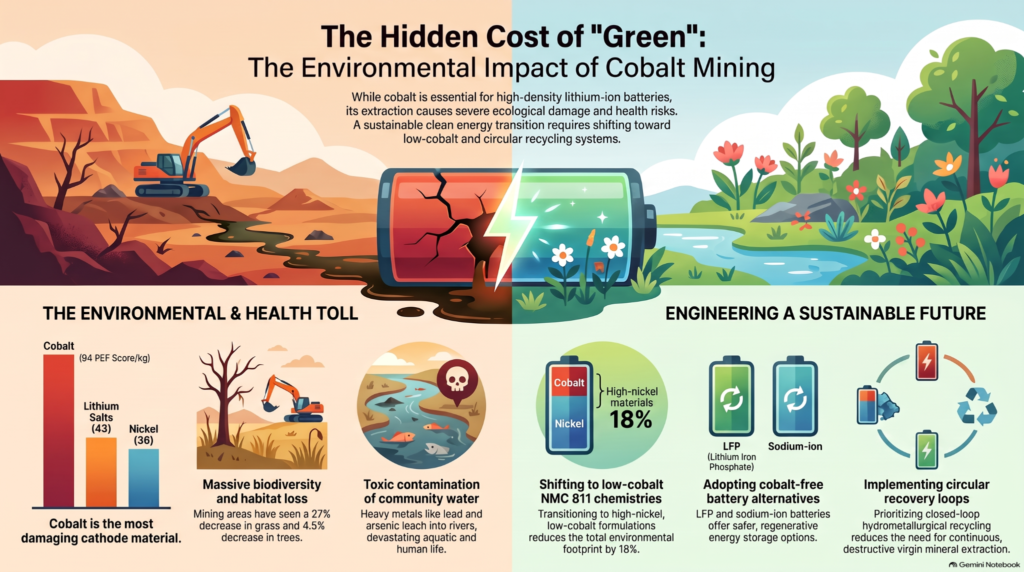
Cobalt mining is very harmful to the environment. The expansion of mines leads to deforestation and destroys habitats. A study conducted by Brown et al, demonstrated that between 2009 and 2021, there was a 4.5% decrease in trees and a 27.1% decrease in grass, which increased rock exposure by 56.2%. Mining waste also contaminates rivers and soil. In Kolwezi (a major mining town), open pits and polluted lakes have left communities without clean water or fertile land.
Cobalt mining exposes workers and residents to significant health effects, primarily due to toxic dust and chemical exposure. Prolonged inhalation of cobalt dust can lead to respiratory issues, skin disorders, and in severe cases, lung disease. The risk escalates during mining accidents, where inadequate safety measures can result in injuries or fatalities, further straining local health resources.
Additionally, communities near mining sites often experience higher rates of chronic illnesses, which can overwhelm local healthcare systems. Contaminated water sources, resulting from improper waste disposal, exacerbate these health challenges, leading to long-term consequences.
In essence, the interplay between cobalt mining practices and health risks reveals a pressing need for innovative safety protocols and community health initiatives to mitigate these adverse effects and promote sustainable mining practices that prioritize human well-being.

TOXIC BYPRODUCTS OF COBALT MINING
In electronics consulting, we frequently evaluate trade-offs between battery lifespan, energy density, and supply chain ethics. Life cycle assessments show that cobalt is often the single most environmentally damaging cathode material per kilogram, especially concerning freshwater ecotoxicity and resource depletion. When you see recent studies suggesting deep-sea mining on seamounts and abyssal plains as an alternative source, the alarm bells ring even louder. Tearing up fragile benthic ecosystems or generating underwater sediment plumes across thousands of cubic kilometers just to feed our mineral demand is simply shifting land-based destruction into the ocean.
Instead of expanding extraction into pristine habitats, our focus in sustainable engineering must remain on alternative chemistries and circular recovery. Transitioning toward lower-cobalt formulations like NMC 811, or adopting cobalt-free Lithium Iron Phosphate (LFP) and emerging sodium-ion batteries, proves we can achieve reliable energy storage without relying on toxic mining practices.
While LFP batteries might have a slightly lower energy density than cobalt-rich cells, their superior cycle life and safer thermal profile make them an incredible choice for smart homes, energy storage, and standard-range EVs. We must design hardware around what is regenerative, not just what is chemically convenient.
While cobalt mining is essential for producing batteries and other technologies, it generates toxic byproducts that pose serious environmental and health risks.
These byproducts not only contaminate surrounding areas but also have profound environmental implications. Understanding these toxic byproducts is vital for developing sustainable practices in the industry.
- Heavy metals, such as lead and arsenic, can leach into soil and groundwater.
- Sulfuric acid, used in extraction, can cause acid mine drainage, harming aquatic life.
- Dust particles containing cobalt can lead to respiratory issues for nearby communities.
- Chemical runoff can disrupt local agriculture, affecting food safety.
Addressing these toxic byproducts requires eco friendly products, innovative solutions, and technologies that minimize harm.
Cobalt Mining and Its Impact on Local Ecosystems
Cobalt is mined through surface and underground mining. Surface mining is the process that involves removing the top layer of soil or rock to access minerals or metals, while underground mining involves digging tunnels and shafts to access minerals or metals located deeper below the surface.
Cobalt mining poses significant threats to local ecosystems, particularly through habitat destruction and water contamination.
You’ll notice that the removal of vegetation and soil disrupts wildlife habitats, leading to a decline in biodiversity.
Additionally, the runoff from mining operations can contaminate nearby water sources, impacting both aquatic life and local communities.
Habitat Destruction Concerns
As mining activities expand, the risk of habitat destruction intensifies, posing serious threats to local ecosystems.
You must consider the implications of cobalt mining on wildlife and plant life, which are vulnerable to various forms of disruption, including:
- Habitat fragmentation, leading to isolated populations and reduced genetic diversity.
- Biodiversity loss, as species struggle to adapt to altered environments and resource availability.
- Disruption of food webs, affecting predator-prey relationships and overall ecosystem balance.
- Altered water runoff patterns, impacting soil health and vegetation growth.
These factors collectively compromise ecological resilience, making ecosystems more susceptible to other stressors.
Addressing habitat destruction is essential for fostering sustainable practices in cobalt mining and ensuring the integrity of local ecosystems.
Water Contamination Issues
Mining activities not only disrupt habitats but also pose significant risks to water quality in the surrounding areas, similar to the environmental concerns associated with PVC plastic emissions in electronics disposal.
The extraction of cobalt often leads to water pollution through chemical runoff, which can leach heavy metals and toxic compounds into local water sources. This contamination not only affects aquatic life but also poses health risks to nearby communities relying on these water supplies.
When you consider the potential for bioaccumulation, the long-term effects can be devastating, leading to disrupted ecosystems and compromised food chains.
Innovative strategies are essential to mitigate these impacts, such as implementing better waste management practices and adopting cleaner mining technologies.
Addressing these water contamination issues is vital for sustainable cobalt mining and protecting local environments.
Sustainable Alternatives to Cobalt Mining
While the demand for cobalt continues to rise, exploring sustainable alternatives is vital for mitigating its environmental impact.
You can support innovative solutions that reduce reliance on cobalt through various strategies:
- Recycling initiatives: Promoting the recycling of lithium-ion batteries can recover cobalt and other metals, minimizing the need for new mining operations.
- Battery alternatives: Researching and developing batteries that utilize less or no cobalt, like sodium-ion or solid-state batteries, can diminish resource depletion.
- Responsible sourcing: Supporting companies that adhere to ethical sourcing practices guarantees that any cobalt extracted is done with minimal environmental harm.
- Enhanced technology: Investing in battery technologies that improve efficiency and longevity helps reduce the overall demand for cobalt in the long term.
The Future of Cobalt Mining and Environmental Responsibility
Given the critical role cobalt plays in modern technology, the future of its mining must prioritize environmental responsibility. To achieve this, you’ll need to advocate for sustainable practices that minimize ecological damage while ensuring efficient resource extraction.
Companies must adopt innovative techniques, such as closed-loop systems and improved waste management, to reduce toxic runoff and preserve local ecosystems.
Ethical sourcing is equally important. You should support initiatives that promote transparency in the supply chain, ensuring that cobalt is sourced from operations that respect both human rights and environmental standards.
By prioritizing partnerships with suppliers committed to responsible mining, you can drive demand for cleaner alternatives.
As technology evolves, integrating more sustainable materials into production will also be essential. You’ll want to stay informed about advancements in battery technology that lessen reliance on cobalt, ultimately paving the way for a more responsible future in cobalt mining.

RELATED STUDIES ABOUT COBALT MINING ENVIRONMENTAL CHEMICAL IMPACT
In the intricate web of modern technology, cobalt shines brightly, yet its dark underbelly reveals a tale of environmental neglect. As you consider the implications of cobalt mining, remember that the toxic shadows it casts can suffocate local ecosystems and endanger health. Embracing sustainable alternatives isn’t just a choice—it’s a responsibility. By prioritizing environmental stewardship, you can help steer the future towards a path where progress and nature coexist harmoniously, ensuring a safer world for generations to come.
The environmental impacts of deep-sea mining
This review assesses several decades of deep-sea environmental research, synthesizing biological baseline data, empirical disturbance experiments, and biodiversity risks across three primary mining targets: abyssal plains (polymetallic nodules), hydrothermal vents (seafloor massive sulphides), and seamounts (cobalt-rich crusts).
Key Findings by Ecosystem Target
- Abyssal Plains (Polymetallic Nodules): The Clarion-Clipperton Zone (CCZ) hosts low faunal biomass driven by low food supply, but possesses high species diversity, with an estimated 6,000 to 8,000 animal species (the vast majority undescribed). Physical mining impacts are long-lasting; collector tracks from 1979 remain visible after 44 years. While dominant foraminifera (such as xenophyophores) and some mobile macrofauna show successional recolonization, megafaunal communities remain permanently altered where nodules are removed. Assessing extinction risk is constrained by massive undersampling across broader abyssal basins.
- Hydrothermal Vents (Seafloor Massive Sulphides / SMS): Active vent fields occupy less than 50 square kilometers globally and represent fragmented, island-like habitats supporting high biomass but low local diversity. Fauna exhibit high rates of local and regional endemism and extreme specialized adaptation. Mining active or mature chimneys would eliminate critical late-stage successional habitats, presenting an immediate, high risk of species extinction. Inactive sulphide mounds may also support unique chemo- or lithotrophic communities, but remain poorly surveyed.
- Seamounts (Cobalt-Rich Crusts): Seamounts act as biodiversity and productivity hotspots populated by long-lived, slow-growing sessile organisms (such as deep-sea corals and sponges) with high species turnover between features. Crust removal results in direct defaunation; recovery is expected to span decades to centuries. High localized endemism creates substantial risks of irreversible biodiversity loss.
- Pelagic Realm (Midwater Discharge): Returning slurry and dewatering plumes at midwater depths (e.g., 1,000 to 1,200 meters) can spread across thousands of cubic kilometers annually. Potential impacts include respiratory distress, visual disruption, impaired feeding efficiency, and heavy metal toxicity across bathypelagic ecosystems and commercial fisheries.
Ecosystem Comparison and Extinction Risk
- Polymetallic Nodules (Abyssal Plains): Characterized by low biomass and exceptionally high macro/meiofaunal diversity with high singleton rates. Disturbance is multi-decadal, with partial faunal succession and permanent loss of hard-substrate epifauna. Extinction risk remains uncertain due to missing data on species range sizes across non-CCZ abyssal plains.
- Massive Sulphides (Hydrothermal Vents): Characterized by high biomass, low local species richness, extreme endemism, and high phylogenetic novelty. Succession can restart on newly venting chimneys, but mature chimney communities are eradicated. Extinction risk is high given that global active habitat is under 50 square kilometers and many species are already IUCN Red-Listed.
- Cobalt-Rich Crusts (Seamounts / Guyots): Characterized by fragile suspension feeders (sponges, corals) and high species turnover between mounts. Recovery timeframes span decades to centuries. Extinction risk is moderate to high due to elevated local endemism and the vulnerability of sessile fauna.
- Dewatering Plumes (Meso- to Abyssopelagic Water Column): Characterized by vertically structured zooplankton, micronekton, gelatinous fauna, and larval stages. Impacts depend heavily on plume dynamics, particle dilution, and discharge depth, though empirical in situ exposure studies remain extremely limited.
Policy and Regulatory Implications
Current environmental frameworks—such as the International Seabed Authority’s 1.97 million square kilometer CCZ network of Areas of Particular Environmental Interest (APEIs)—provide regional spatial management prior to commercial exploitation. However, under the Kunming-Montreal Global Biodiversity Framework (Target 1), which mandates halting the loss of areas of high biodiversity importance, commercial mining at hydrothermal vents and seamounts is scientifically incompatible with existing international conservation commitments due to the definitive risk of species extinctions.
| REFERENCE: Adrian G. Glover, Maria Belen Arias, Guadalupe Bribiesca-Contreras, Jonathan T. Copley, Thomas G. Dahlgren, Jeffrey C. Drazen, Regan Drennan, Jeroen Ingels, Daniel O.B. Jones, Bryan J. O’Malley, Muriel Rabone, Eva C.D. Stewart, The environmental impacts of deep-sea mining, Current Biology, Volume 36, Issue 9, 2026, Pages R400-R419, ISSN 0960-9822, https://doi.org/10.1016/j.cub.2026.03.014. (https://www.sciencedirect.com/science/article/pii/S0960982226003039) |
Environmental impact assessment of material manufacturing for nickel-manganese-cobalt batteries
This study presents a multidimensional life cycle assessment (LCA) combined with the European Commission’s Product Environmental Footprint (PEF) framework to evaluate the environmental impacts of material manufacturing for nickel-manganese-cobalt (NMC) lithium-ion batteries across 16 impact categories.
Key Findings and Material Hotspots
- Dominant Impact Categories: Five categories account for 99% of the total PEF score: fossil resource use, freshwater ecotoxicity, land use, water use, and climate change. Fossil resource use emerges as the largest single hotspot due to the fossil-intensive energy requirements of extraction and refining.
- Material Impact Hierarchy: Cobalt is the most environmentally damaging material per kilogram (PEF score 94/kg), driven by extreme burdens in fossil depletion, freshwater ecotoxicity, and water consumption. It is followed by lithium salts (PEF score 43), aluminum (PEF score 40), and nickel (PEF score 36). Graphite (PEF score 12) and binders (PEF score 11) register significantly lower impacts.
- Auxiliary Materials: Beyond cathode active metals, auxiliary inputs such as aluminum cell pouches and lithium salts contribute substantially to total ecotoxicity, resource depletion, and water stress.
Comparative Chemistry Performance (70.6 kWh Pack)
- NMC 811 Superiority: Transitioning from cobalt-heavy NMC 523 to high-nickel, low-cobalt NMC 811 reduces the overall environmental footprint (PEF single score) by 18% (from 6,175 to 5,092). NMC 622 achieves a 4% overall reduction.
- Category Improvements: For NMC 811 relative to NMC 523, water use decreases by 42%, climate change (GHG emissions) decreases by 20% (1,654 down to 1,323 kg CO2 eq), fossil resource use decreases by 20%, and land use decreases by 16%.
- Burden-Shifting Trade-Offs: The reduction in cobalt and manganese content is accompanied by higher nickel demand, which causes an ~8% increase in terrestrial acidification (rising from 64 to 69 mol H+ eq) and higher nickel-linked freshwater ecotoxicity.
Strategic and Industrial Implications
- Cathode Formulation: The data strongly supports industry shifts toward low-cobalt chemistries (e.g., NMC 811) while highlighting the need to manage trade-offs associated with higher nickel extraction.
- Supply Chain Decarbonization: Mitigating upstream burdens requires integrating renewable energy into mining, smelting, and precursor synthesis.
- Circular Economy and Recycling: High-impact constituents—particularly cobalt, nickel, and lithium salts—should be prioritized for closed-loop hydrometallurgical and pyrometallurgical recycling to displace virgin mineral extraction.
| REFERENCE: Aleksandra Skalba, Angad Panesar, Environmental impact assessment of material manufacturing for nickel-manganese-cobalt batteries, Sustainable Materials and Technologies, Volume 47, 2026, e01790, ISSN 2214-9937, https://doi.org/10.1016/j.susmat.2025.e01790. (https://www.sciencedirect.com/science/article/pii/S2214993725005585) |
A robust hybrid machine learning framework for multidimensional ESG assessment in critical mineral supply chains: The case of cobalt mining
This study introduces esg_assessor, a hybrid machine learning pipeline designed to evaluate site-level Environmental, Social, and Governance (ESG) risks and opportunities across critical mineral supply chains, focusing on cobalt mining in Iran.
Methodology and Machine Learning Framework
- Architecture: The framework integrates expert-elicited weights—derived from a multi-round Delphi panel across 16 risk and 7 opportunity sub-factors—with a non-linear Extreme Gradient Boosting (XGBoost) ensemble surrogate model.
- Predictive Performance: The hybrid XGBoost model attained a Leave-One-Out Cross-Validation (LOOCV) score of R2 = 0.9238, outperforming the raw unaggregated baseline (R2 = 0.8104) by 14.0% with a 59.8% reduction in mean squared error (statistically validated via a Wilcoxon signed-rank test at p = 7.98 x 10^-6).
- Explainability Toolkit: Utilizing game-theoretic SHAP (Shapley Additive exPlanations), Partial Dependence Plots (PDPs), and Principal Component Analysis (PCA), the pipeline decomposes predictions to measure feature importance, directional impact, and nonlinear threshold behaviors.
Key Findings and Risk-Opportunity Dynamics
- Environmental Dominance: Environmental factors represent the principal determinants of ESG risk, accounting for roughly 65% to 75% of explanatory attribution (mean absolute SHAP around 0.0058). Governance factors account for approximately 20% to 24% (0.0019), while Social factors contribute 1.5% to 15% (0.0012).
- Leading Risk Drivers: At the sub-factor level, the most severe constraints are hydrogeological stress and water depletion (P1, risk score 9/10, mean absolute SHAP around 0.0068), ecosystem fragmentation and biodiversity loss (P2, 8/10), and complex pollution pathways (P3, 8/10).
- Directional Asymmetry: Signed SHAP values demonstrate that Environmental (+3.5) and Governance (+1.2) indicators act as net risk amplifiers, whereas Social factors (-4.2) function as risk-mitigating offsets.
- Socio-Economic Offsets: Job creation (P18, opportunity score 9/10), economic revitalization (P20, 8/10), state revenue generation (P21, 8/10), and CSR spending (P19, 8/10) offer the strongest positive impact potential to counterbalance extraction burdens.
- Nonlinear Behaviors: Partial dependence analysis identified a concave saturation effect for environmental emissions (P2), where perceived risk escalates steeply over low-to-moderate thresholds (0.0 to 0.4) before plateauing, contrasting with the steady linear trajectory seen in labor disputes (P11).
Policy and Operational Implications
- Threshold-Based Permitting: Regulators should shift away from static compliance checklists toward graduated, conditional permitting where operating allowances and flexibility are tied directly to verified governance capacity and local hydrological limits.
- Site-Specific Interventions: Unimodal continuous risk distributions and SHAP heatmaps highlight substantial site-level heterogeneity, demonstrating that targeted local mitigation plans outperform uniform mandates.
- Modular Portability: Calibrated on Iranian primary skarn deposits (such as Qamsar) and secondary metallurgical residues, the pipeline architecture can be adapted to other cobalt supply regions (such as the Democratic Republic of the Congo or the Philippines) as well as other critical energy transition minerals like lithium and nickel.
| REFERENCE: Hamid Sarkheil, Taha Salahjou, Amirhossein Hashemi, A robust hybrid machine learning framework for multidimensional ESG assessment in critical mineral supply chains: The case of cobalt mining, Results in Engineering, Volume 29, 2026, 109501, ISSN 2590-1230, https://doi.org/10.1016/j.rineng.2026.109501. (https://www.sciencedirect.com/science/article/pii/S2590123026005414) |
CONCLUSION
Achieving a sustainable future is about much more than just swapping fossil fuels for battery packs, it requires total life-cycle mindfulness. As an engineer and educator, I believe the true test of green innovation lies in how gracefully a device can be recycled and whether its components can re-enter the production loop without requiring continuous virgin extraction. Closed-loop hydrometallurgical recycling and strict ethical supply chain auditing are no longer optional luxuries; they are fundamental engineering requirements.
Every device we bring into our homes should respect the ecosystems that provided its base elements. As consumers and makers, we possess real leverage: we can demand transparency, support companies committed to low-impact chemistries, and prioritize repairability over rapid obsolescence.
When we choose longer-lasting battery architectures and push for circular electronics, we help ensure that our modern gadgets do not come at the expense of poisoned waterways, ruined soils, and shattered ecosystems.