
Whenever I examine a soil sample under the microscope, I am constantly reminded that soil is far from an inert growing medium, it is an intricate, living biological engine. In sustainable engineering and regenerative agriculture, we often get caught up managing the primary macronutrients like nitrogen, phosphorus, and potassium. Yet, some of the most complex biological bottlenecks happen at the microscopic level with trace minerals like zinc.
Zinc may only be required in trace amounts, but within the rhizosphere, it acts as a primary catalyst for enzymatic activity and protein synthesis that plants rely on to build resilience against environmental stress. Over the years, both in laboratory assays and field observations, I have seen healthy-looking soil profiles fail to produce vigorous crops simply because zinc was chemically locked away or biologically inaccessible.
It isn’t just about dumping more synthetic inputs onto a field; it’s about understanding how soil pH, moisture dynamics, microbial health, and organic fractions interact to make these ions bioavailable. When we approach micronutrient management through an ecological lens rather than a quick-fix mindset, we lay the groundwork for a truly regenerative soil system that sustains productivity from the microbes up.
To manage zinc deficiency in your soil, start with regular soil testing to assess zinc levels and pH. Zinc fertilizers, like zinc sulfate or chelated forms, can enhance availability, especially during critical growth stages. Incorporating organic matter improves soil structure and nutrient retention. Foliar applications offer immediate uptake benefits. Finally, crop rotation with diverse root structures can increase zinc accessibility. Understanding these strategies will help you optimize soil health and improve crop yield potential effectively.
KEY TAKEAWAYS
- Conduct regular soil testing to determine zinc levels and pH, ensuring optimal conditions for crop growth and nutrient uptake.
- Apply zinc fertilizers, such as zinc sulfate or chelated zinc, during critical growth stages for effective enhancement of crop health.
- Maintain soil pH between 6.0 and 7.0, as higher pH levels limit zinc availability and hinder plant absorption.
- Incorporate organic matter like compost or manure to improve soil structure and nutrient retention, aiding zinc availability.
- Utilize crop rotation to promote diverse root structures, enhancing the natural availability of zinc in the soil.
WHY ZINC DEFICIENCY HARMS CROP HEALTH
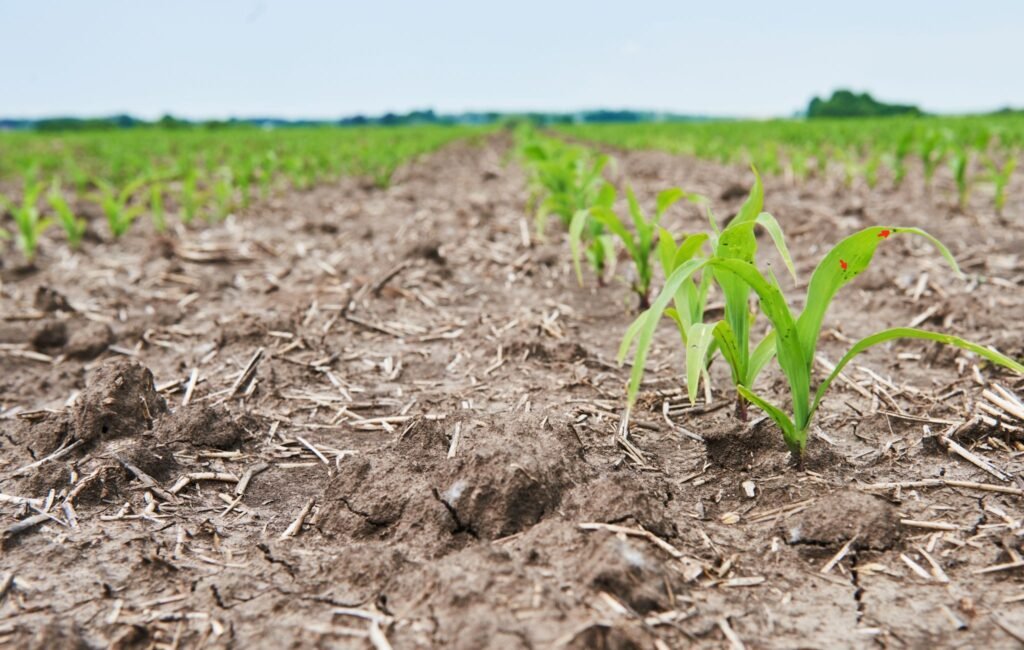
Zinc deficiency is growing in the Midwest, and it’s more likely to occur in corn than soybean fields. This is due in part to earlier planting of corn in cool and moist soil. Also, more residue resulting from conservation tillage and higher grain yields places added stress on seedlings to absorb Zn from soil.
Zinc deficiency can considerably impair crop health, leading to reduced yields and compromised quality. When zinc transport within the plant is disrupted, it hampers essential metabolic functions critical for growth. This micronutrient plays a pivotal role in enzyme activation and protein synthesis, both of which are fundamental for plant metabolism.
Without adequate zinc, plants struggle to produce chlorophyll, limiting photosynthesis and energy production.
Moreover, the deficiency affects hormone levels, impacting growth regulation and stress response mechanisms. As a result, crops become more susceptible to diseases and environmental stressors, ultimately reducing resilience and productivity.
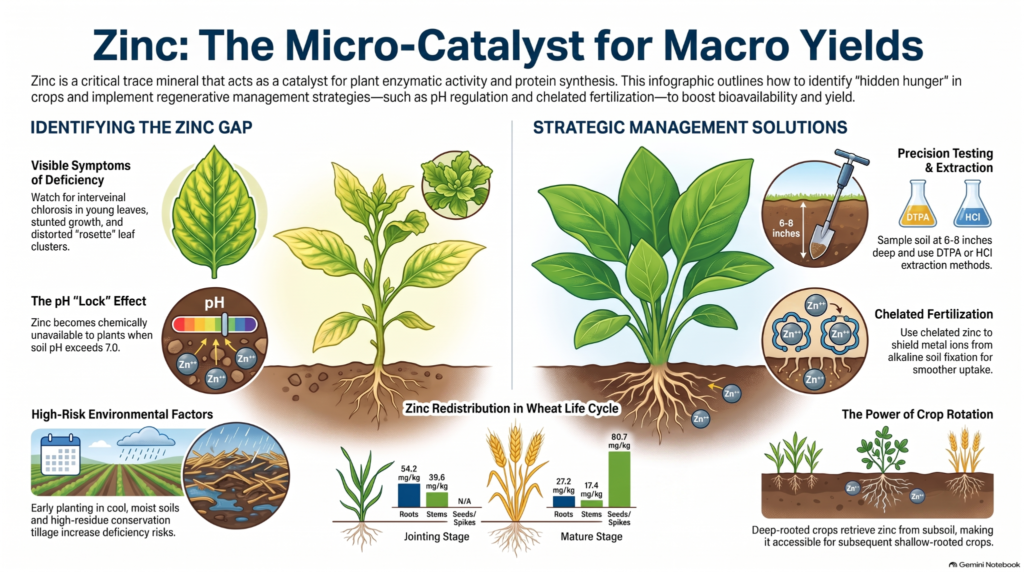
Identifying Symptoms of Zinc Deficiency in Crops
Zinc is usually present in soils in adequate amounts, except where development or grading removed topsoil. More commonly, plants cannot adequately absorb the zinc that is present because of an adverse soil environment or inappropriate cultural practices. Example causes of zinc deficiency include soil that is abnormally high in organic matter or sand or high in pH. Unhealthy roots (e.g., from crushing or other physical injury, soil-dwelling nematodes, or root decay pathogens) and poor irrigation practices (e.g., overwatering and waterlogging) can also cause plants to develop zinc deficiency symptoms.
Recognizing the symptoms of zinc deficiency in crops is essential for timely intervention and management. You’ll want to look for specific crop symptoms that indicate a lack of this vital micronutrient.
One key sign is the presence of chlorosis, where young leaves exhibit yellowing between the veins while the veins remain green. Additionally, you may notice stunted growth, reduced leaf size, and delayed maturity.
In some crops, particularly maize and wheat, you might observe the formation of small, distorted leaves or a rosette effect, where leaves cluster tightly at the top of the plant.
These symptoms can severely impact yield potential if not addressed promptly. Monitoring your crops for these indicators allows you to implement effective strategies to mitigate zinc deficiency, ensuring ideal growth and productivity.
Keep an eye on these signs to secure a healthier crop and maximize your farm’s potential.
How to Test Soil Zinc Levels?
How can you accurately assess the zinc levels in your soil? Start with soil sampling, taking multiple samples from different areas of your field to guarantee representative results. Aim for a depth of 6-8 inches, as this is where roots primarily absorb nutrients.
Once you’ve collected your samples, it’s essential to perform zinc extraction using a suitable chemical method, like DTPA or HCl, to release the zinc for accurate measurement.
Consider these factors to heighten your awareness of soil health:
- Nutrient balance: Zinc is critical for crop development.
- Crop yield potential: Higher zinc levels can boost productivity.
- Soil sustainability: Maintaining mineral balance preserves ecosystem health.
- Economic impact: Optimized yields translate to better profitability.
- Innovative solutions: Testing opens doors to advanced soil management strategies.
Effective Soil Amendments to Fix Zinc Deficiency
When addressing zinc deficiency in soil, selecting the right amendments can greatly enhance nutrient availability and crop health. Zinc fertilizers, such as zinc sulfate or chelated zinc compounds, are effective options that increase zinc levels efficiently.
It’s essential to take into account soil pH when applying these amendments, as higher pH levels can limit zinc availability. Ideally, maintaining a soil pH between 6.0 and 7.0 optimizes nutrient uptake.
Additionally, incorporating organic matter, like compost or manure, can improve soil structure and enhance zinc mobility. These eco friendly products can also promote beneficial microbial activity, further facilitating nutrient cycling. These organic amendments not only supply zinc but also promote beneficial microbial activity, further facilitating nutrient cycling.
Regular soil testing helps you monitor zinc levels and pH adjustments, ensuring targeted applications.
Adopting these innovative strategies won’t only rectify zinc deficiency but also contribute to long-term soil fertility and increased crop yields, enhancing overall agricultural productivity.
Top Strategies for Effective Zinc Fertilization
Zinc deficiency is associated with Sulfur deficiency. It can occur in neutral and calcareous soils, intensively cropped soils, paddy soils and very poorly drained soils, sodic and saline soils, peat soils, soils with high available Phosphorus (P) and Silicon (Si) status, sandy soils, highly weathered, acid, and coarse-textured soils, soils derived from serpentine and laterite, and leached, old acid sulfate soils with a small concentration of Potassium (K), Magnesium (Mg), and Calcium (Ca).
What strategies can you implement to confirm effective zinc fertilization in your soil?
To maximize your zinc application, consider the following top strategies:
- Select the right zinc sources: Use chelated forms for better absorption.
- Enhance application timing: Apply zinc during critical growth stages for maximum impact.
- Monitor soil pH: Verify your soil pH is in the ideal range to enhance zinc availability.
- Utilize foliar applications: Supplement soil treatments with foliar sprays for immediate uptake.
- Employ precision agriculture techniques: Use soil testing and variable rate technology for targeted applications.

HOW CROP ROTATION BOOSTS ZINC AVAILABILITY
While many farmers focus on fertilizer applications to address zinc deficiency, implementing a strategic crop rotation can greatly enhance zinc availability in the soil.
By introducing crop diversity, you not only break disease cycles but also promote varied root structures that improve soil aeration and organic matter decomposition, which can help manage nutrient interactions in soils affected by copper toxicity in soil. Different crops can access zinc at varying soil depths, facilitating better nutrient cycling.
For instance, deep-rooted crops can retrieve zinc from subsoil layers, making it more available for subsequent shallow-rooted crops. Furthermore, rotating legumes with cereals can boost soil nitrogen levels, indirectly enhancing zinc uptake efficiency.
This synergy creates a dynamic ecosystem that fosters microbial activity, further releasing bound zinc in the soil. By incorporating these practices, you can cultivate a resilient soil structure that maximizes zinc availability, ensuring healthier crops and improved yields.
Embracing crop rotation isn’t just innovative; it’s essential for sustainable farming practices.
Keeping Zinc Levels in Check for Healthy Farming
When addressing zinc deficiency, we have to look closely at the rhizosphere mechanisms that dictate nutrient mobility. In alkaline and calcareous soils, free zinc ions easily precipitate or bind tightly to mineral colloids, rendering them completely unreachable for plant roots. This is where engineering our soil biology becomes essential. Plants don’t just passively sit in dirt; under nutrient stress, roots actively secrete low-molecular-weight organic compounds, such as phytosiderophores, to solubilize and mine tightly bound zinc straight out of the mineral matrix.
We can actively support these natural biological pathways by utilizing chelated zinc amendments like citric acid complexes which shield the metal ions from alkaline soil fixation and allow smooth uptake. Simultaneously, fostering deep-rooting crop rotations and integrating quality compost does more than improve physical structure; it builds a vibrant microbial community that continually cycles bound micronutrients.
When you examine organic soil aggregates under digital microscopy, you see a living tapestry of fungal hyphae and bacterial colonies working symbiotically around root hairs. By diversifying root profiles and enhancing organic matter, we empower the soil’s own biology to do the heavy lifting of nutrient delivery naturally.
To maintain healthy farming practices, you need to recognize zinc deficiency symptoms in your crops, such as stunted growth and chlorosis.
Regular soil testing methods are essential for accurately evaluating zinc levels and determining the need for amendments.
Zinc Deficiency Symptoms
Zinc deficiency in soil manifests through a variety of symptoms that can considerably impact crop health and yield. Recognizing these symptoms is essential for maintaining ideal zinc levels.
When zinc sources are inadequate, you might observe:
- Stunted growth in plants
- Leaf chlorosis, particularly in younger leaves
- Poor fruit and seed development
- Increased susceptibility to diseases
- Reduced overall yield and quality
These deficiency impacts can lead to significant economic losses and diminished agricultural sustainability, particularly in areas affected by arsenic soil pollution.
By identifying these symptoms early, you can take proactive measures to replenish zinc levels, ensuring healthier crops and better productivity.
Understanding these signs empowers you to innovate and adapt your farming practices, fostering a more resilient agricultural ecosystem.
Soil Testing Methods
Recognizing zinc deficiency symptoms is just the beginning; effective management requires ongoing monitoring of soil health. To keep zinc levels in check, regular soil sampling is essential.
Start by selecting representative sites across your fields to guarantee thorough insights. Use advanced testing methods, like inductively coupled plasma (ICP) spectroscopy, for precise zinc quantification.
Establish a consistent testing frequency, ideally every 1-3 years, depending on crop needs and soil variability. This approach allows you to adapt fertilization strategies dynamically, optimizing zinc application and enhancing soil fertility.
RELATED STUDIES ABOUT ZINC DEFICIENCY IN SOIL
In summary, managing zinc deficiency is essential for enhancing soil fertility and maximizing crop yield. By identifying symptoms early and testing soil zinc levels, you can implement effective amendments and fertilization strategies. Don’t forget the benefits of crop rotation in boosting zinc availability. So, how will you guarantee your crops thrive in nutrient-deficient soil? By prioritizing zinc management, you can promote healthier farming practices and secure better harvests for the future.
Mechanisms behind zinc transport in a calcareous soil-wheat system and their impacts on human health
CONTEXT AND OBJECTIVES
Zinc deficiency is a critical global nutritional issue affecting nearly half of the world’s population, leading to impaired immune function, central nervous system defects, and growth retardation. Wheat serves as a staple crop and major mineral source globally, yet it is extensively grown in potentially zinc-deficient, calcareous soils (notably across northern China) characterized by high pH, high calcium carbonate levels, and low organic matter. These conditions cause strong zinc fixation and low bioavailability. This study analyzed the characteristics, internal transport dynamics, and biological mechanisms of zinc migration within a calcareous soil-wheat system to establish scientific strategies for increasing grain zinc content and addressing human micronutrient malnutrition.
METHODOLOGY
Outdoor pot experiments were conducted using the North China Plain wheat cultivar Shixin 828 grown in natural calcareous soil (pH 8.35–8.5). Six soil zinc concentration gradients were evaluated: an untreated control group (CK, 0 mg/kg) alongside exogenous additions of zinc sulfate (ZnSO4·7H2O) complexed with citric acid at gradients of 0.5, 0.75, 1.0, 2.0, and 6.0 mg/kg. Samples of rhizosphere soil, roots, stems, leaves, and mature spikes/seeds were collected during the jointing and mature stages to evaluate total/bioavailable zinc concentrations, enrichment coefficients, and transport coefficients.
KEY FINDINGS
Organ Distribution Across Growth Stages:
- Jointing Stage: Zinc concentrations decreased in the order of roots (average 54.2 mg/kg) > stems (average 33.6 mg/kg) > leaves (average 24.8 mg/kg), with zinc moving upward from roots via transpirational pull.
- Mature Stage: Zinc concentrations shifted significantly, decreasing in the order of seeds (average 80.7 mg/kg) > roots (average 27.2 mg/kg) > stems (average 17.4 mg/kg). Stored zinc redistributed from roots, stems, and leaf sheaths into developing seeds during grain filling.
- Overall Enrichment: Across the complete plant life cycle, zinc enrichment followed the descending order of seeds > roots > stems > leaves.
Zinc Migration and Transport Mechanisms:
- Under Zinc-Deficient Soil Conditions: Wheat roots experience deficiency stress and secrete low-molecular-weight organic compounds—specifically phytosiderophores belonging to the mugineic acid family. These phytosiderophores solubilize and activate fixed zinc in the rhizosphere, enhancing root uptake and yielding high transport coefficients (>3.7 in mature plants).
- Under Sufficient Exogenous Zinc Supply: Exogenously applied zinc chelated with citric acid ligands remains stable in alkaline soils. The chelation encapsulates Zn2+, minimizing contact with soil colloids, preventing precipitation as Zn(OH)2 or ZnCO3, and increasing the diffusion rate to the root surface, thereby enhancing plant uptake and translocation.
Soil Zinc Concentration Gradients:
- Non-Linear Grain Accumulation: Seed zinc accumulation did not follow a direct linear correlation across soil concentration gradients.
- Moderate Gradient (1.0 mg/kg): Produced the lowest average seed zinc concentration (68.6 mg/kg; a 13.12% reduction compared to control), because roots neither activated stress-induced phytosiderophore secretion nor received sufficient exogenous zinc saturation.
- High Gradient (6.0 mg/kg): Yielded the highest degree of seed enrichment and highest average seed zinc concentration (88.9 mg/kg; a 12.55% increase over control).
PRACTICAL IMPLICATIONS AND PUBLIC HEALTH
- Agronomic Biofortification: Applying chelated zinc fertilizers (e.g., citric acid-complexed zinc) directly addresses zinc fixation in alkaline, calcareous soils.
- Dosage Thresholds: Because intermediate concentrations (1.0 mg/kg) suppress seed zinc accumulation efficiency, fertilization programs in calcareous soils must avoid intermediate sub-optimal rates and target higher, regulated compensation thresholds (up to 6.0 mg/kg).
- Health Impact: Strategic zinc biofortification in staple wheat provides a scalable, cost-effective intervention to alleviate zinc-related “hidden hunger” and advance Sustainable Development Goal 3 (Good Health and Well-being) in populations dependent on wheat grown in calcareous regions.
| REFERENCE: Su-rong Zhang, Jun-quan Yang, Da-ming Wang, Xue-sheng Gao, Ji-hong Liu, Jing Zhang, Xiao-long Duan, Jian-hua Wang, Ling-zhi Yang, Mechanisms behind zinc transport in a calcareous soil-wheat system and their impacts on human health, China Geology, Volume 8, Issue 3, 2025, Pages 573-585, ISSN 2096-5192, https://doi.org/10.31035/cg2024150. (https://www.sciencedirect.com/science/article/pii/S2096519225000953) |
Utilization of geopolymerisation process for the simultaneous stabilization/solidification of lead/zinc mine tailings and enhancement of expansive subgrade soil
CONTEXT AND OBJECTIVES
Mining industries generate massive volumes of hazardous mine tailings containing heavy metals such as lead and zinc, which pose significant environmental, ecological, and groundwater contamination risks when stockpiled in tailing ponds or landfills. Concurrently, expansive soils (such as Black Cotton Soil) create severe structural challenges in geotechnical and highway engineering due to their high swell-shrink potential, high plasticity, and low load-bearing capacity. This study investigated the application of geopolymerisation as a dual-purpose, sustainable stabilization/solidification (S/S) method to immobilize lead-zinc mine tailings (LZMT) while enhancing the mechanical and subgrade engineering properties of expansive soil. In addition, statistical and machine learning regression models were developed to predict the unconfined compressive strength (UCS) of the geopolymer-treated soil.
MATERIALS AND EXPERIMENTAL METHODOLOGY
- Materials: Natural expansive Black Cotton Soil classified as A-7-5(38) / CH from Benue State, Nigeria; dual aluminosilicate precursors comprising LZMT from Ebonyi State, Nigeria and metabentonite (MB, produced by calcining bentonite at 800 degrees Celsius); and sodium hydroxide (NaOH) solution as the alkaline activator.
- Experimental Design: A Taguchi L9 orthogonal array design was used to optimize experimental combinations across three key factors: LZMT content (10%, 15%, 20%), MB content (10%, 15%, 20%), and NaOH molarity (3 M, 5 M, 7 M) across nine mix formulations (T1 to T9).
- Geotechnical Testing: Laboratory evaluations included modified British Standard Light compaction to determine Maximum Dry Density (MDD) and Optimum Alkali Concentration Content (OACC), California Bearing Ratio (CBR) tests at 7 days of curing, and UCS tests across curing ages of 1, 7, 28, and 56 days.
- Microstructural and Predictive Modeling: Scanning Electron Microscopy (SEM) and Energy Dispersive X-ray Spectroscopy (EDS) were conducted alongside six regression/machine learning algorithms: Multilinear Regression (MLR), Ridge Regression, LASSO Regression, Elastic-Net Regression, Gaussian Process Regression (GPR), and Relevance Vector Regression (RVR).
KEY FINDINGS AND MECHANISMS
Mechanical Strength Performance (UCS and CBR):
- Optimal Mix Formulation: Mix T7 (20% LZMT, 10% MB, and 7 M NaOH) yielded the highest engineering performance.
- UCS Development: Strength increased progressively with curing time across all mixes due to ongoing geopolymer gel formation. At 56 days of curing, mix T7 achieved the maximum UCS of approximately 1700 kN/m2 (compared to early 1-day values of 110 to 300 kN/m2 across mixes).
- CBR Enhancement: The unsoaked CBR of the optimum mix (T7) reached 76.5% (compared to baseline expansive soil CBR and lower-performing mixes around 10% to 13%), demonstrating sufficient bearing capacity for subgrade and selected subbase pavement applications.
- Influencing Factors: High alkaline concentration (7 M NaOH) significantly promoted the dissolution of silica and alumina from both LZMT and MB. LZMT actively participated in geopolymeric bonding and granular interlocking rather than acting merely as an inert filler. Excessive MB content (20%), however, increased fines and reduced penetration resistance.
Microstructural Mechanisms:
- Untreated expansive soil exhibited an irregular, loosely packed, and highly fragmented structure.
- Geopolymer-stabilized soil displayed a dense, compact, and cohesive microstructure resulting from the synthesis of sodium aluminosilicate hydrate (N-A-S-H) gel, which bonded soil particles and refined pore structures.
Predictive Modeling Assessment:
- Elastic-Net Regression emerged as the superior model for predicting 28-day UCS, achieving coefficient of determination (R2) values of 0.992 on training data and 0.914 on testing data, alongside the lowest overall statistical error metrics (RMSE = 23.665, MAE = 21.421, MAPE = 3.792% on testing data).
- The superior generalization and accuracy of Elastic-Net were attributed to its simultaneous handling of variable selection and coefficient shrinkage penalties, outperforming standard MLR, Ridge, and LASSO. GPR and RVR yielded higher testing errors, primarily due to the limited sample size of the experimental design.
ENGINEERING AND ENVIRONMENTAL IMPLICATIONS
- Sustainable Waste Valorization: Geopolymerisation successfully upcycles industrial hazardous mine tailings into valuable construction materials, lowering the demand for traditional cement binders and reducing mining waste accumulation.
- Pavement Construction Suitability: The significant gains in load-bearing capacity (CBR of 76.5% and UCS up to 1700 kN/m2) validate the suitability of this geopolymeric binder system for highway subgrade stabilization and flexible pavement subbase layers.
- Future Research Needs: While mechanical and microstructural performance is confirmed, future work must incorporate standardized leaching protocols (such as TCLP and SPLP) to quantitatively verify heavy metal immobilization, as well as soaked CBR, swell-shrink, and wetting-drying durability testing to evaluate long-term field stability under environmental cyclic loading.
| REFERENCE: Chijioke Christopher Ikeagwuani, Idorenyin Ndarake Usanga, Kingsley Chinedu Ugwu, Hilda Chidera Olisakwe, Yuel Okey Kalu, Utilization of geopolymerisation process for the simultaneous stabilization/solidification of lead/zinc mine tailings and enhancement of expansive subgrade soil, Next Materials, Volume 13, 2026, 102594, ISSN 2949-8228, https://doi.org/10.1016/j.nxmate.2026.102594. (https://www.sciencedirect.com/science/article/pii/S2949822826010117) |
Identification of nutrient deficiency stress for iron, zinc and manganese in baby spinach using computer vision
CONTEXT AND OBJECTIVES
In controlled-environment greenhouse and hydroponic agriculture, monitoring crop nutritional needs is essential for preventing quality degradation and yield loss. Conventional laboratory testing methods for plant nutrients are destructive, labor-intensive, time-consuming, and expensive. This study developed a non-destructive computer vision and machine learning methodology to detect deficiency stress for three essential micronutrients—iron (Fe), manganese (Mn), and zinc (Zn)—at early developmental stages in baby spinach (Spinacia oleracea).
METHODOLOGY
- Cultivation: Hydroponic cultivation of 78 baby spinach samples was conducted in perlite trays inside a greenhouse under controlled environmental conditions. Treatments comprised five concentration levels: 0%, 25%, 50%, 75%, and 100% (control) of the recommended Hoagland nutrient solution for Fe, Mn, and Zn independently.
- Image Acquisition: A total of 1,092 high-resolution RGB images were captured under standardized morning lighting conditions every two days over a 6-week cultivation period, starting from the expansion of the first true leaf (Day 1).
- Feature Extraction and Selection: Image preprocessing and Otsu adaptive threshold segmentation were performed to extract plant canopy areas. A comprehensive feature set was extracted, including color spaces (RGB, rgb, Lab, HSV, XYZ, I1I2I3, h*, Chroma), morphological area, and Gray Level Co-occurrence Matrix (GLCM) texture metrics across five distances and four directions. Sequential Floating Backward Selection (SFBS) achieved the highest correct classification rate (CCR = 0.556) among tested feature selection algorithms (SFS, SBS, SFFS, ReliefF) and was chosen to rank input features.
- Machine Learning Classification: Five classifiers—Artificial Neural Network (ANN/Multilayer Perceptron), K-Nearest Neighbors (KNN), Random Forest (RF), Support Vector Machine (SVM), and Naive Bayes (NB)—were evaluated across binary, five-class, and thirteen-class output scenarios.
KEY FINDINGS
Classifier Performance Hierarchy:
- Across all evaluated complexity levels, ANN consistently demonstrated the highest overall performance, achieving a mean accuracy of 51.43%, followed by KNN (45.96%), RF (40.73%), SVM (40.16%), and NB (38.70%).
- Across all evaluation metrics (overall mean Precision = 67.24%, Recall = 66.57%, F1-score = 65.54%), ANN remained superior, driven by its capacity to model non-linear agricultural image patterns.
Performance by Classification Complexity:
- Binary Classification (Control vs. Single Deficiency Level): Classifiers achieved their highest efficacy, with ANN reaching an average accuracy of 89.5% (Fe: 92.7%, Zn: 88.3%, Mn: 83.3%).
- Five-Class Classification (Control vs. Four Severity Levels per Nutrient): Average accuracy dropped below 50%, with ANN achieving 47.8%, KNN 40.1%, RF 30.4%, NB 30.0%, and SVM 29.3%.
- Thirteen-Class Classification (Simultaneous Diagnosis of All Nutrients and Levels): Performance dropped significantly below 20% across all models due to feature overlap among deficiency symptoms, with ANN achieving 17.0% and KNN 16.0%.
Early Sub-Visual Detection:
- At the onset of cultivation (Day 1, when the first true leaf expanded), the ANN classifier detected deficiencies with initial accuracies of 88% for Fe, 84% for Mn, and 76% for Zn.
- The computer vision system identified nutrient stress conditions up to two weeks before visual symptoms were distinguishable by human observers.
Hierarchical Decision Framework:
- A three-stage hierarchical ANN model was implemented to manage multiclass complexity by structuring decisions sequentially: 1) screening healthy vs. deficient plants, 2) classifying nutrient type (Fe, Mn, Zn), and 3) predicting severity level (0%, 25%, 50%, 75%).
- This hierarchical structure achieved an overall accuracy of 72.97% (plus or minus 0.54%) with mean Precision of 69.34%, Recall of 70.70%, and F1-score of 68.34%.
PRACTICAL AND COMMERCIAL IMPLICATIONS
- Non-Destructive Monitoring: Integrating automated computer vision systems into commercial greenhouse environments enables timely, sub-visual detection of micronutrient deficiencies, allowing corrective fertigation before irreversible crop damage or yield reductions occur.
- Technical Limitations: Fine-grained severity differentiation remains challenging using standard RGB imaging alone due to overlapping phenotypic symptoms among different micronutrient stresses.
- Future Directions: Incorporating spectral or hyperspectral imaging is recommended to extract deeper biochemical data, alongside evaluating multi-environment and cross-cultivar datasets to enhance model generalizability under commercial field and greenhouse conditions.
| REFERENCE: Maryam Nadafzadeh, Ahmad Banakar, Saman Abdanan Mehdizadeh, Saeid Minaei, Abdul Mounem Mouazen, Gerrit Hoogenboom, Identification of nutrient deficiency stress for iron, zinc and manganese in baby spinach using computer vision, Smart Agricultural Technology, Volume 12, 2025, 101524, ISSN 2772-3755, https://doi.org/10.1016/j.atech.2025.101524. (https://www.sciencedirect.com/science/article/pii/S2772375525007555) |
CONCLUSION
If there is one core principle my research in ecosystem engineering has reinforced, it is that sustainable soil health is built on systemic balance, not reactionary interventions. Addressing zinc deficiency is far more than a routine seasonal checklist to prevent leaf chlorosis or yield decline; it is a fundamental commitment to the long-term nutritional integrity of our food web. Micronutrient deficiencies in soil directly translate to micronutrient deficiencies in our staple crops, which ripples outward to impact human health on a global scale.
Rather than relying exclusively on heavy synthetic applications after symptoms manifest, modern environmental stewardship demands precision: regular diagnostic testing, early stress monitoring, pH stabilization, and the deliberate restoration of biological soil diversity. When we treat soil as a complex living ecosystem and engineer our management strategies to support natural nutrient cycles, the soil rewards us with natural resilience.
By prioritizing the microscopic biological processes happening beneath our feet today, we cultivate fertile ground, high-yielding crops, and a more sustainable agricultural future for generations to come.