
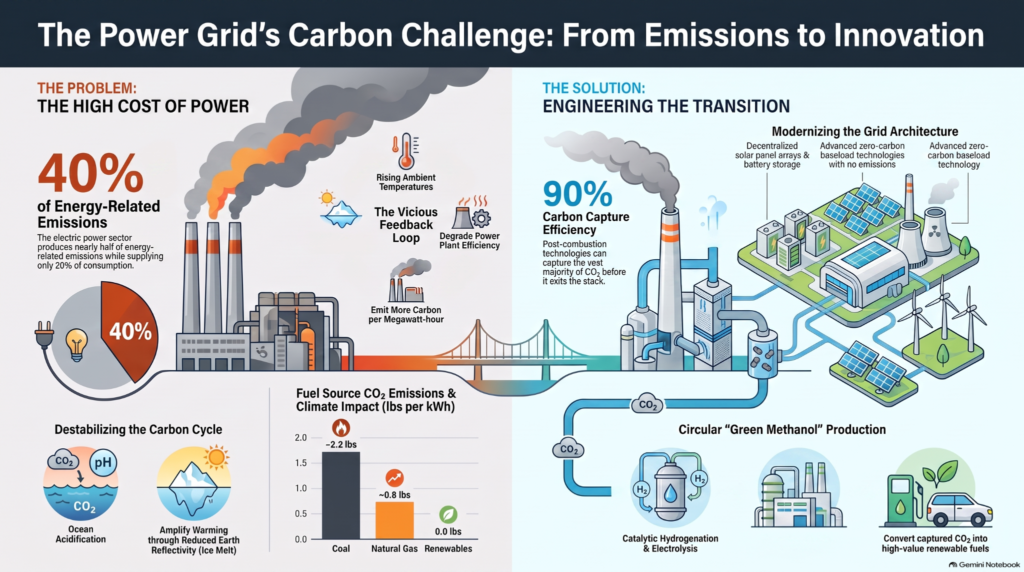
Having spent over 14 years working directly with power generation systems and grid architecture, I often encounter people who view electricity as something inherently clean simply because there isn’t a tailpipe attached to their home appliances. But when you look at the macro thermodynamic ledger, the picture changes entirely. The electric power sector sits right at the heart of our climate challenge. It produces more than 40% of all energy-related carbon emissions while supplying only about a fifth of our end-use energy consumption.
In my early career analyzing plant operational metrics, what struck me most was the sheer volume of fuel required just to turn turbine shafts against massive parasitic losses. We are essentially burning ancient hydrocarbons at tremendous environmental cost to satisfy an increasingly electrified world.
Understanding the exact mechanisms through which these centralized generation facilities impact our atmosphere is not merely an academic exercise; it is the baseline requirement for engineering our way out of it. We cannot fix what we do not precisely measure, and demystifying the direct line between stationary combustion stacks and planetary warming is where real systemic change starts.
Carbon dioxide emissions from power plants, primarily from burning fossil fuels like coal, oil, and natural gas, greatly drive global warming. For example, coal emits about 2.2 pounds of CO2 per kilowatt-hour, contributing to increased atmospheric CO2 levels. This disrupts the carbon cycle, leading to climate feedback loops, ocean acidification, and extreme weather events. As you explore this topic further, you’ll discover innovative solutions and alternatives to mitigate these impacts effectively.
KEY TAKEAWAYS
- Power plants emit significant carbon dioxide through fossil fuel combustion, primarily from coal, oil, and natural gas.
- Increased atmospheric CO2 disrupts the carbon cycle, leading to climate feedback loops that amplify global warming.
- Elevated CO2 levels contribute to ocean acidification, harming marine ecosystems and biodiversity.
- Power plant emissions destabilize weather patterns, resulting in extreme weather events like droughts and floods.
- Urgent transition to renewable energy sources is essential to mitigate CO2 emissions and combat climate change effectively.
HOW POWER PLANTS CONTRIBUTE TO GLOBAL WARMING
Energy-related greenhouse gas emissions account for the majority of all anthropogenic emissions – about 80% in the USA and the European Union, for example. Just 20% of final energy consumption is in the form of electricity, but the generation of electricity is responsible for over 40% of all energy-related emissions.
Power plants considerably contribute to global warming, primarily through the combustion of fossil fuels like coal, oil, and natural gas. These energy sources release significant power plant emissions, including carbon dioxide, methane, and nitrous oxide, which amplify greenhouse gas effects in the atmosphere.
When you consider that power plants are among the largest contributors to greenhouse gases, it becomes clear how urgent the need for innovation is. Shifting to renewable energy sources such as solar, wind, and hydroelectric power can drastically reduce these harmful emissions.
By investing in cleaner technologies, you not only mitigate the detrimental impacts of power plant emissions but also foster a sustainable energy future. Furthermore, implementing carbon capture and storage techniques can further lower the greenhouse gases released from existing plants.
Addressing this issue is pivotal in combating climate change and ensuring a healthier planet for future generations.
Impact of Carbon Dioxide on Climate
The emissions from power plants greatly increase the concentration of carbon dioxide (CO2) in the atmosphere, leading to profound changes in the Earth’s climate. Elevated CO2 levels disrupt the carbon cycle, affecting natural processes and exacerbating climate feedback mechanisms.
As you might know, these feedback loops can amplify warming; for instance, melting ice reduces the Earth’s reflectivity, causing more heat absorption.
Moreover, increased CO2 contributes to ocean acidification, threatening marine ecosystems that play a significant role in carbon sequestration. As power plants continue to emit large quantities of CO2, they not only intensify global warming but also destabilize weather patterns, leading to extreme events like droughts and floods.
Understanding this impact is essential for innovation in energy solutions, as mitigating CO2 emissions could help restore balance to the carbon cycle and stabilize our climate.
Addressing these emissions is an important step in combating climate change effectively.
How Fossil Fuels Power Our Energy Needs
There are more than 3,400 fossil fuel-fired power plants in the U.S. Collectively, these power plants are the largest stationary source category of nitrogen oxides (NOX) and sulfur dioxide (SO2) emissions and a significant source of mercury (Hg) and fine particle emissions. Fossil fuel-fired power plants are also a significant source of emissions of carbon dioxide (CO2), an important greenhouse gas.
Fossil fuels—coal, oil, and natural gas—are the backbone of our energy production, powering everything from homes to industries.
Understanding the energy production process reveals how these resources convert into electricity and heat, fueling modern life.
However, it’s essential to assess the environmental impact of relying on these fuels, especially in the context of rising carbon dioxide emissions and climate change.
Fossil Fuels Overview
As energy demands continue to rise globally, understanding how fossil fuels meet these needs becomes important. Fossil fuels—coal, oil, and natural gas—have powered industries, homes, and transportation for decades. However, as society shifts towards fossil fuel alternatives, it’s essential to analyze their role in the ongoing energy change.
| Fossil Fuel Type | Primary Use | Environmental Impact |
| Coal | Electricity | High CO2 emissions |
| Oil | Transportation | Air pollution, spills |
| Natural Gas | Heating, Power | Lower emissions than coal |
While fossil fuels currently dominate energy production, innovation in renewable resources is critical for sustainable progress, ensuring a cleaner future while addressing global warming.
Energy Production Process
While many people recognize fossil fuels as a primary energy source, understanding the energy production process reveals how they efficiently convert into usable power.
Fossil fuels, like coal, natural gas, and oil, undergo combustion in power plants, releasing heat energy. This heat drives turbines, initiating mechanical energy conversion. The efficiency of this process, known as thermal efficiency, is essential; it determines the amount of energy extracted from the fuel versus what’s wasted.
Advanced technologies, such as combined cycle systems, enhance this efficiency by capturing and reusing exhaust heat.
As you explore innovations in energy production, consider how optimizing energy conversion can reduce reliance on fossil fuels, ultimately addressing the broader challenges of global warming and energy sustainability.
Environmental Impact Assessment
Understanding the environmental impact of fossil fuels is essential for evaluating how they power our energy needs. Fossil fuels, while efficient for energy production, contribute considerably to carbon dioxide emissions, necessitating thorough ecological assessments.
These assessments help you identify potential harm to ecosystems, air quality, and public health. Compliance with environmental regulations is vital in mitigating these impacts, as they guide the development and operation of power plants.
By prioritizing innovative energy solutions, you can reduce reliance on fossil fuels and explore cleaner alternatives. Investing in renewable energy sources can create a sustainable energy future, minimizing adverse environmental effects while meeting growing energy demands.
Ultimately, understanding these dynamics is key to informed decision-making and fostering a healthier planet.
Comparing Carbon Emissions From Coal, Natural Gas, and Renewables
Natural gas emissions rose by around 2.5% (180 Mt CO₂) in 2024, making it the largest contributor to global carbon emissions growth. This increase was driven by higher consumption in China, the United States, the Middle East, and India.
When evaluating the impact of energy sources on carbon emissions, it’s crucial to compare coal, natural gas, and renewables directly. Coal remains the highest emitter, releasing approximately 2.2 pounds of CO2 per kilowatt-hour generated. In contrast, natural gas, though still a fossil fuel, emits about 0.9 pounds per kilowatt-hour, making it a cleaner alternative in the coal versus natural gas debate.
However, both fall short when stacked against renewables. Wind, solar, and hydroelectric power generate electricity without direct carbon emissions, presenting a sustainable solution to our energy needs.
Renewable energy comparisons reveal that while natural gas may serve as an interim fuel, the ultimate goal must be a shift toward renewables. By investing in innovative technologies and infrastructure for renewables, you can notably reduce overall carbon emissions, contributing to a healthier planet and a sustainable future.

EMERGING TECHNOLOGIES TO CUT CARBON EMISSIONS FROM POWER PLANTS
When evaluating power plant emissions, engineering nuance matters immensely. Far too often, public debates treat all generation assets as static, monolithic emitters. In reality, as recent empirical modeling of natural gas turbines shows, plant emissions fluctuate significantly based on ambient temperature, humidity, and compression ratios. Higher intake temperatures degrade net thermal efficiency, meaning that as regional climates warm, thermal plants can actually become less efficient and emit more carbon per megawatt-hour generated. It’s a vicious feedback loop that rarely gets discussed outside specialized research circles.
Furthermore, while transitional strategies like high-efficiency Combined Heat and Power (CHP) provide measurable short-term carbon intensity reductions in fossil-heavy grids, their net climate benefit diminishes rapidly as the wider power grid decarbonizes. Through my work modeling energy storage and grid-scale solar integration, I’ve seen firsthand that technological add-ons whether post-combustion carbon capture or catalytic conversion into e-fuels must be evaluated honestly alongside direct renewable replacement.
Carbon capture and circular utilization have a distinct role to play in hard-to-abate sectors, but we must account for the substantial energy penalties involved. True sustainability requires optimizing system-wide efficiency while deploying scalable storage that allows renewables to handle base-load demands reliably.
As you explore emerging technologies to reduce carbon emissions from power plants, consider carbon capture technologies that can markedly lower atmospheric CO2 levels.
Integrating renewable energy sources with traditional power generation also plays an essential role in minimizing emissions.
Additionally, advanced nuclear solutions offer a promising path to cleaner energy production while maintaining reliability.
Carbon Capture Technologies
Carbon capture technologies are revolutionizing how power plants address carbon emissions, providing viable solutions that can substantially reduce their environmental impact.
Through recent technology advancements, these systems efficiently capture up to 90% of CO2 emissions before they enter the atmosphere. You can explore various methods, such as post-combustion capture, where solvents absorb CO2 from flue gases, or pre-combustion capture, which focuses on removing carbon before combustion occurs.
Emerging innovations, like direct air capture, further enhance efficiency by extracting CO2 directly from the air. By integrating carbon capture into existing infrastructure, power plants can substantially lower their carbon footprint.
Investing in these technologies not only helps combat climate change but also positions you at the forefront of sustainable energy solutions, including the adoption of eco friendly products.
Renewable Energy Integration
Integrating renewable energy sources into power generation is essential for reducing carbon emissions and combating climate change. and wind energy, you can greatly decrease reliance on fossil fuels.
However, effective energy storage solutions are vital for managing intermittent supply. Smart grids facilitate grid integration, allowing for real-time adjustments and maximizing efficiency.
Policy incentives can further accelerate the adoption of decentralized generation, enabling communities to produce energy locally. Hybrid systems that combine different renewable sources optimize energy output while enhancing reliability.
As you explore these innovative technologies, you’ll find that a collaborative approach to energy change not only mitigates emissions but also fosters sustainable economic growth. Embrace this shift and contribute to a cleaner, greener future.
Advanced Nuclear Solutions
While traditional nuclear power has faced criticism over safety and waste concerns, advanced nuclear solutions are emerging as a promising avenue to considerably reduce carbon emissions from power plants.
Innovations like small modular reactors (SMRs) and advanced reactor designs enhance energy efficiency while prioritizing nuclear safety. These technologies are designed to operate at higher temperatures and utilize fuel more effectively, minimizing waste and maximizing output.
Additionally, they can be deployed more flexibly, integrating seamlessly with renewable energy sources. By adopting advanced nuclear solutions, you’ll not only help reduce reliance on fossil fuels but also address climate change proactively.
Embracing these innovations could redefine your energy landscape, making it cleaner and more sustainable for future generations.
What Are the Best Alternatives to Fossil Fuels?
As the world seeks to mitigate climate change, exploring effective alternatives to fossil fuels becomes essential.
Solar energy harnesses the sun’s power, offering a clean, renewable source that’s rapidly advancing in efficiency. Wind power, with its vast potential, generates electricity without emissions, making it a strong contender.
Biofuels provide benefits such as reduced greenhouse gas emissions when sourced sustainably, while geothermal energy taps into the Earth’s heat for reliable energy generation. Hydropower, with its immense potential, can produce significant electricity while supporting local ecosystems if managed wisely.
To further enhance sustainability, energy efficiency in buildings and industries is essential, reducing overall consumption. Electric vehicles are changing the transportation landscape, drastically lowering emissions when combined with renewable energy sources.
Finally, energy storage technologies are critical for balancing supply and demand, ensuring that renewable energy can be utilized effectively. Shifting to these alternatives isn’t just beneficial; it’s imperative for a sustainable future.
The Urgent Need for Transitioning to Sustainable Energy Sources
Shifting to green energy is essential not only for combating climate change but also for ensuring energy security and public health.
By embracing innovative technologies and sustainable practices, you can greatly reduce carbon dioxide emissions from power plants. Moving to renewable energy sources like solar, wind, and hydroelectric power enhances energy efficiency, which minimizes waste and maximizes output.
Moreover, integrating energy-efficient designs in infrastructure can lower consumption rates and decrease reliance on fossil fuels. This change not only mitigates environmental impacts but also fosters economic growth through job creation in the green energy sector.
Incorporating smart grids and energy storage solutions further enhances the reliability of renewable energy, ensuring a stable supply.
As you advocate for this shift, you’ll contribute to a healthier planet and a more sustainable future, benefiting both current and future generations.
The time for action is now—embrace the change.
RELATED STUDIES ABOUT CARBON DIOXIDE EMISSIONS FROM POWER PLANTS
As you reflect on the impact of carbon dioxide emissions from power plants, envision a world where the air is crisp and clear, free from the haze of pollution. Shifting to sustainable energy sources isn’t just a choice; it’s a necessity. By embracing renewables and innovative technologies, you can help pave the way for a healthier planet. The urgency of this change is undeniable, and together, we can forge a future that’s not just livable, but thriving.
Analysis of “green methanol” production from carbon dioxide acquired from negative emission power plants using CFD approach for catalytic reactor
Overview and Context
This study investigates the synthesis of green methanol by combining carbon dioxide (CO2) captured from a negative emission power plant (nCO2PP) with hydrogen (H2) generated via water electrolysis. Using a computational fluid dynamics (CFD) approach integrated with chemical kinetics, the research evaluates how key operational parameters—primarily operating pressure and feed inlet velocity—impact methanol yield within a catalytic fixed-bed reactor.
Research Methodology and Modeling
- CFD Framework: The study implements a User-Defined Function (UDF) written in C within commercial ANSYS Fluent software to model reaction kinetics, species adsorption/desorption, and mass sources directly onto catalytic surfaces.
- Chemical Reactions Considered:
- Direct CO2 hydrogenation: CO2 + 3H2 ⇌ CH3 OH + H2 O
- CO hydrogenation: CO + 2H2 ⇌ CH3 OH
- Reverse Water Gas Shift (RWGS): CO2 + H2 ⇌ CO + H2 O
- Direct CO2 hydrogenation: CO2 + 3H2 ⇌ CH3 OH + H2 O
- Reactor Geometry: A staggered (chessboard) arrangement of cylindrical catalyst pellets was simulated, chosen for its demonstrated superior yield in 2D configurations.
- Validation: Flow dynamics and heat transfer models were systematically validated against literature benchmarks using single-cylinder and multi-cylinder (77-cylinder) configurations across Reynolds numbers Re = 10 – 100).
Key Findings
A. Impact of Operating Pressure
- Increasing reactor operating pressure from 4 MPa to 6 MPa (at a constant velocity of 0.123 m/s and temperature of 250℃) significantly enhanced the conversion rate.
- The maximum mass fraction of methanol increased from 0.088 (8.8%) at 4 MPa to 0.107 (10.7%) at 5 MPa, reaching 0.125 (12.5%) at 6 MPa.
- Higher pressures accelerate the reaction equilibrium toward product formation earlier in the catalytic bed rows.
B. Impact of Feed Velocity
- Feed inlet velocity was tested across 0.0615 m/s to 1.230 m/s at a constant pressure of 5 MPa and temperature of 250℃.
- Lower velocities promoted higher methanol yields due to increased residence time over the catalyst bed.
- At the lowest velocity (0.0615 m/s), a maximum methanol mass fraction of 0.111 was achieved.
- Increasing velocity reduced the yield: it dropped to 0.044 at 0.615 m/s and down to 0.027 at 1.230 m/s.
C. Outlet Yield Performance
- The simulated single-stage reactor achieved an outlet methanol mass fraction between 4% and 10% (up to 11% locally), comparing favorably with existing academic literature and commercial industrial methods (e.g., Lurgi, Haldor Topsoe, LPMeOH).
Integration with Negative Emission Power Plant (nCO2PP)
- Plant Capacity: For an nCO2PP facility utilizing sewage sludge gasification, the captured CO2 mass flux was evaluated at m = 22.0 g/s (equivalent to a volumetric flow of 41.6 m^3 ᐧ h).
- Reactor Sizing: Based on the feed consumption rate (6 m^3/kg_cat ᐧ h), the authors estimate that 7 modular reactors of the proposed configuration are needed to utilize the entire CO2 stream from the power plant.
Strategic Insights and Conclusions
- Operating Balance: While elevated pressures (6 MPa) optimize conversion rates, commercial applications must balance this against higher compression costs.
- Flow Optimization: Lower inlet velocities maximize residence time and single-pass conversion, whereas higher velocities induce vortex merging and reduce contact time.
- Catalytic Efficiency: Utilizing selective catalysts helps lower activation energy for desired reactions, allowing high production rates without requiring excessively severe pressures.
- Decarbonization Value: Integrating catalytic green methanol synthesis with negative-emission power generation provides a circular pathway for converting captured industrial CO2 into high-value chemical feedstocks and renewable fuels.
| REFERENCE: Sylwia Oleś, Paweł Ziółkowski, Dariusz Mikielewicz, Analysis of “green methanol” production from carbon dioxide acquired from negative emission power plants using CFD approach for catalytic reactor, Renewable Energy, Volume 240, 2025, 122160, ISSN 0960-1481, https://doi.org/10.1016/j.renene.2024.122160. (https://www.sciencedirect.com/science/article/pii/S0960148124022286) |
A novel empirical model for predicting the carbon dioxide emission of a gas turbine power plant
Overview and Purpose
Carbon dioxide is the predominant greenhouse gas emitted by gas turbine power plants. Conventional estimation techniques typically rely on generalized emission factors or time-series models that do not account for site-specific environmental conditions. This research develops and validates a novel empirical predictive model to evaluate carbon dioxide emissions from a 153 MW Siemens SGT5-2000E natural gas turbine power plant located in Benin City, Nigeria, taking into account both internal operational parameters and external ambient conditions.
Methodology
The thermodynamic performance of the plant was simulated using Ebsilon Professional software, utilizing operational data gathered between December 2017 and December 2021. The model proved highly accurate, yielding validation errors of 0.886% for net power output and -3.135% for net heat rate at rated design conditions, and an average error of -0.31% for net power output under off-design conditions. Off-design simulation results were subsequently evaluated via multilinear regression analysis to formulate the empirical predictive equation.
Empirical Model and Key Parameters
The derived predictive model relates the mass flow rate of carbon dioxide emissions (in kilograms per second) to four primary independent variables: the ratio of turbine inlet temperature to ambient air temperature, ambient relative humidity, compressor pressure ratio, and exhaust gas mass flow rate.
The empirical formula is defined as: CO2 Mass Flow Rate = 0.000365 * (Turbine Inlet Temperature / Ambient Temperature) – 0.00478 * (Relative Humidity) – 5.272583 * (Compressor Pressure Ratio) – 0.000546 * (Exhaust Gas Mass Flow Rate) + 83.734.
The predictive equation achieved a determination coefficient (R-squared) of 0.998, demonstrating strong predictive accuracy for gas turbine units operating in ambient temperature ranges between 20°C and 35°C in humid regions.
Operational Parameter Sensitivities:
- Ambient Temperature and Air-Fuel Ratio: Rises in ambient temperature and air-fuel ratio result in increased carbon dioxide emissions.
- Relative Humidity and Pressure Ratio: Increases in ambient relative humidity and higher compressor pressure ratios lead to a reduction in carbon dioxide emissions.
- Thermal Efficiency and Turbine Inlet Temperature: Carbon dioxide emission intensity decreases as both the plant’s net thermal efficiency and turbine inlet temperature rise.
Emissions Performance and Benchmark Evaluation:
- The plant’s average carbon dioxide emission intensity was calculated at 644.893 kg CO2 per MWh (ranging between 591.50 and 701.46 kg CO2/MWh), which falls within the published literature range of 214 to 720 kg CO2/MWh.
- The annual carbon dioxide emission averaged 634,066,348.44 kg CO2 per year (634.07 kton/year), remaining within the plant’s guaranteed limit of 726,000,000 kg CO2 per year.
- Although compliant with the manufacturer’s performance guarantee, the annual emission level exceeds the International Finance Corporation (IFC) benchmark threshold of 100,000,000 kg CO2 per year.
Strategic Recommendations:
- Air Inlet Cooling: Integrate intake air cooling systems (such as fogging or chillers) to lower compressor inlet temperatures and raise air density and humidity, which lowers the mass flow rate of carbon dioxide emitted.
- Operating Optimization: Maintain higher compressor pressure ratios and optimize fuel flow rates to maximize combustion and net thermal efficiency.
- Carbon Capture Integration: Explore post-combustion carbon capture and storage technologies to achieve compliance with stricter international standards such as those established by the IFC.
| REFERENCE: Henry Okechukwu Egware, Collins Chike Kwasi-Effah, A novel empirical model for predicting the carbon dioxide emission of a gas turbine power plant, Heliyon, Volume 9, Issue 3, 2023, e14645, ISSN 2405-8440, https://doi.org/10.1016/j.heliyon.2023.e14645. (https://www.sciencedirect.com/science/article/pii/S2405844023018522) |
Allocation of carbon dioxide emissions to the by-products of combined heat and power plants: A methodological guidance
Context and Problem Statement
Combined heat and power (CHP) processes achieve higher overall energy efficiency than separate production by simultaneously generating electrical and thermal energy from a single fuel input. To perform greenhouse gas (GHG) accounting, Life Cycle Assessments (LCA), and internal carbon budgeting, emissions must be divided between the co-generated electricity and heat. Numerous allocation methodologies exist, producing widely conflicting results without standard consensus. This study establishes a structured evaluation scheme to compare twelve allocation methods and provide transparent guidance for selecting an appropriate method based on specific use cases.
Evaluation Scheme Structure
The evaluation framework assesses methods using nine criteria divided into three equally weighted categories, scored on a scale from 0 to 3:
- Applicability (Weighting factor: 1): Calculation effort (number of parameters), data availability, availability of methodological guidelines/standards, and consideration of energy quality (working capacity) alongside quantity.
- Environmental Relevance (Weighting factor: 2): Inclusion of climate-relevant concerns within the allocation factor, and scope of life cycle stages (use phase versus upstream/downstream chains).
- Systematic Approach (Weighting factor: 4/3): Scientific soundness (literature prevalence), plausibility of results (absence of negative emission factors), and stability against input data uncertainties (+/- 5%).
Evaluation Ranking and Comparative Performance:
- Finnish Method (Rank 1, Score: 20.5 / 27): Achieved the highest overall rating due to consistent performance across all categories, strong parameter stability, and existing standardization in European Union regulations and German Federal Environmental Agency reporting. Its main drawback is the reliance on assumptions for separate reference production systems.
- Energy Method, Exergy Method, and Greenhouse Gas (GHG) Method (Tied for Rank 2, Score: 19.5 / 27 each):
- The Energy Method offers low calculation effort and broad familiarity but fails to consider the thermodynamic quality of heat versus electricity.
- The Exergy Method effectively accounts for energy quality using Carnot factors but scores lower on direct environmental relevance criteria.
- The GHG Method excels in environmental and life cycle relevance but requires higher calculation effort and lacks energy quality differentiation.
- Economic Values Method (Score: 17.5 / 27): Straightforward to apply using market prices, but susceptible to volatile market dynamics and lacks a physical thermodynamic basis.
- Electricity Reduction and Remainder Value / Substitution Methods (Score: 14.0 / 27 each): Remainder Value and Substitution methods frequently suffer from systematic flaws that produce implausible negative emission values for by-products.
- Dresden Method (Score: 12.5 / 27) and Efficiency Method (Score: 12.0 / 27): Limited by low literature adoption or weak physical rationale.
- Displacement Mix Method (Score: 10.5 / 27): Highly vulnerable to input uncertainty and prone to negative emission allocations. (Note: The Exergy Loss method was excluded from scoring due to excessive operational complexity).
Key Case Study and Sensitivity Findings:
- Base Case (100 kW Natural Gas Plant in Germany): Applying the top-ranked Finnish method resulted in emission factors of 322 g CO2/kWh for electricity and 192 g CO2/kWh for heat. Both values are lower than the 2020 German reference averages of 375 g CO2/kWh for grid electricity and 270 g CO2/kWh for district heating, confirming that natural gas CHP offers climate benefits in carbon-intensive grid environments.
- Efficiency Sensitivity: Adjusting the electrical and thermal efficiency balance narrowed the spread between electricity and heat emission factors across methods without disrupting the core rankings.
- Geographical Sensitivity (Sweden Scenario): In a grid with very low carbon intensity (Sweden at 8.8 g CO2/kWh), natural gas CHP electricity produced far higher emissions than the grid baseline across all allocation methods. This demonstrates that geographical grid composition and displaced fuel mixes have a greater impact on net emissions than internal plant efficiencies.
Decision-Making Recommendations:
- Standard and Regulatory Compliance: The Finnish method is the most balanced and suitable default for general reporting, corporate inventories, and alignment with European regulatory frameworks.
- Thermodynamic Optimization: The Exergy method should be selected when the primary goal is technical system optimization that respects thermodynamic working potential.
- Life Cycle Assessments: The GHG method is best suited for comprehensive LCA studies where upstream emissions and avoided environmental burdens are central.
- Fuel Transition Requirement: As regional power grids decarbonize through renewables, fossil-fueled CHP plants must transition to low-emission renewable fuels (such as biomethane or synthetic fuels) to maintain their climate benefit over the long term.
| REFERENCE: Nadja Buchenau, Conrad Hannen, Peter Holzapfel, Matthias Finkbeiner, Jens Hesselbach, Allocation of carbon dioxide emissions to the by-products of combined heat and power plants: A methodological guidance, Renewable and Sustainable Energy Transition, Volume 4, 2023, 100069, ISSN 2667-095X, https://doi.org/10.1016/j.rset.2023.100069. (https://www.sciencedirect.com/science/article/pii/S2667095X23000259) |
CONCLUSION
Looking ahead, the transformation of our power sector is the single most pivotal engineering challenge of our generation. We have moved past the era where renewable energy was considered an experimental, intermittent novelty. Today, modern utility-scale solar, advanced wind turbine designs, smart inverters, and utility battery storage systems have demonstrated that a resilient, low-carbon grid is technically and economically viable. What remains is an integration challenge: modernizing distribution networks, updating carbon accounting frameworks, and retiring legacy fossil assets methodically.
Whenever I consult on commercial clean power installations or mentor engineering students entering the clean energy field, my message remains consistent: there is no single silver bullet, but there is a comprehensive toolbox. Decarbonizing our grid requires an aggressive, multi-pronged approach that blends decentralized solar-plus-storage, demand-side management, and advanced zero-carbon baseload technologies.
Eliminating carbon dioxide emissions from power plants is no longer just an environmental ideal; it is a fundamental infrastructure imperative. By modernizing how we generate, store, and manage electrical power today, we build the foundation for a secure, resilient, and thriving clean energy economy for decades to come.