Whenever I stand beside a freshwater lake or riverbank, I am reminded of how seamlessly terrestrial and aquatic ecosystems are bound together. In my fieldwork as an evolutionary ecologist—whether examining forest ecotones or tracking species adaptation—I have consistently seen that what happens on land inevitably dictates the vitality of our waterways. Nitrate and phosphate runoff from excessive fertilization and improper waste disposal might seem like invisible, localized chemical changes at first, but their ecological cascade is swift and unforgiving.
When nutrient over-enrichment triggers unchecked algal blooms, it suffocates the system from within, stripping water columns of dissolved oxygen and fundamentally unraveling the evolutionary fabric of aquatic communities. As an ecologist who spends early mornings watching diverse bird populations hunt along vibrant shorelines, seeing these habitats collapse into hypoxic dead zones is devastating. Mitigating this disruption demands more than passive concern; it requires active, integrated water management strategies that view watersheds as dynamic living networks.
By adopting targeted interventions like vegetative buffer strips, smart soil management, and community-driven monitoring, we can actively intercept excess nutrients before they reach fragile ecosystems. Protecting biodiversity is not an abstract endeavor—it starts with recognizing our ecological footprint and restoring balance to the vital waters that sustain us all.
Preventing nitrate and phosphate eutrophication is essential for protecting biodiversity. You can implement effective water management strategies like utilizing buffer strips and cover crops to absorb excess nutrients and minimize runoff. Developing nutrient management plans and engaging in community initiatives fosters a sense of ownership and accountability in local water quality efforts. Understanding the interplay between nutrient cycling and ecosystem health is critical. There’s more to discover about innovative techniques and community involvement that can make a real difference.
KEY TAKEAWAYS
- Implement buffer strips and cover crops to filter excess nitrates and phosphates before they enter waterways, improving water quality and biodiversity.
- Develop and enforce nutrient management plans to optimize fertilizer application, minimizing nutrient runoff and its detrimental effects on aquatic ecosystems.
- Engage communities in stormwater management initiatives, such as rain gardens, to promote local involvement and enhance pollutant filtering.
- Invest in innovative technologies like smart irrigation and bioremediation to effectively combat nutrient pollution and support ecosystem health.
- Foster collaboration among stakeholders and conduct regular water quality assessments to ensure sustainable practices that protect biodiversity from eutrophication impacts.
WHAT IS EUTROPHICATION AND WHY DOES IT MATTER?
Eutrophication is a process where water bodies become overly enriched with nutrients, primarily nitrogen and phosphorus, leading to excessive growth of algae and aquatic plants. Understanding the eutrophication definition is essential because it highlights the imbalance created in aquatic ecosystems.
When nutrient levels spike, you witness harmful algal blooms that can produce toxins, reducing water quality and harming aquatic life. The environmental impact extends beyond the water itself; it affects local economies reliant on fishing and tourism.
As algae die and decompose, oxygen levels plummet, resulting in hypoxic conditions that can devastate fish populations. Additionally, the loss of biodiversity complicates the recovery of these ecosystems.
You must recognize that preventing eutrophication isn’t just about managing nutrients; it’s about ensuring the health of ecosystems, protecting livelihoods, and maintaining the delicate balance of nature. Innovative water management strategies can play a pivotal role in mitigating these effects.
The Role of Nitrate and Phosphate in Eutrophication
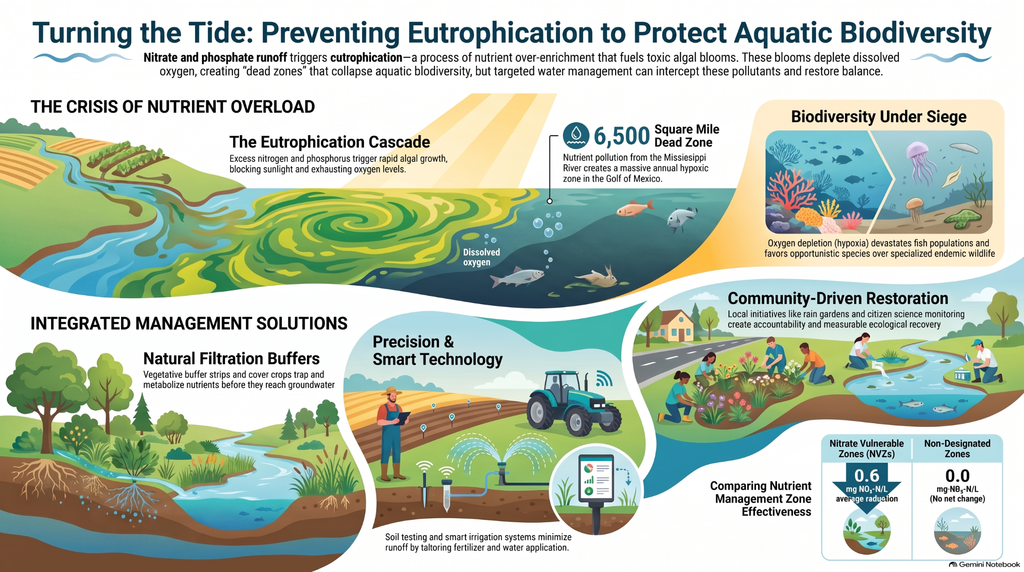
Excess nitrogen and phosphorus cause an overgrowth of algae in a short period of time, also called algae blooms. The overgrowth of algae consumes oxygen and blocks sunlight from underwater plants. When the algae eventually dies, the oxygen in the water is consumed. The lack of oxygen makes it impossible for aquatic life to survive. The largest dead zone in the United States – about 6,500 square miles – is in the Gulf of America and occurs every summer as a result of nutrient pollution from the Mississippi River Basin.
Nitrate and phosphate are key contributors to nutrient overload in aquatic systems, leading to severe environmental consequences.
When these nutrients accumulate, they trigger algal blooms that can block sunlight and deplete oxygen levels in the water.
This not only disrupts aquatic life but also threatens the overall health of ecosystems and water quality.
Nutrient Overload Consequences
Nutrient conditions in European surface waters have improved in recent decades. Average concentrations of nitrate and phosphate in rivers and total phosphorus in lakes have decreased. The decrease in nutrient concentrations is mainly related to improvements in wastewater treatment and the reduction of phosphorus in detergents. However, there has been a clear tendency for surface water concentrations to level off in recent years, in particular phosphorus in rivers. There has been little change in groundwater nitrate concentration in the past few decades.
When excessive nutrients enter aquatic systems, the consequences can be devastating, primarily due to the presence of nitrates and phosphates.
These compounds disrupt nutrient cycling, leading to imbalances that threaten ecological stability. You may notice how increased nutrient levels stimulate rapid growth of certain organisms, ultimately diminishing biodiversity and compounding the herbicide effects on plant species diversity.
This unchecked proliferation can exhaust oxygen levels, creating hypoxic conditions detrimental to fish and other aquatic life. Furthermore, the altered food web dynamics can lead to species loss and shifts in community structure.
In the pursuit of innovation, understanding these consequences is vital for developing effective water management strategies that safeguard ecological balance and promote sustainable use of aquatic resources.
Your awareness and action can help mitigate these dire outcomes.
Algal Bloom Formation
As nutrient levels rise in water bodies, a surge in algal blooms often follows, primarily fueled by the excess of nitrates and phosphates.
Understanding algal bloom dynamics is essential for effective water management. Here are three key factors to take into account:
- Nutrient Availability: Elevated nitrates and phosphates create an ideal environment for rapid algal growth.
- Environmental Conditions: Warm temperatures and stagnant water enhance bloom formation, leading to extensive coverage.
- Monitoring Techniques: Effective bloom monitoring through satellite imagery and in-situ sensors allows for real-time data collection, aiding in early intervention strategies.
Impact on Aquatic Life
The presence of elevated nitrates and phosphates in water bodies greatly disrupts aquatic ecosystems, leading to a cascade of negative effects on aquatic life.
You’ll notice that these nutrients fuel excessive algal blooms, which deplete oxygen levels in the water. This hypoxia can devastate fish populations, causing declines in biodiversity and altering community structures.
Moreover, the degradation of aquatic habitats occurs as bottom-dwelling organisms struggle to survive in low-oxygen conditions. As these conditions persist, the resilience of aquatic ecosystems weakens, making recovery increasingly difficult, especially when combined with pesticide contamination and insect biodiversity loss.
Innovative water management practices are crucial to mitigate these impacts. By addressing nutrient runoff and promoting balanced nutrient levels, you can help restore aquatic habitats and guarantee the sustainability of diverse fish populations for future generations.
EFFECTIVE TECHNIQUES TO REDUCE NUTRIENT RUNOFF
From an evolutionary standpoint, aquatic biodiversity depends heavily on stability and balanced nutrient cycling. When immense volumes of agricultural nitrates and phosphorus enter freshwater systems, they act as an aggressive environmental filter, drastically favoring fast-growing, opportunistic cyanobacteria and surface algae while starving benthic plants of light and mobile fauna of oxygen. I have observed similar disruptive dynamics across tropical and temperate systems, where sudden shifts in water chemistry cause specialized endemic species to vanish, leaving behind homogenized, low-resilience environments.
The data we see in modern environmental studies—from the persistent legacy nitrogen in French watersheds to the phytoplankton shifts in tropical river reservoirs—illustrate that these issues are deeply persistent and chemically complex. This is why nature-based solutions, such as establishing deep-rooted native buffer strips and diverse off-season cover crops, are so vital.
In my own garden and during habitat restoration workshops, I emphasize how native vegetation actively traps and metabolizes excess compounds before they leach into groundwater aquifers. When paired with precision agriculture and bioremediation, these ecological buffers allow us to harmonize vital food production with the non-negotiable imperative of preserving aquatic food webs.
To effectively reduce nutrient runoff, implementing targeted management practices is crucial for protecting water quality.
You can adopt innovative techniques that not only minimize the impact but also enhance agricultural sustainability.
Consider the following methods:
- Buffer Strips: Establish vegetated areas along water bodies to absorb excess nutrients before they enter waterways. These strips act as natural filters, improving water quality.
- Cover Crops: Planting cover crops during off-seasons helps prevent soil erosion and nutrient leaching. They enhance soil structure and retain moisture, contributing to healthier ecosystems.
- Nutrient Management Plans: Tailor your fertilization strategies based on soil testing and crop needs. This guarantees that nutrients are applied in ideal amounts and at the right times, reducing the potential for runoff.
Case Studies: Successful Community Efforts Against Eutrophication
Effective nutrient runoff management lays the groundwork for community-driven initiatives that tackle eutrophication. Across the globe, local partnerships have emerged as catalysts for innovative solutions.
In one notable case, a community in the Chesapeake Bay region collaborated with farmers to implement buffer zones, markedly reducing nutrient runoff into nearby waterways. This initiative not only improved water quality but also enhanced local biodiversity, demonstrating the power of collective action.
Another successful example can be found in a Midwest community that established a rain garden program. By engaging residents in creating these gardens, they effectively managed stormwater and filtered pollutants before entering local streams.
These community initiatives exemplify how grassroots efforts can lead to considerable environmental improvements. Engaging local stakeholders fosters ownership and accountability, highlighting the importance of collaboration in combating eutrophication.
Ultimately, these success stories inspire other communities to take proactive steps toward sustainable water management.
Best Practices to Reduce Nutrients and Combat Eutrophication
The intensive application of nitrogen and phosphorus fertilisers on agricultural land to fertilise crops has caused eutrophication, the nutrient enrichment of waterbodies leading to excessive growth of algae, deoxygenation and loss of aquatic biodiversity. Life cycle impact assessments (LCIA) are often used to determine the environmental impacts of fertilizer use. However, the lack of suitable methodologies to estimate the fate and transport of nutrients from soils makes crop and regional impact comparisons challenging. Using a newly devised, spatially explicit nutrient fate and transport model (fate factor, FF) within an LCIA framework, this study estimates the global spatial-variability of nutrient loss from fertilisation of crops and their relative impact on aquatic biodiversity, specifically species richness.
While many factors contribute to eutrophication, implementing best practices for nutrient management can greatly mitigate its impacts.
By adopting innovative strategies, you can promote sustainable agriculture and maintain healthy ecosystems. Here are three effective practices you should consider:
- Precision Fertilization: Tailor fertilizer applications based on soil tests and crop needs. This minimizes nutrient runoff while maximizing crop yields.
- Cover Cropping: Utilize cover crops to absorb excess nitrogen and phosphorus during the off-season. This not only reduces nutrient loss but also improves soil health.
- Buffer Strips: Establish vegetative buffer strips near water bodies to filter pollutants before they enter aquatic systems. This natural barrier can considerably lower nutrient loads in waterways.
How Community Involvement Makes a Difference in Water Management
When community members actively engage in water management efforts, they can create a significant impact on the health of local ecosystems.
Through community engagement, individuals can collaborate with local authorities and environmental organizations to devise innovative strategies for monitoring and reducing nutrient pollution. One effective method is citizen science, where residents gather data on water quality, helping to identify pollution sources and trends.
This grassroots approach not only fosters a sense of ownership but also empowers communities to advocate for sustainable practices and choose eco friendly products that help reduce nutrient pollution. By participating in workshops and educational programs, community members can enhance their knowledge about nutrient cycling and the implications of eutrophication.
Ultimately, when you take an active role in water management, you contribute to creating a resilient ecosystem that supports biodiversity while ensuring cleaner water for future generations.
Your involvement can drive local policies and inspire others to prioritize environmental stewardship in their own communities.
Future Innovations in Water Management to Address Eutrophication
As we look to the future, innovative approaches in water management are crucial for tackling the complex issue of eutrophication.
You’ll find that adopting cutting-edge strategies can greatly mitigate nutrient pollution. Here are three promising innovations:
- Smart Irrigation Systems: Utilizing sensors and data analytics, these systems optimize water usage and minimize runoff, reducing nutrient discharge into waterways.
- Bioremediation Technologies: Implementing natural processes, such as using specific plants or microorganisms, can help absorb excess nitrates and phosphates, effectively cleaning water bodies.
- Integrated Watershed Management: A holistic approach that combines land use planning, agricultural practices, and community engagement guarantees that all stakeholders work together to maintain water quality.

RELATED STUDIES ABOUT NITRATE AND PHOSPHATE EUTROPHICATION BIODIVERSITY EFFECTS
In tackling eutrophication, it’s clear that your actions matter. By reducing nitrate and phosphate runoff, you’re not just protecting water quality; you’re also fostering biodiversity. When communities unite, sharing knowledge and resources, the impact is profound. As you engage in best practices and embrace innovative solutions, you’re not just combating a problem; you’re creating a legacy of stewardship for future generations. Together, you can turn the tide against eutrophication and guarantee healthier ecosystems thrive.
30 years of Nitrates Directive in a changing climate: Environmental and policy impacts on nutrient pollution of French rivers
Overview and Study Purpose
This study investigates the 30-year environmental and policy outcomes of the EU Nitrates Directive (1991–2022) across French river basins. Researchers evaluated long-term water quality and streamflow time series from 268 monitoring stations covering approximately half of metropolitan France. Using Weighted Regressions on Time, Discharge, and Season (WRTDS) alongside Generalized Flow Normalization (GFN), the authors separated the effects of watershed management measures from the influences of climate-driven hydrological variability.
Key Findings
- Long-Term Nitrate Reductions: Combined annual riverine nitrate loads across nine major French basins declined by 38 million kg N between 2003 and 2022 (from 263 million to 225 million kg N per year). Watershed management alone drove a 42 million kg N (~16%) reduction in nitrate flux. Reductions in point-source wastewater emissions contributed 26 million kg N, while diffuse agricultural best management practices contributed at least 16 million kg N.
- Impact in Nitrate Vulnerable Zones: Significant improvements were strongly concentrated in designated Nitrate Vulnerable Zones (NVZs). Stations inside NVZs showed an average management-driven reduction of 0.6 mg NO3-N per liter, whereas stations outside NVZs showed no net management-driven change (0.0 mg NO3-N per liter).
- Hydrological Interplay and Antagonism: While management interventions reduced nitrate concentrations at 102 stations, long-term hydrological changes (such as decreasing river discharge) caused an antagonistic increase in nitrate concentrations at 141 stations. Despite this counteracting trend, management remained the dominant driver of net water quality improvements.
- Catchment Response Lag Times: Cross-correlation analysis identified an average response lag of approximately 5 years between agricultural input reductions and riverine nitrate improvements in NVZs (ranging from 1 to 10 years across major river basin outlets). This delay is driven by the storage and slow release of legacy nitrogen in soils and groundwater aquifers.
- Stoichiometric Imbalance: Phosphorus concentrations declined roughly fivefold over the same period, far outpacing nitrate reductions. As a result, the ratio of total nitrogen to total phosphorus (TN:TP) increased significantly, sustaining potential eutrophication risks in coastal and freshwater ecosystems.
Policy and Management Recommendations
- Adjusting EU Reporting Cycles: Because the average catchment lag time (5 years) exceeds the 4-year reporting cycle mandated by the Nitrates Directive, short-term evaluations can obscure true policy benefits. Member States should report on both current and preceding Action Programmes and evaluate mass loads in addition to concentrations.
- Targeted Resource Allocation: The largest water quality gains occurred in historically high-pressure regions like the Vilaine basin in Brittany, proving that prioritizing intensive agricultural hotspots yields the highest mitigation efficiency.
- Harmonized Nutrient Policy: The widening disparity between nitrogen and phosphorus declines underscores the limitations of single-nutrient regulation and points to the need for integrated legislation managing both nutrients jointly.
| REFERENCE: F. Bouraoui, A. Udias, O. Vigiak, B. Grizzetti, 30 years of Nitrates Directive in a changing climate: Environmental and policy impacts on nutrient pollution of French rivers, Journal of Hydrology: Regional Studies, Volume 65, 2026, 103445, ISSN 2214-5818, https://doi.org/10.1016/j.ejrh.2026.103445. (https://www.sciencedirect.com/science/article/pii/S2214581826003435) |
Nitrate, water temperature, conductivity, and transparency drive littoral phytoplankton species composition and biovolume in two reservoirs in the Xingu river
Overview and Study Purpose
This study evaluates the physicochemical characteristics and littoral phytoplankton community dynamics (species richness, biovolume, and taxonomic composition) across two distinct reservoirs of the Belo Monte Hydroelectric Complex on the Xingu River in the Brazilian Amazon: the main riverbed Xingu Reservoir (RX) and the flooded upland Intermediate Reservoir (RI). Sampling across 22 littoral sites during the 2022 dry season, the authors evaluated how local abiotic variables and environmental filtering processes shape primary producer communities in reservoir ecotones.
Key Findings
- Environmental Differences: Water physicochemical profiles differed significantly between the two reservoirs. The Intermediate Reservoir exhibited higher mean nitrate concentrations (0.18 mg/L compared to 0.09 mg/L in RX) and slightly higher mean water temperatures (31.19°C compared to 30.79°C in RX), whereas dissolved orthophosphate and nitrite were below detection limits across all sample sites.
- Species Richness versus Biovolume:
- Richness: Total morphospecies richness (134 taxa across nine taxonomic classes) did not differ significantly between reservoirs, averaging 23 taxa per site in RX and 18 taxa in RI.
- Biovolume: Total phytoplankton biovolume differed significantly between the reservoirs. The Xingu Reservoir accounted for 76.97% (87.49 mm3/L) of the total biovolume, dominated by Heterokontophyta (diatoms, 41.28%) and Charophyta (19.33%). The Intermediate Reservoir contributed 23.03% (26.18 mm3/L) and was predominantly dominated by Cyanobacteria.
- Primary Physicochemical Drivers: Redundancy analysis (RDA) demonstrated that four key environmental parameters explained 25.73% of the variation in phytoplankton community composition:
- Nitrate: Positively associated with the biovolume of diatoms and flagellates, including Aulacoseira granulata, Gonatozygon brebissonii, and Cryptomonas brasiliensis.
- Water Temperature: Positively correlated with bloom-forming cyanobacteria, particularly Dolichospermum planctonicum and Oscillatoria perornata.
- Electrical Conductivity: Positively associated with the cyanobacterium Anagnostidinema amphibium.
- Water Transparency: Associated with higher biovolumes of light-dependent taxa such as Planktolyngbya limnetica and Eunotia asterionelloides.
Ecological and Management Implications
- Environmental Filtering: The clear taxonomic and biovolume divergence between hydrologically linked reservoirs confirms that local environmental filters (consistent with Reynolds’ habitat model) outweigh passive dispersal, preventing community homogenization.
- Cyanobacterial Bloom Risks: Elevated water temperatures and conductivity in the more lentic Intermediate Reservoir select for competitive cyanobacterial species, highlighting potential risks of harmful algal blooms.
- Littoral Zone Monitoring: Because littoral zones function as essential ecotones for aquatic food webs and nutrient cycling, routine spatial and seasonal monitoring of littoral phytoplankton is critical for sustaining reservoir water quality and ecosystem services.
| REFERENCE: Dilailson Araújo de Souza, Francieli de Fátima Bomfim, Daniela Santana Nunes, Thiago Bernardi Vieira, Juliana Feitosa Felizzola, Karina Dias-Silva, Nitrate, water temperature, conductivity, and transparency drive littoral phytoplankton species composition and biovolume in two reservoirs in the Xingu river, Water Biology and Security, Volume 5, Issue 2, 2026, 100457, ISSN 2772-7351, https://doi.org/10.1016/j.watbs.2025.100457. (https://www.sciencedirect.com/science/article/pii/S2772735125001003) |
Trade-offs between higher productivity and lower environmental impacts for biodiversity-friendly and conventional cattle-oriented systems
Overview and Study Purpose
This study investigates the trade-offs between agricultural productivity, environmental impacts, and energy efficiency across seven cattle-oriented production systems in France and England representing a wide gradient of input intensities and biodiversity integration. Using Life Cycle Assessment (LCA) combined with Energy Return on Investment (EROI) calculations, the authors evaluated an agricultural rewilding estate (Knepp), three suckler beef systems (La Barge, Saint Laurent de la Prée, and Thorigné d’Anjou), and three dairy systems (Trévarn, Oasys, and Derval) across six midpoint impact categories.
Key Findings
- Productivity and Input Scaling: Human-edible animal protein production and per-hectare environmental impacts scaled directly with input intensity and cumulative energy demand. Protein production ranged from 5 kg per hectare per year in the rewilding system to 239 kg per hectare per year in the conventional dairy farm. Per-hectare energy demand ranged from 90 MJ to 20,496 MJ per year, with linear regression indicating that each additional kilogram of protein required approximately 81 MJ of energy.
- Climate Change and Carbon Dynamics: Without considering carbon dynamics, climate change impact per hectare ranged from 562 kg CO2-equivalent in the rewilding system to 8,949 kg CO2-equivalent in the conventional dairy system. Including soil organic carbon sequestration and unharvested woody biomass growth reduced net emissions across all systems and turned the rewilding system into a net carbon sink (-5,466 kg CO2-equivalent per hectare per year). Enteric methane contributed the largest share of greenhouse gas emissions across all systems (56% to 90%).
- Energy Return on Investment (EROI): The agricultural rewilding system achieved the highest EROI (2.42) due to minimal external energy inputs. Pasture-based, biodiversity-friendly dairy (Trévarn: 1.07) and suckler beef (La Barge: 0.48) systems showed higher EROI values than more intensive systems of the same production category (Derval dairy: 0.92; Saint Laurent beef: 0.21).
- Functional Unit Discrepancies: Biodiversity-friendly systems exhibited substantially lower impacts per hectare for acidification, eutrophication, and energy demand. However, their lower stocking rates and yields led to higher impacts per kilogram of protein for land competition, acidification, and marine eutrophication.
Identified Trade-Off Patterns and Strategic Implications
- Four Production Profiles:
- Productivity Priority (Conventional Dairy): High protein output per hectare and lower impacts per kilogram of product in exchange for higher input use and greater per-hectare footprints.
- Low-Input Land Management (Mixed Suckler Beef): High feed self-sufficiency and moderate per-hectare impacts in exchange for lower productivity and EROI.
- Low-Impact Land Management (Grass-Based Dairy and Beef): Markedly lower per-hectare impacts and higher EROI than conventional peers via 100% pasture feeding and lower stocking rates, at the cost of total volume.
- Low-Impact Priority (Agricultural Rewilding): Minimal human intervention yielding net-negative greenhouse gas impacts and high EROI, in exchange for very low food output.
- Methodological and Policy Context: Conventional LCA frameworks struggle to capture the non-provisioning ecosystem services and natural baseline emissions of extensive grazing systems. While biodiversity-friendly systems offer high energy self-sufficiency and resilience, widespread adoption must be paired with broader dietary shifts toward reduced animal protein consumption to balance land use with food security.
| REFERENCE: Aymeric Mondière, Michael S. Corson, Julie Auberger, Daphné Durant, Sylvain Foray, Jean-Francois Glinec, Penny Green, Sandra Novak, Frédéric Signoret, Hayo M.G. van der Werf, Trade-offs between higher productivity and lower environmental impacts for biodiversity-friendly and conventional cattle-oriented systems, Agricultural Systems, Volume 213, 2024, 103798, ISSN 0308-521X, https://doi.org/10.1016/j.agsy.2023.103798. (https://www.sciencedirect.com/science/article/pii/S0308521X23002032) |
CONCLUSION
Restoring our water bodies and reversing the biodiversity losses driven by eutrophication is ultimately a collective ecological responsibility. While the scientific principles of nutrient management and ecological modeling can often appear complex on paper, their true power emerges when they are put into practice at the community level. When local stakeholders, land managers, and residents unite around citizen science—whether by monitoring local stream transparency, cultivating rain gardens, or demanding sustainable watershed policies—the ecological recovery is genuine and measurable.
In my career mentoring the next generation of researchers and leading hands-on workshops, I have witnessed how grassroots education transforms passive observers into fierce stewards of their local habitats. Every proactive choice, from eliminating harmful domestic contaminants to supporting regenerative land-use practices, acts as an investment in our planet’s ecological resilience.
When we protect the clarity and chemical balance of our waterways, we do far more than prevent toxic algal blooms; we safeguard the intricate tapestry of life, ensuring that future generations can witness diverse, thriving freshwater ecosystems in all their natural splendor.